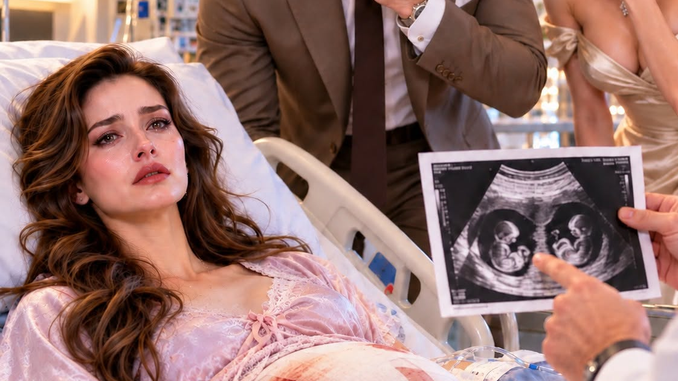
My husband stabbed me twice over a scratch on his mistress’s arm, then stepped over my bleeding body to comfort her while I lay dying on our living-room rug. What neither of them realized was that beneath me, my finger had found my smartwatch, and I had just pressed Record.
“If you ever touch Selena again, I swear I’ll kill you.”
Those were Julian’s last words before the knife entered my stomach.
Until that moment, some foolish part of me still believed our three-year marriage could survive. Julian Vance, powerful CEO, polished husband, respected businessman. I had given up my career to build a life with him.
Then Selena Cole, his first love, came back.
That afternoon, she burst into our house crying, holding out an arm with a tiny scratch.
“Nora attacked me downtown,” she whispered.
I stared at her. I was wearing silk pajamas. I hadn’t left the house all day.
“She’s lying, Julian.”
He didn’t ask questions.
He was still holding the knife he’d been using to slice an apple.
“Did you touch her?”
“No.”
Selena lowered her eyes. “Please don’t fight because of me.”
His hand tightened.
Then he crossed the room.
The first stab knocked the breath from my lungs. The second sent me crashing onto the Persian rug.
Warm blood spread beneath me.
I looked up at my husband, waiting for shock, regret, anything.
Instead, Julian stepped over me.
He knelt beside Selena, wrapped his jacket around her shoulders, and whispered, “You’re safe now.”
Over his shoulder, Selena looked directly at me.
She smiled.
Something inside me hardened.
I closed my eyes and went limp.
My left arm was pinned beneath my body, hidden from them. Fighting the pain, I dragged one finger across my smartwatch.
Voice Memos.
Record.
For several seconds, nobody spoke.
Then Julian’s voice broke the silence.
“She’s gone.”
My heart nearly stopped.
“I did it, Selena. Just like you said.”
A pause.
Then he whispered, “We’re free.”
Three days later, I woke in intensive care.
Every breath felt like broken glass. Machines surrounded me. My abdomen was wrapped in bandages.
Then the door opened.
Julian walked in carrying white roses.
“Nora…”
Before he could reach me, Dr. Caleb Reed stepped between us.
“Mr. Vance, there’s something you need to understand.”
Julian’s face hardened. “I’m her husband.”
“Exactly.”
Dr. Reed placed an ultrasound image beside my bed.
Julian looked down.
So did I.
And suddenly, the stabbing wasn’t the most devastating thing that had happened to me that week.
There were two tiny silhouettes on the screen.
Twins.
Julian’s children.
The children he had nearly killed without ever knowing they existed.
His face drained of color.
But I wasn’t looking at him anymore.
Because beneath my hospital blanket, my smartwatch had already been recovered.
And the recording was still there.
Every word.
Every confession.
Every lie.
Julian thought waking up meant I had survived.
He had no idea it meant his nightmare was about to begin.
PART 2: The Recording They Thought Had Disappeared5-019
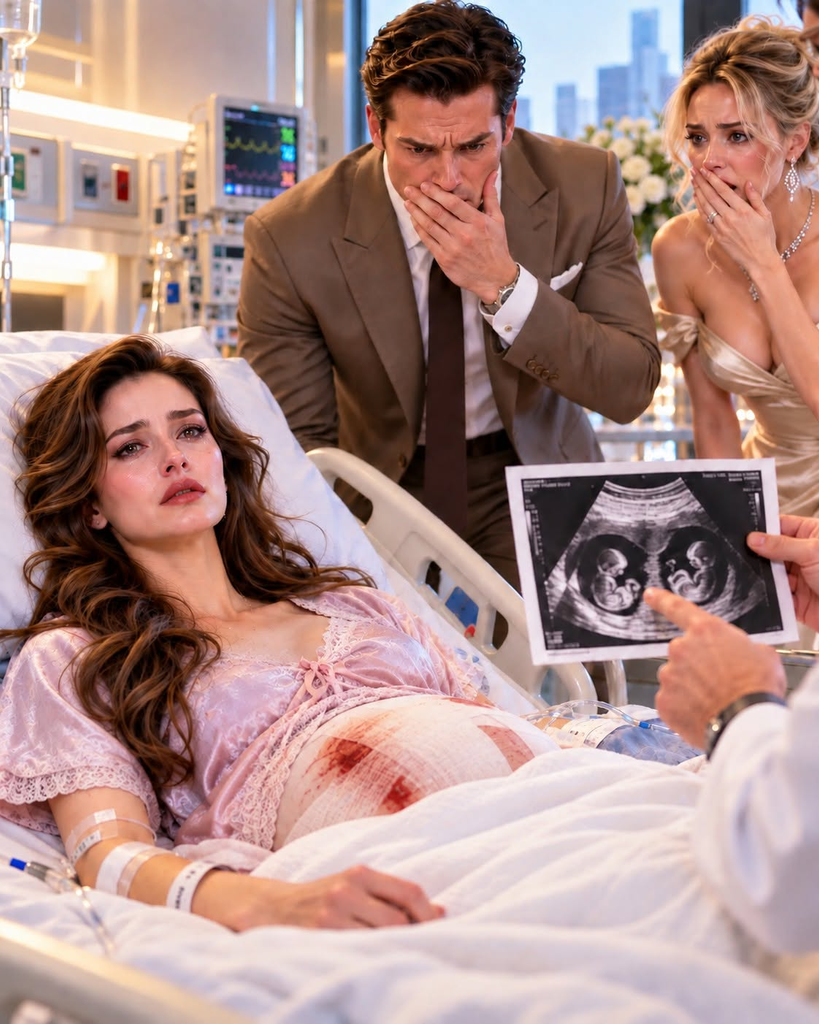
For a few seconds, nobody moved.
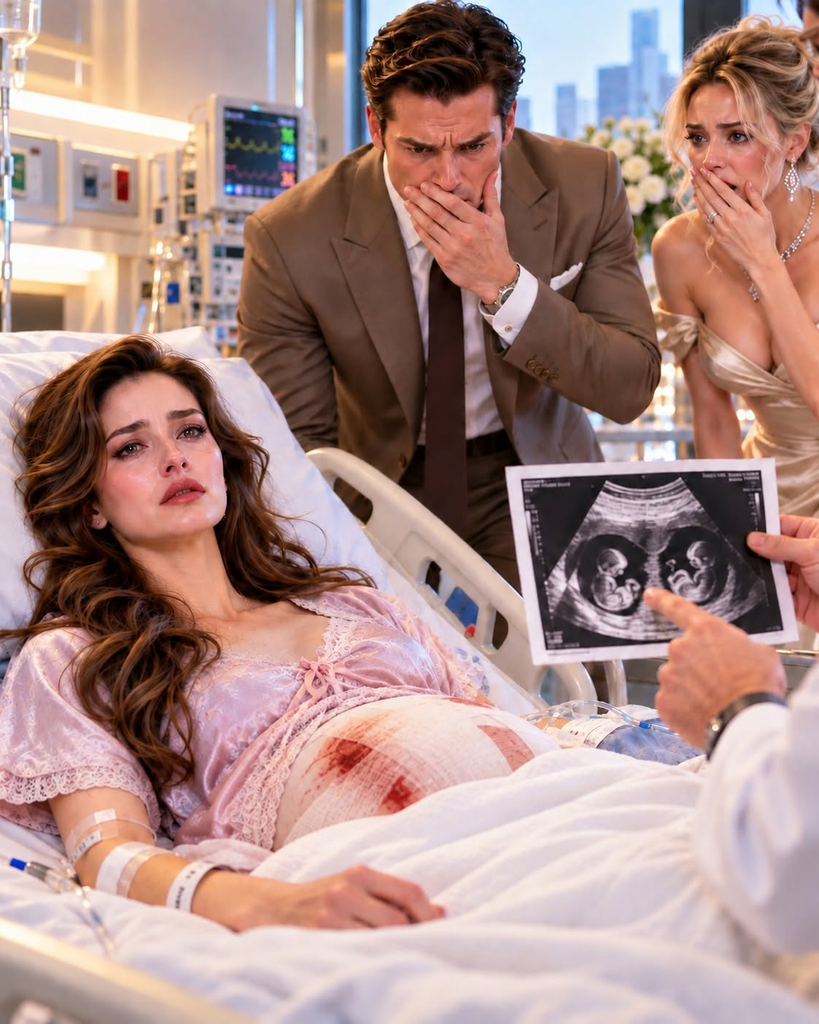
The ultrasound image lay on the table between us, its grainy shadows impossible to interpret unless someone explained them. To me, they had already become the clearest thing in the room.
Two small lives.
Two heartbeats I had protected without even knowing I was protecting them.
Julian stared at the image as if it belonged to someone else’s life. The white roses slipped from his hand and landed against the polished floor, scattering a few pale petals beneath the hospital chair.
“Twins?” he asked.
His voice was so quiet that I almost didn’t hear him.
Dr. Reed folded his arms. “The scan was taken yesterday. Both fetuses are developing normally, considering the circumstances. Nora will need close observation, but the pregnancy is viable.”
Julian looked at me.
I had imagined that moment many times during the long hours of surgery and recovery. I had imagined anger. I had imagined shouting. I had imagined asking him how he could have looked at me and decided I deserved to die.
I had never imagined the hollow disbelief in his eyes.
“How long did you know?” he asked.
The question should have offended me. Instead, it made something inside me grow still.
“You don’t get to ask me that.”
His jaw tightened.
“I’m not trying to—”
“You’re trying to understand how you could have missed something so important,” I said. “That’s not the same as being sorry.”
Dr. Reed glanced toward the heart monitor. Its steady rhythm filled the silence between us.
Julian took one step closer to the bed. “Nora, I didn’t know.”
“No,” I said. “You didn’t.”
The words landed softly, but he flinched as though I had struck him.
I watched him look at my bandaged abdomen, the IV in my arm, the bruised skin along my wrist. Then his gaze returned to the ultrasound image.
“You were pregnant when it happened?”
“I was.”
His face changed again.
Not into grief. Not yet.
Into the first fragile shape of consequence.
Dr. Reed reached for the photograph and placed it in a folder. “Mr. Vance, you need to leave.”
Julian’s attention remained on me. “Can I come back?”
“No,” I answered.
His eyes lifted.
“Not until I decide whether I ever want to see you again.”
A shadow crossed his face. “Nora, whatever you think happened that day—”
“I don’t think anything happened.” My hand tightened around the blanket. “I heard it.”
He stopped.
The room seemed to contract around us.
Dr. Reed’s expression sharpened. “Heard what?”
I looked toward the small bedside table.
My smartwatch was not there. The nurses had removed it before surgery, and for the past three days I had assumed it was lost somewhere in the emergency department. But earlier that morning, a technician had found it among my belongings and returned it in a sealed plastic bag.
It lay inside the drawer beside my bed.
I had not told anyone what it contained.
Not yet.
Julian noticed the direction of my gaze. “What are you talking about?”
“You said she was safe.”
His face went rigid.
Dr. Reed looked between us. “Who?”
“Selena.”
Julian’s silence answered before he did.
I felt the old pain rise, but it no longer had the power to pull me under. It was there, sharp and familiar, yet separated from me by a thin sheet of glass.
“You said, ‘I did it, Selena. Just like you said.’ Then you said you were free.”
Julian took a step back.
“That’s impossible.”
“I was conscious.”
“You were bleeding out.”
“And listening.”
He shook his head. “Nora, you were confused. You had lost a lot of blood.”
“I pressed Record.”
The words seemed to drain the color from his face.
Dr. Reed turned toward me. “You recorded the incident?”
“My watch did.”
Julian’s lips parted, but no sound came out.
I had expected relief when I finally said it aloud. Instead, I felt tired. Exhausted in a way sleep couldn’t touch.
He looked from me to the drawer. “Where is it?”
“Not your concern.”
“If you have a recording, then you know I didn’t—”
“I know exactly what you did.”
His expression hardened for the first time since entering the room. The polished, controlled Julian I had known for three years began to reappear beneath the shock.
“You can’t make accusations without context.”
Dr. Reed moved closer to the bed. “Mr. Vance, leave now.”
Julian ignored him. “You think a few words from a damaged recording explain everything?”
“A few words?” I repeated. “You stabbed me twice.”
His eyes flickered.
I saw it then—not regret, but calculation. He was already thinking about what could be challenged, what could be explained, what could be made to sound uncertain.
That realization hurt more than his denial.
“Go,” I said.
“I need to speak with you privately.”
“You had privacy when you stood over me.”
His expression faltered.
I pressed the call button. “Nurse.”
Within moments, the door opened. A nurse entered, followed by hospital security. Julian remained still for several seconds, staring at me as if waiting for the woman he had married to return.
She had not disappeared.
She had simply stopped protecting him from the truth.
When he finally turned away, his shoulders seemed heavier than before. He left without another word.
The door closed.
Dr. Reed waited until his footsteps faded. “Are you sure you want to keep that recording here?”
“I don’t know.”
“Then we should secure it properly.”
I looked at him. “You believe me?”
“I believe that a patient in your condition should be allowed to speak without being argued with.” His expression softened. “As for the recording, we’ll have a digital forensics specialist make a verified copy. You should also contact an attorney.”
“I don’t have one.”
“I know someone.”
I almost smiled. “You know someone for everything?”
“I’m a trauma surgeon. We develop relationships with people who can solve problems.”
“Is that what I am now?”
His gaze dropped briefly to the ultrasound folder. “You’re a patient who needs time to recover.”
No one had called me that in months. Not wife. Not suspect. Not obstacle.
Patient.
The word felt strangely safe.
Later that afternoon, my older sister arrived.
Mara pushed through the door carrying a canvas bag, two books, and the expression she wore whenever she was trying not to cry.
She had always been the practical one. While I had chased possibilities, Mara had made lists. While I had trusted instinct, she had checked the fine print. She was three years older and had spent most of her life quietly believing that my optimism would eventually get me into trouble.
This time, she had been right.
She stopped beside the bed and studied me.
“You look terrible,” she said.
My mouth trembled. “You always know what to say.”
“I considered flowers, but they seemed too cheerful.”
She leaned down and hugged me carefully, one arm around my shoulders, the other avoiding the IV. Her familiar scent—coffee, rain, and the citrus lotion she had used since college—made my eyes burn.
For the first time since waking, I allowed myself to cry.
Mara said nothing. She simply held me until the tears passed.
When I finally pulled away, she wiped beneath my eyes with the edge of her sleeve.
“Did you know?” she asked.
“About the twins?”
She nodded.
“Dr. Reed found out during surgery. I didn’t know before.”
Her hand moved instinctively toward my stomach, then stopped. “Are they all right?”
“They think so.”
“Think?”
“I need monitoring. The stress and blood loss could have affected the pregnancy, but so far, their heartbeats are strong.”
Mara closed her eyes briefly. “Two babies.”
“I know.”
“Does Julian know?”
“He came here.”
Her expression changed. “You let him in?”
“I didn’t. He walked in.”
“What did he say?”
“That he didn’t know I was pregnant.”
“That wasn’t what I asked.”
I looked away.
Mara understood before I answered. “He denied it.”
“He said the recording lacked context.”
Her face became very still. “You recorded him?”
“My watch.”
For several seconds, she only stared at me. Then she sat down and took my hand.
“Where is it?”
“In the drawer.”
Mara glanced toward the bedside table. “Did anyone else see it?”
“A technician returned it. Dr. Reed knows.”
“We need to get it out of the hospital.”
“I know.”
“I’ll take it.”
“You can’t.”
“Why not?”
“Because if something happens to it, I’ll never forgive you.”
Her fingers tightened around mine. “Then tell me what you need.”
The question was simple. It carried more love than any promise could have.
“I need you to help me remember who I was before him.”
Mara’s eyes filled, but her voice remained steady. “I remember.”
That evening, a woman named Evelyn Shaw came to my room.
She was in her late fifties, with silver hair cut to her jaw and a leather folder tucked under one arm. She had represented my father years earlier in a business dispute, and Mara had contacted her after Dr. Reed recommended someone familiar with complicated evidence.
Evelyn introduced herself without wasting time.
“I’m not asking you to make any decisions tonight,” she said. “I’m here to explain what must happen next.”
She examined the watch without touching it. The hospital had placed it in an evidence bag, labeled with the date and my patient number.
“Do you know whether the recording is still accessible?” she asked.
“Yes.”
“Have you listened to it?”
“Once.”
“Do not listen again.”
“Why?”
“Because memory changes under stress. You should describe what you remember in your own words, separately from the file. Then we preserve the original and create verified copies.”
I looked toward Mara. “What if the recording doesn’t prove enough?”
“Then we find out what else does.”
Evelyn opened her folder. “There may be emergency call records, medical photographs, fingerprints, statements from paramedics, the hospital intake notes, and any messages between your husband and Ms. Cole. We proceed carefully. No accusations to the press. No contact with either of them. No social media posts.”
“I wasn’t planning to post anything.”
“Good. People often ruin strong evidence by trying to tell their story too quickly.”
Her words reminded me of something.
“Selena told him I attacked her.”
“Were you near her that day?”
“No.”
“Can anyone confirm that?”
“I ordered groceries. The delivery driver saw me at home. There may be security footage from the building.”
“Excellent. We start there.”
Mara looked at me. “What happens to Julian?”
“That depends on the evidence,” Evelyn said. “But the recording may be significant.”
I studied the sealed watch. “He said he did it because of her.”
“Those exact words?”
“Yes.”
“Then we will preserve them exactly.”
The following morning, Evelyn returned with a digital specialist and a police liaison. I gave permission for the watch to be examined in my presence. The process was methodical, almost painfully ordinary. The watch was connected to a secured device. Its data was copied, hashed, and stored on two encrypted drives.
No one played the audio aloud.
Instead, the specialist showed me the file details.
The recording had begun at 3:17 p.m. and continued for eleven minutes. There was no evidence of editing. The file contained the sounds of movement, voices, and a phone ringing twice.
Evelyn leaned over the screen. “You said the stabbing occurred shortly before the recording captured the conversation?”
“I pressed Record before it happened.”
“Then it may contain everything.”
My throat tightened. “I don’t want to hear it again.”
“You don’t have to.”
The police liaison, Detective Hall, was a calm woman with tired eyes and a notebook she barely glanced at. She had been assigned to the case after the hospital reported injuries inconsistent with an accidental fall.
“Ms. Vance,” she said, “I need to ask about the day of the incident.”
I told her everything.
The grocery delivery. The silk pajamas. Selena’s arrival. The accusation. Julian holding the knife. The first blow, the second, and the moment he stepped away from me.
I told her about pretending to lose consciousness.
When I reached the conversation I had overheard, Detective Hall asked whether I was certain of the wording.
“Yes.”
“Did Mr. Vance say, ‘I did it, Selena. Just like you said’?”
“Yes.”
“And after that?”
“He said they were free.”
Detective Hall wrote it down. “Did Ms. Cole respond?”
“I don’t remember the exact words. I think she said something like, ‘You promised.’”
The detective’s pen paused.
“What did he say then?”
“I don’t know. My awareness faded. I remember the ambulance arriving.”
Detective Hall nodded. “The file will tell us.”
“And Selena’s scratch?”
“We’ve requested photographs and medical records from the clinic she visited.”
“Will that prove it was fake?”
“Not necessarily. But it may establish timing and severity.”
“She said I attacked her downtown. I was home.”
“We’ll verify your movements.”
For the first time, the case felt less like a desperate attempt to be believed and more like a collection of facts being placed in order.
That afternoon, I learned that Selena had not gone to a hospital. She had visited a private urgent-care clinic fifteen minutes after leaving my house. Her injury was described as a superficial abrasion, less than two centimeters long.
The physician’s notes contained an odd detail.
The scratch was on the inside of her left forearm.
Not the outside.
Detective Hall explained it carefully. “If someone grabbed or scratched her during a struggle, the injury could appear in several places. The location alone proves nothing.”
“But?”
“But her story says you attacked her from behind in a parking garage.”
“And the scratch?”
“Would be difficult to explain if she was facing away from you.”
It was a small inconsistency. The kind most people overlooked.
But lies rarely broke apart all at once. They loosened at the edges.
Two days later, my former assistant, Priya, came to the hospital.
She had worked with me before I married Julian, back when I managed a design studio and spent my days choosing fabrics, sketching floor plans, and arguing with contractors over lighting. After the wedding, I had closed the studio. Julian said we could reopen it whenever I wanted, but each time I mentioned the idea, something else demanded my attention.
Priya had stayed in touch, though less often than either of us intended.
She stood in the doorway holding a paper bag.
“I brought soup,” she said. “And three files.”
“What kind of files?”
“The kind I probably shouldn’t have.”
Evelyn, who was reviewing documents in the corner, looked up. “You’re welcome to leave them with me.”
Priya placed the bag on the table. “These were in the office archive.”
I recognized the blue folder immediately.
My old client portfolio.
Inside were photographs of homes I had redesigned, fabric samples, invoices, and a contract for a renovation project I had abandoned after my wedding.
“I thought Julian had thrown these away,” I said.
Priya shook her head. “He didn’t.”
“What do you mean?”
“He moved them.”
“Where?”
“His office. In a locked cabinet.”
I stared at her.
Priya looked uncomfortable. “I only know because I was there last month. He asked me to locate the original drawings for the Hawthorne project.”
“Why would he keep them?”
“I assumed you knew.”
“I didn’t.”
She took a breath. “There’s more.”
Evelyn closed the folder. “Go on.”
“Three weeks before the incident, Julian asked me for a list of Nora’s former clients.”
My skin prickled. “Why?”
“He said he was exploring a charitable design initiative. He wanted to reconnect with people who had worked with you.”
“That sounds like him.”
“I thought so too. But he also asked whether you had maintained access to the old business accounts.”
“I didn’t.”
“I told him the studio’s accounts were closed. Then he asked if you had any copies of contracts, tax documents, or client correspondence.”
Evelyn’s expression sharpened. “Did he say why?”
“He said he was organizing your professional records as a surprise.”
I looked down at my hands.
For years, Julian had framed every decision as care. He had handled bills because he was better with numbers. He had encouraged me to leave the studio because I was exhausted. He had suggested that my accounts be combined because marriage was about trust.
I had believed him.
“Why didn’t you tell me?” I asked.
Priya lowered her gaze. “Because I thought it was romantic. And because you seemed happy.”
The honesty hurt, but I couldn’t blame her for not seeing what I had refused to see.
“Did he ever contact my former clients?”
“I don’t know. But one of them did contact me recently.”
“Who?”
“Lillian Hart. She said Julian approached her about purchasing one of your designs.”
“That makes no sense. My designs weren’t for sale.”
“Exactly.”
Evelyn began writing notes.
A new thread had appeared, one unrelated to Selena’s scratch but connected to the life Julian had been quietly rearranging around me.
That night, Mara helped me eat half a bowl of soup.
“You don’t have to understand everything at once,” she said.
“I spent three years thinking I knew my husband.”
“You knew the version of him he showed you.”
“What if that was the real version, and I simply brought out the worst in him?”
Mara put the spoon down. “Don’t do that.”
“Do what?”
“Take responsibility for choices another adult made.”
I looked toward the window. The city lights blurred against the glass.
“I left my work. My friends. I let him manage everything.”
“You trusted someone you loved.”
“I ignored every warning.”
“You interpreted things generously.”
“That sounds like a polite way to say I was foolish.”
“It’s a truthful way to say you were hopeful.”
I swallowed. “Hope can be dangerous.”
“So can fear. You can’t spend the rest of your life using either one as a compass.”
Her words stayed with me after she left.
The next morning, Detective Hall arrived with news.
“The grocery company provided delivery records and exterior camera footage,” she said. “You were at home from 1:42 p.m. until the ambulance arrived.”
I felt a breath leave my body.
“And Selena?”
“She was recorded entering the building at 3:02 p.m. She was not with anyone.”
“Did she come directly from downtown?”
“We’re checking that.”
Detective Hall placed a printed image on the table. It showed Selena in the lobby, one hand raised toward the security camera. Her face was turned slightly aside, but the scratch on her arm was not visible.
“What is that?” I asked.
“A message from her phone to your husband, sent at 2:47 p.m.”
I read the transcript.
I’m going in now. Don’t hesitate this time.
My stomach tightened.
“When was it sent?”
“Thirty minutes before she arrived.”
I looked up. “She planned it.”
“It suggests coordination.”
“What did Julian reply?”
“We haven’t recovered the message yet. His attorney claims the phone is missing.”
“His attorney?”
“He retained one this morning.”
Of course he had.
The detective slid another page toward me. “There’s also a deleted message from Selena’s device, recovered through the carrier.”
It contained only four words.
She still trusts you.
I closed my eyes.
For a moment, I remembered the beginning of my marriage. Julian standing in my parents’ garden beneath strings of warm lights. His hand around mine. The way he had promised never to make me feel alone.
Perhaps he had meant it then.
Perhaps people changed slowly, one private choice at a time, until the person they became could no longer recognize the person they had promised to love.
“Do you know where Selena is?” I asked.
“Her attorney says she’s staying with friends.”
“Does she know about the recording?”
“Mr. Vance may have told her.”
A cold unease moved through me.
“What does that mean?”
“It means we’re increasing security around you.”
“I don’t want protection like I’m some kind of target.”
“You survived a serious assault connected to two people who may have planned it. Caution is reasonable.”
The word assault still felt unfamiliar when applied to my life.
I had always imagined such words belonged to other people, other homes, other marriages. But reality did not require permission before crossing a threshold.
That afternoon, Dr. Reed told me I could leave the hospital in two days if my recovery continued.
The thought frightened me.
At the hospital, every sound had an explanation. Every pain brought a nurse. Every question had a professional answer.
Home was different.
Home contained the rug where I had fallen, the kitchen where Julian had held the knife, the hallway where he had walked past me without looking down.
“I don’t want to return there,” I said.
“You don’t have to,” Mara replied.
“I don’t know where else to go.”
“You can stay with me.”
“You have one bedroom.”
“You can have it.”
“And where will you sleep?”
“On the couch.”
“You hate the couch.”
“I hate many things. I’m adaptable.”
I laughed, and the movement pulled at my stitches.
Mara immediately frowned. “Don’t make me regret being funny.”
“I needed that.”
“I know.”
Evelyn arranged for a security company to change the locks on my house and preserve the interior as evidence. My belongings could be collected later. For now, Mara’s small apartment became the safest place I had.
Before leaving, I asked Detective Hall whether I could see the living room.
She hesitated. “Why?”
“There’s something I need.”
“What?”
“A photograph.”
She understood that I wasn’t asking for a sentimental picture.
“You can enter with an officer,” she said, “but do not touch anything.”
The house smelled faintly of apples and the lemon cleaner our housekeeper used every Thursday. Nothing looked damaged except the Persian rug, which had been removed and sealed.
Without it, the living room appeared larger and strangely bare.
I stood near the place where I had fallen.
The memory came in pieces: Selena’s pale face, Julian’s hand, the cold floor beneath my cheek, the watch hidden under my arm.
On the mantel sat a framed photograph from our wedding.
Julian was smiling at me as though I were the only person in the world.
I lifted it carefully.
Behind the frame, something had been tucked into the wood.
A narrow envelope.
My name was written across it in handwriting I recognized immediately.
Not Julian’s.
Selena’s.
The officer stepped closer. “Was that there before?”
“I don’t know.”
The envelope was unsealed.
Inside was a single sheet of paper.
At the top was a date from six months earlier.
Beneath it, one sentence:
Julian promised me that once Nora signed the final transfer, everything would be ours.
My hands began to shake.
There was no signature.
No explanation.
Only a second line written beneath the first, in darker ink:
But he never told me about the babies.
I looked at the officer.
The house seemed to tilt around me.
On the back of the page, someone had written an address.
Not Selena’s home.
Not Julian’s office.
A small clinic across town.
And below the address was an appointment date scheduled for the following morning—one day before Selena entered my house carrying the scratch that had nearly destroyed my life.
Để lại một phản hồi