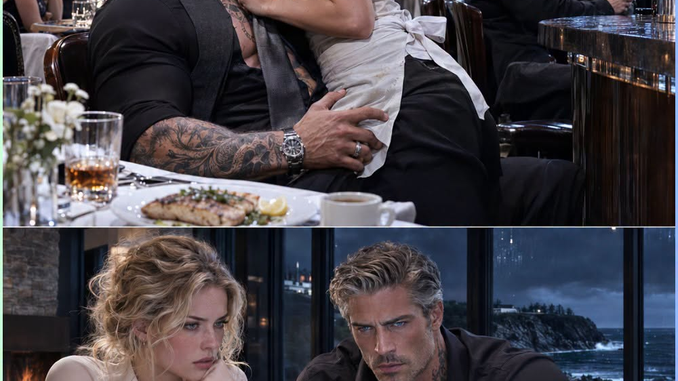
I knew that because the man at the bar had just mouthed the words, When the guards step outside, put two in his chest.
He had no idea I could read his lips.
Neither did Vincent.
Neither did anyone in the Harbor Glass.
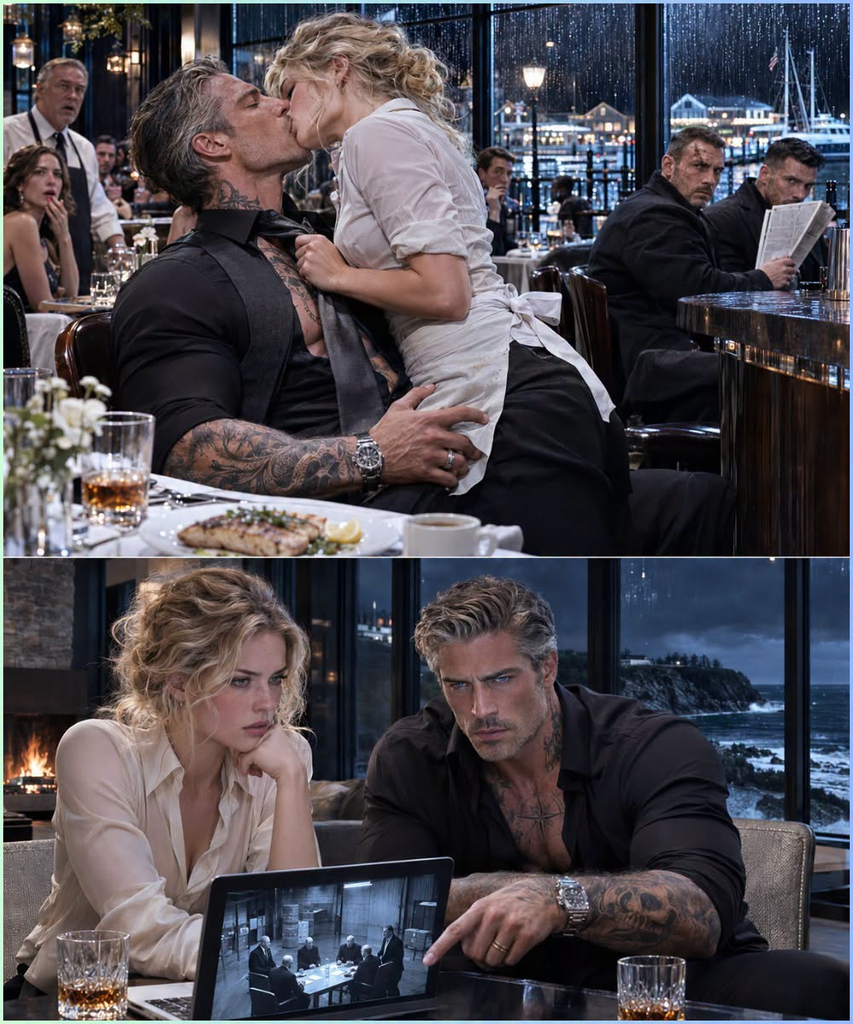
At 10:29 on a rainy Thursday night, I set down a tray of untouched coffee, crossed the dining room, grabbed the most dangerous man on the Massachusetts coast by his silk tie, and pulled his face toward mine.
His eyes went cold.
His hand closed around my wrist.
I kissed him anyway.
Then, without moving my mouth away from his, I whispered, “Pretend you like it. There are two men at the bar. One has a gun inside the newspaper.”
For half a second, Vincent Cade stopped breathing.
Then his grip loosened.
His hand slid from my wrist to the back of my neck.
And the man kissed me like pretending was the last thing on his mind.
My name is Nora Hale.
At thirty-one, I had spent seven years waiting tables at the Harbor Glass, a waterfront restaurant in Port Alder, Massachusetts, where fishing boats shared the marina with yachts and people learned not to ask why certain black SUVs idled at the curb.
I wasn’t brave.
I wasn’t reckless.
I wasn’t looking for excitement.
Until that night, the most dangerous thing I did regularly was carry six bowls of clam chowder without a tray.
Vincent came every Thursday.
Same table.
Number nine.
Window to his left, brick wall behind him, front entrance directly in his line of sight.
He ordered grilled striped bass, black coffee, and whatever bourbon was oldest behind the bar.
He tipped two hundred dollars.
Never flirted.
Never complained.
Never touched me.
Everyone in Port Alder knew who he was.
Officially, Vincent Cade owned shipping warehouses, waterfront property, a freight company and several restaurants.
Unofficially, nothing valuable entered the harbor without somebody in his organization knowing about it.
People called him a businessman when he was within hearing distance.
They called him worse things when he wasn’t.
At forty-two, he had a face that looked as though life had started punching him early and eventually decided it respected him too much to continue. He was broad-shouldered, dark-haired except for silver at his temples, and usually expressionless.
Two men always accompanied him.
Mason Reed stood near the front door.
Eli Turner watched the street.
And every Thursday at exactly 10:30, they stepped outside for four minutes.
One cigarette each.
Routine is comforting when you’re an ordinary person.
For dangerous men, routine can become a death sentence.
I knew that because I could read lips.
My father had been deaf from birth.
Jack Hale was a commercial fisherman with hands like rope knots and the patience of a saint. Before I understood spoken language, I understood his hands. Before I learned to spell, he taught me to watch faces.
“People speak before sound reaches you,” he used to sign.
By five, I could read simple sentences across our kitchen.
By ten, I could follow conversations across a dock.
By sixteen, I could understand someone through a restaurant window if the light was good enough.
I never told people.
It made them uncomfortable.
My ex-boyfriend had once joked that dating me felt like dating a surveillance camera. Eventually, the joke stopped being a joke, and he left.
So I learned to keep my eyes down.
I learned not to notice.
At the Harbor Glass, hundreds of mouths moved every hour.
Affairs were confessed over oysters.
Couples lied over wine.
Parents fought with teenagers.
Businessmen insulted partners before smiling and shaking hands.
I trained myself to let the words pass through my mind like gulls over water.
Until that Thursday.
Two strangers sat at the bar.
Both wore dark coats.
Neither drank more than half an inch from his glass.
One had a pale scar cutting through his right eyebrow.
The other held a folded newspaper in his lap.
Too thick.
Too stiff.
My eyes caught the scarred man’s mouth in the mirror above the bottles.
“Thirty seconds.”
His partner replied, “Reed and Turner outside?”
“Just went.”
I looked at the front door.
Mason and Eli were beneath the awning, lighting cigarettes.
I looked back toward the mirror.
The newspaper man said, “When the guards step outside, put two in his chest. Then the car.”
My heart stopped.
I could have screamed.
That might have killed everyone.
I could have run toward Vincent’s guards.
The men at the bar would have seen me.
I could have called emergency services.
Too slow.
I could have leaned down and whispered to Vincent.
A waitress whispering into the ear of their target would have been obvious.
I needed something so inappropriate that nobody would mistake it for a warning.
So I kissed him.
Vincent’s body turned rigid beneath my hands.
Someone dropped a fork.
A group of college kids near the window started laughing.
Our owner, Frank Delaney, appeared in the kitchen doorway and nearly dropped an entire rack of glasses.
Vincent’s fingers tightened painfully around my wrist.
“Pretend you like it,” I breathed against his mouth. “Men at the bar. Gun in newspaper. Don’t look.”
Something changed in his eyes.
Then he kissed me back.
Not politely.
Not carefully.
He pulled me between his knees and buried one hand in my hair.
My mind went completely blank.
For one horrifying second, I forgot the killers.
Then I saw them in the mirror.
The scarred man frowned.
His lips moved.
“What the hell is this?”
His partner stood.
I wrapped my arms around Vincent’s neck, keeping my face close to his.
“Newspaper is moving,” I whispered.
Vincent’s mouth shifted to my cheek.
“Tell me where.”
“Ten feet.”
He kissed below my ear.
“Eight.”
His arms tightened around me.
“Six. He’s reaching inside.”
Vincent suddenly stood, lifting me with him.
I gasped for real.
Then the most feared man in Port Alder laughed.
Loudly.
Warmly.
Almost drunkenly.
He lifted me completely off the floor and turned as if some lovesick waitress had just made his night.
Every head in the restaurant swung toward us.
Forty witnesses.
Forty sets of eyes.
The man with the newspaper stopped three feet away.
For one second we stared at each other over Vincent’s shoulder.
His face was ordinary.
His eyes weren’t.
Then the front door opened.
Mason and Eli stepped inside.
Mason’s expression changed immediately.
The newspaper man turned away, placed cash on the bar and walked out with his partner.
Nobody followed.
Nobody spoke.
Vincent slowly lowered me.
His hands remained on my waist.
“What did you see?” he asked.
I looked through the window. The scarred man was getting into a gray sedan. Before he climbed inside, he turned toward the restaurant. His lips moved. The waitress too. My blood went cold.
“They know about me.”
Vincent didn’t ask what I meant. He looked at Mason.
“Car.”
“I have a cat,” I blurted.
He stared at me. “What?”
“My apartment. I have a cat.”
“Nora—”
“And my father’s photographs.”
The fact that I was arguing with Vincent Cade about a twelve-pound orange cat while assassins were possibly heading toward my apartment seemed completely reasonable at the time.
He took my hand. “Eli will get the cat.”
“I don’t know Eli.”
Eli looked offended. “I love cats.”
“You have a gun.”
“That doesn’t mean I don’t love cats.”
Vincent almost smiled. Then the smile vanished.
“You’re not going home.”
Twenty minutes later, I was in the back of a black SUV wearing my white apron, sitting beside a man I’d just kissed in front of half the harbor. My life had become unrecognizable so quickly that I hadn’t even clocked out.
Vincent’s house stood north of Port Alder on a cliff above a violent stretch of Atlantic water. It wasn’t what I expected. No gold. No marble statues. No ridiculous display of wealth. Just cedar, stone, enormous windows and the black ocean beyond them.
What surprised me most were the empty walls. No family photographs. Not one.
“You don’t like pictures?” I asked.
Vincent poured two glasses of bourbon. “I like people.”
“That doesn’t answer the question.”
“It does in my world.”
He handed me a glass. “Photographs become addresses. Addresses become leverage.”
I thought of my apartment. My father smiling beside his battered fishing boat. Mom holding me at graduation. Pictures everywhere. I had always thought Vincent’s kind of wealth meant freedom. Standing in that empty house, I realized maybe I had been wrong.
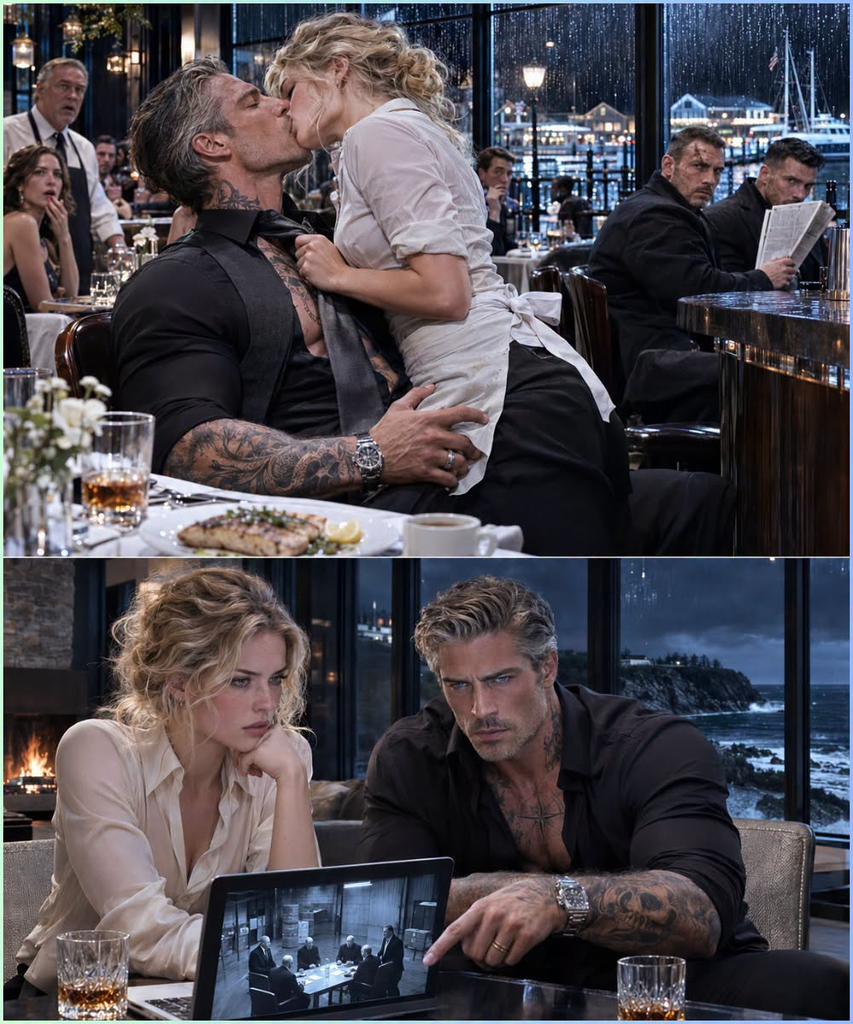
He opened a laptop. “I need your help.”
“Tonight hasn’t been helpful enough?”
That almost earned another smile. Instead, he turned the screen toward me. Security footage showed six men around a conference table in a warehouse. No audio.
“Three nights ago,” Vincent said. “Only these men knew I’d be at the Harbor Glass tonight.”
I studied the footage. “You think one of them arranged it.”
“I think coincidence is something people invent because betrayal hurts more.”
He pressed play. I translated what I could. Shipping schedules. Money. A dispute over warehouse space. Nothing important.
Then the meeting ended. Vincent walked out of frame. Two men remained. One was thick-necked and bald. The other was older, silver-haired, with a trimmed beard.
The older man leaned toward the bald one. My stomach tightened.
“Pause.”
Vincent did.
“Back.”
He replayed it. Again. Again.
“What?” he asked.
Để lại một phản hồi