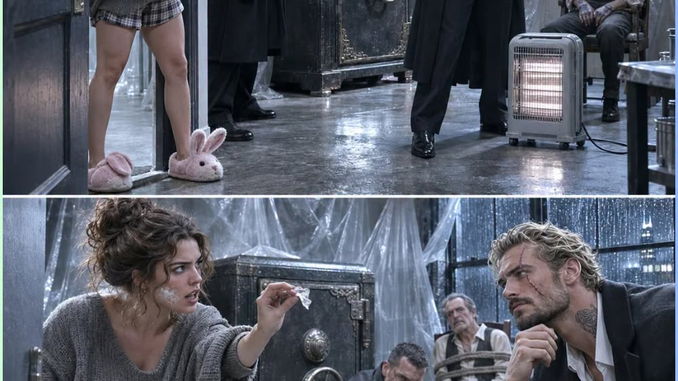
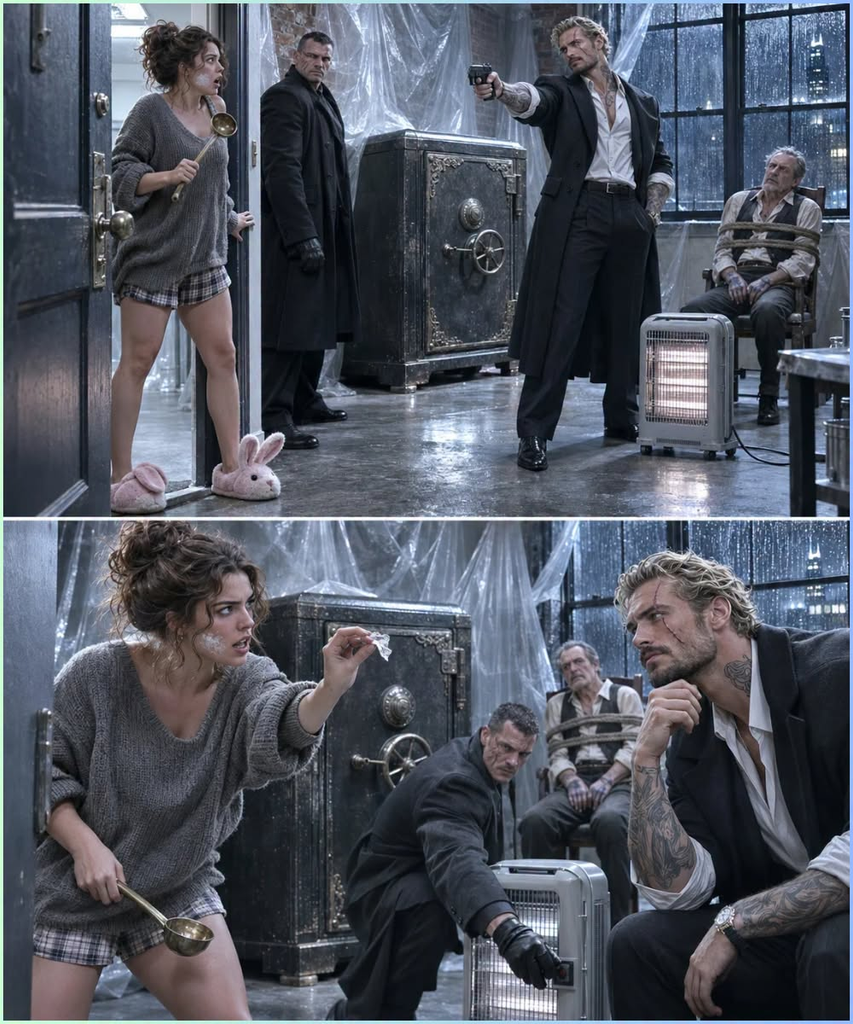
Seven minutes later, she was staring down the barrel of a silenced pistol.
And the man holding it would eventually put half of Chicago on its knees for her.
But on that freezing November night, Phoebe knew none of that.
All she knew was that somebody on the third floor had been dragging what sounded like a cast-iron bathtub across hardwood for almost two hours, and one final crash had shattered the spun-sugar swan she needed for a nine o’clock wedding delivery.
That swan had taken fourteen hours.
The bride had already cried twice over the phone.
Phoebe had slept ninety minutes.
The radiator in her apartment barely worked.
And a $54,000 tax lien sat folded inside the drawer beneath her butcher block, threatening to take away the bakery her father had spent thirty-two years building.
So when a chunk of ceiling plaster landed directly in her hair, something inside Phoebe snapped.
“Oh, absolutely not.”
She threw off her quilt.
She was thirty years old, five-foot-four, soft and curvy, with chestnut hair twisted into a collapsing bun and flour still dusted along one cheek from the previous evening’s pastry work.
She wore an oversized gray sweater, plaid sleep shorts, and the ridiculous slippers eight-year-old Theo Bennett had bought her last Christmas with money he had saved in a pickle jar.
The left rabbit ear flopped sideways.
The right slipper was missing one plastic eye.
Phoebe shoved her feet into them anyway, grabbed the long brass ladle she used for boiling caramel, and marched upstairs.
She hammered on apartment 3B.
“Open this door!”
The scraping stopped.
The entire building went silent.
Phoebe knocked again.
“Some of us have to turn on bread ovens before sunrise! You just murdered a two-hundred-dollar sugar swan!”
Nothing.
She raised the ladle.
“Do not make me—”
Two locks slid open.
The steel door swung inward.
Phoebe forgot the rest of the sentence.
A huge man stood in the doorway.
He was perhaps six-foot-three, with a pale scar running from his left cheekbone toward his ear. He wore a charcoal overcoat over a black suit, and his expression contained absolutely nothing human or friendly.
Behind him, apartment 3B looked nothing like an apartment.
There was no sofa.
No bed.
No television.
Plastic sheeting covered the brick walls.
A heavy antique safe sat in the center of the bare floor.
An older man with ink-stained fingers was tied to a wooden chair near the window.
And beside a portable heater stood another man.
He stepped out of the shadows slowly.
Phoebe’s heartbeat stopped.
He was tall enough to make the scarred man look ordinary.
Broad shoulders. Narrow waist. Platinum-blond hair swept back from a hard, elegant face. A neatly trimmed dark beard sharpened his jaw. His white dress shirt was open at the throat and rolled above both elbows, exposing black tattoos that disappeared beneath his collar and wrapped down his forearms in roses, gears, compass lines, and dates.
He was holding a black pistol fitted with a suppressor.
Not pointing it at her.
Not yet.
But holding it with the calm familiarity of a man carrying his own house keys.
Phoebe’s knees went cold.
The scarred man’s hand moved beneath his coat.
The blond man lifted two fingers.
The scarred man froze.
For three unbearable seconds, the stranger looked Phoebe over.
Her messy hair.
Her flour-smudged cheek.
Her oversized sweater.
Her brass ladle.
Finally, his gaze dropped to the pink bunny slippers.
Something almost like amusement touched his mouth.
“We’re finished moving the furniture,” he said.
His voice was low, controlled, strangely smooth.
“You can go back downstairs.”
Phoebe nodded.
Excellent idea.
Fantastic idea.
Possibly the best idea anyone had ever suggested.
She backed toward the stairs.
Then she smelled something.
Phoebe stopped.
The blond man’s expression changed.
“What?”
She sniffed again.
Oil.
Hot iron.
Wet wool.
And beneath it, something faintly rotten and metallic.
Years of working with cocoa, scorched sugar, yeast, vanilla, alcohol extracts, fruit acids, and delicate confectionery compounds had trained Phoebe’s nose better than she realized.
She glanced at the open safe.
Then at the heater.
“Oh, hell.”
The scarred man frowned.
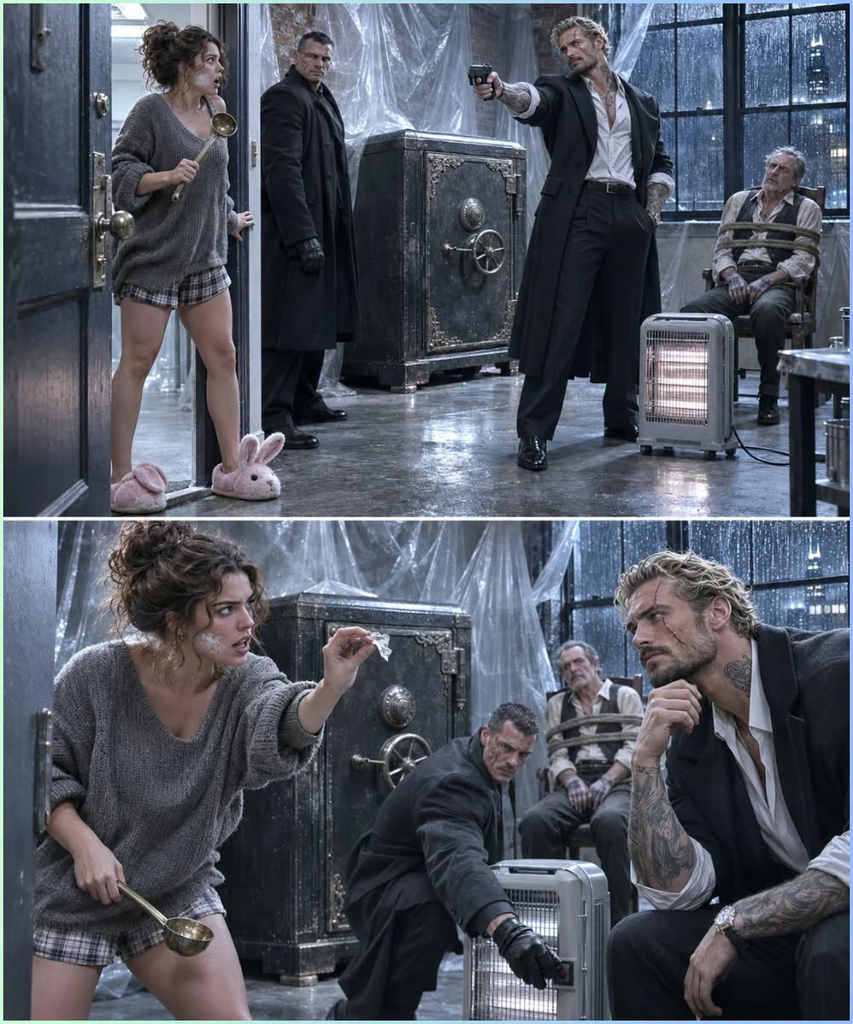
Phoebe shoved the ladle under one arm, dug through her sweater pocket, and found a little paper booklet of edible silver leaf.
She tore off a piece.
“What are you doing?” the blond man asked.
“Trying to determine whether we’re all about to die.”
That got everyone’s attention.
She held the silver near the warm air drifting from the cracked safe.
The bright surface began to discolor.
Phoebe’s fear vanished beneath professional instinct.
“Turn off that heater.”
Nobody moved.
She pointed the ladle at the blond man.
“Now.”
His eyebrows rose.
“Harland.”
The scarred man immediately killed the flame.
“Open the windows,” Phoebe said. “And stop hovering over the safe.”
The blond man studied her.
Phoebe swallowed.
“There could be a toxic compound reacting inside a false compartment. I don’t know exactly what’s in there, and I don’t want to find out with an open flame three feet away.”
Harland crossed the room and pushed both windows up.
Cold Chicago rain blasted inside.
Phoebe backed away.
“If that thing is booby-trapped, call someone who knows what they’re doing.”
A faint smile touched the blond man’s lips.
“You don’t?”
“I decorate wedding cakes.”
She stared at the tied man.
“And whatever this is, I’m pretty sure it’s not covered under my business insurance.”
Then she pointed the ladle at them one final time.
“And keep the noise down.”
She turned and fled downstairs.
Phoebe locked all three bolts on her apartment door.
Then she sat on the kitchen floor holding the ladle until nearly dawn.
At 5:30, two expensive engines started outside.
From behind her curtain, she watched two black sedans disappear through the rain.
She hoped she would never see the blond man again.
Ten blocks away, Harland Mercer sat in the front passenger seat of an armored sedan and read a message from the specialist they had called after evacuating the room.
He slowly looked over his shoulder.
“She was right.”
Raphael Savoy sat alone in the back.
At forty, Raphael controlled a private shipping network, three harbor terminals, a merchant bank, dozens of legitimate corporations, and a criminal organization polite newspapers called “the Savoy syndicate.”
Judges lowered their voices around his attorneys.
Businessmen stopped talking when he entered restaurants.
Men who betrayed him sometimes disappeared into the same lake his ships crossed.
Yet Raphael was staring at a blackened scrap of edible silver leaf resting in his palm.
Harland continued.
“Safe had a chemical trap built beneath the bottom plate. Heater could’ve made the room considerably worse.”
Raphael said nothing.
“The engraver wasn’t behind it. Somebody inside the bank hired him. Looks like they were reproducing custody certificates tied to that missing forty-two million.”
Still nothing.
Harland shifted.
“The woman downstairs saw our faces.”
Raphael finally looked up.
Harland knew that look.
“What do you want me to do?”
Raphael closed his hand around the silver.
“If anyone frightens her, touches her, follows her into an alley, or interferes with her business, I will consider it a personal betrayal.”
Harland blinked.
“Understood.”
“Find out who she is.”
Harland almost smiled.
Raphael’s stare sharpened.
“Professionally.”
“Of course.”
“And find out why someone with that kind of skill is living over a freezing bakery with a lien hanging over her property.”
By Thursday afternoon, Phoebe had almost convinced herself the entire thing had been an exhaustion-induced hallucination.
Then she noticed the black sedan across the street.
It stayed there through breakfast.
Through lunch.
Through a sleet storm.
Nobody got out.
At six-fifteen, while Theo stacked cocoa tins and sixty-five-year-old Nora Alvarez washed copper bowls in the back room, the bakery door slammed open.
A man named Calvin Rusk walked inside.
Phoebe knew him immediately.
Everybody in the neighborhood did.
Rusk collected debts for people who did not like courtrooms.
He planted both hands on Phoebe’s marble counter.
“Monday noon.”
Phoebe didn’t look up from the tray she was glazing.
“You’re blocking my light.”
“Fifty-four thousand dollars.”
“That lien is under appeal.”
“Not anymore.”
Phoebe slowly raised her eyes.
Rusk smiled.
“Your sister’s fiancé says the building gets seized Monday. Unless you sign the sale agreement tonight.”
Phoebe’s jaw tightened.
Her half sister, Valerie, had been trying to force a sale for months.
Valerie did not want the bakery.
She wanted the land beneath it.
Three floors in a rapidly changing neighborhood near downtown Chicago were suddenly worth a fortune.
Their father had left Phoebe controlling interest because she had spent her twenties beside him in the kitchen while Valerie moved to luxury apartments and called the bakery “that dusty old sugar shop.”
Rusk leaned closer.
“Sign it.”
“No.”
His smile disappeared.
He grabbed Phoebe’s blouse at the collar.
Theo gasped in the pantry doorway.
Phoebe saw him.
That changed everything.
She seized Rusk’s wrist.
“Take your hand off me.”
Rusk laughed.
Then somebody behind him said, “She asked you nicely.”
Rusk went white.
Harland Mercer stood two feet away.
Phoebe had not heard the door open.
Harland rested one hand on Rusk’s shoulder and whispered something into his ear.
Phoebe never learned what.
She only saw Rusk’s face drain of color.
He released her.
Then he hurried out into the sleet so fast he nearly collided with a parking meter.
Harland adjusted his cuff.
He gave Phoebe one respectful nod.
Then he left too.
Phoebe stared through the window at the black sedan.
“Oh, no.”
Nora came beside her.
“What?”
Để lại một phản hồi