
PART 1: THE SEAT HE THOUGHT HE OWNED
The sergeant slammed his lunch tray onto my table, leaned close enough for me to smell the coffee on his breath, and ordered me to get out of a chair that had never belonged to him.
I kept peeling my orange.
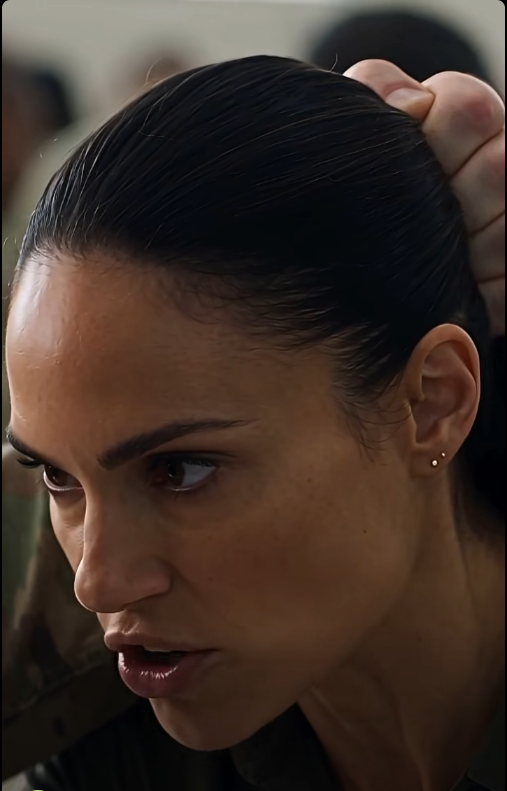
Around us, conversations faded beneath the harsh fluorescent lights of the crowded Army mess hall, and I could feel dozens of soldiers watching to see whether I would obey.
“Move,” Sergeant Jaxson Miller repeated, his voice carrying the practiced authority of a man who rarely expected anyone to question him.
I separated another strip of orange peel and placed it neatly beside my plate.
“I’m eating my lunch, Sergeant,” I replied.
His expression changed so quickly that I almost missed the surprise beneath the anger.
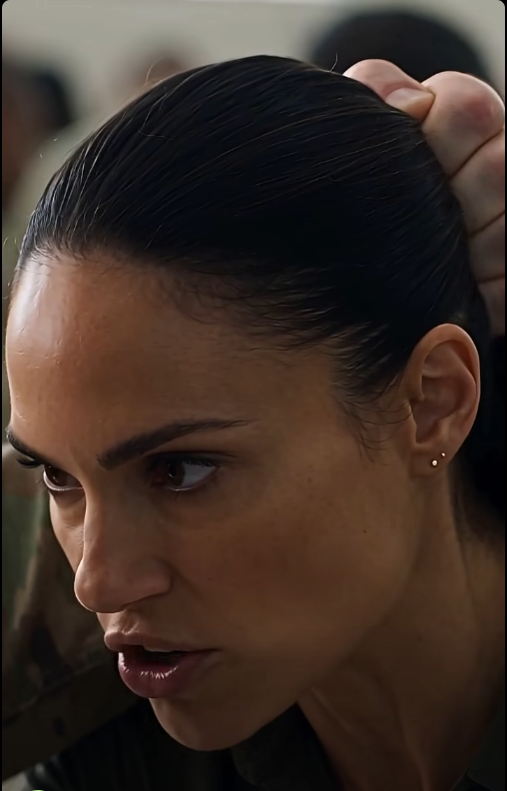
Most people would have stood up immediately, not because the chair belonged to him, but because his broad shoulders, powerful build, and unmistakable temper made confrontation seem like an unnecessary risk.
I had spent enough years around military personnel to recognize the difference between genuine authority and a man performing it for an audience.
Jaxson Miller was performing.
Unfortunately, the men standing behind him seemed eager to encourage the show.
A young specialist near the beverage station lowered his coffee cup, while another soldier nudged his companion and whispered something that made both of them grin.
I knew what they expected.
They expected the unfamiliar woman in the plain gray shirt and dark trousers to apologize, gather her belongings, and disappear before the sergeant became truly angry.
They were about to discover that I had no intention of doing that.
The mess hall had been crowded when I entered twenty minutes earlier, with soldiers moving through the serving lines, kitchen workers carrying fresh trays, and the steady clatter of utensils filling the enormous room.
I had chosen a small table near the windows because it offered a clear view of the dining area without placing me directly in anyone’s path.
There had been no reserved sign on the chair, no personal belongings marking the table, and no indication that anyone had a legitimate claim to the space.
My lunch consisted of a turkey sandwich, a bottle of water, and the orange I had taken from a basket beside the checkout counter.
I had barely touched the sandwich.
The orange, however, had seemed like a pleasant way to spend a few quiet minutes before returning to the work that had brought me onto the installation.
I had arrived that morning without the usual ceremony that accompanied an official visit.
There had been no formation waiting outside, no polished introductions, and no nervous officers rehearsing their briefings before I entered a conference room.
I wanted to observe an ordinary training day without turning every interaction into a performance staged for visiting leadership.
Experience had taught me that military standards were easiest to admire during inspections and hardest to measure when nobody expected an inspector.
I had not come looking for a confrontation.
I certainly had not expected a disagreement over a chair to become the most important event of my visit.
But military service had also taught me that small moments often revealed more about leadership than elaborate presentations ever could.
The way a soldier treated a stranger could say something that a perfectly arranged inspection binder never would.
I was thinking about that when the shadow first crossed my table.
“Move.”
The command had been delivered without greeting, explanation, or even the courtesy of looking directly at me.
I glanced briefly toward the source and saw a muscular sergeant holding a loaded lunch tray in both hands.
His name tape identified him as MILLER.
Three soldiers stood behind him, and their expressions suggested they were familiar with the routine.
I returned my attention to the orange.
“Didn’t you hear me?” he demanded.
I slid my thumbnail beneath the peel and removed another section.
His boots scraped against the polished floor as he stepped closer.
“Lady, I’m talking to you.”
I placed the orange peel beside my plate and finally looked up.
“I heard you, Sergeant.”
He waited for me to continue.
When I said nothing else, his forehead tightened.
“Then get up.”
“Is this seat reserved?”
One of the soldiers behind him gave a quiet laugh.
Jaxson turned his head just enough to silence the man with a glare.
“It’s my seat,” he answered.
I glanced at the empty chairs farther down the table.
“There are several available seats.”
The soldier nearest the beverage station lowered his eyes.
Jaxson’s fingers tightened around the edges of his tray.
“I didn’t ask whether there were other seats.”
I nodded once.
“Then perhaps you should have.”
The words were neither loud nor insulting, but the silence that followed made them sound much sharper than I had intended.
Jaxson stared at me as though I had committed an offense he had never imagined anyone would dare attempt.
Behind him, one of his companions shifted uncomfortably.
Another grinned.
I recognized the dangerous combination immediately.
A man who built his reputation on intimidation could often survive private disagreement, but public embarrassment threatened the entire image he depended upon.
I had seen officers make terrible decisions because they could not distinguish between preserving discipline and protecting their pride.
The difference mattered.
Real discipline required self-control, judgment, and respect for legitimate authority.
What stood before me now was a man who believed obedience belonged to him personally.
Jaxson dropped his tray onto the table hard enough to send his fork bouncing against a plastic cup.
The noise drew attention from three nearby tables.
“You’re sitting in the wrong seat,” he growled.
I looked at the rattling utensils.
“You nearly spilled your lunch.”
His face darkened.
“That’s your final warning.”
I placed another orange segment beside the peel.
“About what?”
He bent toward me.
“About making me repeat myself.”
I held his gaze.
“I understand what you’re saying, Sergeant, but you haven’t given me a lawful reason to leave.”
A few soldiers at the neighboring table stopped eating entirely.
The young specialist with the coffee cup glanced toward the exit, apparently considering whether he should find someone in charge.
Jaxson noticed the movement.
“Everybody mind your business,” he snapped.
Several faces turned away.
I noticed that the soldiers nearest him obeyed immediately, while those farther away continued watching from the corners of their eyes.
That distinction interested me more than his raised voice.
Fear traveled differently through a room than respect.
Respect allowed people to look their leaders in the eye.
Fear made them study their plates.
Jaxson pulled out the chair opposite mine and shoved it aside with his knee.
“Do you know who I am?”
I glanced at his name tape again.
“Sergeant Miller.”
His companions exchanged looks.
“You think that’s funny?”
“No.”
“Then why are you smiling?”
I had not been smiling.
I was simply keeping my expression neutral, which apparently frustrated him even more.
“You’ve got a real attitude problem,” he said.
I folded a piece of orange peel between my fingers.
“I’m sitting quietly, Sergeant.”
“You’re refusing a direct order.”
I looked around at the tables, the serving counter, and the soldiers who had begun to gather near the aisle.
“An order requires authority and a legitimate purpose.”
His jaw tightened.
“You want to lecture me about authority?”
“No.”
“Because I can teach you a few things.”
I set the orange peel down.
“I would prefer to finish my lunch.”
A soldier behind him laughed before abruptly turning the sound into a cough.
Jaxson spun toward him.
“Something funny, Wynn?”
“No, Sergeant.”
“Then shut your mouth.”
The soldier immediately straightened.
I looked at Wynn and noticed how quickly his grin had disappeared.
Whatever amusement he felt was now buried beneath an expression of careful obedience.
Jaxson returned his attention to me.
“You see that?”
I waited.
“That’s what happens when I speak.”
I glanced toward the soldier.
“He heard you.”
Jaxson leaned farther over the table.
“You think you’re somebody important?”
The question was familiar enough that I almost sighed.
People who measured human worth by titles frequently assumed everyone else used the same scale.
I had learned long ago that a person’s dignity did not become more valuable because of the insignia attached to a uniform.
It also did not become less valuable because someone happened to be wearing civilian clothes.
“I’m simply trying to eat my lunch,” I answered.
Jaxson looked behind him again.
The growing audience had become impossible to ignore.
Soldiers who had been walking toward the serving line now stood near the walls, and several kitchen employees watched from behind the stainless-steel counter.
The room had not gone completely silent, but the ordinary rhythm of lunch had broken apart.
A tray clattered somewhere near the dish return.
Someone whispered Jaxson’s name.
He heard it.
His shoulders stiffened.
I could almost see him deciding that walking away would be worse than doing something foolish.
That was the moment I began to worry about what he might do.
Not because I doubted my ability to remain calm, but because an angry man surrounded by frightened witnesses could become dangerously unpredictable.
“Stand up,” he said.
I remained seated.
“Sergeant, there is no reason for this.”
“I gave you an order.”
I folded my hands on the table.
“You gave me a demand.”
His face flushed.
“STAND UP!”
The shout struck the room like a dropped metal pan.
A woman working behind the serving counter flinched.
The specialist holding the coffee cup took an involuntary step backward.
I could feel my heartbeat becoming more deliberate, the familiar physical response that came when a confrontation shifted from unpleasant to potentially dangerous.
I kept my voice level.
“Lower your voice, Sergeant.”
He stared at me.
For several seconds, he seemed unable to decide whether he had heard correctly.
Then he laughed.
It was a harsh, humorless sound that made his companions smile uncertainly.
“You’re going to tell me how to speak?”
“No.”
“Sounds like you just did.”
“I asked you to behave professionally.”
His laughter stopped.
The word professionally seemed to offend him more deeply than anything else I had said.
He straightened and looked around the mess hall.
“Everybody seeing this?”
Nobody answered.
“Some random civilian walks onto my base and decides she can disrespect a noncommissioned officer.”
I glanced at the young specialist standing near the beverage station.
His name tape read PRICE.
Price looked directly at me for a moment, then lowered his eyes.
I knew that expression.
He understood something was wrong, but he was calculating what speaking up might cost him.
I had once been a young soldier making similar calculations.
That memory kept me from judging him too quickly.
Jaxson placed both palms flat against the table.
“Last chance.”
I looked at the sandwich I had not finished.
“I haven’t interfered with your lunch.”
“You’re interfering with me.”
“That isn’t the same thing.”
His eyes narrowed.
I saw his right hand twitch.
The movement was small, but my attention sharpened immediately.
“Sergeant Miller,” I said, “you need to step away from this table.”
He smiled.
“Or what?”
“Or you’re going to turn an unnecessary argument into something much more serious.”
He leaned so close that his shadow covered my plate.
“You threatening me?”
“I’m warning you.”
The words came out quietly.
For the first time, uncertainty flickered across his face.
He looked at my clothing, my unmarked jacket folded beside the chair, and the plain black watch on my wrist.
He was searching for some visible explanation for my confidence.
When he found none, he decided it had to be arrogance.
“You’re going to learn some respect,” he muttered.
I watched his hands.
“Don’t touch me, Sergeant.”
He laughed again.
Then he reached across the table, caught the shoulder of my shirt, and gave it a sharp tug.
My chair scraped backward several inches.
The orange rolled toward the edge of my plate.
Several soldiers gasped.
I stayed seated, although every instinct told me to rise and put distance between us.
“Remove your hand,” I said.
He released my shirt, but only because he had apparently decided that a more humiliating gesture would impress his audience.
“You don’t get to tell me what to do.”
I looked directly into his eyes.
“You are making a serious mistake.”
Jaxson’s mouth twisted into a grin.
“Big words for somebody who won’t even stand up.”
He stepped behind my chair.
I felt the movement before I saw it, and I turned my head slightly to keep him within my peripheral vision.
His boots stopped directly behind me.
The room became so quiet that I could hear the refrigerator compressor humming near the serving counter.
I placed both palms on the table.
“Sergeant Miller, step away.”
Instead, his hand moved toward the back of my head.
A cold awareness settled over me as I understood exactly what he intended to do.
He was no longer trying to claim a chair.
He was trying to demonstrate ownership over another human being.
“Don’t,” I warned.
His fingers closed around the base of my ponytail.
Then he pulled.
PART 2: THE HAND THAT SILENCED THE ROOM
Pain shot across my scalp as Jaxson tightened his fist around my hair, forcing my head backward against the top of the chair.
For one suspended moment, the entire mess hall seemed to stop breathing.
My orange slipped from my fingers and landed on the floor.
“TAKE YOUR HAND OFF ME, SERGEANT,” I said.
My voice was so calm that the words seemed to carry farther than his shouting had.
Jaxson leaned over my shoulder.
“Or what?”
I could feel individual strands pulling against my scalp, but I refused to give him the reaction he wanted.
“You’re about to make the biggest mistake of your entire military career.”
He burst into laughter.
“Lady, I think you already made yours.”
His grip tightened.
I turned my head as far as the pressure allowed and looked directly into his eyes.
“Release me immediately.”
The laughter around us had disappeared.
Even the soldiers who had encouraged him were standing motionless.
Jaxson looked toward his companions, apparently expecting approval.
Nobody offered any.
“You all see how disrespectful she is?” he demanded.
Specialist Price took a step forward.
“Sergeant, maybe you should let go.”
Jaxson’s expression hardened.
“Back off, Price.”
Price stopped, but he did not return to his table.
I watched the young soldier’s hands open and close at his sides.
He wanted to intervene.
He was afraid.
Both things could be true.
“I’m not resisting you,” I told Jaxson, “but you are assaulting me.”
The word assault changed the atmosphere.
Jaxson glanced around as though suddenly aware of the witnesses.
“Don’t start throwing accusations.”
“Then remove your hand.”
He released my ponytail with a shove.
My head moved forward, and I caught myself against the table.
A sharp ache spread behind my right ear.
Jaxson stepped away, flexing his fingers as if the encounter had inconvenienced him.
“There,” he said, “happy now?”
I straightened slowly.
“Not particularly.”
His eyes widened.
“You still running your mouth?”
I reached for the water bottle beside my sandwich.
My hand was steady, although my scalp throbbed.
“You need to remain where you are.”
Jaxson laughed again.
“Now you’re arresting me?”
“No.”
“Then mind your own business.”
He reached for his tray.
I looked toward the young specialist.
“Specialist Price, would you please ask the duty officer to come here?”
Price hesitated.
Jaxson turned sharply.
“You’d better not move.”
The specialist’s face drained of color.
I recognized the conflict immediately.
He had just received two incompatible instructions, one from a sergeant he knew and another from a stranger whose authority he could not establish.
“Price,” I said gently, “you are allowed to report what you witnessed.”
Jaxson slammed his palm against the table.
“You don’t give orders to my soldiers.”
“I asked him to contact the duty officer.”
“Same difference.”
“No, Sergeant.”
Price looked toward the entrance.
Then he looked at Jaxson.
For a second, I thought fear would win.
Instead, the young specialist put down his coffee cup.
“I’m getting the duty officer,” he said.
Jaxson moved toward him.
“You take one more step and you’ll regret it.”
Price froze.
The threat was not shouted.
That made it worse.
A man could sometimes explain an angry outburst, but this was deliberate intimidation delivered in front of witnesses.
I stood.
My chair legs scraped across the floor.
Jaxson turned back toward me.
For the first time, I noticed something like uncertainty in his expression.
Standing, I was not particularly imposing.
I was five feet seven, forty-eight years old, and dressed like an ordinary civilian employee.
There was nothing about my appearance that should have frightened a broad-shouldered sergeant.
Yet something about my decision to rise seemed to unsettle him.
“Specialist,” I said, “go.”
Price walked quickly toward the entrance.
Jaxson took a step after him.
“Price!”
The specialist did not stop.
A ripple moved through the room as several soldiers exchanged stunned looks.
Jaxson spun toward me.
“You just got that kid in serious trouble.”
I folded my arms.
“He made a responsible decision.”
“You don’t know anything about this unit.”
“I know what I just witnessed.”
Jaxson pointed at me.
“You’re going to regret interfering with my people.”
I looked at his outstretched finger.
“Keep your hands to yourself.”
His face tightened.
A soldier named Wynn stepped between us, raising both hands.
“Sergeant, let’s just eat somewhere else.”
Jaxson shoved his arm aside.
“Stay out of it.”
Wynn retreated.
The change in his expression told me that the entertainment had ended for him as well.
A kitchen employee approached with cautious steps.
“Ma’am, are you hurt?”
“My scalp is sore, but I’m all right.”
She glanced at Jaxson.
“I saw what happened.”
He turned toward her.
“Nobody asked you.”
The woman stiffened.
I answered before she could apologize.
“She was speaking to me.”
Jaxson looked around, searching for someone willing to support him.
The soldiers closest to his table suddenly found their food fascinating.
He picked up his lunch tray.
“This is ridiculous.”
I watched him turn toward the exit.
“Sergeant Miller, you should remain until the duty officer arrives.”
He stopped.
His shoulders rose with a slow breath.
“Make me.”
I did not move.
He began walking away.
Then a uniformed lieutenant appeared at the entrance beside Specialist Price.
The lieutenant scanned the room, noticed the unnatural silence, and looked directly at Jaxson.
“Sergeant Miller, what’s going on here?”
Jaxson immediately straightened.
“Sir, I was handling a disciplinary issue.”
The lieutenant looked from him to me.
“Whose disciplinary issue?”
Jaxson pointed at my chair.
“Hers, sir.”
The lieutenant frowned.
“And what exactly did she do?”
Jaxson answered without hesitation.
“She refused a lawful order and became confrontational.”
I watched the lieutenant’s expression sharpen.
Then he turned toward me.
“Ma’am, is that accurate?”
Before I could respond, Jaxson added the sentence that would follow him through every stage of the investigation.
“She attacked my authority, sir, and I had to physically correct her.”
Để lại một phản hồi