Three knocks. That’s all it took to end three years of silence.
Not loud. Not angry. Just three weak, hesitant taps against the iron gate, swallowed almost whole by the storm tearing across my land. I nearly ignored them. Nobody comes to Bennett Farm. Nobody had come in years, and that was exactly how I’d wanted it.
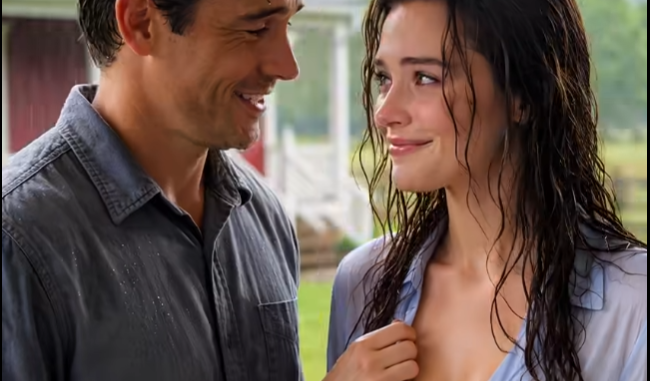
But when my flashlight cut through the rain, she was there, gripping the gate post like it was the only thing keeping her upright. Soaked to the bone. Mud to her knees. And on her left wrist, a bruise so fresh it still looked angry.
She said she only needed water.
Yet her eyes didn’t beg me for anything. They were calm, terrifyingly calm, the eyes of someone who had already decided what price she would pay for a warm night.
And when she stepped through my gate, I had no idea that someone was already searching for her.
After that, I stopped talking about the past. I fed the horses. I mended fences that didn’t need mending. I drank my coffee black on the porch and let the wind say whatever it wanted.
That was the man standing at the gate when the storm broke.
—
Up close, she was younger than I’d thought. Twenty-four, maybe twenty-five. Her jacket was too thin for the weather and clung to her like a second skin. One hand strangled the strap of a small canvas bag. The other still held the gate post.
“”I’m sorry,”” she said. Her voice was cracked from the cold. “”I just need some water. Then I’ll go.””
I looked at the bruise again. Not new. Not old either. The kind of purple that only comes from fingers.
“”You’re standing in the middle of nowhere in a storm,”” I said. “”Water isn’t the only thing you need.””
“”I don’t want to cause trouble.””
“”Trouble’s already here. It’s almost midnight, and you’re eight miles from town.””
She studied me while the rain ran down her face, and I did the only thing I could think of. I took one slow step backward, so she’d never feel cornered.
“”My name’s Caleb. I live alone. There’s hot water, clean towels, and a couch. You can sit in the kitchen, drink something warm, and decide what you want after that. Nobody’s going to hurt you here.””
Nothing. Thunder rolled across the empty fields like furniture being dragged through a room upstairs.
Then she stepped through the gate.
Her name was Lena Castillo. I learned it in my kitchen, after I handed her a towel and one of my flannel shirts and set a glass of water on the table.
She held it with both hands, as if someone might try to take it from her. She was clearly thirsty, but she drank in small, careful sips, the way you drink when you’ve learned that nothing lasts.
“”You walked from Route 17?”” I asked, leaning against the counter.
She nodded at the glass. “”It was over ten miles.””
I didn’t ask why. Some questions are doors, and I could see how tightly she was holding hers shut.
That was when the whinny came from the barn. Thin. Wrong.
The foal I’d taken in three days earlier had been running a fever since dawn. I’d told myself he was improving. That sound told me I’d been lying.
I was already reaching for my jacket when Lena lifted her head.
“”A foal?””
“”You know horses?””
“”A little.””
She pushed back her chair and followed me into the rain without another word.
—
Under the yellow barn light, he lay curled in the straw, ribs fluttering too fast. Lena didn’t rush him. She knelt, slow as a held breath, and let him smell her hand before she touched anything. Then she took the bottle from my fingers, warmed it in a bucket of hot water, and lowered herself until she was nearly eye level with him.
She started speaking. Low, steady, a murmur I couldn’t catch. The words weren’t for me.
Ten minutes later, the foal was drinking.
I stood there with rainwater dripping off my hair, watching a stranger who had looked like she’d crawled out of hell work miracles with nothing but patience and quiet hands. Something in my chest shifted. It felt like a rusted hinge, stiff and unwilling, giving way an inch.
When the foal finally settled, Lena stood. Exhaustion had drained the color from her face.
“”Thank you,”” she said. “”I should go now.””
I looked at the doorway. The rain was coming sideways. The wind howled like it had a grudge.
“”You don’t have anywhere to go, do you?””
She didn’t answer, and that was answer enough.
I took a breath. It felt like stepping off a ledge.
“”Do you want to stay here tonight?””
The question sat between us, and I hated how much it weighed. I rushed to fill the silence.
“”The couch is comfortable. The door has a lock, and you can use it from the inside if that helps. In the morning, if you still want to leave, I’ll drive you to the bus station. No questions.””
Rain hammered the barn roof like a thousand impatient fists. Lena’s fingers tightened around the strap of her bag until her knuckles went white. She looked at me for a long time. I had the strange feeling she wasn’t looking at my face at all. She was searching for the trap. The catch. The hand that would close around her wrist the moment she trusted it.
I let her search. I didn’t move.
Finally she nodded. Once, small and fragile, the nod of someone jumping from a great height and hoping there’s water below.
That was how Lena Castillo spent her first night on my farm.
—
I lay awake afterward, listening to the storm ease against the roof. Through the wall, I heard the soft click of the lock turning from inside the living room. Then, a minute later, a second sound. Barely there.
The lock, turning back.
She’d unlocked it. Maybe she wanted to hear me if I came. Maybe she wanted to hear anyone else who did.
And I lay in the dark, my hands folded over my chest like a man at his own funeral, and thought about the bruise on her wrist. Fresh enough to still be angry. Old enough that she’d had time to run.
Whoever put it there hadn’t finished with her.
I didn’t know his name yet. I didn’t know what he owned, or what he’d do when he found the one place in the county where his money couldn’t buy the gate.
I only knew that for the first time in three years, someone was sleeping under my roof.
And that was the moment I stopped being afraid of the silence, and started being afraid of losing it.
“I woke at five, like always, convinced I’d dreamed her.
Then I smelled coffee.
Lena stood at my sink in the flannel shirt, sleeves rolled, washing the two glasses from the night before.
“”I didn’t know how you take it,”” she said. “”So I made it black.””
I almost smiled. It was the first real one in days.
She said she’d leave after breakfast. Then the foal cried out again from the barn, and she asked for a few more hours. Those hours became the day. The day became a week.
And I began to notice things.
She sat with her back straight, angled toward the door. She flinched whenever a car passed on the dirt road. Wherever she worked, she could see the front gate. That canvas bag never left her reach.
I knew that fear. I’d worn it myself after Claire.
On the sixth day, while we mended a fence, I offered her a job. A room, three meals, pay every Friday.
“”You don’t know anything about me,”” she said. “”Why would you trust me with your home?””
I had no answer that made sense.
Then one Tuesday morning, an engine climbed my road. Lena went rigid, dropped her bucket, and backed into the barn wall until she had nowhere left to go.
A black SUV stopped at my gate.
Who was inside it?
Để lại một phản hồi