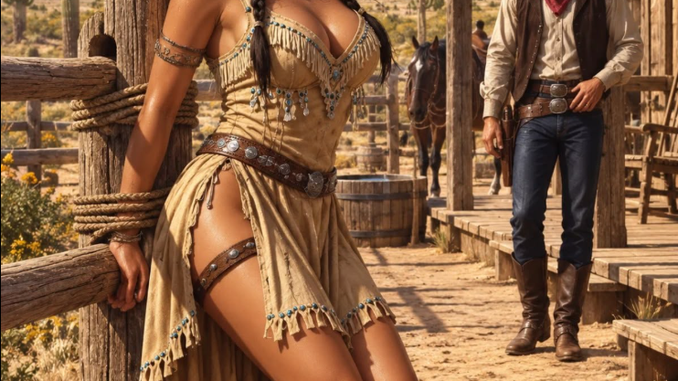
PART 1 — THREE MEN TRADED HIM A BEATEN APACHE WOMAN FOR A HORSE… BY NIGHTFALL, HE REALIZED THEY HAD LEFT HIM SOMETHING FAR MORE DANGEROUS
For twelve years, Caleb Monroe had managed to disappear without actually leaving Arizona. His ranch sat beyond Scorpion Ridge, where the ground was hard, the summers were merciless, and visitors usually meant trouble. Once, Caleb had been a trail scout, a man who could read broken grass like a newspaper, but that life ended when his younger brother Daniel died during a raid while Caleb was too far ahead to save him. Since then, Caleb wanted only cattle, silence, and enough distance from humanity to keep another grave from appearing beside his cabin.
Then, one evening, three riders came out of the dust.
Caleb heard them before he saw them, their horses stumbling along the southern trail with the uneven rhythm of exhausted animals. The riders looked worse: dirty clothes, unshaven faces, hard eyes, and guns worn where hands could reach them quickly. One wore an old cavalry coat stripped of its insignia, another had a white scar through his eyebrow, and the man in front smelled of whiskey before his horse even reached the fence. Caleb stayed where he was, expressionless, waiting for them to explain why they had come.
The leader pointed toward Caleb’s bay mare. He claimed they had been promised the horse for work done months earlier, a debt Caleb knew did not exist. Caleb refused, and for one second the desert seemed to stop breathing. Then the stranger smiled and said they had brought payment.
That was when Caleb saw the rope.
It ran from the third rider’s saddle into the dust behind his horse. At the end of it walked a young Apache woman, barefoot, bruised, and barely standing. Her wrists had been bound so tightly that dried blood darkened the rope, her feet were torn from walking, and her deerskin dress was ripped and filthy. Yet whenever her knees threatened to buckle, she forced herself upright again.
The leader announced that they had caught her near the canyon. According to him, the army did not want her, so she was now worth whatever somebody was willing to trade for her. He wanted Caleb’s mare. In exchange, Caleb could have the woman.
Caleb’s stomach turned cold.
“I don’t trade people,” he said.
The men laughed.
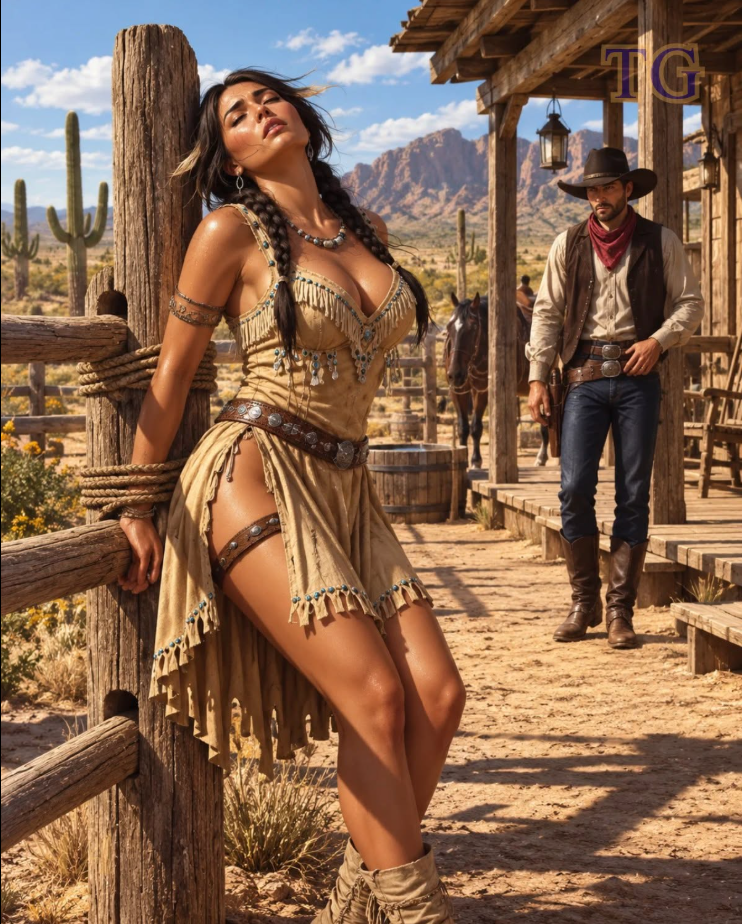
Their leader explained that Caleb was not being asked to trade for her. They were simply leaving her behind, taking the mare, and making whatever happened next Caleb’s problem. Three armed men stood in his yard, half drunk and eager for violence, while the woman could barely remain conscious. Caleb calculated the odds and hated every answer he found.
So he pointed toward the corral.
“Take the mare. Ride.”
The men grinned as if they had won. They untied Caleb’s horse, fastened the woman’s rope to his fence post, and mounted up. Before leaving, one shouted that if she died, Caleb could bury her—or leave her to the wolves.
Then they disappeared into the dust.
Caleb remained beside the fence for almost a minute. The woman said nothing. She did not beg him to free her, did not cry, did not even look directly at him; she simply stood against the post, trembling violently while pretending she was not.
Caleb turned away.
Inside his cabin, he poured water and told himself she was not his responsibility. An army patrol might pass. Her people might be searching. Somebody else could solve a problem he had never asked to receive.
But darkness came, and nobody came with it.
The temperature dropped. Coyotes began calling from the hills. Caleb tried to eat, then tried to sleep, but every time he closed his eyes he saw another person he had once failed to reach in time: Daniel, bleeding beneath the Arizona sun while Caleb returned too late.
Finally, Caleb cursed, grabbed his knife, and walked outside.
The woman tensed when he approached. He reached for the rope, and she became completely rigid, clearly expecting another act of cruelty. Instead, Caleb sliced through the knot.
Her body collapsed almost immediately.
He caught her before she hit the ground.
She was burning with fever.
Caleb carried her into the cabin and laid her on the spare cot Daniel had once used. Under the lamplight, the damage became impossible to ignore: swollen wrists, bruised ribs, bleeding feet, a dirty cut across her thigh. He cleaned what he could, covered her with a blanket, placed water beside her, and told himself she would leave the moment she could walk.
Then he sat beside the cot all night to make certain she kept breathing.
By morning, she was still alive.
When her eyes finally opened, she did not scream. She studied Caleb with the exhausted caution of someone who had learned that every stranger might demand a price. Caleb offered water, bread, salve for her wrists, and one of his clean shirts, but made his terms clear: she was free, and when she became strong enough, she could go.
Her first answer surprised him.
“No go.”
Later, after forcing down several bites of bread, she asked his name.
“Caleb.”
He hesitated before asking hers.
“Nyall,” she whispered.
That single name changed something. A nameless stranger could disappear back into the desert. Nyall was a person, and somewhere beyond Scorpion Ridge there might be people desperate to find her.
Over the next day, fragments of her story emerged. Soldiers had raided her people near Water Pass. She escaped into the rocks, only to be captured by the three riders while searching for water. They kept her for three days with almost no food, bound her, and refused even to use her name.
Caleb listened without interrupting.
Then Nyall asked the question he had been avoiding.
“If my people come… you send me out?”
Caleb looked toward his rifle.
“Depends who rides in.”
Nyall’s expression remained calm. “If my people find me here, they may kill you. They think you took me.”
Caleb met her eyes.
“Then you’ll tell them different.”
She glanced at her bandaged wrists. “They not always listen first.”
That night, Caleb placed his spare boots beside her cot and told her she could remain until she knew where she wanted to go. He would not take her into town. He would not hand her to the army. And if the men who had abused her returned, they would discover that the quiet rancher at Scorpion Ridge was not nearly as harmless as they had assumed.
Nyall stared at him for a long moment.
“If my people come first,” she said, “you speak before they kill.”
Caleb answered quietly.
“I don’t run from a door I opened.”
Hours later, before sunrise, Caleb woke with his hand already reaching for his revolver.
Something was wrong.
Nyall was awake too.
Three riders stood on the distant ridge.
They did not move like soldiers. They did not sway like drunk bounty hunters. They approached silently, deliberately, with rifles and bows visible against the pale morning sky.
Nyall moved to the window.
For the first time since arriving at Caleb’s ranch, something powerful flashed across her face—not fear, but recognition.
“My people.”
Caleb looked at the approaching warriors and then at the woman standing inside his dead brother’s shirt.
“Are you sure?”
Nyall pointed toward the lead horse. A raven symbol had been braided into its tail.
Then she said something that made Caleb tighten his grip on the rifle.
“They find me here… they may kill you before I can speak.”
The three warriors were already descending the ridge.
And Caleb suddenly understood that saving Nyall’s life might cost him his own.
PART 2 — APACHE WARRIORS SURROUNDED HIS RANCH… THEN ONE SENTENCE FROM NYALL CHANGED EVERYTHING
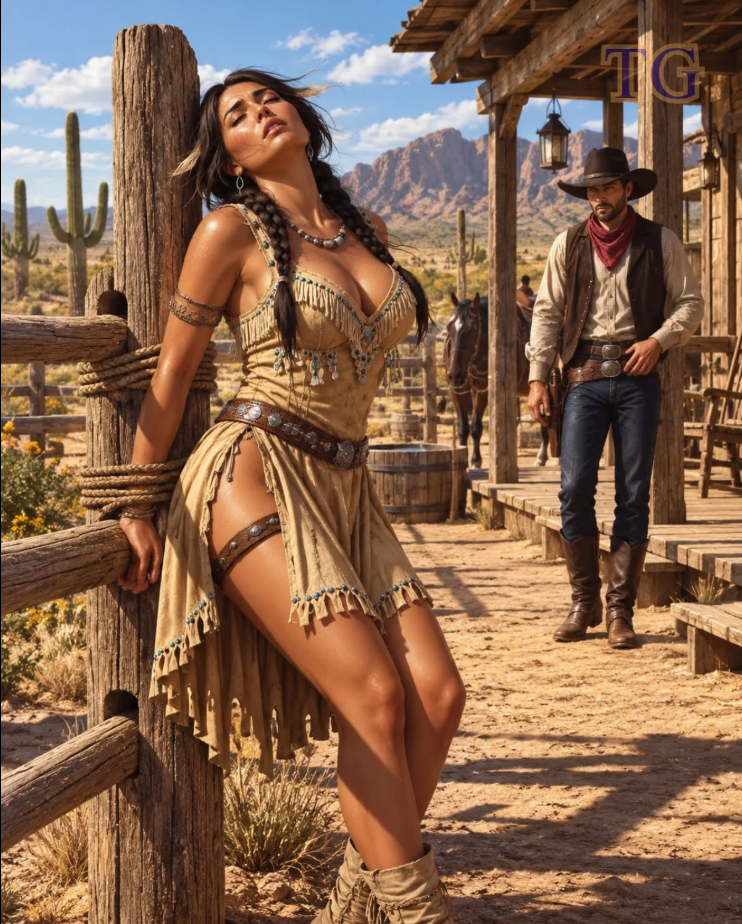
The three riders stopped thirty yards from Caleb’s cabin. The oldest sat in front, his face weathered and unreadable, while two younger warriors watched Caleb with unmistakable suspicion. Caleb stepped onto the porch with his rifle lowered toward the dirt, hoping the gesture would buy him enough seconds to speak. Before he could finish saying that Nyall was alive, she stepped into the doorway behind him.
The reaction was immediate. One young warrior shifted his hand toward his weapon, while the older man’s face tightened with relief and fury at the same time. Nyall raised her chin and spoke first in her own language, fast and forceful, then deliberately changed to English so Caleb could understand.
“I am not bound. I stand here because I choose.” The older warrior dismounted. His eyes dropped to Nyall’s bandaged wrists, Caleb’s oversized shirt around her body, and then the rifle in Caleb’s hand. “You trade horse for her?” he demanded. “No,” Caleb replied. “They left her tied to my fence.
I let them take my horse because fighting three armed men would have gotten her killed. I cut her loose after they left.” Nyall confirmed it. She told them Caleb had given her water, food, clothing, medicine, and freedom. Nobody had forced her to remain. Still, the older man did not relax.
“Why help?” Caleb could have invented something heroic. Instead, he gave the only answer he had. “Because she would have died, and I’ve buried enough people.” Silence followed. Then the warrior looked toward Nyall and spoke rapidly in Apache. Whatever he asked made her straighten.
Her answer came with such authority that even the two younger men lowered their eyes for a moment. The older warrior turned back toward Caleb. “She is daughter of Nache.” Caleb said nothing, but the name carried weight even without explanation. Nyall was not simply a survivor whose absence might be noticed.
She was the daughter of a leader whose people had already crossed miles of hostile territory looking for her. And then Nyall stunned everyone. “I do not leave yet.” The younger warriors stared at her. The older man demanded an explanation, but Nyall stood her ground.
Caleb remained silent because he understood something the men who had dragged her across the desert never had: the decision belonged to her. Finally, the older warrior accepted it. But before leaving, he asked Caleb for the names and direction of the three men responsible for taking Nyall.
Caleb gave him everything. “Corbin Vance. One man has a scar through his eyebrow. Another wears an old cavalry coat. They rode toward Dust Devil Gulch.” The warriors exchanged a look. It was the kind of look men shared when a decision had already been made. Then they rode away. Nyall watched until they disappeared beyond the ridge.
“They come back,” she said. Caleb looked at her. “For you?” “For them.” Days passed. Nyall grew stronger, but neither she nor Caleb spoke much about what would happen when her people returned. Then, one morning, a lone Apache rider appeared. He spoke privately with Nyall for several minutes.
When he left, she returned to Caleb with an expression he could not read. “They found Corbin Vance.” Caleb waited. Nyall’s next words landed harder. “My father knows I live.” She looked toward the ridge. “He is coming here himself.” Three days later, riders appeared across the horizon.
This time there were many. At their head rode Chief Nache. Would the chief honor the stranger who saved his daughter—or decide that Nyall had remained in Caleb’s cabin far too long? If you’re ready for the ending, comment one word from the story: “Freedom.”
Để lại một phản hồi