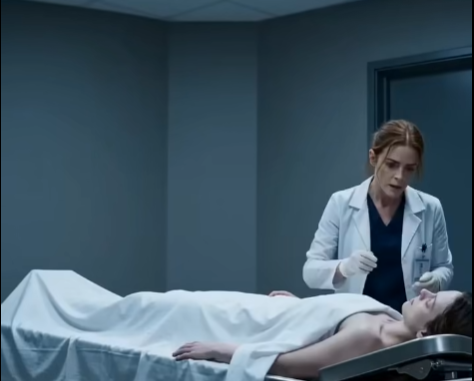
Chapter 1: The Hand Beneath the Sheet
The woman on my examination table was supposed to be dead. I knew that because I had spent eleven minutes reading the paperwork that said so, and because someone with considerable influence had already called my office three times to arrange her cremation. Neither fact explained why her hand had just closed around my wrist.
“Don’t tell them I’ve woken up,” she whispered.
I had been reaching for the first button of her hospital gown. My scalpel rested against the steel tray, untouched. Above us, the surgical lamp cast a pale circle over her face. Her eyes were open now, gray and frightened, while the rest of her body seemed too exhausted to move.
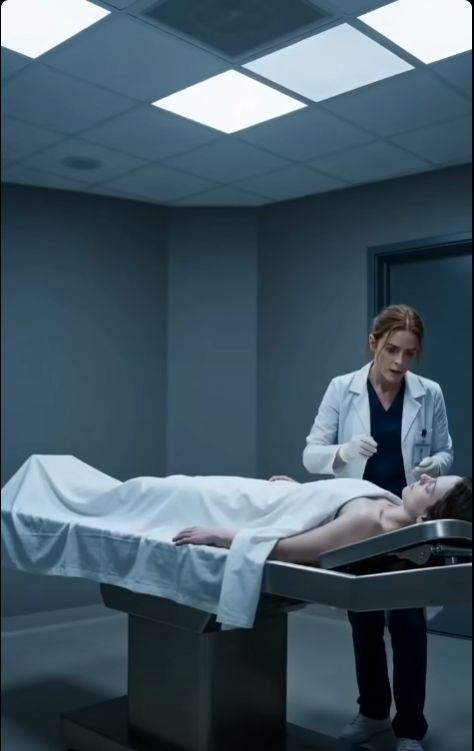
For a moment, the ordinary sounds of my work vanished. The ventilation faded. The clock stopped mattering. I was Dr. Mara Ellis, chief deputy medical examiner for Bellweather County, and I had just discovered that the twenty-nine-year-old woman delivered to our morgue under a signed death certificate was alive.
“Don’t move,” I said, although she barely could. “I’m going to help you. Tell me your name.”
“Evelyn.” Her lips cracked around the word. “Evelyn Cross.”
I knew her name from the paperwork. Cause of death: accidental fall. Certifying physician: Dr. Leonard Vale. Disposition requested: immediate cremation. What the form didn’t mention was the bruising beneath her gown collar, faint violet marks around her neck that looked nothing like injuries from a staircase fall.
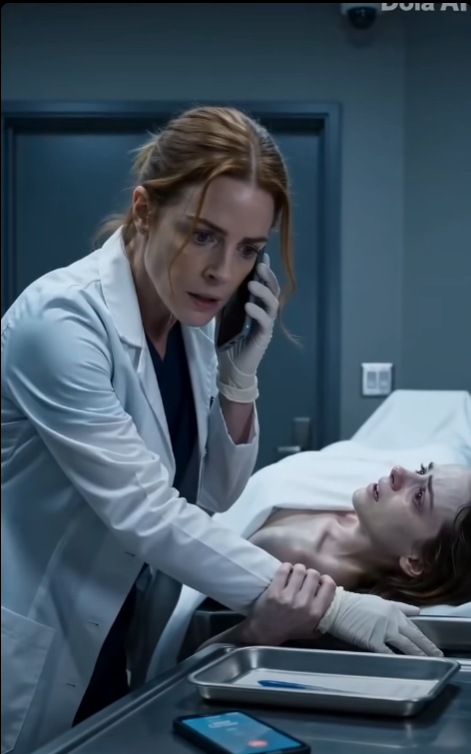
I touched two fingers to her wrist. The pulse was weak but unmistakable. Her skin was cold; her pupils responded sluggishly to light. Someone might have mistaken those signs for death in a rushed examination, but Dr. Vale had certified a woman without ensuring the most basic fact about her condition.
“Who are you afraid of?” I asked.
She tightened her fingers. “My husband. His father. Please, they know people everywhere.”
Before I could ask more, my phone began to ring. The screen showed an unknown number. Evelyn’s eyes widened at the sound as if it were a gunshot.
I answered on speaker. “Dr. Mara Ellis.”
“Richard Cross,” said a controlled male voice. “My daughter-in-law’s funeral home is waiting. She must be cremated this afternoon.”
Behind me, Evelyn trembled beneath the white sheet.
“I’ve just begun my examination,” I said.
“That’s unnecessary. Her death was certified by our physician.”
“And the county is required to review unexplained deaths.”
He exhaled impatiently. “Doctor, perhaps you don’t understand who I am.”
I looked at the security camera in the corner and at the woman struggling not to make a sound. “Perhaps you don’t understand who I am.”
I ended the call, locked the door, and pulled a warmed sheet over Evelyn’s shoulders. A part of me wanted to run into the hallway and summon every nurse and officer in the building. Another part understood that the people who had delivered her here had somehow convinced a physician to sign an impossible certificate. Until I knew whom to trust, announcing that she lived would make her vulnerable again.
“Can you breathe?” I asked. “Any chest pain?”
“A little. My legs feel far away.”
That worried me more than anything she had said. Her respirations were shallow, and she was not fully alert. Concealment could not come before medical care. I checked her oxygen saturation with the small monitor kept for unexpected situations. The reading was low enough to demand immediate treatment.
I reached for the internal emergency phone and called one person: Dr. Tessa Nguyen, the emergency physician who had saved my own daughter after a highway collision five years earlier. Tessa knew that I never used the phrase “private consult” lightly.
“I need a critical living patient in the morgue,” I told her. “Come yourself, with a portable monitor and airway kit. Use the service hall. Please don’t send a general announcement.”
She paused only long enough to say, “I’m coming.”
Footsteps approached outside. Someone struck the door once.
“Dr. Ellis?” called an unfamiliar man. “I’m with the funeral home. The family says we’re on a schedule.”
“The examination hasn’t been released,” I replied. “Please wait in reception.”
“Mr. Cross expects cooperation.”
“Then Mr. Cross will have to learn patience.”
His footsteps receded, but not before I heard the low murmur of another voice. Two people were waiting out there, not one.
Evelyn flinched. “They’ll come in.”
“This door stays locked until I say otherwise.”
She watched me lift her death certificate. In the lower-right corner, I noticed a tiny black rectangle beside the handwritten signature. It was a records stamp, the kind the hospital system assigned when a document was printed. I turned the page over. An electronic copy had been generated at 7:42 a.m. But the hospital’s transfer record claimed Evelyn had been declared dead at 8:16 a.m.
The death certificate had been prepared thirty-four minutes before the stated time of death.
“Evelyn, where did this happen?”
“At home. The stairs. That’s what they’re saying.”
“What really happened?”
She struggled to focus. “I found something. In Richard’s study. A folder. My name was inside.”
I kept my voice level. “What kind of folder?”
“Insurance. Property. A trust my grandmother left me.” She swallowed painfully. “I thought Nathan loved me. He said the money didn’t matter.”
Nathan Cross. Her husband. He was a philanthropist whose photographs appeared in newspaper society pages beside Richard’s. Their family funded half the west wing at Bellweather Memorial Hospital. I had attended a charity dinner where Richard was applauded for his generosity. I’d even shaken his hand.
“Did he hurt you?” I asked.
“He told me I was confused.” Tears slid toward her hairline. “Then his father came into the room. They asked where I put the photographs. Nathan held my arms. I remember Dr. Vale saying I’d be calmer soon. And then I couldn’t speak.”
I thought of the injection site on her forearm that the transport documentation had called a routine medical intervention. It was possible that medication had induced a state of profound unresponsiveness; there was no way to establish exactly what without toxicology and a proper clinical evaluation. Either way, the signature on that certificate became more sinister by the second.
The doorknob rattled. Once. Twice.
“Dr. Ellis,” the funeral director called, more urgently. “We have authorization from the family.”
“Not from this office,” I said.
Evelyn reached for me again. “My phone,” she breathed. “They took my phone. But I sent a picture before they found me.”
“To whom?”
“My sister, Lily.” Her voice weakened. “If she hasn’t answered, she’s in trouble.”
My own phone lit up with a text from an unknown number: RELEASE THE BODY. DO NOT MAKE THIS DIFFICULT.
I showed no reaction, though I felt the words settle like ice behind my ribs. I had seen threats before, usually from grieving relatives desperate for quick answers. This was different. No one should have known I was delaying the release unless they were watching the process closely.
I moved between Evelyn and the door. “I need you to stay with me, Evelyn. Tell me anything that will help us find your sister.”
“She works at the public library. She wears a yellow raincoat because she always loses umbrellas. She wouldn’t leave without telling me.” Evelyn closed her eyes for a second. “I promised I’d call her this morning.”
The next knock came from the staff entrance that connected the morgue to the hospital’s service corridor. Three quick taps, followed by one. It was our private signal. I opened it just enough to see Tessa in scrubs, with a monitor balanced on a wheeled cart. She took in the room with one swift look and asked no unnecessary questions.
“We have to move her to a treatment bay now,” Tessa said after a brief examination. “And Mara, if somebody administered what I think they did, we may be dealing with more than one drug.”
“Can you do it quietly?”
“Quietly, yes. Safely, first.”
Together we prepared to transfer Evelyn. I told Tessa about the forged timeline, the threatening text, and the men outside. Her face changed when she heard the doctor’s name. “Leonard Vale? He was removed from our emergency rotation years ago after an unexplained medication incident. Richard Cross hired him the next month.”
I looked once more at the certificate. Along the margin, partly hidden beneath a staple, was an unfamiliar handwritten notation: EC / 2:30 / BELL TOWER.
“What does that mean?” I asked.
Evelyn’s expression became so frightened that I feared she might lose consciousness again.
“It’s where they took the others,” she whispered. “And Lily knows where it is.”
From outside the main door, a woman’s voice suddenly shouted my name. “Dr. Ellis! This is Detective Jonah Reed. Open up. We’ve received a report that you’re unlawfully holding a deceased woman.”
Detective Jonah Reed stood on the other side of the morgue door with a warrantless accusation and a voice that sounded more annoyed than concerned. I had known him for seven years, long enough to recognize the difference between his ordinary impatience and fear. That morning, beneath his clipped words, I heard fear.
“Who called you?” I asked through the door.
“The Cross family attorney. He says a legal order is being ignored.”
“And you accepted his version without speaking to me?”
“Mara, open the door.”
I glanced at Tessa. She had fitted Evelyn with supplemental oxygen and was watching the monitor. Evelyn’s pulse was improving, but she remained disoriented. We needed a monitored treatment room, not an argument with the police in a corridor crowded with strangers.
“I’m sending you my staff identification and a request for a secure officer response,” I said. “Have dispatch confirm your badge number. Meanwhile, clear everyone from this hallway.”
“Why?”
“Because this is a medical emergency involving a living person falsely certified dead.”
Silence.
Then a faint sound, like Reed catching himself before speaking too loudly. “Say that again.”
“You heard me.”
It took ninety seconds for him to send confirmation through the county dispatch channel. I watched his response arrive on my office tablet, then allowed him inside alone. He came without drawing his weapon, stopped at the sight of Evelyn, and stared at the death certificate I held up in my gloved hand.
“My God,” he whispered.
“She’s in danger, Jonah. And someone knew you’d come before I did.”
“The attorney said you were interfering with an authorized transport. Richard Cross called the chief personally.”
I handed him the document showing that her certificate had been printed before her supposed death. He read it twice. “That’s not possible.”
“It’s possible if someone planned the death before it occurred.”
Tessa interrupted. “If we want her alive tomorrow, we move now.”
Reed radioed for an ambulance transfer team with strict instructions to use the service access and to report to him alone. He requested a second detective from a separate unit, a woman named Aisha Carter whose reputation for stubborn independence I respected. I asked him not to give the Cross family a location, not until we knew who had compromised the hospital’s paperwork.
As we rolled Evelyn through the narrow corridor, the funeral director stood at the far end with a polished black briefcase. He raised a phone and photographed the covered stretcher. Reed stepped into his path.
“Delete it,” Reed said.
“I’m documenting a delay.”
“You’re documenting an active emergency scene. Put the phone away.”
The man slipped it into his pocket but did not delete anything. Before we reached the elevator, my own phone rang. This time the display read HOSPITAL ADMINISTRATION.
“Mara,” said deputy director Paul Mercer, “I understand there has been an unfortunate misunderstanding. Richard Cross has agreed to handle this discreetly.”
“What misunderstanding?”
“The patient may have been misidentified. We can smooth over the paperwork.”
“The patient’s identity isn’t in doubt. A licensed physician certified a living woman dead.”
Mercer dropped his friendly tone. “Don’t make this a public spectacle. The Cross foundation supports your department’s equipment budget.”
“Then you’ll be pleased to learn we keep records of every donation and every death investigation.”
I ended the call. Reed’s expression had grown darker. “They got to administration already?”
“Or administration was waiting for the call.”
The emergency elevator opened into a small treatment wing where Tessa’s trusted senior nurse, Helena Brooks, had cleared a room. The staff moved swiftly. Blood tests were drawn. Evelyn was placed under cardiac monitoring while Tessa consulted toxicology about possible sedatives and other agents. Nobody pretended we could name a drug from her symptoms alone. Time, laboratory evidence, and careful observation would tell us more.
When Evelyn could finally speak above a whisper, Reed introduced himself at a distance that would not crowd her. “I need to understand what happened, but you can stop at any time.”
She looked first to me. I pulled a chair beside her bed.
“I believed my husband,” she began. “When my grandmother died, she left me shares in a company that owned land by the old Bell Tower textile mill. Nathan told me the properties were worthless. He said he’d help sell them.”
“Did you sign anything?” Reed asked.
“Some documents. Then I discovered the land had become valuable. Richard’s development project needed it. But there were families still living in the old workers’ cottages. My grandmother had promised they could stay.”
She described a folder containing transfer deeds, forged authorizations, and photographs of a basement at the mill. She had found the folder when Richard’s housekeeper asked her to retrieve a medical bill from his study. One picture showed a storage room with numbered cartons. Another showed a familiar face standing beside a man in a white coat.
“Dr. Vale?” I asked.
“Yes. And two women. I don’t know their names. They looked frightened.”
“You said there were others,” I reminded her.
Evelyn squeezed the edge of her blanket. “I heard Richard talk about people who wouldn’t sign. They were sent somewhere to be kept quiet. I thought he meant lawyers. Then I found the photographs.”
Reed asked about the phrase BELL TOWER. Evelyn said she had once overheard Richard use it while arguing with Vale. The note on the certificate might have been a planned appointment, a coded location, or someone deliberately leaving a clue. We could not know yet.
Her eyes suddenly widened. “Lily has the pictures. I sent her everything I could photograph before Nathan took my phone.”
Reed stepped into the hallway and called dispatch to request a welfare check at the public library. The dispatcher reported that Lily Cross—Lily Hart before her sister’s marriage—had not arrived for her shift. Her coworkers had expected her at nine.
“She never misses work,” Evelyn said. “Not without calling.”
The words cracked apart. She began to cry, trying unsuccessfully to sit up. I settled her back against her pillow and promised only what I could honestly promise: we were looking for Lily, and we would not stop because someone important wanted us to.
At noon, Aisha Carter arrived with news from the house. The Cross estate’s security system had apparently malfunctioned during the hour Evelyn was injured. The central cameras were blank. Yet a neighbor’s doorbell camera showed a private medical van arriving before the emergency services were notified.
“And there’s something else,” Aisha said. “Nathan Cross told the responding deputy his wife fell down the stairs at 8:05. But at 8:01, he texted his father: ‘It’s done.'”
I studied the time on her phone. Four minutes before the supposed accident. Another piece of a timeline that had been arranged backward.
“Do we have enough for an arrest?” I asked.
“Not yet. We have enough to keep digging.”
Aisha showed me the property records for Evelyn’s grandmother’s trust. A transfer of ownership had been filed two days earlier, electronically signed by Evelyn. The signature looked convincing. What made my stomach drop was the accompanying affidavit: it stated that Evelyn had appeared before a notary at 10:30 the previous evening, the same period when she remembered being drugged and unable to move.
We began documenting everything independently. Reed instructed me to preserve the original death certificate and the record of every person who had touched it. Tessa labeled the clinical samples with witnessed collection times. Aisha placed the suspicious deed on an evidence preservation request. We were careful because a story this outrageous would collapse in court if anyone could show that we had rushed its proof.
Just after one, a nurse came through the doorway carrying a white envelope. She said a hospital volunteer had left it at reception with my name written across the front. No sender. Inside was a printed photograph of a small yellow raincoat hanging from a chair in an empty room. Behind the chair rose an old stone wall with a narrow arched window.
On the back were six words: BRING EVELYN TO THE BELL TOWER.
Under them, in a different handwriting, someone had added: OR LILY DOES NOT COME HOME.
Evelyn saw the picture before I could hide it. Her face drained of color.
“That’s Lily’s coat,” she whispered. “She wore it this morning.”
Reed reached for his radio. At that precise moment, an alert appeared on his phone: the police chief had ordered him to relinquish the case to a special investigative team appointed at the request of Richard Cross.
For a few seconds, all of us stood in a silence broken only by the soft mechanical pulse of Evelyn’s monitor. I thought about how a threat could travel through ordinary channels: a polite telephone call, an administrative request, a document forwarded by someone who had no reason to question its sender. None of the people carrying those messages needed to know the truth to help bury it. Reed seemed to reach the same conclusion. He asked Aisha to document every contact with the chief’s office and told the nurse at the desk to report unfamiliar visitors without confronting them. Evelyn watched these preparations, her fear still visible, but now she had people who were finally willing to take it seriously.
The photograph was still trembling in Evelyn’s hands when Reed looked at me and said, “We have a problem. The new team is already on its way.”
Để lại một phản hồi