Chapter 1: The Colonel Who Tried to Bury Me in the Pacific
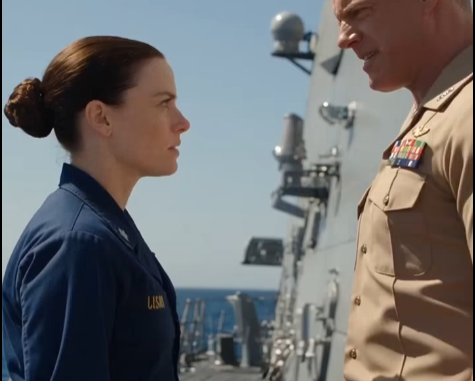
Colonel Victor Kane drove his boot into my chest and sent me over the railing of the USNS Resolute in front of five hundred sailors and Marines.
“Problem taken care of,” he announced.
He had no idea that the woman he had just kicked into the Pacific Ocean was carrying the evidence that could destroy his entire military career.
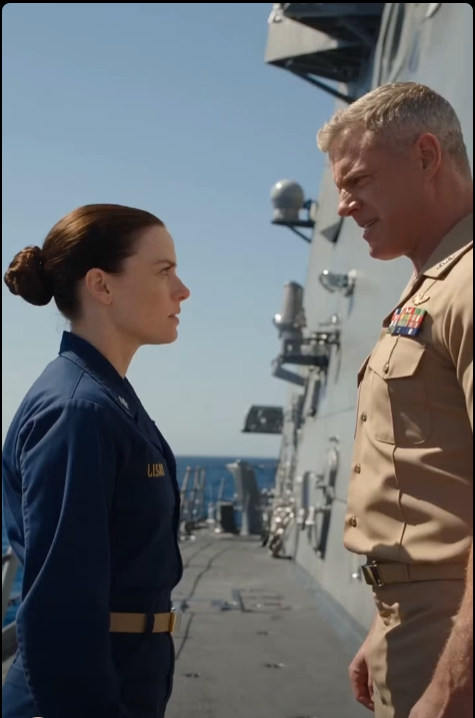
For one terrifying second, I was suspended between the white steel hull and the dark blue water, watching the ship rise above me like the wall of a prison.
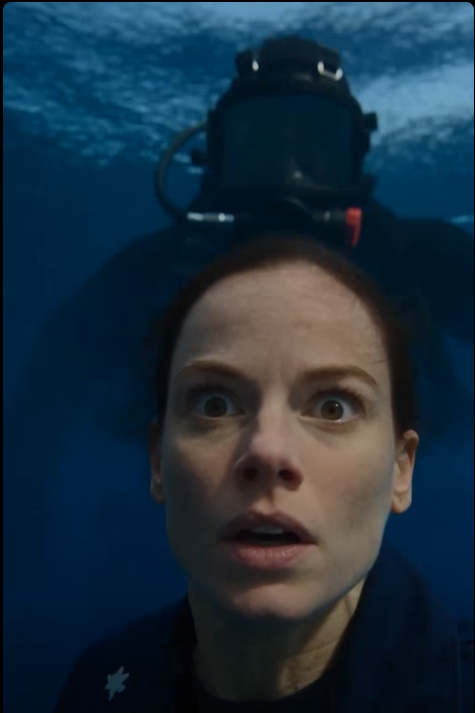
Then I hit the ocean.
The impact drove the air from my lungs.
Saltwater flooded my mouth as I plunged beneath the surface, my uniform dragging against my shoulders.
Above me, the ship’s massive engines had begun slowing, but the current still churned violently around the stern.
I fought the instinct to panic.
One arm broke through the surface, followed by my head.
I inhaled sharply.
Someone was screaming.
Someone else shouted, “Man overboard!”
But the voice I heard most clearly belonged to Colonel Kane.
“Get back into formation! Nobody moves without my authorization!”
Even with seawater burning my eyes, I could see him standing above the railing.
His spotless uniform looked almost theatrical against the exhausted sailors surrounding him.
He wasn’t frightened.
He wasn’t even surprised.
He was smiling.
My name is Hannah Mercer Cole.
I was thirty-four years old, a Petty Officer First Class in the United States Navy, and officially assigned to the Resolute as a logistics specialist supporting a joint Marine expeditionary deployment.
Unofficially, I was working with the Naval Criminal Investigative Service.
And what I had discovered aboard that ship was far more dangerous than anyone at NCIS had anticipated.
Three days earlier, I had boarded the Resolute carrying a duffel bag, a forged assignment explanation, and a waterproof evidence key hidden inside the reinforced seam of my left sleeve.
My orders appeared routine.
Review cargo accountability records, reconcile supply discrepancies, and assist the embarked Marine logistics team during its Pacific deployment.
Nothing about my paperwork suggested that I was searching for an unauthorized compartment concealed behind the bulkheads of Deck Four.
Nothing indicated that NCIS had already identified three suspicious transfers involving military equipment officially listed as delivered to shore.
And absolutely nothing explained why one shipment, supposedly unloaded six weeks earlier, continued appearing in the ship’s internal electrical maintenance records.
That contradiction was the reason I had been sent.
The Resolute was a Military Sealift Command vessel, a massive gray-hulled transport ship supporting joint operations across the Pacific.
Its civilian master, Captain Adrian Sloane, controlled the vessel’s navigation and maritime safety.
Colonel Kane commanded the embarked Marine contingent.
In theory, their responsibilities were separate.
In practice, Kane behaved as though every person aboard answered directly to him.
I recognized the problem before I had been aboard twenty minutes.
A young sailor carrying a stack of equipment records nearly collided with Kane outside the operations office.
The sailor immediately apologized.
Kane looked at the papers scattered across the deck.
“Pick them up.”
The sailor crouched.
“Faster.”
Nobody nearby reacted.
That silence disturbed me more than the order itself.
I had served long enough to recognize the difference between military discipline and deliberate humiliation.
Discipline created confidence under pressure.
Humiliation taught people to remain silent when something was wrong.
And aboard the Resolute, silence seemed to be the most strictly enforced regulation.
My NCIS contact, Special Agent Mara Velez, had warned me not to confront Kane.
“Observe, document, and preserve your cover,” she had said during our final encrypted briefing.
We had met in an unremarkable office near the waterfront, away from the main installation.
Mara was forty-one, sharp-eyed, and almost painfully economical with her words.
She had spent sixteen years investigating crimes involving military personnel.
I trusted her because she never promised outcomes she couldn’t guarantee.
“Your priority is the missing compartment,” she continued. “We need to establish whether it exists before requesting a broader intervention.”
“Why not inspect the ship openly?”
“Because somebody has already altered the official records.”
She placed a photograph on the table.
It showed a sealed cylindrical transport container with a stamped serial number.
“Unit R-417. Listed as transferred ashore six weeks ago.”
I studied the photograph.
“What’s inside?”
“We don’t know.”
“Hazardous material?”
“Officially, environmental monitoring equipment.”
“Unofficially?”
Mara held my gaze.
“Three people who questioned that shipment have disappeared from the reporting chain.”
That sentence followed me onto the ship.
I had spent the first two days examining manifests, interviewing supply personnel, and pretending that the discrepancies were ordinary administrative mistakes.
Most crew members avoided prolonged conversation.
Questions about Deck Four produced especially strange reactions.
A maintenance technician told me the area was restricted because of ongoing ventilation work.
Another insisted that the passageway had been permanently sealed during a refit.
A third claimed there was no passageway at all.
All three statements couldn’t be true.
On my second evening, I found Chief Petty Officer Evelyn Shaw studying a damage-control diagram near the engineering office.
Shaw was forty-six, broad-shouldered, and carried herself with the quiet authority of someone who had spent half her life aboard ships.
She noticed where I was looking.
“Lost, Cole?”
“Trying to understand the Deck Four arrangement.”
Her expression changed.
“What’s wrong with the arrangement?”
“Nothing, if the ship is missing twenty-six feet of internal space.”
She stared at me for several seconds.
Then she folded the diagram.
“Some measurements aren’t updated after modifications.”
“Modifications usually require documentation.”
“Usually.”
She walked away before I could ask another question.
That night, I recorded the conversation in my notebook.
I also wrote down the name of a young sailor who had helped me locate an old cargo ledger.
Seaman Daniel Reyes.
Twenty-one years old.
Assigned to visual communications.
He had nervous hands, an easy smile, and the habit of calling everyone “sir” or “ma’am,” even when nobody required it.
He reminded me of the sailors I had once supervised during my first deployment.
That memory mattered.
Eight years earlier, during an equipment casualty aboard another vessel, I had obeyed an order to remain at my station while an injured sailor waited for assistance.
The order had been rescinded within minutes.
The sailor survived, but his injuries became more severe during the delay.
I had never forgotten how helpless I felt standing in the passageway, knowing someone needed help while waiting for permission to provide it.
I promised myself afterward that I would never confuse obedience with responsibility again.
On the afternoon Kane threw me overboard, that promise was tested.
The heat had become unbearable by noon.
The Resolute was operating in still, humid weather beneath a sky without a cloud.
We were assembled on an exposed section of deck for what Kane called an emergency readiness inspection.
Five hundred sailors and Marines stood in ordered rows.
The steel beneath our boots radiated heat.
Several people had already reported dizziness.
Water stations had been emptied during the morning, and the replenishment detail had been turned away from the lower storage area.
The official explanation was a temporary inventory restriction.
I knew enough about supply procedure to recognize how absurd that sounded.
Potable water was available elsewhere aboard.
Emergency stores were also recorded below deck.
But Kane had ordered the nearest reserves secured until the inspection ended.
For more than an hour, he sat beneath a canvas shade canopy eating a steak lunch while the rest of us stood in formation.
Beside him, Lieutenant Colonel Aaron Pike studied a clipboard.
Pike was Kane’s executive officer, an impeccably groomed man whose expression seldom changed.
He occasionally glanced toward the exhausted formation.
He never objected.
The first sailor collapsed just after one o’clock.
Medical personnel carried him away.
Kane continued speaking.
Twenty minutes later, another man went down.
Then a third.
By the time Daniel Reyes began swaying beside me, I could feel sweat soaking through the back of my uniform.
“Reyes,” I whispered. “Look at me.”
He blinked.
“I’m okay, Petty Officer.”
“No, you’re not.”
His lips had lost their color.
He attempted to straighten his shoulders.
“I just need a second.”
Then his knees buckled.
I caught him beneath the arms before his head struck the deck.
“Medical!” I shouted.
Several sailors turned.
Kane rose from his chair.
“Petty Officer Cole!”
I lowered Reyes carefully.
“He needs immediate assistance, sir.”
Kane approached with deliberate steps.
“Did I give you permission to break formation?”
“Seaman Reyes is showing signs of serious heat illness.”
“Answer my question.”
“No, sir.”
His face tightened.
“Then stand up.”
I looked at Reyes.
His eyes were half closed.
A nearby sailor had already started toward us with a medical bag.
Kane pointed at him.
“Return to your position.”
The sailor stopped.
Something cold settled inside my chest despite the terrible heat.
“Sir,” I said, “he needs water and medical evaluation now.”
Kane stared at me.
Then he smiled.
It wasn’t a pleasant expression.
“You think you know more about command than I do?”
“This isn’t a disagreement about command, sir.”
“You’re embarrassing me in front of my personnel.”
“Respectfully, sir, I’m trying to keep one of them alive.”
That was the moment everything changed.
A murmur spread through the formation.
Kane stepped closer.
“Perhaps our new logistics specialist needs a lesson in endurance.”
Pike lowered his clipboard.
“Colonel—”
Kane raised one hand.
“Petty Officer Cole has volunteered for an open-water endurance demonstration.”
I looked toward the railing.
We were miles from the nearest land.
“Sir, I have not volunteered.”
“Are you refusing an order?”
“I’m refusing to participate in an unauthorized activity while a sailor requires emergency care.”
His jaw worked.
Behind him, I saw Shaw approaching from the forward passageway.
Her eyes moved from Reyes to Kane.
She understood what was happening.
“Colonel,” she called, “the master needs to be informed before anyone enters the water.”
Kane ignored her.
“Apologize, Cole.”
“For what, sir?”
“For challenging my authority.”
I stood very still.
The faces surrounding us were pale with exhaustion.
Some sailors looked away.
Others watched with expressions I would remember for the rest of my life.
“I will not apologize for requesting medical assistance.”
Kane moved so quickly that I had almost no time to react.
He seized my upper arm and shoved me toward the rail.
My shoulder struck the metal.
Someone shouted my name.
Then his boot hit my chest.
And the Pacific opened beneath me.
Now, struggling against the ship’s wake, I knew exactly what Kane had intended.
He wanted me frightened.
He wanted me helpless.
Most importantly, he wanted me gone before I could finish investigating Deck Four.
But he had made one extraordinary mistake.
He had thrown me into the water beside the very section of the hull I had been trying to inspect.
During my earlier examination of maintenance records, I had found a reference to a stern access plate omitted from the current structural drawings.
The plate was supposed to be permanently sealed.
Yet somebody had recently ordered replacement gaskets for it.
As the Resolute slowed under its emergency recovery procedure, I spotted a narrow recess beneath the stern platform, above the worst of the churning water.
A small metal panel was set into the hull.
Fresh welding marks glinted around its edges.
I swam toward it.
Above me, alarms were sounding.
“Cole!” Shaw shouted from the deck. “Stay clear of the stern!”
“I found it!” I called.
The wind carried away my words.
I reached the panel, caught a recessed handhold, and pulled myself close.
My fingers located an unfamiliar lock beneath the lower lip.
The evidence key in my sleeve had been prepared for a particular series of security fittings identified in the investigation.
I pulled it free.
For one moment, I hesitated.
Opening an unknown access point from the water could expose me to a dangerous current or a flooded compartment.
But the lock was mounted in a shallow external equipment recess, not directly through the ship’s pressure boundary.
I inserted the key.
Turned it.
The mechanism clicked.
A narrow service cover swung outward.
Inside rested a metal cylinder.
Its identification number was R-417.
My breath caught.
It was the same unit that had supposedly been unloaded six weeks earlier.
I gripped the cylinder.
And then I saw three words scratched into its surface.
THEY ARE STILL HERE.
I stared at the message.
Whoever had written it had pressed hard enough to cut through the paint.
Before I could examine the cylinder further, I heard Kane shouting above me.
“Keep her away from that compartment!”
His voice had changed.
The arrogance was gone.
For the first time, he sounded afraid.
I pulled the cylinder closer.
Behind the recess, somewhere beyond the hull plating, came a faint metallic tapping.
Three taps.
A pause.
Three more.
Then a muffled human voice spoke through what sounded like a maintenance communication tube.
“Cole?”
I froze.
The speaker knew my name.
“Who’s there?” I whispered.
The answer was barely audible.
“Don’t tell Agent Velez you found us.”
And suddenly, the one person I trusted most in this investigation became the person I was most afraid to contact.
For several seconds, I forgot about the ocean.
The cold water slapping against my shoulders, the alarm echoing across the ship, the urgent shouting above me—everything seemed to fade beneath the weight of that warning.
“Don’t tell Agent Velez you found us.”
I tightened my grip on the cylinder.
“Who are you?”
The answer came through the narrow tube in a broken whisper.
“Naomi Vale.”
My stomach dropped.
Dr. Naomi Vale was one of the three people NCIS had been unable to locate.
According to the Resolute’s records, she had disembarked six weeks earlier after completing an equipment inspection.
Her employer had received confirmation of her departure.
Her access credentials had been deactivated.
And yet I was hearing her voice from somewhere inside the ship.
“Dr. Vale, how many people are with you?”
“Three.”
“Are you injured?”
A pause.
“Not all of us are going to make it.”
Water surged against my back, nearly tearing me away from the recess.
I caught the edge with my free hand.
Above, a rescue boat was being prepared.
Somebody shouted that the propellers had stopped.
I could hear Shaw issuing orders in a voice that cut through the confusion.
“Dr. Vale,” I said, “listen carefully. I’m going to get you out.”
“No.”
The urgency in her response startled me.
“You don’t understand. He’ll flood the compartment before he lets anyone see what’s inside.”
“Who will?”
“Kane.”
I glanced upward.
Through the opening between the stern platform and the rail, I could see the colonel arguing with two sailors.
He was pointing directly toward me.
“Why shouldn’t I contact Velez?” I asked.
“Because her name is on the order.”
“What order?”
The tapping stopped.
Then Naomi said something I would remember long after the voyage ended.
“The order that put us here.”
A wave struck the hull.
The cylinder slipped against my wet fingers.
I caught it against my chest just as a rescue line dropped into the water beside me.
“Cole!”
Shaw leaned over the stern recovery platform with a flotation sling.
“Take the line!”
I hesitated.
The cylinder was small enough to conceal beneath my uniform blouse, but I couldn’t secure it without letting go of the hull.
Another wave rose behind me.
This time I grabbed the sling.
Shaw’s team pulled me clear of the recess.
As I rose out of the water, I looked once more toward the concealed panel.
A shadow moved behind the narrow opening.
Then the cover swung shut.
Someone inside had closed it.
My boots struck the recovery platform.
Two sailors caught my arms and helped me over the rail.
I collapsed onto my knees, coughing seawater.
Shaw knelt beside me.
“Can you breathe?”
I nodded.
“Any neck or back pain?”
“Chest. Mostly.”
Her expression tightened when she saw the mark forming beneath my collar.
“Medical team!” she shouted.
I seized her wrist.
“Chief, listen. There’s something inside that stern compartment.”
Her eyes flickered toward the cylinder concealed beneath my wet uniform.
She noticed the outline immediately.
But instead of asking questions, she moved her body between me and the approaching officers.
“Not here,” she murmured.
That was the first moment I considered that Evelyn Shaw might be more than another frightened witness.
Kane arrived less than a minute later.
His face was flushed, but his voice had regained its controlled authority.
“Petty Officer Cole is under detention for insubordination and refusal to comply with a lawful order.”
Shaw rose.
“Sir, she needs medical attention.”
“She can receive it under guard.”
“She’s been pulled from the ocean after a violent fall.”
“I witnessed an unauthorized entry into the water.”
Several sailors nearby exchanged glances.
The lie was so audacious that for a moment nobody spoke.
Then a young Marine stepped forward.
“Sir, that’s not what happened.”
Kane turned.
“Identify yourself.”
“Lance Corporal Jacob Ellis, sir.”
“Return to your assigned position.”
Ellis hesitated.
I watched his hands curl into fists.
He was frightened.
Not of what he had seen.
Of what would happen if he told the truth.
“Sir,” he said quietly, “I saw you push her.”
Kane’s expression hardened.
“Choose your next words carefully, Marine.”
Before Ellis could answer, Shaw stepped forward.
“Colonel, the incident is a maritime safety matter now. Captain Sloane has been notified.”
Kane looked at her with open contempt.
“Your captain can concern himself with navigation.”
“He’s responsible for the safety of everyone aboard.”
“Don’t lecture me about responsibility, Chief.”
Shaw didn’t move.
“I wouldn’t presume to, sir.”
Her voice remained respectful.
But something in the way she held Kane’s gaze told me she had stopped accepting his authority as an explanation for everything.
Two medical personnel arrived with a stretcher.
I allowed them to guide me toward the interior passageway.
Kane ordered Lieutenant Colonel Pike to accompany us.
Shaw immediately assigned one of her own sailors to assist the medical team.
For several tense seconds, the officers stood facing each other.
Then Pike stepped aside.
I kept my eyes lowered.
Under my blouse, the cylinder rested against the inside of my waistband, secured by the lanyard attached to my evidence key.
If Kane discovered it, I suspected I would not reach the medical compartment alive.
The ship’s medical treatment room smelled of antiseptic, damp uniforms, and overheated machinery.
A Navy corpsman named Petty Officer Second Class Tessa Lin examined my chest while another checked my oxygen saturation.
I had bruising, a painful shoulder, and mild breathing difficulty.
There was no immediate evidence of a major injury, but Lin insisted that I needed continued observation.
“Any loss of consciousness?”
“No.”
“Dizziness?”
“Some.”
“From the impact or the fact you almost drowned?”
I managed a weak smile.
“Probably both.”
She pulled the privacy curtain closed.
Then her expression changed.
“Chief Shaw told me to ask whether you still had the object.”
I stared at her.
“What object?”
“The one you brought back from the water.”
Her voice was barely above a whisper.
I studied her face.
She was younger than Shaw, perhaps twenty-eight, with dark hair tucked beneath a surgical cap.
Her eyes were alert.
Not curious.
Expectant.
“Who are you?” I asked.
“A corpsman.”
“That isn’t what I meant.”
She glanced toward the curtain.
“Chief Shaw has been trying to understand what’s happening on Deck Four for two weeks.”
“Why?”
“Because my medical inventory keeps changing without my authorization.”
I waited.
“Antibiotics. Nutritional supplements. Saline. Three complete emergency treatment kits.” She swallowed. “Every time I ask who signed them out, I get told the records are classified.”
“Medical supplies aren’t magically classified because somebody doesn’t want to explain where they went.”
“That’s what I thought.”
She sat on the edge of the opposite chair.
“Then Chief Bell told me to stop asking questions if I wanted to finish this deployment.”
Chief Engineer Joseph Bell.
His name had appeared repeatedly in the maintenance records surrounding the unexplained compartment.
“Did you report it?”
“I tried.”
“To whom?”
“Lieutenant Colonel Pike.”
I closed my eyes briefly.
That explained why her complaints had disappeared.
Lin leaned closer.
“Two days later, somebody removed the original medical ledger from my office.”
“Did you keep a copy?”
She nodded.
“Photographs.”
For the first time since Kane’s boot struck my chest, I felt something other than fear.
There were records.
There were witnesses.
And not everyone aboard the Resolute had surrendered to intimidation.
I carefully retrieved the cylinder.
Lin stared at its identification markings.
“Where did you get that?”
“Under the stern.”
Her face drained.
“I saw one like it before.”
“When?”
“Six weeks ago.”
She pulled her chair closer.
“There was an equipment transfer. Three civilian inspectors and a Marine lieutenant were supposed to supervise it. We were told the inspection ended early.”
“Do you remember their names?”
“One was Dr. Vale. Another was a civilian technician named Luis Serrano.”
“And the Marine lieutenant?”
“Miriam Price.”
Those were the exact names from the NCIS case file.
“Did you see them leave?”
Lin shook her head.
“No. But I treated Lieutenant Price for a cut on her hand the night before the alleged departure.”
“What kind of cut?”
“A deep abrasion across her knuckles. She said she’d caught her hand on a maintenance hatch.”
I thought about the fresh welding marks beneath the stern.
“Did she say anything else?”
Lin hesitated.
“She asked whether I knew where the ship’s emergency water reserves were stored.”
A chill moved through me.
“What did you tell her?”
“Deck Four, starboard storage. Why?”
I didn’t answer immediately.
The same deck.
The same emergency water that Kane had forbidden anyone to access.
The same sealed area where three missing people were apparently still imprisoned.
I examined the cylinder.
Its outer casing was watertight, approximately fourteen inches long, with a reinforced cap and a faded red inspection stripe.
The cap had a small release collar.
I turned it carefully.
Inside was a tightly packed protective sleeve containing a compact data recorder and several folded sheets of waterproof paper.
Lin inhaled sharply.
“That’s not environmental monitoring equipment.”
“No,” I said. “It isn’t.”
The first paper was a cargo reconciliation worksheet.
There were shipping numbers, dates, and quantities.
Twenty-eight portable desalination systems.
Sixteen field medical refrigeration units.
Hundreds of emergency purification cartridges.
The total value ran into millions of dollars.
But the document had two separate destination entries.
One matched the official transfer records provided to NCIS.
The other listed a private maritime logistics company.
Grayhaven Maritime Solutions.
I recognized the name.
Grayhaven had recently received several lucrative contracts supporting overseas military infrastructure.
Its public records described it as a transportation and equipment maintenance company.
Nothing in those descriptions suggested it should have been receiving restricted military emergency supplies without documented authorization.
I scanned the signatures.
Colonel Victor Kane.
Chief Engineer Joseph Bell.
A shipping representative named Martin Keene.
And beneath the final approval line, one more name.
Mara Velez.
I stared at it.
Lin leaned forward.
“What is it?”
I didn’t answer.
The signature was dated six weeks earlier.
That was before Mara had told me the investigation began.
Before she had shown me the photograph.
Before she had said NCIS didn’t know what was inside R-417.
I turned the document over.
On the reverse side, someone had written a warning in small, cramped letters.
DON’T TRUST THE APPROVAL RECORD.
CHECK THE ORIGINAL TRANSFER AUTHORIZATION.
I understood enough about evidence to know that a name on a document wasn’t proof that the named person had signed it.
But Mara had never mentioned any connection to the shipment.
Not even a possible forgery.
I looked at the data recorder.
Its battery indicator showed almost no remaining power.
“We need to preserve this,” I said.
Lin opened a drawer and retrieved a small protective medical equipment case.
“Can we copy it?”
“Not without documenting exactly what we do.”
A familiar knock sounded against the treatment-room door.
Three quick taps.
Shaw entered without waiting.
Her expression was grim.
“Captain Sloane wants to see you.”
“Now?”
“Kane has filed a report claiming you attacked him and jumped overboard to avoid detention.”
Lin gave an incredulous laugh.
Shaw didn’t smile.
“There’s more.”
“What?”
“Security personnel are being posted outside this compartment.”
I closed the cylinder.
“Then we need to move quickly.”
Shaw noticed the papers on the examination table.
For a long moment, she stared at the shipping manifest.
Then she whispered, “God help us.”
“You’ve seen this company before?”
She nodded.
“Grayhaven.”
“What do you know about it?”
“Six weeks ago, I was assigned to supervise an equipment handover. The transfer was canceled halfway through.”
“Why?”
“Because three inspectors refused to sign the final acceptance document.”
My heartbeat quickened.
“What happened to them?”
Shaw’s eyes filled with something that looked painfully close to shame.
“I was told they had been flown ashore.”
“And you believed that?”
“At the time.”
She looked away.
“Until I found their personal effects still aboard.”
The room fell silent.
Outside, footsteps approached.
Shaw straightened.
“Cole, there’s something else. I requested an independent review of the transfer two weeks ago.”
“Through whom?”
“The command’s NCIS liaison.”
I felt my chest tighten.
“Who responded?”
Shaw reached into her pocket and handed me a folded message acknowledgment.
The reply was brief.
The investigation had been reviewed.
No further action was authorized.
The digital approval line displayed a familiar name.
Special Agent Mara Velez.
But the most disturbing detail was beneath it.
A case reference number.
I recognized every digit.
It was the reference number Mara had given me for my undercover assignment.
According to that acknowledgment, my investigation had been officially closed eleven days before I ever boarded the Resolute.
And someone had sent me aboard anyway.
Để lại một phản hồi