PART 1 — She Came to Marry a Mountain Stranger… But His Wedding-Night Confession Changed Everything
The wagon abandoned Tamson Colton at the foot of the mountain as if even the driver wanted no part of what waited above. Twenty-eight, widowed, nearly penniless, and carrying everything she owned in one battered trunk, she watched the wagon vanish into the Wyoming snow before turning toward a trail that climbed three brutal miles into the wilderness. Somewhere up there lived Ezra Garrick, the stranger she had agreed to marry through a handful of painfully short letters. She knew almost nothing about him except six words that had mattered more than every love poem she had ever received: “I won’t raise a hand to you.”
Her first husband, Elias, had taught her why those words mattered. He had been charming before marriage, cruel afterward, and drunk often enough that Tamson had learned to identify his mood by the rhythm of his boots on the stairs. When his heart finally stopped in a St. Louis tavern, she had felt something she was ashamed to call relief. Two years later, with money disappearing and no family coming to rescue her, she answered Ezra Garrick’s advertisement because a cold mountain seemed less frightening than another respectable man behind a locked door.
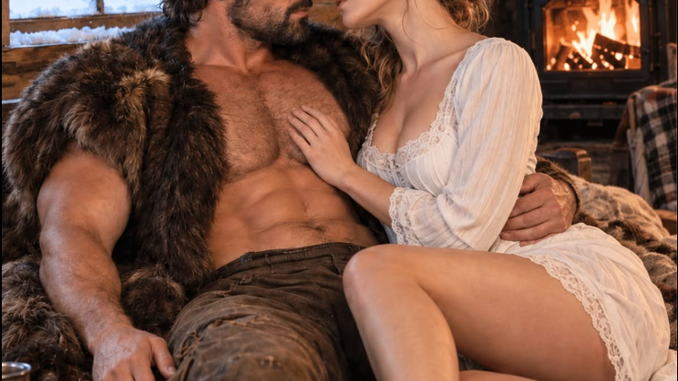
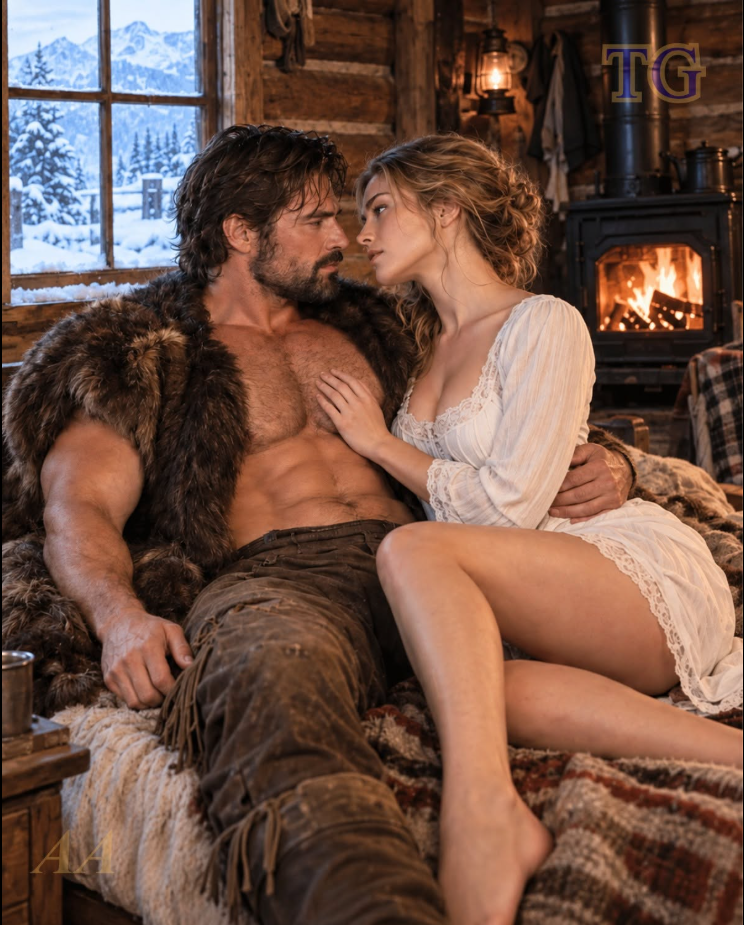
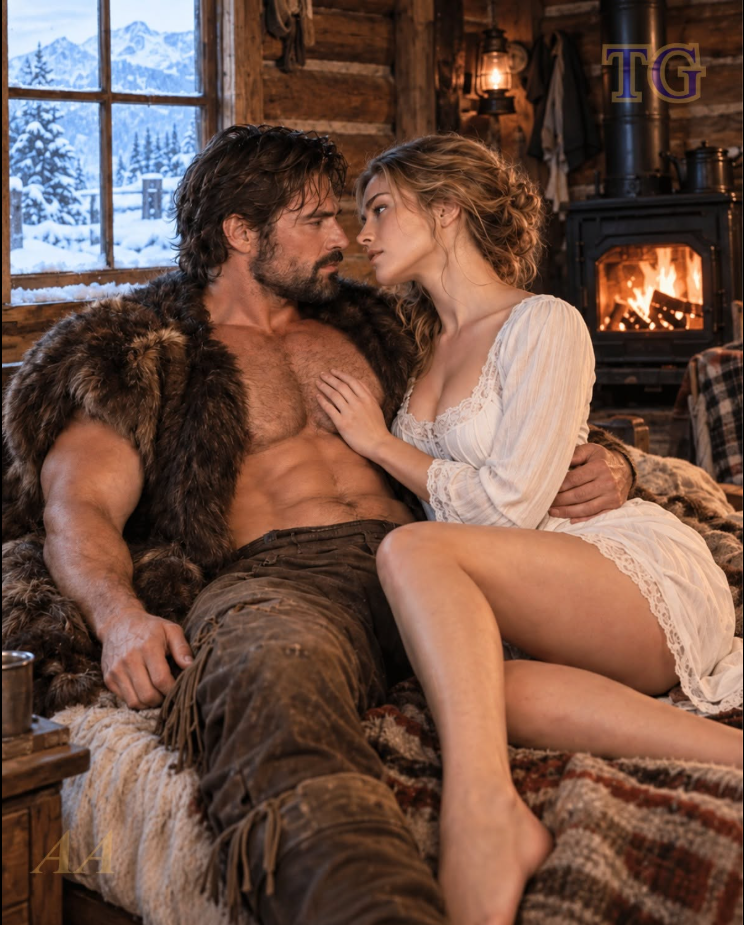
By the time she found his cabin, her legs were shaking. Then the door opened, and she forgot the cold entirely. Ezra was enormous—broad shoulders, dark beard, weathered face, the body of a man who wrestled winters for a living—and his right sleeve ended below the elbow, folded and pinned where an arm should have been. Yet the strangest thing about him was not his size or the missing limb; it was the way this giant of a man looked at her as though she were the dangerous one.
“You’re Tamson,” he said.
“You’re Ezra.”
That was nearly their entire courtship.
Inside, the cabin was rough but warm. There was elk stew on the stove, enough chopped wood to survive a siege, a sleepy dog beside the hearth—and one bed. Tamson noticed the bed immediately. Ezra noticed her noticing it, immediately looked somewhere else, and suddenly became deeply interested in absolutely everything that was not his new wife.
They ate in a silence that should have frightened her. Instead, Tamson slowly realized Ezra’s silence contained no threat. He did not slam things, demand things, drink, boast, or stare at her body as if marriage had turned her into property. When she told him she could cook, mend clothes, and work hard enough not to become a burden, something almost wounded crossed his face.
“I didn’t ask for a hired hand,” he said. “I asked for a wife.”
That word followed her into the night.
By eight o’clock, Tamson sat on the bed in her nightgown while Ezra remained beside the fire sharpening a knife that had been sharp twenty minutes earlier. Finally she could stand the waiting no longer. She told him it was late. He offered to sleep on the floor.
Tamson stared at him.
They were married. She had crossed half a country and three miles of snow. She had spent years surviving a husband who never asked what she wanted, and she refused to spend another night pretending the unspoken did not exist. So she looked straight at this giant mountain man and asked the question that nearly stopped his heart.
“Can you make tonight good for me?”
Ezra froze.
Not hesitated. Froze.
Tamson pressed harder, asking whether he actually knew what he was doing. The color vanished from his face. His hand opened and closed uselessly at his side, and the terrifying mountain hermit suddenly looked like a boy standing before a firing squad.
“I don’t know how,” he finally whispered.
Tamson misunderstood at first.
Then Ezra admitted the truth.
He had never been with a woman.
He was thirty-three years old, built like a grizzly, scarred by war, capable of facing blizzards and mountain lions without blinking—and completely inexperienced. Years earlier, before the war took his arm, he had been engaged to a woman named Varity Caldwell. When she saw what remained of his wounded arm, she left on the morning train and reportedly told her sister that Ezra looked like something from a nightmare.
After that, Ezra stopped trying.
He stopped believing tenderness belonged in his life.
Tamson felt something inside her crack. She had expected appetite, entitlement, perhaps awkwardness. She had not expected fear—the fear of a powerful man terrified that his strength might hurt her.
When Ezra realized someone had hurt Tamson before, his expression changed.
“My husband,” she admitted. “He’s dead.”
Ezra’s jaw tightened.
“Then he’s lucky he’s already in the ground.”
For the first time in years, those words did not frighten her.
Tamson invited him to sit beside her. What followed was not a transaction and not the ugly bargain she had prepared herself to endure. It was careful, hesitant, imperfect, and unexpectedly tender. She guided him; he listened. Neither pretended not to be afraid, and when the cabin finally went dark, Tamson stared at the ceiling beams above them and realized something extraordinary.
She was not counting them.
Morning brought an even stranger sight: Ezra had apparently dealt with his embarrassment by chopping enough firewood to survive several winters. When Tamson told him she was not leaving, relief visibly emptied his shoulders. Then she laughed—really laughed—and the shy smile that appeared beneath his beard made him look ten years younger.
Days became a rhythm. They ruined bread together. She taught him to read and write more confidently. He showed her the mountain. When cougar tracks appeared near the trail, he stepped between Tamson and danger, but carefully explained that he was doing so because he had the rifle—not because he believed she was helpless.
At night, she discovered Ezra carried his own ghosts. War still dragged him back into nightmares where he was twenty years old again, bleeding in a field and calling for men who had been dead for years. Tamson did not wake him with sudden hands. She stayed close, spoke his name, and waited until the mountain returned to his eyes.
“My ghosts followed me here,” he confessed.
“So did mine,” she answered.
For a few brief days, two wounded strangers began building something neither had expected.
Then a letter arrived from St. Louis.
Tamson recognized the name before she opened it: Cyrus Colton, her dead husband’s older brother.
Cyrus claimed Elias had borrowed $200 before his death and that Tamson, as the widow, was responsible. She knew immediately something was wrong. Cyrus had ignored her when Elias died. He had never offered food, burial money, or even condolences.
Why cross hundreds of miles now for $200?
Tamson had an answer she was afraid to tell Ezra.
Hidden at the bottom of her trunk was an old land deed Elias had won in a drunken card game. He had tossed it at Tamson as a joke, calling the worthless Wyoming parcel her “dowry.” She had kept it for no reason beyond the fact that it was one of the few things Elias ever gave her without pain attached.
Ten days later, Cyrus himself rode onto Ezra’s property.
He brought an armed witness and a document bearing Elias’s supposed signature. The debt, Cyrus said, could disappear instantly if Tamson surrendered that “worthless” parcel of land.
That was the moment she knew.
The debt was a lie.
Ezra knew something else.
He studied the deed and recognized the creek running through the property. Prospectors had found traces of mineral there the previous spring. Rumors in Sable Forks suggested something much larger lay beneath the rock.
Silver.
Suddenly a forgotten card-game prize was worth enough to bring Cyrus through a Wyoming winter.
“He’s not here to collect a debt,” Tamson whispered.
Ezra’s eyes hardened.
“He’s here to steal a mountain.”
They rode to Sable Forks after a savage storm and found surveyor Thaddeus Boon, who compared Cyrus’s note against genuine examples of Elias’s handwriting. His conclusion was immediate: the signature had been traced. Forged.
Even better, Boon confirmed that Tamson’s creek contained mineral color.
They finally had proof.
But when they rode past the saloon afterward, Cyrus was waiting on the boardwalk.
He watched them with the stillness of a man whose plan had just changed.
And two nights later, long after midnight, Ezra’s dog suddenly stood beside the hearth and began growling at the darkness.
Hooves were coming up the mountain.
Several horses.
Fast.
Ezra sat upright.
Then the cabin door exploded inward.
Three armed men poured through the opening.
Ezra moved before Tamson could scream. With one arm, he drove the first attacker into the washbasin and sent another crashing into the wall. For one impossible second, it looked as though the giant mountain man might actually defeat all three.
Then a boot smashed behind his knee.
Ezra fell.
A rifle stock struck his skull.
Blood ran into his beard.
A man planted his boot between Ezra’s shoulders and pinned him to his own floor while Cyrus seized Tamson by the arm.
“You’re signing that deed before sunrise,” Cyrus said. “Or my men stop being patient.”
Tamson looked back.
Ezra pushed himself onto one elbow despite the boot grinding into his spine. Blood covered half his face, but his gray eyes never left hers.
There was a promise in them.
He was coming.
And Cyrus had just made the worst mistake of his life.
PART 2 — They Dragged His Bride Away at Gunpoint… Then She Heard the Name Ezra Never Expected
Tamson agreed to sign only because Cyrus’s men were still standing over Ezra. They dragged her barefoot into the snow, bound her wrists, put her on a horse, and rode toward Sable Forks beneath a moonless sky. Behind her, the broken cabin disappeared among the pines, but the final image burned into her mind: Ezra bleeding on the floor, forcing himself upward while three armed men tried to keep him down.
Cyrus believed fear would make her obedient. He had chosen the wrong widow. Tamson had survived Elias by learning to listen when cruel men assumed she was too frightened to think. So during the ride, she listened. She memorized directions, names, arguments, every careless sentence Cyrus and his men let fall into the darkness.
The more they talked, the clearer the scheme became: Cyrus needed her signature before a judge could examine the forged debt, because once the court saw the evidence, his entire claim could collapse. Then one of the gunmen said something he was never supposed to say. “Coldwell’s going to want her handled quiet.”
Tamson’s head snapped up. Coldwell. She knew that name. Ezra had whispered it during their first night together. Varity Caldwell. The woman who had once promised to marry Ezra, saw his missing arm, and fled on a morning train. Tamson confronted Cyrus, and his silence answered before his mouth did.
Finally, with nowhere left to hide the truth, he admitted that Varity had married a mineral buyer. News of Ezra’s marriage had reached her, along with rumors about Tamson’s land and the silver beneath it. Varity had supplied money behind the scheme. Cyrus supplied the forged debt, the muscle, and the legal pressure.
Tamson felt the entire story turn upside down. Greed had started the fight. But jealousy had helped finance it. Years after abandoning Ezra, Varity apparently could not bear hearing that another woman had walked into his lonely cabin and discovered the man she had thrown away. Meanwhile, Ezra was not lying helpless on his floor.
The moment Cyrus’s men left, he forced himself upright. His head was bleeding, his balance was failing, but the thought of Tamson riding through the darkness with the men who had broken into their home burned through every other sensation. He saddled a horse and started down the mountain.
He did not ride alone for long. The commotion brought help, and word traveled toward Sable Forks. The sheriff began asking questions. Boon already knew about the forgery. Cyrus thought he was dragging a defenseless woman toward a forced signature. In reality, every mile was carrying him closer to witnesses.
Inside town, Tamson was taken to a back room where papers waited on a table. Cyrus placed a pen before her and told her that one signature would end everything. Tamson picked it up. Cyrus smiled. Then she looked at the deed. At the blank line. At the man who believed he had finally won.
And she slowly put the pen back down. “No.” Cyrus’s smile disappeared. Outside, somewhere beyond the walls, a horse came thundering down the frozen street. Then another. Then someone shouted Ezra Garrick’s name. Tamson turned toward the door just as Cyrus reached inside his coat.
But what happened when that door opened—and what evidence was about to expose the person behind Cyrus—would change far more than ownership of one silver claim. If you are ready for the ending, comment “SILVER”. Because the silver was valuable—but the secret hidden behind the money was about to cost Cyrus everything.
Để lại một phản hồi