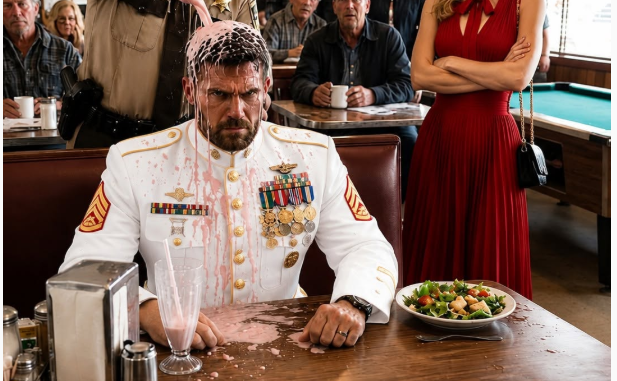
Chapter 1 – The Weight of a Quiet LifeThe heavy, humid scent of fried grease and stale coffee inside the Rusty Spur Diner usually brought a sense of rural normalcy to my afternoons, but today, that atmosphere had shattered into a million sticky fragments of strawberry syrup.
I sat motionless in the scarred wooden booth, feeling the cold, viscous pink liquid slowly drip from my eyebrows, trace the bridge of my nose, and soak into the collar of my flannel shirt. Across the table, the empty glass clinked against a ceramic coffee mug where Sheriff Travis Cole had slammed it down just seconds before.
The entire diner—twelve locals, two waitresses, and the fry cook peering through the kitchen window—had gone deathly, terrifyingly still. The only sound was the low, steady hum of the ancient neon sign flickering near the front door and the rhythmic drip-drop of strawberry syrup hitting the cracked linoleum floor.
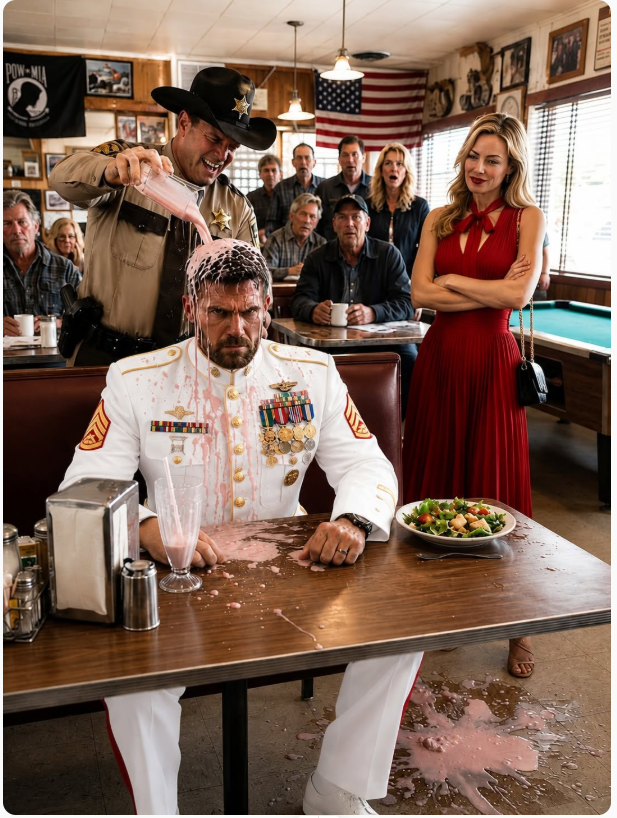
“Look at the town ghost,” Sheriff Cole sneered, his belt buckle gleaming beneath his heavy brass badge, his chest puffed out like a bantam rooster high on petty tyranny. “Doesn’t even have the stomach to wipe his own face.”
A few nervous, sycophant chuckles rippled from the corner booth where the county clerk and a couple of land speculators sat. That was how bullies operated in towns like this—they manufactured an audience, forced everyone into complicity through intimidation, and tested the waters to see who would stand and who would crawl.
I didn’t blink. I didn’t reach for a napkin. I didn’t tense my shoulders.
My eyes shifted slowly across the table to my wife.
Rachel sat by the window, her fingers clutching her leather purse so tightly her knuckles were stark white. Her untouched house salad sat wilted beneath a layer of warm dressing. She wasn’t looking at the sheriff, and she wasn’t looking at the sticky pink mess dripping down my face.
She was looking down at her lap, her cheeks burning with a hot, miserable flush of shame.
“Ethan,” she whispered, her voice trembling with a quiet, pleading desperation as she refused to meet my eyes. “Please… don’t make a scene. Just… let it go.”
That single sentence cut deeper, sharper, and more permanently than any glass of ice-cold syrup ever could.
For fourteen years, my name wasn’t Ethan Hayes, local auto mechanic and quiet neighbor. For fourteen years, I answered to Commander Hayes, leading Tier-1 operators through black sites, hostile jungles, and combat zones where hesitation meant immediate death. I had made split-second decisions that protected national security, neutralized high-value targets, and kept men alive in the darkest corners of the earth.
When I retired three years ago, my body was riddled with old shrapnel scars, and my mind was heavy with the ghosts of fallen brothers. I traded the tactical satellite uplinks, the encrypted frequencies, and the constant roar of war for the crisp mountain air and quiet pine forests of rural Montana.
I did it for peace.
I did it for her.
I wanted a home where the loudest sound was the wind through the pines and where my only daily battle was diagnosing a stubborn diesel alternator.
Instead, over the last three years, as the isolation of the small town set in and the local economy tightened its grip, I had watched myself slowly shrink in my wife’s eyes. To Rachel, the man who once commanded elite operators had become nothing more than the quiet, dusty mechanic who smelled of motor oil—a man who let the local good-old-boy sheriff push him around because he lacked the stomach to fight back.
Sheriff Cole stepped closer, invading my personal space, reeking cheap bourbon and stale tobacco.
“You got something to say, mechanic?” Cole taunted, leaning his weight onto his left hip. “Or are you just going to sit there looking like a strawberry sundae?”
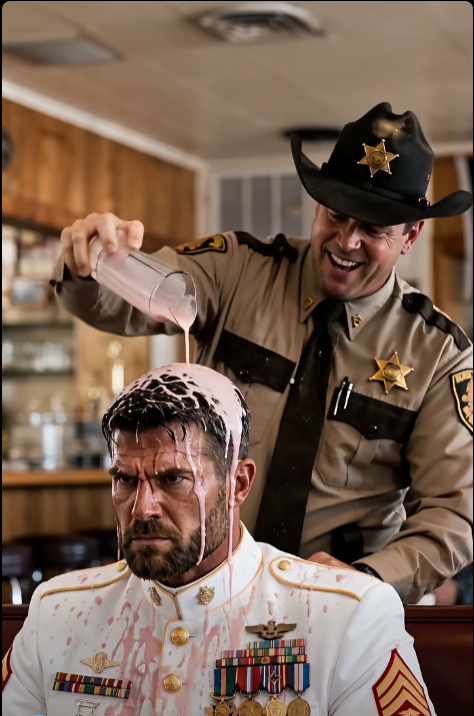
My hands rested calmly, palms down, flat against the wooden bench under the table.
Muscle memory—forged through thousands of hours of close-quarters combat training—kicked in automatically, operating entirely independent of my conscious mind.
Target analysis: Height, six-foot-one. Weight, roughly two-twenty. Left knee favoring an old meniscus tear—probably from high school football. Right shoulder rotating slower than the left, indicating a previous rotator cuff impingement. Sidearm—a Sig P320 service pistol—riding too high in a cheap leather retention holster, completely obstructed by his heavy winter jacket if he needed a fast draw.
Every single structural weakness and tactical vulnerability registered in my brain in less than eight tenths of a second.
One swift strike to his laryngeal prominence, a sweep of his bad knee, and a disarm maneuver would have put the sheriff flat on his back, gasping for air against the cracked linoleum, before he even realized his feet had left the floor.
It would have taken three seconds.
The diner would have erupted in chaos. The illusion of his small-town invincibility would have evaporated instantly.
But I didn’t move.
War teaches you many things, but the most important lesson—the one that separates elite operators from common street thugs—is that violence is never an emotional outlet. It is a scalpel. It is the absolute last tool in the kit, reserved only when all other options have been systematically exhausted.
Patience, discipline, and absolute control destroy enemies far more completely than a sudden outburst of rage. Let a wolf think he’s cornered a sheep, and he’ll expose every member of his pack before the night is over.
Slowly, deliberately, I picked up a paper napkin from the dispenser and wiped a streak of pink syrup from my eyebrow.
“No,” I said quietly, my voice level, smooth, and entirely devoid of anger. “I’m done eating.”
Sheriff Cole flashed a wide, arrogant grin, puffed out his chest, and chuckled, basking in the silent approval of the terrified diners. He thought he had broken me. He thought he had cemented his status as the undisputed king of this county.
Rachel stood up so abruptly her chair scraped loudly against the floor.
“I’ll wait in the truck,” she said flatly, her voice cold and distant. She wouldn’t even look at me. “Try not to embarrass me any more than you already have.”
She turned on her heel and walked past the sheriff, keeping her head down.
And then, as she brushed past Sheriff Cole’s shoulder toward the exit door, I saw it.
It was so small, so quick, that ninety-nine people out of a hundred would have missed it entirely.
Sheriff Cole didn’t step back to let her pass. Instead, as she went by, his right hand twitched, and he gave her the tiniest, almost imperceptible downward nod of his chin.
A confirmation. A signal between co-conspirators.
And Rachel, without breaking her stride, lowered her eyes instantly in response.
Not in surprise. Not in accidental acknowledgment.
In recognition.
The air rushed out of my lungs as if I’d taken a rifle butt to the solar plexus. In one blinding, sickening flash, my entire world shifted on its axis.
That public humiliation with the milkshake wasn’t just a random act of drunken small-town bullying. It wasn’t just Cole asserting his dominance over the quiet mechanic.
It was a performance.
A theatrical display designed to push me to the absolute brink, to humiliate me publicly, and to drive a permanent wedge between me and my wife.
And my own wife wasn’t just a bystander caught in the crossfire.
She was part of it.
I pushed myself up from the booth, leaving the sticky syrup dripping down my flannel shirt, and walked slowly out into the biting, freezing Montana air.
Rachel was already sitting in the passenger seat of our truck, her eyes glued to the glowing screen of her smartphone, her thumbs moving at lightning speed. She didn’t look up when I opened the door. She didn’t ask if I was okay. She didn’t offer a tissue, an apology, or a shred of comfort.
I stood outside the driver’s side door for a long, silent moment, looking out over the snow-dusted peaks of the Rockies while the puzzle pieces of the last six months snapped violently into place.
The mysterious “town council meetings” that kept Rachel away until past midnight.
The sudden, chilling emotional distance that had grown between us, as if she were waiting for me to pack my bags and leave.
The way Sheriff Cole always seemed to show up at our property whenever I was out running parts, his cruiser parked near our side gate, his attitude far too familiar for a local law enforcement officer visiting a constituent.
The entire picture was crystal clear.
I opened the driver’s side door, slid behind the wheel, and reached into the locked center console. My fingers punched in a four-digit mechanical combination—not the one for our house keys, but the secure code for the hidden compartment lining the bottom of the console box.
I pulled out a heavy, matte-black satellite communications device—a military-grade iridium transceiver that had no business being in rural Montana.
From the passenger seat, Rachel let out a sharp, audible gasp. The color drained entirely from her face, leaving her skin the gray-white of skim milk.
“Who… who are you calling?” she stammered, her voice pitching upward in sudden, unadulterated panic.
I raised the device, extended the miniature signal antenna toward the open window, and thumbed the secure activation sequence.
“JAG,” I said into the encrypted mic. “This is Commander Ethan Hayes, retired Tier-1. I am formally requesting immediate federal legal intervention, investigative audit, and military oversight regarding a sitting county sheriff and local municipal officials involved in active federal corruption, extortion, and treasonous conspiracy.”
Rachel stopped breathing.
In that single second, the illusion shattered. She looked at me—really looked at me—and realized with terrifying clarity that the quiet, broken-down mechanic she had stopped respecting, patronized, and betrayed was never just a mechanic.
And Sheriff Travis Cole, sitting smugly in the Rusty Spur Diner believing he owned the county, had just stepped onto a landmine with his foot firmly pressed down on the trigger.
Để lại một phản hồi