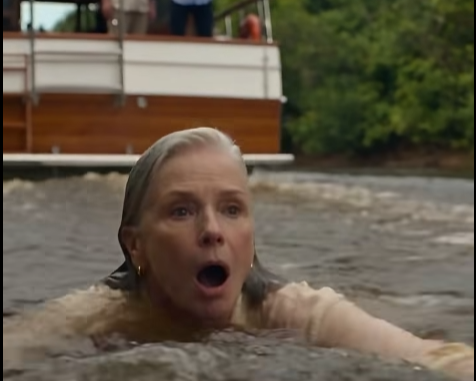
My own son pushed me off a boat into the Amazon River, and my husband of forty-six years stood there watching me drown.
I was seventy-two years old.
The two men I had loved more than anyone in the world had just decided that my life was worth less than the money I would leave behind.
And as their boat began pulling away, my son looked back at me, smiled, and said the words I would remember until my dying day.
“It’s over, Mom.”
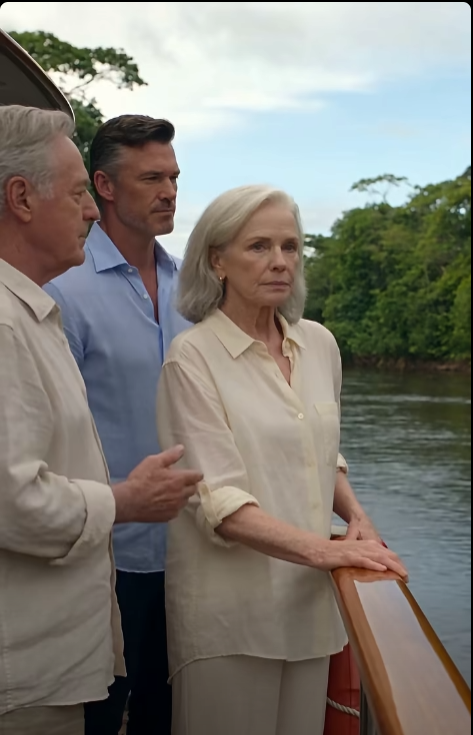
For one terrible moment, I believed him.
The river was warm, brown, and impossibly powerful. My dress tangled around my legs as I struggled to keep my head above the surface. My right ankle had struck something hard when I fell, and every attempt to kick sent a sharp pain through my entire leg.
I swallowed a mouthful of muddy water.
Then another.
Above the roar of the cruiser’s engine, I screamed my son’s name.
“Julian!”
He stood near the back of the boat, one hand resting on the polished railing.
“Julian, please! Help me!”
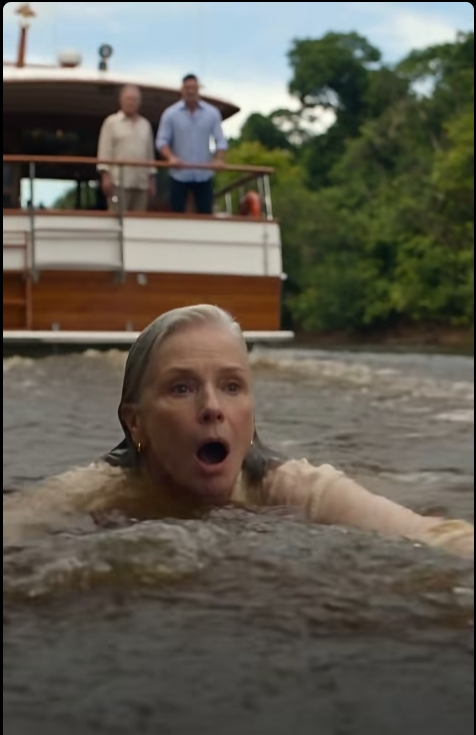
My husband, Richard, stood beside him.
I could see both of them clearly.
That was the part I would never be able to forget.
They were not looking away because they couldn’t bear to witness my suffering. They were looking directly at me.
Watching.
Waiting.
My daughter-in-law, Celeste, remained beneath the canopy, her pale dress moving gently in the river breeze.
For one desperate second, I thought she might help.
She took a small step forward.
Then Julian turned toward her.
I couldn’t hear what he said, but I saw her stop.
She pressed a hand against her mouth.
And did nothing.
“Richard!”
I tried to raise one arm above the water.
“Richard, please!”
My husband of forty-six years stared at me without moving.
I remembered that same face leaning over me in a hospital room when Julian was born.
I remembered his tears when the doctor placed our son in his arms.
I remembered the nights we had slept on a mattress on the floor because we couldn’t afford a bed frame, and how Richard had promised that whatever happened, we would always face the world together.
Now he stood on a beautiful private boat while his wife drowned.
And he did not even reach for a life ring.
The engine grew louder.
The cruiser began turning away.
“No!”
My voice cracked.
“Don’t leave me!”
Julian glanced back one final time.
There was no panic in his expression.
No confusion.
Not even the slightest trace of regret.
Then the boat disappeared around a bend in the river.
I was alone.
For several seconds, I did nothing but fight to breathe.
The water pulled me downstream, carrying branches, leaves, and pieces of debris past my face. I tried kicking with my left leg while keeping my injured right ankle still, but the current twisted me sideways.
Somewhere beneath the surface, something brushed against my calf.
I screamed.
It might have been a branch.
It might have been a fish.
I would never know.
All I knew was that I had to reach the bank.
I could see a wall of dense green vegetation perhaps thirty feet away. The distance looked small from the boat, but in the water it might as well have been a mile.
I had never been a strong swimmer.
At seventy-two, I was certainly not getting stronger.
But I had spent fifty years refusing to surrender when the odds were against me.
I had built a company through recessions, strikes, financial disasters, and decisions that would have frightened people half my age.
I had survived things I once believed would destroy me.
And I was not going to let my son decide when my life ended.
Not if I could help it.
I pulled myself forward with both arms.
One stroke.
Then another.
My injured ankle dragged beneath me.
My dress felt like a weight pulling me toward the riverbed.
When I finally reached the muddy bank, my fingers sank into wet soil.
I tried climbing out.
The mud collapsed.
I slipped backward, scraping my palm against a submerged branch.
Blood spread into the water.
I grabbed again.
Another handful of mud broke apart.
I nearly went under.
“Please,” I whispered.
I didn’t know whether I was speaking to God, to the river, or to the woman I had once been.
“Please, not like this.”
Then I saw a thick root protruding from the bank.
I lunged toward it.
My fingers closed around the rough wood.
I held on.
For several moments, I could only hang there, gasping.
Then I pulled.
The effort sent pain shooting through my shoulder.
I pulled again.
My chest rose onto the bank.
Then my stomach.
Finally, with one last desperate movement, I dragged my legs from the river.
I lay face down in the mud.
I was alive.
I didn’t know how long that would remain true.
Rain began falling through the canopy, first in scattered drops and then in heavy sheets.
Within minutes, my dress was soaked again.
My body shook uncontrollably.
I rolled onto my back and stared through the trees at a narrow patch of gray sky.
And for the first time since Julian had pushed me, I understood something that frightened me more than the river.
This had not been an accident.
My family had planned to kill me.
They had chosen the location.
They had removed the guide.
They had taken me far from the lodge.
And they had left me where they believed no one would ever find my body.
My name is Eleanor Thorne.
For most of my adult life, people knew me as the founder and chief executive officer of Thorne Meridian, an international logistics company worth approximately two billion dollars.
We operated shipping terminals, freight networks, warehouses, and transportation services across several continents.
More than eleven thousand people depended on the company for their livelihoods.
But before I became a wealthy businesswoman, I was a young wife with a secondhand desk, a borrowed telephone, and a stubborn belief that I could build something worthwhile.
Richard had been there in those early days.
That was why his betrayal hurt in a way I could barely comprehend.
When I started the business, I was twenty-two.
We had been married less than a year.
I worked from a rented office above an auto repair shop, arranging regional shipments for manufacturers who couldn’t afford the major freight companies.
I kept paper records in cardboard boxes.
I answered the telephone myself.
On evenings when there wasn’t enough money for both groceries and office supplies, I bought the supplies.
Richard used to bring me sandwiches after his shift at work.
He would sit across from my desk, loosen his tie, and tell me how proud he was.
“One day,” he said, “you’re going to build something enormous.”
I would laugh.
“Something enormous enough to buy a refrigerator that doesn’t leak?”
“Much bigger than that.”
Then he would take my hand.
“And I’ll be right beside you.”
For years, he was.
When Julian was born, Richard insisted that we were the luckiest people alive.
Our son grew up in a home filled with books, business discussions, and parents who believed hard work could open almost any door.
I never wanted him to experience the financial uncertainty we had known.
Perhaps that was my first mistake.
I gave him opportunities I had never possessed.
Private schools.
International travel.
The best university education money could buy.
When he decided to join Thorne Meridian at thirty-three, I welcomed him.
I imagined that one day he might lead the company.
But I wanted him to understand it first.
I asked him to spend time in operations, learn how shipments were coordinated, visit warehouses, speak with employees, and study the financial realities of the business.
Julian hated it.
He believed those assignments were beneath him.
“Mom, I’m your son,” he told me during his first year. “Why are you treating me like some entry-level employee?”
“Because the people working in those warehouses deserve a leader who understands their jobs.”
He rolled his eyes.
“I know how business works.”
“Then learning more shouldn’t frighten you.”
He didn’t answer.
Over the next seventeen years, he moved through several positions.
He was intelligent, charming, and capable of impressing people during meetings.
But whenever a project went badly, someone else was responsible.
A delayed shipment was the operations manager’s fault.
A failed negotiation was the legal department’s fault.
A missed deadline was caused by employees who supposedly didn’t understand his vision.
I hoped maturity would change him.
Instead, the older he grew, the more convinced he became that the company belonged to him.
Three months before our trip to the Amazon, I appointed Naomi Chen to oversee a major expansion project.
Naomi had worked beside me for twenty-six years.
She understood the company better than almost anyone.
She had guided us through financial crises, difficult acquisitions, and international negotiations that could have ruined us if handled badly.
She earned that responsibility.
Julian saw it as humiliation.
He stormed into my office without knocking.
“You’re doing this deliberately.”
I looked up from a contract.
“Good afternoon to you, too.”
“Don’t pretend you don’t know what I’m talking about.”
“Sit down, Julian.”
“I don’t want to sit down.”
“Then speak calmly while standing.”
His face turned red.
“Naomi? You gave Naomi the expansion project?”
“Yes.”
“After everything I’ve done for this company?”
I closed the contract.
“Julian, this is a complex project. Naomi has the experience it requires.”
“And I don’t?”
“Not for this assignment.”
He stared at me.
“Say what you really mean.”
“I just did.”
“No. What you really mean is that I’ll never be good enough.”
I sighed.
“You’re fifty years old. We should be able to discuss professional decisions without turning them into personal attacks.”
That seemed to make him angrier.
“You’ve been grooming Naomi to replace you.”
“I’m preparing the company for a future when I won’t be here.”
“And what am I supposed to do? Watch a stranger take everything that belongs to my family?”
“Naomi isn’t a stranger.”
“She’s not a Thorne.”
I stood.
“Neither are eleven thousand of our employees. Their futures matter, too.”
Julian laughed bitterly.
“You always have a speech ready.”
“This isn’t a speech. It’s my responsibility.”
He approached my desk.
For a moment, I saw an expression I did not recognize.
It wasn’t ordinary anger.
It was something colder.
“You won’t live forever, Mother.”
The words silenced the room.
I looked at him.
“What did you say?”
He held my gaze.
“One day you’ll have to let go.”
Then he walked out.
I told myself he had spoken out of frustration.
I wanted to believe that.
Richard certainly encouraged me to.
That evening, when I described the argument, my husband barely looked up from his drink.
“He’s right about one thing.”
“What?”
“You can’t run the company forever.”
“I know that.”
“Then why not give him what he wants?”
“Because he isn’t ready.”
Richard set down his glass.
“He’s your son, Eleanor.”
“That doesn’t make him qualified.”
“Sometimes I think you care more about that company than your own family.”
The accusation wounded me.
Everything I had built was supposed to benefit our family.
But Richard had begun treating my professional judgment as evidence that I didn’t love our son.
Over the following weeks, the tension worsened.
Julian became distant.
Richard became increasingly impatient whenever I mentioned work.
Celeste, who usually filled silences with conversation, started watching me with an odd, guarded expression.
At the time, I thought she was tired of family arguments.
Now I wondered how much she had known.
Two weeks before our vacation, Richard and I were sitting on the terrace after dinner.
Julian had left following another argument about succession.
Richard watched the garden lights flicker on.
“Maybe the company would be better off if the decision were taken out of your hands.”
I turned toward him.
“What decision?”
“Retirement.”
“What do you mean, taken out of my hands?”
He shrugged.
“Eleanor, you’re seventy-two. Nature eventually makes these decisions for everyone.”
Something about his tone made me uncomfortable.
“That’s a dreadful thing to say.”
He smiled.
“Don’t be so sensitive. I’m talking about growing old.”
I looked at him for a long moment.
Then he leaned over and kissed my forehead.
“We need a vacation,” he said. “Somewhere neither of us has to think about business.”
A week later, he proposed the Amazon.
He knew I had always dreamed of seeing the rainforest.
He arranged the lodge, the travel, and the private excursions.
When Julian and Celeste agreed to join us, I felt genuine hope.
Perhaps spending time together without board meetings or arguments would remind us that we were a family before we were anything else.
On the morning of the boat trip, that hope was still alive.
We ate breakfast on an open terrace overlooking the river.
Bright birds called from the trees.
Mist drifted over the water.
Julian was unusually cheerful.
He asked whether I had slept well.
He brought me coffee.
He even apologized for our recent disagreements.
“I’ve been difficult,” he admitted.
I smiled.
“We’ve both been stubborn.”
He shook his head.
“No, Mom. You’ve earned everything you have.”
I remember feeling tears gather in my eyes.
“Thank you, sweetheart.”
He reached across the table and squeezed my hand.
I had no idea those same hands would push me into the river.
A short time later, I saw Julian speaking privately with Mateus, our regular guide.
He handed the younger man a folded bundle of money.
Mateus looked uncomfortable.
When he noticed me watching, he quickly lowered his eyes.
I walked over.
“Is something wrong?”
Julian laughed.
“Nothing. I gave Mateus the afternoon off.”
“Why?”
“Because I thought we could have one excursion without a stranger listening to every conversation.”
Mateus opened his mouth.
Then closed it.
I looked at him.
“Are you comfortable with that?”
He hesitated.
“Madam, the river is not always predictable.”
Julian clapped a hand on his shoulder.
“We’ll be careful.”
Richard joined us.
“Come on, Eleanor. It’s a simple boat ride.”
I wanted to object.
But I was tired of being the difficult one.
So I agreed.
That decision nearly cost me my life.
Hours later, lying injured beneath the trees, I remembered the expression on Mateus’s face.
He had been trying to tell me something.
And I hadn’t listened.
Thunder rolled above the forest.
I pushed myself upright.
The pain in my ankle was severe.
It had swollen beneath the hem of my dress, and my right shoe was missing.
My left palm was bleeding.
I had no phone.
No drinking water.
No idea how far we were from the lodge.
And no certainty that the people who wanted me dead would stop looking for an opportunity to finish what they had started.
But I remembered one important detail from an earlier excursion.
Mateus had pointed out an abandoned government survey route through the forest.
He said the old trail was marked by faded red metal signs nailed to trees.
Eventually, it reached a gravel access road connected to the lodge’s service route.
I didn’t know whether I could find it.
I didn’t even know whether I could walk.
But remaining beside the river meant waiting for death.
I tore strips from the bottom of my dress and wrapped them tightly around my injured ankle.
Then I tied another strip around my bleeding hand.
I grabbed a fallen branch to use as a walking stick.
And I stood.
The pain was so intense that my vision blurred.
I nearly collapsed.
I held onto a tree until the dizziness passed.
Then I took one step.
And another.
Behind me, the river continued flowing as though nothing had happened.
I thought of Julian returning to the lodge.
I imagined him telling the staff that his mother had slipped.
I imagined Richard standing beside him, shaking his head sadly.
I imagined Celeste pretending to cry.
And I realized that by tomorrow morning, they might already be preparing statements about my tragic death.
My son would probably be thinking about my office.
My husband would be thinking about my estate.
But neither of them knew one crucial thing.
I was still alive.
And I intended to stay that way.
I entered the rainforest.
What happened next would determine whether my family got away with murder—or whether I would live long enough to make them answer for what they had done.
Để lại một phản hồi