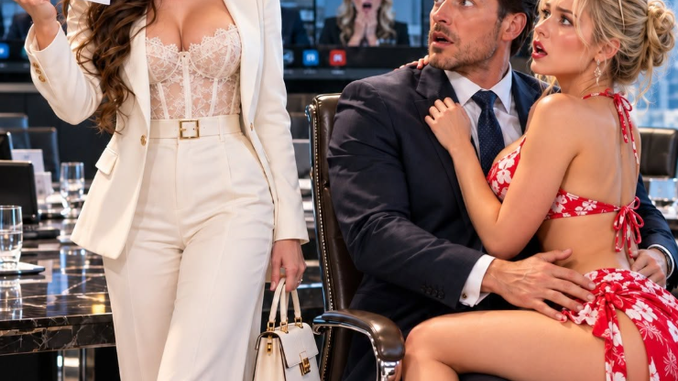
wearing the $110,000 diamond necklace he’d refused to buy me because I supposedly “didn’t earn my own money.”
Flynn thought the affair becoming public was his biggest disaster, but that night I opened a folder my late father had left me and discovered something my husband had never bothered to learn: the company bearing his family name wasn’t entirely his.
“Darling, you forgot to end the call.”

Flynn spun toward his laptop.
Thirty faces stared back.
Selina jumped from his lap, fastening her blouse.
But I couldn’t stop looking at her necklace.
Two months earlier, I’d shown Flynn that exact piece in a Beacon Hill jewelry store.
He’d laughed at the $110,000 price.
“You don’t work anymore, Mabel.
What would you need that for?”

That same week, he’d lectured me about our mortgage while I stretched $1,800 across groceries, school expenses, clothes, and everything our five-year-old daughter needed.
Now Selina was wearing it.
“What are you doing here?”
Flynn snapped.
I lifted the dinner bag in my hand.
“You said you’d be working late.”
“Mabel, this isn’t what it looks like.”
“She was sitting on your lap.”
“It was an accident.”
I almost laughed.
“And the necklace?”
“A performance bonus.”
“Your assistant gets a $110,000 bonus while your wife and daughter live on $1,800 a month?”
Selina stepped closer.
“We’re only colleagues.”
“Does your job description include sitting on him?”
Flynn immediately moved between us.
“Enough.
Don’t humiliate her.”
That sentence ended something inside me.
“How long?”
Silence.
“Flynn.”
He finally looked away.
“Two years.”
Two years.
The affair had started the same year he’d convinced me to leave my financial consulting career.
“I’ll provide for you,” he’d promised.
Apparently, he’d meant barely.
I looked at Selina.
“Her apartment?”
Flynn froze.
“How much?”
“Thirty-two hundred a month.”
I nodded slowly.
Then I pointed toward his laptop.
“You should probably worry about something else.”
His face changed.
“The meeting.”
“Still connected.”
Thirty employees had watched everything.
But I wasn’t finished.
That night, after putting my daughter to bed, I opened the locked drawer containing documents my father had given me before he died.
I’d ignored them for three years.
One folder carried the name VANCE GLOBAL.
Inside was an old shareholder agreement.
My father had financed Flynn’s father during the company’s near-collapse twenty-one years earlier.
In return, he’d received a silent equity position.
I read the inheritance clause twice.
Then a third time.
When my father died, his shares had transferred to me.
Not Flynn.
Me.
I called the attorney whose number appeared on the final page.
“Mrs.
Vance,” he said after checking the records, “I’ve wondered when you’d call.”
My hand tightened around the phone.
“How much of the company do I own?”
He paused.
“Enough that your husband should have been much more careful about how he treated you.”
And suddenly, the necklace around Selina’s neck didn’t bother me anymore.
Because Flynn had purchased it with money from a company he didn’t realize his “worthless” wife could help take away from him.

The attorney was silent for so long that I thought the call had dropped.
“How much?”
I asked again.
Finally, he answered.
“Twenty-eight percent.”
I closed my eyes.
Twenty-eight percent.
It didn’t sound like much until I remembered what Vance Global had become.
A company valued at nearly eight hundred million dollars.
Twenty-eight percent meant more than two hundred million dollars.
But money wasn’t what made my hands shake.
It was the fact that Flynn had spent three years treating me like a dependent wife while quietly benefiting from an empire my father had helped create.
“Are you certain?”
I asked.
“I’ve been certain since the day your father died.”
“Then why didn’t anyone tell me?”
“Your father instructed us not to.”
“Why?”
“Because he believed you would eventually need to know.”
I looked toward the hallway.
My five-year-old daughter, Lily, was asleep in her room.
For three years, I’d believed my father had left me nothing except memories.
Flynn had told me the company belonged to his family.
He had told me my career was unnecessary.
He had told me that if I wanted to contribute to the household, I could simply be grateful.
And I had believed him.
“What exactly did my father leave me?”
The attorney took a breath.
“Twenty-eight percent voting shares in Vance Global Holdings, plus a controlling interest in the preferred class created during the 2005 restructuring.”
I sat down.
“Controlling?”
“Yes.”
“So why isn’t my name on the company records?”
“Because the shares were held in a private trust.”
“Whose trust?”
“Yours.”
I stared at the wall.
“Flynn doesn’t know?”
“No.”
“Does his father?”
“Your father made certain he didn’t.”
I laughed softly.
For the first time that night, the sound didn’t feel sad.
It felt dangerous.
“Mr.
Caldwell.”
“Yes?”
“Why did my father hide this from me?”
There was a pause.
“Because he knew Flynn.”
My smile disappeared.
“What does that mean?”
“He met your husband long before you married him.”
I sat completely still.
“My father knew Flynn?”
“Very well.”
“How?”
“Your father was one of the people who helped rescue Vance Global when Flynn’s father nearly lost it.”
I looked at the folder.
There were dozens of documents inside.
Loan agreements.
Share certificates.
Board minutes.
Private correspondence.
And one handwritten note from my father.
I hadn’t noticed it before.
It was folded beneath the shareholder agreement.
I opened it.
The handwriting was unmistakable.
Mabel,
If you’re reading this, something has happened that made you finally open the folder.
I hope I’m wrong about why.
My throat tightened.
I continued.
I didn’t give you these shares because I wanted you to control your husband.
I gave them to you because I wanted you to remember that you were never financially powerless.
I stopped reading.
My eyes filled with tears.
My father had known.
Not the affair.
Not Selina.
But he had known what Flynn might become.
I continued.
Your husband may one day convince you that your worth is measured by what you earn.
Don’t believe him.
Money is a tool.
It is not a measure of your value.
Then the final line made my breath catch.
And if he ever tells you that the company is his because it carries his family’s name, ask him who paid for the years when that name was almost worth nothing.
I folded the letter.
For the first time in three years, I understood why my father had insisted I keep his old office key.
Why he had refused to discuss Vance Global after Flynn and I married.
Why he’d looked at Flynn strangely during our wedding.
I had thought my father simply didn’t like him.
Maybe he had seen exactly who Flynn was becoming.
The next morning, Flynn acted as if nothing had happened.
He walked into the kitchen wearing a navy suit.
“Morning.”
I was making Lily’s breakfast.
“Morning.”
He kissed my cheek.
I didn’t move.
He noticed.
“What?”
“Nothing.”
He poured coffee.
“About last night…”
I kept cutting strawberries.
“We’ll talk later.”
“Mabel.”
“Lily is eating.”
Our daughter looked between us.
“Are you fighting?”
I smiled.
“No, sweetheart.”
Flynn smiled too.
“Mommy and Daddy are just tired.”
Lily nodded and went back to her cereal.
Flynn waited until she wasn’t looking.
“Selina made a mistake.”
I looked at him.
“She sat on your lap.”
“It was a joke.”
“For two years?”
His face tightened.
“You don’t understand the pressure I’ve been under.”
I laughed quietly.
“I’m sure.”
He leaned against the counter.
“Look, I know you’re upset.”
“I’m not upset.”
“You’re not?”
“No.”
That seemed to confuse him.
“What are you?”
I placed the knife down.
“Finished.”
His face changed.
“With what?”
“With being your wife.”
He stared at me.
Then laughed.
It wasn’t a genuine laugh.
It was the kind of laugh people use when reality doesn’t match what they believe they’re entitled to.
“You’re serious?”
“Yes.”
“You’re going to destroy our family because of one mistake?”
I looked at him.
“One mistake?”
He went silent.
“Two years isn’t a mistake, Flynn.”
“You don’t know what happened.”
“I know enough.”
He rubbed his forehead.
“Fine.
I made a mistake.”
“You made a choice.”
“I was lonely.”
“So was I.”
“You had Lily.”
I stared at him.
“And you had me.”
Silence.
Then he said something that changed everything.
“You’ve been living off me for three years.”
I felt strangely calm.
“I see.”
“What?”
“Nothing.”
He picked up his briefcase.
“I have to go.”
“Of course.”
He walked toward the door.
Then turned.
“Don’t do anything stupid.”
I smiled.
“You should take your own advice.”
He left.
I waited until his car disappeared.
Then I called Mr.
Caldwell.
“Good morning.”
“Good morning, Mrs.
Vance.”
“I need a meeting.”
“Today?”
“Yes.”
“I’ll arrange it.”
“And one more thing.”
“Yes?”
“Don’t contact Flynn.”
There was a pause.
“Understood.”
“Not yet.”
I looked at the folder.
“First, I want to know exactly what my father knew.”
The meeting took place in a private conference room at Caldwell & Pierce.
Mr.
Jonathan Caldwell was seventy-one.
He had represented my father for almost thirty years.
When I walked in, he stood.
For a moment, he simply looked at me.
“You look like him.”
“My father?”
“Yes.”
“People always say that.”
“He would have been proud of you.”
I looked down.
“I don’t feel very impressive right now.”
“You’ve just discovered that you own a quarter of one of Boston’s most powerful companies.”
“I also discovered my husband has been cheating on me for two years.”
Caldwell’s expression softened.
“Then perhaps the company is not the most important thing you discovered.”
I sat down.
“Tell me everything.”
He opened a thick file.
“Twenty-one years ago, your father loaned Flynn’s father twelve million dollars.”
“Twelve million?”
“At the time, Vance Global was nearly insolvent.”
“What did my father get in return?”
“Equity.”
“How much?”
“Thirty-five percent.”
I stared at him.
“Thirty-five?”
“Yes.”
“What happened to the other seven percent?”
“Your father eventually transferred it back to the Vance family when the company stabilized.”
“So he kept twenty-eight.”
“Exactly.”
“And when he died…”
“The twenty-eight percent passed to you.”
I leaned back.
“What about Flynn?”
“Flynn inherited his father’s personal holdings.”
“How much?”
“Fourteen percent.”
I frowned.
“Only fourteen?”
“His mother owns another nine.”
“So Flynn doesn’t control the company.”
“No.”
“Who does?”
Caldwell smiled slightly.
“That is complicated.”
“Explain.”
“Vance Global has three major shareholder groups.
Flynn’s family owns twenty-three percent collectively.
You own twenty-eight.
Several institutional investors own the rest.”
“So if I wanted to…”
“You could block major corporate actions.”
I stared at him.
“Could I remove Flynn?”
“If the board votes accordingly.”
“Could I force a sale?”
“With the preferred shares your father established, you have significant veto rights.”
I looked down.
“Does Flynn know?”
“No.”
“Does the board know?”
“Some do.”
“Who?”
“Your father’s former associates.”
“Why haven’t they told him?”
“Because your father specifically instructed them not to reveal your ownership unless you requested it.”
I shook my head.
“My father knew I might need protection.”
“He did.”
I looked at Caldwell.
“What else did he know about Flynn?”
Caldwell hesitated.
That hesitation told me everything.
“Tell me.”
“He didn’t trust him.”
“Why?”
“Because Flynn once asked your father for money.”
“How much?”
“Five million.”
“For what?”
“To expand a division that your father believed was fraudulent.”
I frowned.
“Fraudulent?”
“Not technically.
Aggressive accounting.”
“What happened?”
“Your father refused.”
“And Flynn?”
“He was angry.”
“How angry?”
“He told your father that one day Vance Global would belong to him.”
My stomach tightened.
“What did my father say?”
Caldwell smiled sadly.
“He told Flynn, ‘Then learn to deserve it.’”
I looked at the floor.
My father had known.
All along.
I didn’t go home immediately.
I went to my old office.
The one I had left when Flynn convinced me to quit consulting.
It was a tiny office in Boston overlooking the Charles River.
My name was still faintly visible on the glass.
MABEL CARTER — FINANCIAL STRATEGY
I stood outside for several minutes.
Three years ago, I had walked away from that office.
Flynn had told me:
“You don’t need a career anymore.”
I had believed marriage meant compromise.
I had thought staying home with Lily was the right choice.
It wasn’t the choice that hurt.
It was the fact that he had used my decision against me.
When I opened the door, dust covered the desk.
But my old computer was still there.
I turned it on.
Hundreds of files remained.
Financial models.
Consulting reports.
Investment analyses.
My old work.
I opened one.
Then another.
The woman staring back at me through those files felt unfamiliar.
Sharp.
Confident.
Independent.
I had forgotten her.
No.
Flynn had convinced me to forget her.
I sat down.
Then I started working.
By midnight, I had built a financial map of Vance Global.
I didn’t need to be an employee to understand the company.
I had spent fifteen years doing exactly this.
And within three hours, I found something that made my stomach turn.
Several subsidiaries had been moving money through consulting firms.
One of those firms was owned by a company registered to a Delaware trust.
The beneficial owner was hidden.
But the payment pattern was obvious.
Millions had flowed through it.
I followed the transactions.
Then I found the name.
S.B.
Strategic Advisory LLC.
S.B.
Selina Bennett.
I stared at the screen.
The $110,000 necklace wasn’t a bonus.
It was the smallest part of the story.
I printed everything.
Then I called Caldwell.
“Are you awake?”
“I was expecting your call.”
“I found something.”
“What?”
“Selina’s consulting company.”
Silence.
“What about it?”
“It’s receiving payments from Vance Global.”
“How much?”
“Three million dollars over eighteen months.”
Caldwell’s voice changed.
“Are you certain?”
“Yes.”
“That’s not an affair.”
“No.”
“That’s embezzlement.”
“I know.”
The next morning, I went to Vance Global.
Not as Flynn’s wife.
Not as an employee.
As a shareholder.
The receptionist looked surprised.
“Mrs.
Vance?”
“Yes.”
“Do you have an appointment?”
“No.”
“I’ll need to call Mr.
Vance.”
“Don’t.”
She hesitated.
I placed a folder on the desk.
“Call the board secretary.”
“Why?”
“Tell her Mabel Vance is here for an emergency shareholder review.”
Her face changed.
“Of course.”
Five minutes later, the board secretary came rushing downstairs.
Her name was Margaret Lowell.
She had worked at Vance Global for twenty-five years.
When she saw me, she stopped.
“Mrs.
Vance.”
“Margaret.”
She looked nervous.
“Your father told me you would come one day.”
I smiled.
“Apparently everyone knew except me.”
She lowered her eyes.
“I’m sorry.”
“Don’t be.”
I handed her the folder.
“I need an emergency board meeting.”
“Today?”
“Yes.”
“Mr.
Vance will object.”
“I know.”
She looked at the folder.
“What is this?”
“Evidence.”
She opened it.
Her face went pale.
“Where did you get this?”
“I used to be a financial consultant.”
She smiled sadly.
“I remember.”
“I haven’t forgotten how to read numbers.”
The board meeting was scheduled for 4 p.m.
Flynn walked in five minutes late.
He looked furious.
When he saw me sitting at the head of the table, he stopped.
“What are you doing here?”
I looked up.
“Good afternoon, Flynn.”
“This is a board meeting.”
“Yes.”
“You’re not on the board.”
I smiled.
“Actually, I am.”
He laughed.
“No, you’re not.”
Margaret placed a document in front of him.
Flynn picked it up.
He read the first page.
Then the second.
His expression changed.
He looked at me.
“What is this?”
“My father’s estate documents.”
“This is impossible.”
“No.”
“You don’t own these shares.”
“I do.”
“Dad would never have—”
“Your father signed the agreement.”
Flynn stood.
“You’re lying.”
Caldwell walked into the room.
Flynn stared at him.
“You.”
“Hello, Flynn.”
“You knew?”
“Yes.”
“For three years?”
“Yes.”
Flynn looked at me.
“You’ve been hiding this?”
“No.”
“You knew?”
“I found out last night.”
He stared at me.
Then he laughed.
“You think you can walk in here and take my company?”
I shook my head.
“Your company?”
I placed the financial reports on the table.
“No.”
“Then what?”
“Your father’s company.”
His face hardened.
“Don’t do this.”
“I’m not doing anything.”
I pushed the documents toward him.
“You did.”
He looked at the first page.
Then the second.
Then the third.
His face became pale.
“Where did you get these?”
“Your accounting department.”
“They’re confidential.”
“I’m a shareholder.”
“You can’t access them.”
“I don’t need to.”
I pointed to the document.
“You already gave me access.”
He looked confused.
“How?”
“Your affair.”
Silence.
Selina’s name appeared on the page.
Flynn’s face changed.
“No.”
“Three million dollars.”
He looked at Margaret.
“This isn’t what it looks like.”
I almost smiled.
That sentence again.
“It never is with you.”
Flynn turned toward the board.
“Selina was a consultant.”
“An assistant.”
“She provided services.”
“Name one.”
He said nothing.
I opened another folder.
“Her company received $3.2 million.”
Another page.
“Your company paid for her apartment.”
Another.
“Her car.”
Another.
“Her jewelry.”
Then I placed the final document down.
“And a $1.1 million transfer to an account in the Cayman Islands.”
Flynn’s face went white.
“That wasn’t me.”
I looked at him.
“Then who?”
He couldn’t answer.
The room was silent.
Finally, Margaret spoke.
“Mr.
Vance, did you authorize these transfers?”
Flynn looked at her.
“I…”
I leaned back.
“This is no longer a marital dispute.”
I looked around the room.
“This is a corporate investigation.”
Selina arrived twenty minutes later.
She looked terrified.
Flynn had called her.
She walked into the boardroom wearing the same diamond necklace.
I looked at it.
Then at her.
“You should take that off.”
She touched the necklace.
“What?”
“It’s company property.”
Her face changed.
“It was a gift.”
“Paid for by Vance Global.”
She looked at Flynn.
“Tell her.”
Flynn said nothing.
Selina’s expression shifted.
“You told me it was yours.”
“It was.”
“No.”
I stood.
“You were paid through a shell company.”
Selina looked at me.
“I didn’t know.”
“Then you should cooperate.”
“With what?”
“The federal investigation.”
She froze.
“Federal?”
I nodded.
“Your payments crossed state lines.”
Her eyes filled with tears.
“Flynn…”
He stepped toward her.
“Don’t say anything.”
I smiled.
“That’s good advice.”
Selina stared at him.
Then at me.
And something inside her broke.
“I didn’t know about the money.”
Flynn’s face tightened.
“Selina.”
“I swear.”
“Stop talking.”
She looked at him.
“You told me you loved me.”
“I do.”
“You said your wife was leaving you.”
“She is.”
“You said the company would be ours.”
I looked at Flynn.
He closed his eyes.
Selina continued.
“You said we’d move to New York.”
“Selina.”
“You said you bought me that necklace because I deserved something beautiful.”
Her voice cracked.
“You never told me you were stealing from the company.”
Flynn slammed his hand against the table.
“Enough!”
Everyone jumped.
I didn’t.
“Thank you,” I said.
Flynn stared at me.
“For what?”
“For demonstrating exactly why this board needs to remove you.”
The vote lasted eleven minutes.
Flynn was removed as CEO.
His mother abstained.
Two directors voted against him.
Five voted for removal.
My twenty-eight percent voting interest made the decision possible.
Flynn sat in silence.
When the final vote was announced, he looked at me.
“You ruined me.”
I shook my head.
“No.”
I stood.
“You ruined yourself.”
He looked toward Selina.
She was crying.
Then back at me.
“You’re still my wife.”
“No.”
“I haven’t signed anything.”
“I filed this morning.”
He stared at me.
“Divorce papers?”
“Yes.”
“You planned all this?”
“No.”
I picked up my bag.
“I planned to spend my life with a man who respected me.”
I looked him directly in the eyes.
“You were the one who changed the plan.”
The divorce became ugly.
Flynn hired three lawyers.
He claimed my shares were marital property.
Caldwell destroyed that argument in less than a week.
The shares had been transferred to me before our marriage.
They were inherited property.
Untouchable.
Then Flynn claimed I had abandoned my career voluntarily.
That was true.
But he didn’t know I had kept copies of every email he had sent me.
You don’t need to work anymore.
I’ll take care of everything.
Focus on Lily.
Your consulting job is unnecessary.
His own words became evidence.
The court awarded me primary custody of Lily.
Flynn received supervised visitation initially because of the financial investigation.
He wasn’t dangerous physically.
But the judge determined his pattern of dishonesty required restrictions.
One afternoon, he asked to speak with me.
I agreed.
We met in a quiet conference room.
He looked older.
Tired.
“What do you want?”
I asked.
“I want to apologize.”
I said nothing.
“I was wrong.”
“Yes.”
“I treated you terribly.”
“Yes.”
“I thought because I earned the money, I had more value.”
I looked at him.
“You didn’t just think it.”
“You’re right.”
“You made me believe it.”
His eyes filled.
“I know.”
“And you made Lily watch her mother count grocery money while you spent six figures on another woman.”
He looked down.
“I know.”
“Do you?”
He nodded.
“I do now.”
I stood.
“Then remember it.”
He looked at me.
“Are you happy?”
I thought about the question.
“Yes.”
His eyes dropped.
“I wish I’d understood what I had.”
“You didn’t have me.”
He looked up.
“I had a wife.”
“No.”
I shook my head.
“You had a person who loved you.”
He swallowed.
“And you treated that love like an entitlement.”
I walked toward the door.
Then stopped.
“Flynn?”
“Yes?”
“Lily is five.”
He looked at me.
“She doesn’t need to hear about your mistakes from either of us.”
He nodded.
“I’ll never speak badly about you to her.”
“Good.”
I opened the door.
“And don’t ever tell her that I took anything from you.”
He looked confused.
“Because I didn’t.”
I smiled.
“Your family lost control of Vance Global twenty-one years ago.”
I paused.
“My father simply trusted you to remember that.”
Then I left.
A year later, Vance Global was stronger than it had been in years.
I didn’t become CEO.
I didn’t want the job.
Instead, I joined the board.
I returned to financial consulting.
My first client was a nonprofit helping women rebuild careers after leaving financially controlling marriages.
I donated a portion of my shareholder dividends to the organization.
When a reporter asked why, I said:
“Because financial independence isn’t just about money.”
“Then what is it?”
“Choice.”
That answer became the headline.
MABEL VANCE: THE WOMAN WHO RECLAIMED HER CHOICE.
I never mentioned Selina.
I never discussed Flynn publicly.
I didn’t need to.
The facts spoke for themselves.
Selina cooperated with investigators.
She returned the necklace.
Flynn eventually pleaded guilty to several financial crimes.
He received a sentence that included prison time, restitution, and a permanent ban from serving as an executive of a public company.
The night before he reported to prison, he sent me one final letter.
I didn’t want to read it.
But Lily was asleep.
The house was quiet.
So I opened it.
There were only six sentences.
Mabel,
I spent years thinking money made me powerful.
Then I spent a year watching you take control of a company I thought belonged to me.
I finally understand that the money was never the thing that made you strong.
You were strong before you knew you owned a single share.
I’m sorry it took losing everything for me to see it.
I folded the letter.
Then placed it in a drawer.
Not because I forgave him.
Not because I wanted him back.
Because some things don’t deserve to occupy your mind forever.
Three years later, Lily was eight.
One Saturday morning, she came running into my bedroom.
“Mom!”
I opened one eye.
“What?”
“I have a question.”
“What?”
“Why do people call you boss?”
I laughed.
“Who called me boss?”
“Grandma.”
I smiled.
“Because I sit on the board of a company.”
“Are you the boss of Daddy?”
I laughed again.
“No.”
“Why not?”
“Because Daddy is an adult.”
She thought about that.
“Are you richer than Daddy?”
I paused.
“Money isn’t a competition.”
“But are you?”
I smiled.
“Go brush your teeth.”
She laughed and ran away.
I followed her downstairs.
On the kitchen counter was a newspaper.
The headline read:
VANCE GLOBAL ANNOUNCES RECORD GROWTH UNDER NEW LEADERSHIP
I looked at the company logo.
The same name Flynn once believed belonged to him.
The same company my father had saved.
The same company I had almost forgotten I owned.
And I thought about the night it all began.
The dinner bag.
The laptop.
Thirty employees watching.
Selina on his lap.
The $110,000 necklace.
Flynn telling me I didn’t earn my own money.
At the time, I thought that necklace was the cruelest thing I had ever seen.
I was wrong.
The cruelest thing was the belief I had accepted about myself.
That because I wasn’t earning a paycheck, I wasn’t contributing.
That because I stayed home with my daughter, I wasn’t valuable.
That because my husband paid the mortgage, he had more power.
That because I loved him, I had to tolerate being diminished.
My father had known better.
He had left me something more important than twenty-eight percent of a company.
He had left me proof.
Proof that my worth existed long before Flynn ever decided to measure it.
One afternoon, I visited his grave.
I placed flowers beside his name.
“I finally opened the folder,” I whispered.
The wind moved through the trees.
“I wish you could have seen it.”
I smiled through tears.
“You were right.”
Then I sat there quietly.
For years, I had thought inheritance meant money.
Shares.
Property.
Assets.
But my father had left me something else.
The courage to stop asking permission to value myself.
The wisdom to walk away from someone who confused control with love.
And the reminder that sometimes the greatest revenge isn’t taking something from the person who hurt you.
It’s realizing they never owned the thing they thought they controlled.
Flynn thought he owned my future because he paid the bills.
He thought he owned Vance Global because his last name was on the building.
He thought Selina’s necklace proved he had power.
He thought I was financially helpless because I had stopped earning a salary.
He was wrong about all of it.
The company wasn’t entirely his.
My future was never his.
And my worth certainly wasn’t his to determine.
I had spent three years believing I had lost everything when I left my career.
In reality, I had only lost the illusion that I needed my husband’s permission to rebuild my life.
And sometimes, the most powerful moment in a woman’s life isn’t when she discovers how much money she owns.
It’s when she realizes she never needed someone else’s money to know what she was worth.
The necklace cost $110,000.
My freedom cost nothing.
And that was the one thing Flynn could never buy back.
Để lại một phản hồi