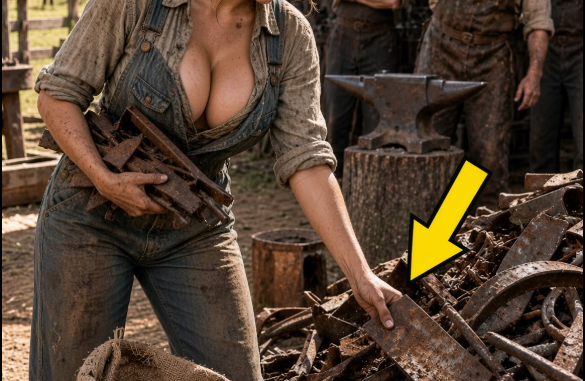
The blacksmith laughed when fourteen-year-old Nora Hale asked if she could have the rusted steel behind his shop.
Three weeks later, he would be standing in a muddy field, staring at something he had spent thirty years believing was impossible.
But that cold April morning in 1946, all he saw was a skinny girl pushing a wheelbarrow.
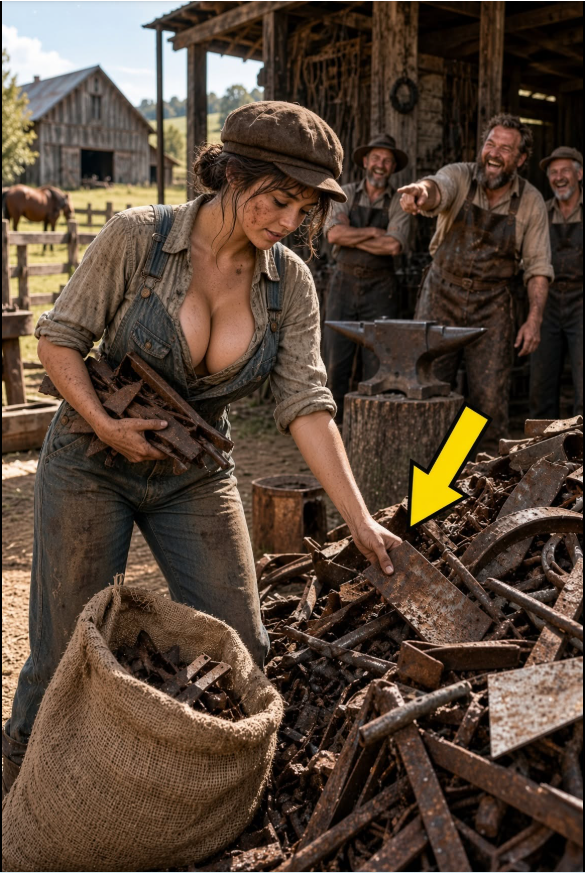
“Planning to build yourself a battleship?” Gus Mercer asked.
Nora shook her head.
“A plow.”
The men waiting outside the forge burst into laughter.
Nora kept sorting through the scrap.
There were broken disc blades, bent wagon fittings, and a truck spring nobody had touched in years.
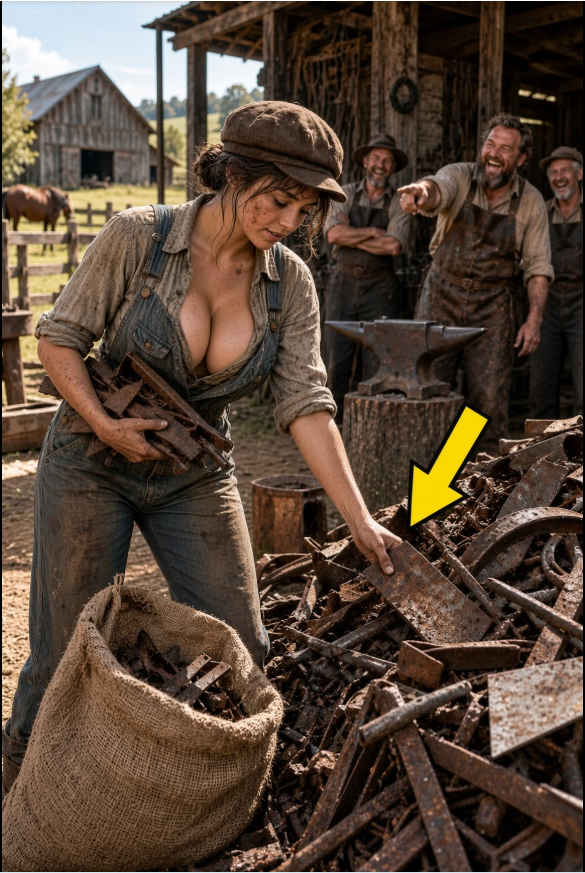
Most of the metal was useless.
But one curved piece caught her attention.
She held it against the light, studying the worn edge.
“That’s cracked,” Gus warned.
“Not where I need it.”
He raised an eyebrow.
“Since when do little girls know anything about plows?”
Nora put the steel in her wheelbarrow.
“Since somebody had to learn.”
She didn’t tell him about the letter hidden beneath her mattress.
It had arrived six months earlier, bearing the official seal of the United States Army.
Her father, Samuel Hale, had been killed overseas.
The letter described him as brave, honorable, and devoted to his country.
It said nothing about the unfinished promises he had left behind.
One of those promises belonged to Ruth Callaway.
Ruth was a widow who lived three miles outside Alder Hollow, New York. Her husband had died in 1943, leaving her a small farm and an aging mare named Bell.
Last autumn, Ruth’s plow had struck a buried stone.
The iron bottom split.
Without a replacement, she couldn’t prepare her fields for spring planting.
Without a crop, she would lose the farm.
Nora had watched Ruth count coins at the general store, putting flour back on the shelf so she could afford oats for Bell.
That night, Nora found her father’s old notebook.
He had been a mechanic before the war.
Between sketches of engines and farm equipment, he had drawn a narrow, lightweight plow designed for one horse.
Beside the drawing were four words.
For Ruth. Before spring.
Nora had stared at them until her eyes burned.
Her father had intended to help Ruth.
Now Nora would have to finish the job.
For the next two weeks, she worked behind her mother’s house.
She measured steel, filed rough edges, and carried pieces to Gus when a joint required heat she couldn’t produce herself.
He charged her almost nothing, though he never stopped criticizing her design.
“Too narrow.”
“Too light.”
“That brace won’t hold.”
Sometimes he was right.
Nora changed the drawings each night.
Her mother found her asleep at the kitchen table one morning, a pencil still between her fingers.
“You don’t have to carry every promise your father made,” she whispered.
Nora looked at the notebook.
“I know.”
But she kept working.
On the third Saturday, Nora and Ruth brought the finished plow to the field.
Half the village seemed to have heard about it.
Gus arrived with his arms folded.
Hank Dutton, the feed hauler, announced that he had come to watch the contraption break.
Nora harnessed Bell.
The mare stepped forward.
The blade entered the soil.
For six feet, it worked beautifully.
Then came a sharp metallic crack.
Bell stopped.
The crowd fell silent.
Nora knelt beside the plow, expecting to find her work destroyed.
Instead, she saw that a small retaining pin had snapped.
She reached into her pocket for a replacement.
That was when Gus noticed the mark stamped into the steel beneath the broken pin.
He pushed past the others and crouched beside her.
“Where did you get this piece?”
“From your scrap pile.”
His face changed.
“Who gave you permission to take it?”
“You did.”
Gus didn’t answer.
He wiped the mud from the metal with his sleeve, revealing a tiny stamped number.
H-17.
Nora recognized it immediately.
The same number appeared beside her father’s final drawing.
Gus looked at her, suddenly pale.
“Your father didn’t draw this plow from imagination,” he said.
Then he glanced toward the road, where a black government sedan had just stopped.
“He was trying to prove who stole it.”
Nora stared at the black government sedan as two men stepped onto the muddy road, their eyes fixed on the broken plow she had built from discarded steel. Gus Mercer quickly covered the stamped H-17 mark with his hand, but it was too late.
One man introduced himself as a federal investigator and asked whether Samuel Hale had left behind any engineering drawings before his death.
Nora remembered the notebook hidden beneath her bed, especially the unfinished diagram marked with Ruth Callaway’s name, but something in Gus’s frightened expression warned her to remain silent.
After the men left, Gus finally explained that Samuel had designed an improved farming mechanism during the war, and someone powerful had claimed the invention as his own.
Now that Nora had unknowingly rebuilt part of it, the secret was no longer buried. Would you trust the investigators or protect your father’s notebook?
Để lại một phản hồi