The Arrow Was Never Meant to K/i/ll Nasha. The Cowboy Who Saved Her Was Walking Into a Trap Buried Thirty Years in His Own Past.
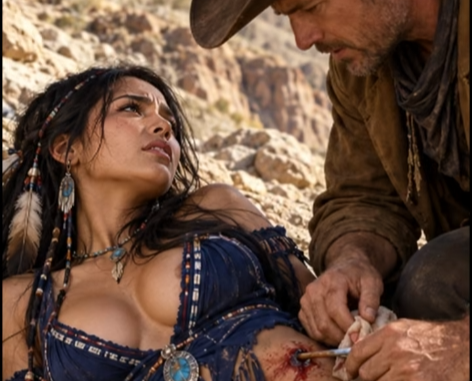
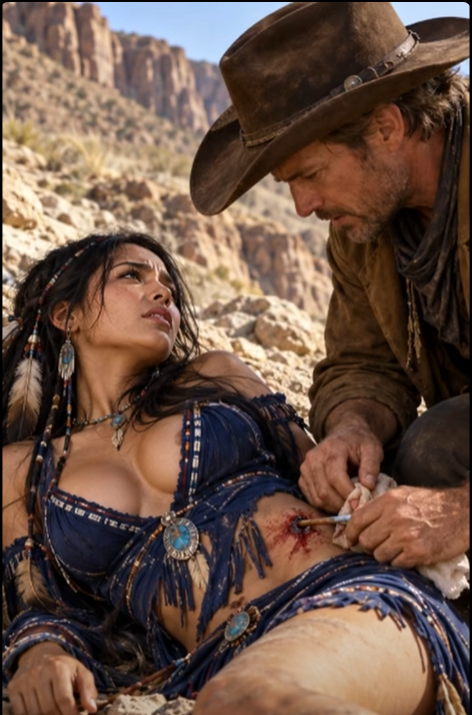
The first thing Gideon Cole noticed about the woman lying in the dry creek bed was not the arrow buried between her ribs.
It was her eyes.
They were open.
Watching him.
Waiting.
Gideon sat motionless on Raft, his old bay gelding, beneath an afternoon sun that seemed determined to bake every living thing between the mesa and the eastern horizon.
For three days, Gideon had survived on bad water, dried meat, and stubbornness.
At fifty-three, stubbornness was what remained when a man had outlived nearly everything else.
He had spent thirty years carrying a g/u/n for people rich enough to hire someone else to solve their problems.
He had been frighteningly good at it.
Now the West was changing.
Railroads crossed country that once took weeks to ride.
Telegraph wires carried threats faster than horses.
Towns had sheriffs, judges, banks, newspapers.
Men like Gideon Cole were becoming relics.
And relics rarely knew when to disappear.
He almost kept riding.
Then the woman whispered.
“Hurry, cowboy.”
Gideon dismounted.
The arrow shaft had broken four inches above her side.
Apache-made.
Either her own people had fired it—or someone wanted him to believe they had.
Gideon crouched.
“You understand English?”
Her mouth twitched.
“Better than you, apparently.”
Despite himself, Gideon nearly smiled.
Then her expression tightened.
“Take it out before I sleep and don’t wake up.”
“That could k/i/ll you faster.”
“It will k/i/ll me slower if you leave it.”
She was right.
Gideon had whiskey, cloth, a kn/i/fe, and lard meant for saddle leather.
It would have to be enough.
The arrowhead could not safely come backward.
It had to go through.
He explained.
She nodded once.
No pleading.
No dramatics.
Just trust given to a stranger because there was nothing else left to give.
“Name?” Gideon asked.
“Nasha.”
“I’m Gideon.”
“I didn’t ask.”
That time he actually smiled.
Then he pushed.
Nasha’s hand slammed into the sand.
A strangled sound escaped her throat, but she refused to scream.
The arrow moved.
Caught.
Moved again.
Gideon found the point and carefully pulled it through.
Dark bl/o/od followed rather than the bright arterial bl/o/od he feared.
The arrow had missed her lung.
“Good,” Nasha whispered.
“Don’t talk.”
He cleaned and bound the wound.
That night Gideon sat against a boulder with his rifle across his knees while Nasha slept beside a tiny fire.
He watched the darkness.
And for reasons he could not explain, he wondered whether this woman had appeared on his road because fate had finally decided where he was going.
By morning, Nasha had a fever.
Not terrible.
Not yet.
She explained that three men had appeared near the canyon where she had camped with two companions.
There had been stolen livestock.
Confusion.
Riders.
Then the arrow.
Her companions escaped.
She did not.
“Who fired?” Gideon asked.
“I never saw.”
He changed her dressing.
The wound remained clean.
He gave her his last dried meat.
“You aren’t eating,” she said.
“Not hungry.”
“You’re lying.”
“Yes.”
She broke the meat in half.
Gideon stared.
Nasha held one piece toward him.
“You saved my life.”
“Maybe.”
“Then don’t make me watch you starve immediately afterward. It makes the rescue look poorly planned.”
He laughed.
The sound startled him.
He could not remember the last time he had done it.
By afternoon, Nasha was riding Raft while Gideon walked beside them.
She asked about him.
Against every instinct, he answered honestly.
He told her about the years working as a hired g/u/n.
Not everything.
But enough.
“You’re tired of it,” she said.
“I didn’t say that.”
“You didn’t need to.”
They reached a low adobe house near sunset.
Its owner, Ruth Calder, was a silver-haired widow with the personality of a cavalry commander.
She took one look at Nasha and immediately ordered Gideon to boil water.
He obeyed.
For three days, he remained.
Nasha’s fever broke.
Her appetite returned.
And something inside Gideon began changing.
There was coffee every morning.
Work that needed doing.
A loose hinge.
A damaged corral.
Raft needed shoeing.
Ruth’s roof needed patching.
Small things.
Useful things.
Things that did not require anyone to d/i/e.
On the third afternoon, Gideon was repairing Raft’s left rear shoe when Nasha came outside.
“You could stay,” she said.
Gideon kept working.
“This isn’t my place.”
“No. But you have no place, so that is not a real objection.”
He straightened.
Nasha sat on an overturned bucket.
“You know useful things,” she continued. “You are not kind in an easy way. But you are honest. And you don’t leave when things become difficult.”
“You’ve known me three days.”
“Sometimes three days is enough.”
Gideon looked toward the horizon.
“What happens when your wound heals?”
“You could still leave.”
“And if I didn’t?”
Nasha smiled faintly.
“Then perhaps we discover what happens next.”
Raft suddenly lifted his head.
His ears pointed west.
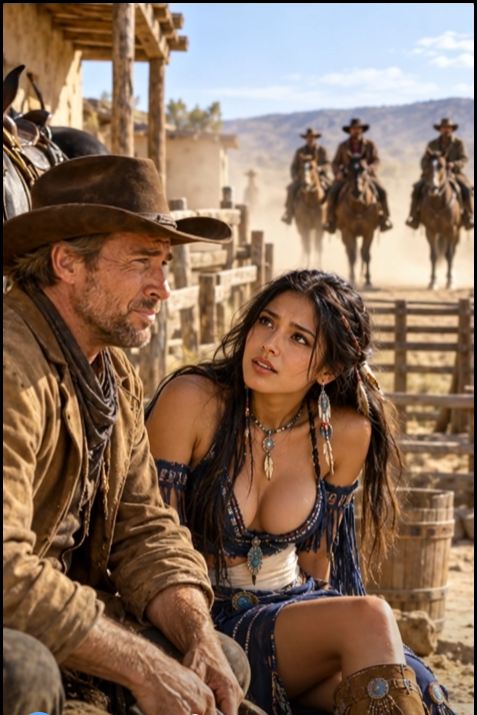
Hoofbeats.
Three riders emerged through the dust.
Gideon reached for his rifle.
Nasha grabbed his wrist.
“Don’t shoot yet.”
“You know them?”
“Yes.”
The center rider dismounted.
Broad shoulders.
Gray hair.
No we/@/pon visible in his hands.
“Nasha!”
Gideon glanced at her.
“You told me three men found you in that canyon.”
“They did.”
“They @tt/@cked you?”
“No.”
The answer landed harder than a fist.
“They were tracking the men who stole our livestock,” Nasha said. “Someone else fired the arrow.”
The gray-haired rider approached.
His name was Taza.
He looked at Nasha’s bandage, then Gideon.
“You saved her?”
“Yes.”
Taza studied him strangely.
Then he reached inside his coat.
Gideon’s hand moved toward his revolver.
Taza stopped.
“Paper.”
He slowly produced a folded note.
Gideon opened it.
BRING NASHA TO BLACK CANYON. COME ALONE.
Below it was a symbol.
A circle crossed by three vertical lines.
Gideon’s stomach tightened.
“Silas Mercer,” Taza said.
Gideon had not heard that name in twelve years.
Once, Mercer had paid him.
Then Gideon discovered what Mercer really was.
A thief.
A trafficker in stolen cattle and stolen land.
A man who manufactured conflicts between settlers and Apache communities, then profited when frightened families abandoned valuable property.
Gideon had walked away.
Mercer had promised they would meet again.
An arrow suddenly struck Ruth’s porch post.
Everyone turned.
Another message was attached.
YOU HAVE UNTIL SUNSET.
Nasha stared at Gideon.
Then Gideon understood.
The arrow had never been meant to k/i/ll Nasha.
It had been meant to bring him here.
“Why me?” Nasha asked.
Gideon folded the message.
“Because Mercer knows something about me.”
“What?”
“I finish what I start.”
Taza shook his head.
“No. There is more.”
Gideon looked at him.
Taza removed something from beneath his shirt.
A silver medallion.
Gideon stopped breathing.
He had seen it before.
Thirty years earlier.
A young Apache scout named Chato had worn one exactly like it.
Chato had saved Gideon’s life when Gideon was twenty-three.
They had ridden together for almost a year.
Then one winter, Chato disappeared.
Gideon had always believed he was d/e/@/d.
“Where did you get that?”
“My father.”
Gideon stared.
“Chato?”
Taza nodded.
“My father spoke of you.”
A strange ache opened inside Gideon.
“He survived?”
“For many years.”
“Where is he?”
Taza’s eyes softened.
“He d/i/ed six winters ago.”
Gideon looked away.
The news hurt more than it had any right to.
Then Taza said something stranger.
“Before he d/i/ed, he told me if Silas Mercer ever returned, I should find Gideon Cole.”
“Why?”
“Because you were the only man Mercer feared.”
Gideon gave a humorless laugh.
“Mercer never feared me.”
“Yes,” Taza said.
“He did.”
Taza stepped closer.
“Because you know what happened at Black Canyon.”
Gideon went still.
“I’ve never been there.”
Taza stared at him.
“That is what Mercer made you believe.”
Gideon rode toward Black Canyon before sunset.
Not alone.
Nasha refused to remain behind.
“So much for following instructions,” Gideon muttered.
“You followed Mercer’s instructions for years,” she replied. “Perhaps you should try ignoring them.”
Taza and his two riders followed at a distance.
Ruth stayed behind.
The canyon appeared as the sun sank, its walls glowing red.
Gideon recognized nothing.
Yet his body did.
His palms sweated.
His heartbeat accelerated.
A memory stirred.
Smoke.
Horses screaming.
A younger Gideon riding through darkness.
Then nothing.
At the canyon mouth stood Silas Mercer.
Older.
White-haired.
But unmistakable.
Six armed men surrounded him.
Mercer smiled.
“Gideon.”
Gideon dismounted.
“You look terrible, Silas.”
“You look old.”
“I am old.”
Mercer’s eyes moved toward Nasha.
“And sentimental.”
Nasha remained mounted.
“What do you want?”
Mercer laughed.
“Not you.”
His attention returned to Gideon.
“I wanted him.”
“Then why shoot her?”
“Because Gideon ignores invitations.”
Gideon’s jaw tightened.
“You could have sent a telegram.”
“I needed to know whether you were still the same man.”
“And?”
Mercer smiled.
“You stopped.”
The words chilled him.
“You saw an injured stranger and stopped.”
Mercer stepped forward.
“That was the test.”
Nasha looked between them.
“What does that prove?”
“That he remembers more than he thinks.”
Mercer pointed toward a narrow passage in the canyon wall.
“Come.”
Gideon did not move.
Mercer smiled.
“You’ve spent thirty years wondering why you have nowhere to go.”
His voice lowered.
“Tonight you learn why.”
They entered the canyon.
Every step disturbed something inside Gideon.
A twisted cedar.
A stone ledge.
A dry wash.
He had seen them.
But where?
Mercer stopped beside an abandoned stone building hidden beneath an overhang.
Inside were old crates.
Ledgers.
Maps.
Documents.
Gideon opened one.
Land deeds.
Hundreds.
Some belonged to settlers.
Others recorded agreements with Apache families.
Many bore forged transfers.
Mercer had spent decades stealing land through engineered violence.
“This could hang you,” Gideon said.
Mercer smiled.
“It could have thirty years ago.”
Gideon turned.
“What happened here?”
Mercer’s smile disappeared.
“You really don’t remember.”
“No.”
“Then allow me.”
Thirty years earlier, Mercer had organized an @tt/@ck on a wagon settlement.
He intended to blame Apache raiders.
The settlers would flee.
Mercer would purchase their abandoned claims.
But someone discovered the plan.
Chato.
And Gideon.
“You tried to stop me,” Mercer said.
Gideon’s breathing changed.
Images flashed.
Fire.
A revolver.
Chato shouting.
A woman crying.
A baby.
Gideon staggered.
Nasha caught his arm.
Mercer continued.
“I hit you with a rifle stock. Hard enough that you forgot most of that night.”
Memory slammed into Gideon.
He saw himself younger.
Bleeding.
Fighting.
Chato dragging families from burning wagons.
Mercer firing.
Then—
A woman.
Elena.
Gideon’s wife.
Gideon dropped to one knee.
“No.”
Nasha stared.
“You were married?”
Gideon could barely speak.
“I… didn’t remember.”
Mercer laughed softly.
“Now we arrive at the interesting part.”
Gideon remembered Elena screaming.
Remembered putting her on a horse.
Remembered—
A child.
Their child.
His daughter.
Gideon looked at Mercer with horror.
“What happened to her?”
Mercer smiled.
“I wondered when you’d ask.”
Gideon drew his revolver.
Mercer’s men immediately raised their rifles.
Nasha stepped between them.
“No.”
Gideon’s voice shook.
“Move.”
“No.”
“He knows what happened to my daughter.”
“And if you k/i/ll him now, you never will.”
Mercer applauded slowly.
“Smart woman.”
Then another voice came from the canyon entrance.
“She always was.”
Taza entered.
But he was not looking at Mercer.
He was looking at Nasha.
Gideon noticed.
Then noticed something else.
Nasha was crying.
“Nasha?”
She looked at him.
For the first time since he had found her, the woman who had faced pain without begging seemed afraid.
Not of Mercer.
Of Gideon.
“I’m sorry,” she whispered.
Gideon’s revolver slowly lowered.
“For what?”
Taza answered.
“Her mother’s name was Elena.”
The canyon became silent.
Gideon stared at Nasha.
No.
Impossible.
Nasha was perhaps thirty.
Maybe a little older.
His daughter would be—
Thirty.
His knees weakened.
Mercer smiled.
“There it is.”
Gideon looked into Nasha’s dark eyes.
The same eyes that had watched him from the creek bed.
The same eyes that had somehow seemed familiar.
“Elena survived?” he whispered.
Nasha nodded through tears.
“For nine years.”
Gideon could not breathe.
“She believed you were d/e/@/d.”
“And you?”
“Chato raised me after she was gone.”
Taza stepped beside her.
“She is my sister in every way that matters.”
Gideon stared at Nasha.
“You knew?”
“Not when you found me.”
“When?”
“Taza told me after we reached Ruth’s house.”
Pain flashed across Gideon’s face.
“You let me sit there for three days.”
“I needed to know.”
“Know what?”
Nasha’s voice broke.
“Whether the man my mother loved still existed.”
Gideon turned away.
Thirty years of emptiness suddenly had a name.
He had not wandered because there was nowhere to go.
He had wandered because part of him remembered losing somewhere he belonged.
Mercer began laughing.
“That is beautiful.”
Gideon looked at him.
Mercer’s hand moved.
Nasha shouted.
A g/u/n appeared beneath Mercer’s coat.
Everything happened at once.
Gideon moved toward Nasha.
Taza fired.
Mercer’s shot struck stone.
His men hesitated.
Then a voice echoed from above.
“Drop them!”
Rifles appeared along both canyon ridges.
Deputy marshals.
Ranchers.
Apache riders.
And standing above them was Ruth Calder.
Gideon stared.
Ruth smiled down.
“You men always assume an old widow stays where she’s told.”
Mercer went pale.
Taza smiled.
“You thought we came here to fight you?”
Nasha wiped her tears.
“No.”
She looked at the ledgers.
“We came to make you confess.”
Gideon finally understood.
Ruth had ridden for the territorial marshal after they left.
Taza had deliberately allowed Mercer to speak.
Witnesses had surrounded the canyon.
Mercer had confessed to everything.
The forged deeds.
The staged @tt/@cks.
The stolen livestock.
Black Canyon.
Elena.
All of it.
Mercer looked at Nasha.
“You planned this?”
She nodded.
“Most of it.”
Mercer pointed toward her side.
“The arrow?”
Nasha’s expression hardened.
“No.”
Everyone went quiet.
Mercer frowned.
“I ordered my man to graze you.”
“You missed.”
“I never miss.”
Nasha looked toward the ridge.
“So someone changed your plan.”
A figure emerged above them.
One of Mercer’s own men.
He slowly removed his hat.
Gideon recognized him.
Elias Mercer.
Silas’s younger brother.
Silas stared.
“You?”
Elias nodded.
“I spent thirty years cleaning up after you.”
“You betrayed me?”
“No.”
Elias looked at Gideon.
“I saved his daughter.”
The final piece fell into place.
Elias had discovered Silas’s plan.
He had deliberately altered the shot, ensuring Nasha would survive but forcing Gideon to stop.
He had also sent word to Taza.
The entire trail had been designed not to destroy Gideon—
but to bring a father and daughter together.
Silas screamed in fury.
Deputies restrained him.
And Gideon Cole, hired g/u/n, survivor, wanderer, dropped his revolver into the dust.
He did not pick it up again.
Six months later, Gideon was standing on Ruth Calder’s roof when Nasha shouted from below.
“You’re doing it wrong!”
Gideon looked down.
“I’ve been repairing roofs since before you were born.”
“Apparently incorrectly.”
Taza laughed from the corral.
Raft grazed beneath a cottonwood.
Silas Mercer had been convicted using his own ledgers and confession.
Dozens of stolen claims were restored.
Families returned.
The conflicts Mercer had spent years manufacturing finally began to heal.
Elias testified against his brother and disappeared east afterward.
Gideon never carried a g/u/n professionally again.
He stayed.
At first, he told himself it was temporary.
Then winter came.
He stayed.
Spring arrived.
Still there.
One evening, Nasha sat beside him on Ruth’s porch.
“You know,” she said, “Mother described you.”
Gideon looked over.
“She did?”
“She said you were stubborn.”
“Accurate.”
“Difficult.”
“Also accurate.”
“Terrible at admitting when you were afraid.”
He smiled.
“Your mother talked too much.”
Nasha laughed.
Then she handed him something.
A small wooden box.
Inside was a letter.
Old.
Fragile.
His name was written across it.
Gideon’s hands began trembling.
“My mother wrote it before she d/i/ed,” Nasha said.
“She asked Chato to give it to you if he ever found you.”
Gideon opened it.
He read silently.
Then stopped.
His eyes filled.
Nasha did not ask what it said.
Eventually Gideon handed her the letter.
Near the bottom Elena had written:
If Gideon is alive, tell him our daughter has his stubborn heart. Tell him I never blamed him. And tell him that if he spends the rest of his life believing he has no home, then he is being a fool, because wherever she is, part of his home is walking around with her.
Nasha finished reading.
Neither spoke.
Then Gideon noticed another line.
A final sentence written smaller beneath the rest.
He leaned closer.
And laughed.
“What?”
Nasha asked.
Gideon handed it back.
The final sentence read:
And if he is still riding that ridiculous horse named Raft, tell him I was always right—that is the stupidest name ever given to a horse.
Nasha stared at him.
Then at Raft.
Then burst out laughing.
Gideon laughed with her.
For nearly a minute, neither could stop.
The sun lowered over the mesa.
The adobe walls turned gold.
Somewhere inside, Ruth complained that supper was getting cold.
Taza called from the corral.
Raft flicked his tail.
And Gideon looked around at all of it.
The house.
The horses.
The people.
His daughter.
For thirty years he had believed his story was about everything he had lost.
He had been wrong.
It was about the road back.
Nasha rested her head against his shoulder.
“You still thinking about leaving?”
Gideon looked toward the western horizon.
Once, that horizon had seemed like freedom.
Now it looked lonely.
“No.”
Nasha smiled.
“Good.”
A few moments passed.
Then she said, “There’s something else.”
Gideon groaned.
“I’m getting too old for your surprises.”
“You’ll survive this one.”
She stood and walked toward the house.
At the doorway, two children appeared.
A boy of perhaps seven and a little girl around five.
Gideon stared.
They stared back.
Nasha folded her arms.
“You never asked whether I had children.”
Gideon slowly stood.
The little girl whispered something to her brother.
The boy nodded solemnly.
Then both children ran toward him.
“Grandfather!”
Gideon froze.
Thirty years of gunfights had never frightened him as much as that single word.
The little girl wrapped herself around his leg.
The boy looked up.
“Mother says you know horses.”
Gideon swallowed.
“A little.”
“Can you teach us?”
He looked at Nasha.
She was crying and smiling at once.
Gideon knelt.
The children immediately climbed onto him as though they had known him forever.
And something inside the old cowboy finally surrendered.
Not to violence.
Not to regret.
To joy.
The arrow in the desert had not ended a life.
It had pierced thirty years of silence.
It had led a lost father to his daughter, a daughter to the truth about her mother, and an old wanderer to grandchildren he had never imagined existed.
That night, five people crowded around Ruth Calder’s table.
Six, if Taza counted.
Seven after another neighbor arrived.
Gideon looked around while everyone argued over bread, horses, weather, and who had cheated at cards the previous evening.
Nobody noticed him smiling.
Except Nasha.
She raised an eyebrow.
“What?”
“Nothing.”
“You’re smiling.”
“I do that.”
“Not often.”
Gideon glanced toward the children.
Then toward Elena’s letter beside his plate.
“I was just thinking.”
“That sounds dangerous.”
He smiled wider.
“I spent thirty years believing surviving was the same thing as living.”
Nasha’s expression softened.
“And now?”
Gideon looked around the crowded table.
“Now I know the difference.”
Outside, beneath an enormous western sky, Raft stood peacefully beside the corral.
The road beyond the house stretched toward distant mountains.
Gideon no longer wondered where it led.
For the first time in thirty years, he had no intention of following it.
Because sometimes the greatest surprise waiting at the end of a long road is not treasure, revenge, or redemption.
Sometimes it is a woman lying wounded in the desert who looks into the eyes of a stranger without realizing she is looking at her own father.
Sometimes it is an old letter that survives longer than grief.
Sometimes it is two children running across a dusty yard shouting a name a lonely man never expected anyone to call him.
And sometimes a man spends half his life searching for somewhere to go—
only to discover that home had been searching for him too.
Để lại một phản hồi