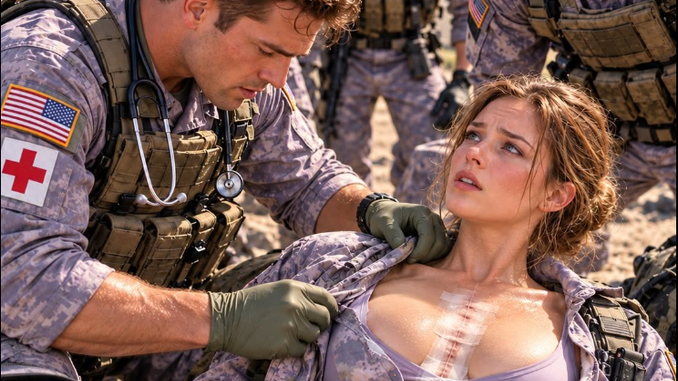
For six weeks, my drill instructor humiliated me in front of an entire infantry platoon, calling me too small, too weak, and unfit to wear an Army uniform. Then I collapsed during a brutal twelve-mile march in the Georgia heat, and a medic cut open the jacket I’d refused to unbutton since arriving. Staff Sergeant Cole Vega stepped closer, expecting proof that he’d been right about me. But when he saw what I’d been hiding beneath my uniform, the man who had never run out of insults suddenly couldn’t speak.
My name is Rowan Mercer, and at five-foot-three, I was the smallest recruit in my infantry selection battalion.
I’d survived six exhausting weeks of training, but nothing tested my determination quite like Staff Sergeant Vega.
From my first morning, he seemed determined to break me.
“Mercer, you planning to fight the enemy or apologize until they surrender?”
The platoon laughed.
I simply corrected my stance and continued training.
Other recruits whispered that I wouldn’t last another week, while Vega watched every movement I made, searching for weakness.
What none of them understood was that I was already fighting something they couldn’t see.
I kept my collar buttoned tightly, even when the Georgia heat became unbearable.
During medical training, I changed clothes privately, avoiding the curious glances of my fellow recruits.
When an intake clerk asked whether my physical limitations had changed, I pushed the paperwork back.
“No change.”
I couldn’t bear the thought of being judged by something beneath my uniform instead of what I could accomplish.
But Vega noticed everything.
One afternoon, while I cleaned Georgia mud from my rifle, he announced, “Mercer’s hiding something. Probably a reason she shouldn’t be here.”
I kept my head down.
By the sixth week, I’d learned that defending myself only encouraged him.
Then came the twelve-mile ruck march.
The temperature was already climbing at 5:18 a.m., and a heat warning had been posted before sunrise.
Our completion times would become part of our selection records, with medics stationed along the route.
For the other recruits, it was another endurance test.
For me, it was the morning I’d been dreading.
At 6:03, Vega stopped directly in front of me.
“You sure you don’t want to save us the paperwork, Mercer?”
“I’m good, Sergeant.”
He shook his head.
“No. You’re stubborn. There’s a difference.”
I adjusted my heavy rucksack and started walking.
For six miles, I concentrated on three things.
Boot. Breath. Road.
The straps dug painfully into my shoulders, and sweat soaked the collar I’d stubbornly kept fastened.
Every movement of the pack sent sharp pain through the part of my body I desperately wanted to conceal.
At mile eight, my fingers began trembling around my canteen.
Vega noticed immediately.
“Look at that. Mercer’s hands are tired.”
Nobody laughed.
At mile ten, white flashes appeared in my vision.
The road shimmered, and the sound of marching boots seemed strangely distant.
Vega moved beside me.
“Quit now, Mercer, and at least you’ll be honest for once.”
“I’m not quitting.”
“Then move.”
So I kept walking.
Another mile.
Then another half.
Stopping felt like admitting that every cruel thing he’d said about me was true.
Suddenly, the ground tilted.
“Mercer!”
I heard Daniels shout just before my knees struck the gravel.
My rucksack dragged me sideways as dust rose around my hands.
Someone shouted for a medic.
Then I heard Vega.
“I knew it.”
The medic knelt beside me and checked my pulse.
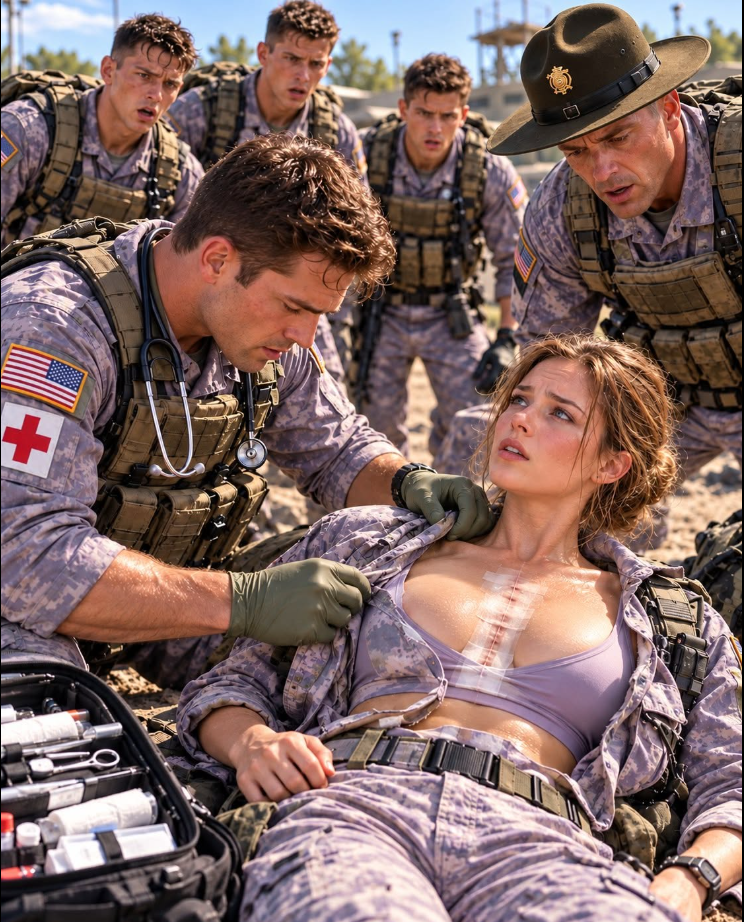
“She’s overheating. Cut the jacket!”
“No,” I tried to whisper.
But the trauma shears were already sliding beneath my tightly buttoned collar.
Vega stood over me, watching.
The medic cut through my uniform and pulled the fabric apart.
Then his hands stopped.
His expression changed completely.
And when Vega finally saw what I’d been hiding for six weeks, the entire world seemed to fall silent.
PART 2: The medic found an old scar, and Vega recognized the name beside it 4025
PART 2: For several seconds, nobody moved.
The medic’s shears rested against the torn edge of my jacket. The morning heat pressed down on us, but I felt cold everywhere the fabric had opened.
I stared at the sky.
A pale blue strip showed between the branches lining the road, and beyond it, clouds gathered over the distant hills. Someone’s boots shifted near my shoulder. A canteen clinked. The ordinary sounds of the march continued around me, yet the world had narrowed to the medic’s silence.
Then he said, very quietly, “Don’t move her.”
Vega’s voice came from above me.
“What is it?”
“Give me space, Staff Sergeant.”
That was not an answer.
I tried to pull the jacket closed, but my arm felt boneless and weak. The medic caught my wrist before I could cover myself.
“Mercer, listen to me. You’re overheated and dehydrated. You need to stay still.”
“I’m fine.”
“You collapsed.”
“I can finish.”
“No,” he said, with a steadiness that left no room for argument. “You can’t.”
The words should have embarrassed me. Instead, relief moved through me so suddenly that my eyes burned.
The medic, Specialist Aaron Bell, looked down at the concealed compression garment beneath my uniform. Its dark fabric was damp with sweat, stretched across the surgical contour beneath my left shoulder and chest. A long, pale scar disappeared beneath the edge near my ribs and curved upward toward my collarbone.
It was not the kind of mark that could be explained away as a childhood accident.
Vega had finally seen it.
For six weeks, he had watched me button my collar in every weather, noticed how carefully I changed clothes, and interpreted every secret as evidence that I did not belong.
Now his expression had gone blank.
Not satisfied.
Not triumphant.
Blank.
Bell glanced at me. “How long ago was the operation?”
My throat tightened.
“Two years.”
“Any complications?”
“No.”
“Any restrictions?”
“Not anymore.”
“That wasn’t my question.”
I turned my face away.
Behind Bell, Daniels crouched with my canteen. He was one of the few recruits who had never joined Vega’s jokes. His brow furrowed as he looked from me to the scar.
“Should I call the ambulance?” he asked.
“Already requested,” Bell said. “They’re bringing a cooling stretcher.”
“I don’t need—”
“Mercer.” Bell’s tone softened. “You are not in trouble. But you are done marching today.”
The words landed harder than Vega’s insults ever had.
Done.
I had spent months earning the right to be there. Years, if I counted all the mornings I had trained before sunrise, all the paperwork I had completed, all the times I had explained to doctors that I understood my own body and wanted the same opportunity as anyone else.
The selection battalion had accepted me after medical review. I had passed the physical evaluation. The only thing I had refused was the invitation to make my history public.
I had believed privacy and weakness were the same thing.
Now, lying in the gravel with my uniform cut open, I could not tell which one I was more afraid of losing.
Vega took one step closer.
“Mercer,” he said.
I kept my eyes on the sky.
“Don’t,” I whispered.
He stopped.
For once, he did exactly what I asked.
The cooling stretcher arrived a few minutes later. By then, my thoughts had begun to drift in and out. Bell placed cold packs beneath my neck and along my sides, then started an IV. I heard him explain my condition to the arriving emergency technician: heat exhaustion, possible heat injury, surgical history, no known cardiac symptoms.
The word surgical made several heads turn.
I closed my eyes.
I could feel the platoon’s questions gathering around me like dust.
When they loaded me into the ambulance, Vega stood beside the open doors. His face had lost the hard certainty he usually wore.
“Mercer,” he said again.
I looked at him.
He seemed about to ask something, but the technician closed the doors before he found the words.
At the hospital, everything became bright lights and clipped questions.
Name. Date of birth. Allergies. Medications. Surgical history.
I answered automatically.
A nurse replaced the IV, checked my temperature, and asked me to rate my pain. Another nurse brought a gown and helped me change behind a curtain. When I finally saw myself in the small mirror, I barely recognized the person looking back.
My hair was stuck to my forehead. Dust marked my cheek. The compression garment had left red lines across my skin, and the scar beneath it looked sharper than I remembered.
I had spent two years learning how to look at that scar without seeing the operating room.
Today, I saw everything.
The first consultation.
The strange ache beneath my arm.
The scans.
The surgeon’s careful explanation that the tumor was benign but large, that removing it would leave a visible change, that recovery would take time.
My mother sitting beside me, holding my hand too tightly.
My older brother, Elias, standing near the window and pretending to read a magazine.
The quiet after the surgeon said, “You may want to reconsider the infantry plan.”
I had been nineteen then, and everyone around me had looked frightened except me.
I had already decided.
The Army was not a punishment or an escape. It was the one future I had chosen before anyone could tell me what I was capable of.
The medical team had removed the mass successfully. The scar was extensive because of its location, and for months I had struggled with stiffness and nerve sensitivity. Eventually, physical therapy had restored my strength. The Army physician who reviewed my records had cleared me with no limitations.
But clearance did not erase memory.
It did not erase the way people stared when they saw the scar. It did not erase the questions, the pity, or the assumption that I had been fragile all along.
So I had covered it.
Not because I was ashamed of surviving.
Because I wanted one place in my life where survival did not become the first thing people saw.
A physician entered carrying a tablet. She introduced herself as Dr. Patel and reviewed my test results. My temperature was falling, my blood pressure had stabilized, and the bloodwork showed significant dehydration but no immediate organ damage.
“You were fortunate,” she said.
I almost laughed.
Fortunate was a complicated word.
“I need to ask about your physical activity,” she continued. “Have you been having pain, shortness of breath, weakness, or dizziness before today?”
“No.”
“Any numbness around the scar?”
“Sometimes. Nothing that affects performance.”
“Did anyone in your chain of command know about your surgical history?”
“The medical department.”
“Your drill instructor?”
I hesitated.
“That’s not a medical requirement,” I said.
Dr. Patel studied me, not unkindly. “No. But if you were experiencing symptoms or pushing beyond a medical limitation, it would be relevant.”
“I wasn’t.”
“Then the heat may have been the primary problem.”
I nodded.
She entered a few notes. “You’ll be observed for several hours. After that, the battalion medical officer will decide whether you return to training, recover with modified activity, or undergo further evaluation.”
“Modified activity will remove me from selection.”
“Perhaps temporarily.”
“Temporarily becomes permanently if I miss an assessment.”
She looked at me over the tablet. “You collapsed on a twelve-mile march during a heat warning. Remaining in training is not a test of character.”
I looked down at the blanket.
“I know.”
But I did not know how to convince myself.
An hour later, Daniels appeared at the doorway.
He was still in uniform, though his rucksack was gone. Dust covered his boots, and he held my canteen in one hand.
“Platoon’s at the barracks,” he said. “They sent me with your things.”
I sat up slightly. “How did you get past the desk?”
“I told them you’d left your phone with me.”
“You have my phone?”
He produced it from his pocket.
The screen showed eleven missed calls from my mother and three from an unfamiliar number.
“Your mom called twice while we were waiting,” he said. “I didn’t answer.”
“Thank you.”
Daniels placed the phone on the bedside table, then looked toward the curtain.
“Can I ask something?”
“You already are.”
A faint smile crossed his face. “Are you all right?”
“I’m dehydrated.”
“I mean about what happened out there.”
I knew what he meant.
I pulled the blanket higher. “It’s not contagious.”
“I didn’t think it was.”
“Then what?”
“People are wondering whether you’re being discharged.”
“People should focus on their own training.”
“They are. They’re also worried.”
I looked at him skeptically.
“Even Vega?”
Daniels hesitated.
That answer told me enough.
“He’s in the hallway,” Daniels said. “He didn’t leave with the others.”
My stomach tightened.
“Why?”
“He said he needed to speak with the medical officer.”
“That sounds like paperwork.”
“Maybe.”
“What does he want?”
Daniels looked uncomfortable. “He asked if I knew anything about your surgery.”
“And?”
“I told him no.”
“Good.”
He leaned against the wall. “Mercer, I’ve known you for six weeks. You don’t have to tell me anything. But whatever happened before you got here, it doesn’t make you less capable.”
I stared at the floor.
“I know that.”
“Do you?”
The question was gentle enough to hurt.
I picked up my phone. “My mother called.”
“Then call her back.”
“I don’t want her to hear me like this.”
“Like what?”
“Uncertain.”
Daniels nodded as though he understood. “She probably already knows.”
Before I could answer, a nurse stepped inside and said, “Staff Sergeant Vega is asking to see you.”
I nearly said no.
Then I imagined him waiting outside the hospital room, carrying the weight of everything he had said, and felt a strange, unwelcome curiosity.
“Fine,” I said.
Daniels moved toward the door.
“You don’t have to leave,” I told him.
“I know.”
He stayed.
Vega entered alone.
Without his campaign hat, he looked older. The harsh overhead lighting deepened the lines around his eyes. He had changed out of his ruck gear, but dust still marked the knees of his trousers.
For a moment, none of us spoke.
Then he looked at Daniels. “Can I have a minute?”
Daniels glanced at me.
I nodded.
He left, closing the curtain behind him.
Vega kept his distance from the bed.
“I spoke with the battalion medical officer,” he said.
I waited.
“You’re not being dropped from the course today. You’re on observation status until the physician clears you.”
“That’s generous.”
His jaw tightened. “It isn’t my decision.”
“Then why are you here?”
He looked at the floor, and the gesture unsettled me more than anger would have.
“I owe you an apology.”
I said nothing.
He drew a breath. “The things I said about your size and strength were part of how I train recruits. I push where I think there’s uncertainty.”
“You didn’t think there was uncertainty. You thought I was weak.”
“I thought you were hiding something that might put the platoon at risk.”
“So you decided humiliation was a medical assessment?”
“No.”
“But it was your method.”
He accepted that without defending himself.
“I was wrong about the reason,” he said.
“Were you?”
His eyes lifted to mine.
“You were right that I was hiding something.”
“That isn’t the same as being right about you.”
The room fell quiet.
I expected him to argue. Instead, he nodded.
“No,” he said. “It isn’t.”
I studied him. “Why did you care so much?”
His expression changed. Not dramatically. Just enough for me to see something beneath the professional certainty.
“Because people who hide injuries sometimes wait until the worst possible moment to mention them.”
“I didn’t hide an injury.”
“I know that now.”
“Do you?”
“You had surgery. You kept training through the recovery. You passed the medical review. You haven’t had restrictions in years.”
He spoke as if reciting a report, but the words carried an unusual precision.
“Who told you that?”
“The medical officer.”
“Not me.”
“I wasn’t asking you to tell me.”
“Then what were you asking for?”
He looked toward the cut jacket folded on the chair.
“Proof.”
The answer was so honest that it disarmed me.
“Proof of what?”
“That I wasn’t wasting time on someone who would leave the platoon when training got difficult.”
I felt anger return, steadier now.
“You didn’t need proof. You needed trust.”
His mouth tightened.
“Yes.”
It was the first time he had agreed with me.
He moved to the chair but did not sit.
“I’ve had recruits conceal asthma, untreated fractures, medication changes. One soldier lied about chest pain because he thought reporting it would end his career. He collapsed during a live-fire exercise. Nobody died, but people could have.”
“I’m sorry.”
“So am I.” He rubbed a hand over his face. “After that, I started looking for hidden problems. I convinced myself that pressure forced honesty.”
“It forced me to work harder to avoid giving you anything.”
“I see that.”
“No, Sergeant. You see the scar.”
He accepted the correction.
“I see that I confused privacy with deception.”
The words stayed between us.
I had expected an apology to feel satisfying. Instead, it made the room more complicated. It was easier to despise him when he was certain of himself. Now he looked like a man confronting a mistake he could not train his way out of.
“I’m not asking you to forgive me,” he said.
“That’s good.”
“I’m asking what you need from me if you return.”
I looked at him carefully.
“Do not make my medical history a lesson for the platoon.”
“I won’t.”
“Do not treat me like a liability because you know about the surgery.”
“I won’t.”
“And don’t suddenly become kind.”
A flicker of surprise crossed his face.
“I’m not promising kindness,” I continued. “I’m asking for fairness.”
He nodded. “Fairness I can give.”
“Can you?”
“I can try.”
“That’s not the same thing.”
“No,” he said. “But it’s the truth.”
The curtain shifted. Daniels appeared with a nurse carrying a fresh bag of fluids.
Vega stepped back.
Before he left, he said, “There’s one more thing.”
I waited.
“Your mother has been trying to reach the battalion.”
My heart stopped.
“What?”
“She called the number listed on your emergency contact form. Then she called the unit.”
Cold moved through me despite the warm room.
“What did she say?”
“She asked to speak with you.”
“Why would she call the battalion?”
He hesitated.
I understood before he answered.
“She may know you were injured.”
“She doesn’t know anything about today.”
“Then perhaps she knows something else.”
He left before I could ask what that meant.
I reached for my phone.
There were now eighteen missed calls.
The unfamiliar number belonged to the battalion administrative office.
A text from my mother had arrived six minutes earlier.
Please call me before you speak to anyone else. I found the letter.
My hands began to shake.
I called her.
She answered on the first ring but did not speak.
“Mom?”
“Oh, Rowan.” Her voice cracked with relief. “Are you safe?”
“I’m in the hospital. They said I’m stable.”
“I know. Staff Sergeant Vega told me.”
I sat straighter. “You spoke to him?”
“He called after the medical officer contacted the unit. He said you had collapsed, but he didn’t know how serious it was.”
“He called you?”
“He said you listed me as your emergency contact.”
I closed my eyes.
Of course he had.
“Mom, what letter?”
She was silent for so long that I heard the faint hum of traffic on her end.
“It came in the mail yesterday,” she said. “It was addressed to you, but the return address was the regional oncology center.”
My pulse began to race.
“That’s impossible. My follow-up records go to my civilian doctor.”
“I know. I opened it because I thought it was another insurance notice. I’m sorry.”
“What did it say?”
“I didn’t read all of it.”
“Mom.”
“I saw the first page. It mentioned your surgery and a review of the original pathology.”
The room seemed to tilt again, though I was lying down.
“What kind of review?”
“I don’t know. There was a name at the bottom. Dr. Mara Voss.”
I knew the name.
The surgeon who had led my operation.
The woman who had told my mother the tumor was benign.
The woman who had stood beside me two years ago and said, “You can go back to the life you planned.”
“Did the letter say why she was contacting me?”
My mother’s breathing changed.
“Rowan, there was another document.”
“What document?”
“A copy of an imaging report. It had handwritten notes.”
“What did they say?”
“I couldn’t understand most of it.”
“Read me what you can.”
She hesitated, then began.
“‘Postoperative findings stable.’ That part is typed. Then, in handwriting… ‘Recommend patient contact office urgently regarding discrepancy in archived specimen.’”
For a moment, I could not hear anything except the fluid pump beside my bed.
“Discrepancy,” I repeated.
“That’s what it says.”
“Is there more?”
“Yes.”
Her voice dropped.
“‘Please bring original discharge paperwork and do not delay follow-up.’”
I stared at the ceiling.
The scar beneath my gown seemed to pulse.
“Mom, did you call the clinic?”
“They’re closed today. I left a message.”
“Why did you contact the Army?”
“Because the letter included a second number. It said urgent military medical coordination.”
My mouth went dry.
“What second number?”
“I don’t know. I gave it to the battalion office when I called. They said the medical officer was reviewing it.”
A new figure appeared beyond the curtain.
Vega.
He had returned, but he was not alone. The battalion medical officer stood beside him, holding a folder.
The officer’s face was serious.
“Rowan,” my mother said, “what’s happening?”
I watched Vega look at the folder, then at me.
“I don’t know yet,” I whispered.
The medical officer stepped inside.
“Mercer, we need to discuss a document that came through your civilian medical records.”
My fingers tightened around the phone.
“Is it about the surgery?”
“Yes.”
“What kind of discrepancy?”
He exchanged a glance with Vega.
Then he opened the folder and removed a photocopy of the letter my mother had found.
“The original pathology report identified the mass as benign,” he said carefully. “But the archived specimen was recently reexamined as part of a quality audit.”
My heartbeat filled my ears.
“And?”
He placed the report on the tray beside my bed.
“The reexamination did not match the original classification.”
I stared at the page, at the signature beneath the typed paragraph.
Dr. Mara Voss.
The medical officer continued, “The hospital is asking you to return immediately for additional testing.”
“Because they think the tumor was misdiagnosed?”
“We don’t know what they think yet.”
“Then what do you know?”
He turned the page.
At the bottom was a second handwritten note, one I had not heard my mother read.
The ink was uneven, as if written quickly.
“Notify Rowan Mercer that the archived tissue belongs to a different patient.”
Để lại một phản hồi