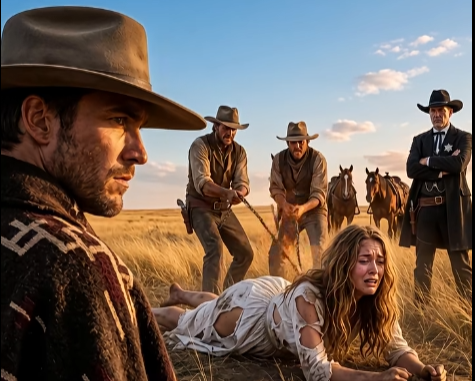
“She Can’t Walk Anymore…” — Until The Nameless Gunslinger Makes Them Pay
The chain was the loudest thing on the prairie.
It dragged through the dry grass with a sound like a rattlesnake that would not stop, and every time it went taut, it rang. Nine miles south of Hays City, Kansas, in the yellow middle of a Friday afternoon in August of 1879, there was nothing else to hear.
No fence. No farmhouse. No church bell. Just wind in the bluestem, two saddled horses blowing through their noses, and a young woman breathing like every breath had to be paid for. Her name was Liesel Haber, and she was lying face down in the grass.
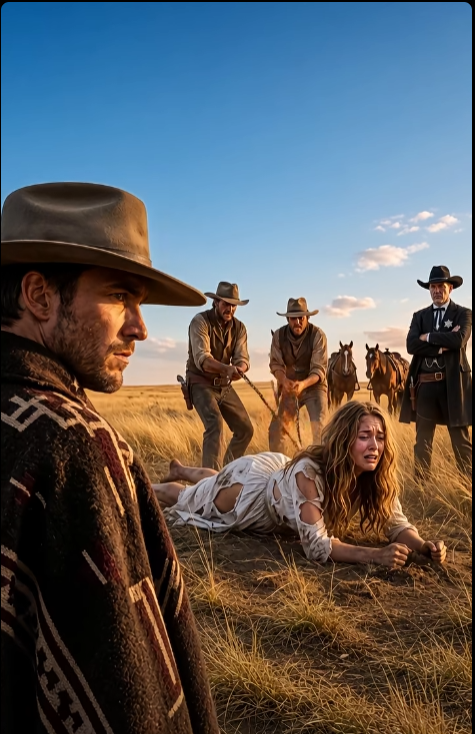
She was twenty-four years old. She had on a white cotton work dress, the kind a camp cook wears because it can be boiled clean, and there was not much left of it. Both sleeves had torn open at the shoulder.
The skirt had ripped along one side where the stubble had caught it, and the whole of it was streaked gray and brown with five miles of Ellis County dirt.
Her feet were bare. She had lost her shoes in Big Creek before dawn, when the mule threw her, and she had walked the rest of the way on prairie stubble that cut like broken glass.
Her long hair, the color of wheat after rain, had come down out of its braid and hung in wet ropes around her face. A chain was looped twice under her arms and padlocked between her shoulder blades.
The other end of it was in the hands of two deputy sheriffs.
Ollie Crain held it nearest, a heavy man with a brown hat, a gray shirt with the sleeves rolled to the elbow, and a dark vest gone shiny at the pockets.
Brody Drummond stood a step behind him and to the right, with a faded bandana at his throat and the slack of the chain wrapped twice around his fist.
Both of them wore revolvers on their hips. Neither of them had looked down at her in an hour. A few yards behind them, Sheriff Lorne Vickery stood with his arms crossed.
He was a tall man in his fifties with a clean-shaven, heavy face, and he dressed like a man who expected to be photographed. Black hat.
Long black frock coat. A white shirt with a black string tie. On the left side of the coat, a six-pointed silver star caught the sun. His boots were clean, which on that prairie was a kind of announcement. He had ridden all the way. Liesel had walked. “She’s dragging her feet on purpose, Sheriff.”
Crain said it without turning his head. “Playing hurt. They all learn that trick.”
Vickery did not uncross his arms. He looked at Liesel the way a man looks at a fence post that has started to lean. “She’ll get up. Give her a reason.”
Then he raised his voice, just a little, toward the wagon road a quarter mile east, where a freighter’s outfit had stopped to let its mules blow. “This is what justice looks like in Ellis County, boys. Stole a mule from the Big Creek Stone Company. Let everybody see what happens to a thief.”
The freighters on the road did not answer. They watched for a minute, the way men watch weather, and then the lead driver cracked his whip and the wagons rolled on toward Hays.
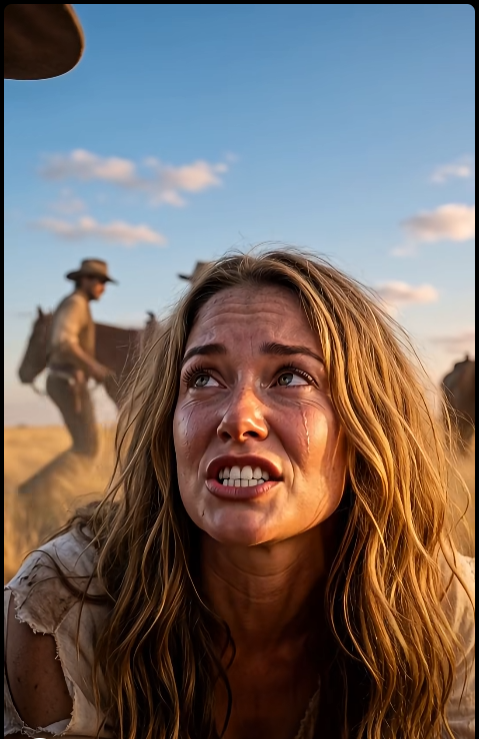
Not one of them asked who she was. Liesel lifted her face out of the grass. There was dirt on her cheek and her eyes were red from crying, but she looked straight past the deputies at the man in the black coat. “Where is my brother, Sheriff? Where is Jakob?” Vickery’s face did not change. “Get her up.”
Crain jerked the chain. Liesel pushed against the ground with both fists. Her arms shook. Her bare knees slid in the dirt. Then her left ankle folded, and she dropped back into the grass, and the sound she made was not quite a cry.
Crain clicked his tongue, like a man whose mule has lain down in harness, and gave the chain a hard jerk. She slid a foot through the grass on her face. That was when the rider on the rise stepped down.
He had been sitting a dun horse thirty yards off for perhaps four minutes, long enough to see all of it. He came down out of the saddle slowly, like a man whose knees had opinions about it, and dropped the reins so the dun would stand. He was a lean, weathered man in his late fifties, with graying stubble on a lined jaw and pale eyes that squinted even when the sun was behind him. His hat was a sweat-stained brown felt with a flat brim.
He wore a heavy wool poncho in dark brown, woven with bands of wine red and pale cream in a stepped pattern like the edge of a canyon, and under it a faded shirt. When the wind lifted the poncho, there was a worn gun belt underneath with one revolver in it. He walked down off the rise and stopped a few feet to the left of the woman in the grass, close enough to see her hands. He looked at her for a long moment.
He looked at the chain. Then he looked up at the two men holding it. Crain noticed him first. His hand went to rest on the butt of his holstered revolver, so the stranger would see it there. “Ride on, old-timer. This is county business.” The stranger did not answer him. He did not raise his voice, either, when he finally spoke.
He said it the way a doctor says a thing that has already happened. “She can’t walk anymore.” For a second nobody moved. Then Brody Drummond laughed, short and ugly, and wrapped one more turn of the chain around his fist. “Then she can crawl to Hays.” In the grass, Liesel Haber turned her head and looked up at the stranger.
Her lip was split and her voice came out of her like something torn, but it came out. “I can walk. Just not for you.” The stranger’s eyes went from her face to Drummond’s fist. “Set that chain down, son. Gently.” Behind them, Sheriff Vickery had stopped looking bored.
He was staring at the stranger’s face under the flat brown brim, and something in his own face had gone very still, the way a dog goes still when it hears a step it remembers. “Well, now. I heard you were dead.” The stranger did not take his eyes off the chain. “Lots of folks heard that, Lorne. Tell your boy to set it down.”
Vickery smiled, but only with the bottom half of his face. “Pull, Brody.” The stranger spoke once more, quietly, before Drummond could. “Pull once more and you’re the one who can’t walk.” Drummond pulled.
Nobody on that prairie saw the stranger draw. The poncho moved, and there was one flat, hard crack that rolled away across nine miles of grass with nothing to stop it.
The chain jumped in the dirt halfway between Drummond’s fist and Liesel’s back, and a link that had been whole a moment before….
Để lại một phản hồi