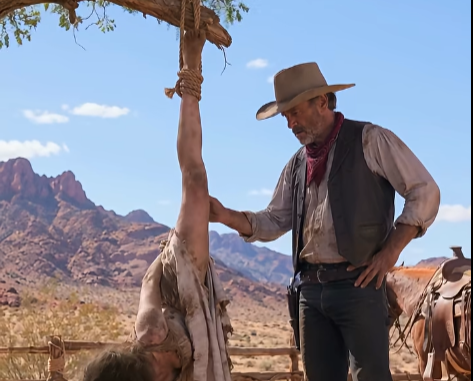
“Turn away… please.”
Shame, terror, helplessness—each word trembled beneath the merciless noon sun.
Nora dangled upside down from a cottonwood branch, one ankle bound in coarse rope that had bitten deep into her skin. Every attempt to lift herself made her hair drag through the cracked earth. Dust clung to her face. Her breathing came in thin, desperate pulls.
Then she saw him.
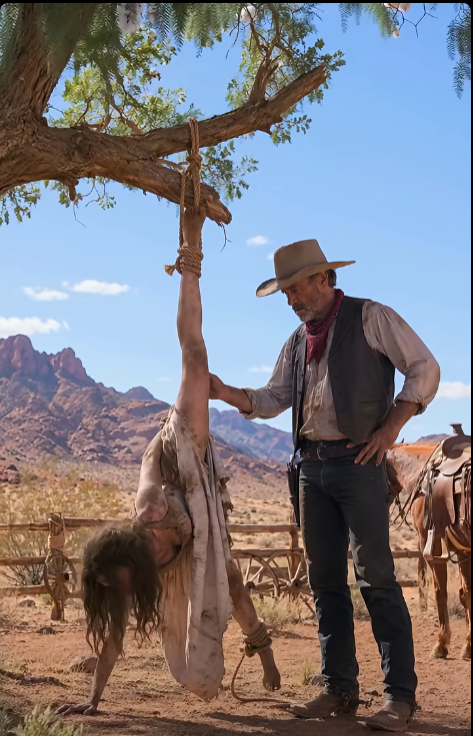
An older rider stood a few feet away, weathered by years and dry country. Caleb Horn did not move at once. His hand drifted toward the blade at his hip, then stopped.
He had seen cruelty before. He knew how often it ended in blood.
For one hard moment, he considered riding on.
To Nora, he had to look like every other man who had stood by and watched.
“Turn away,” she whispered again. “Please.”
The wind shoved dust between them.
Caleb turned his back immediately.
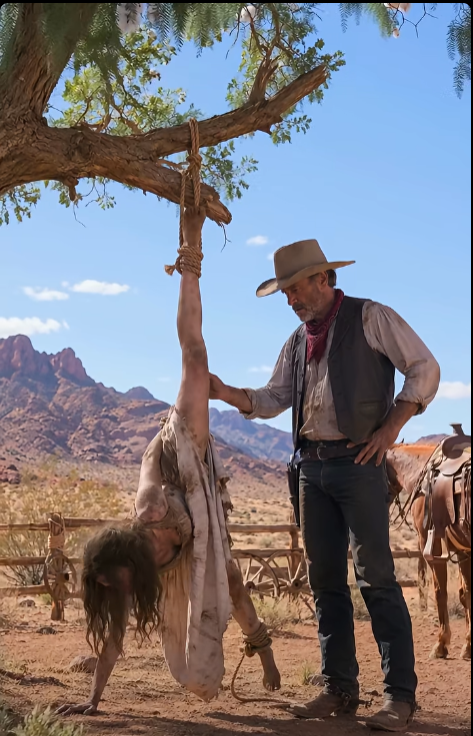
Not slowly. Not reluctantly. He faced the far ridge, pulled the kerchief from his neck, stripped off his outer shirt, and stepped toward the rope with his eyes fixed only on the knot.
“Don’t move,” he said quietly.
She flinched at the flash of his knife.
Then the rope split.
Nora struck the ground hard, curling inward. Before she could scramble away, Caleb tossed the shirt over her. She wrapped it around herself and dragged in breath after breath, as if she had been pulled back from someplace dark.
Caleb stepped away again. He looked toward the ridge.
No questions. No pity.
Only wind, dust, and the sound of both of them breathing.
At last Nora spoke, but the brokenness had left her voice. What remained was guarded and sharp.
“Who put you up to this?”
“Nobody,” Caleb said. “I ride alone.”
She did not believe him.
Out here, she had no reason to.
She staggered to her feet, still wrapped in his shirt, and backed away. Caleb kept his gaze lowered, but he saw enough: fading bruises around her wrists, drag marks in the dirt, boot prints layered over one another.
Three men, maybe four.
And one thought settled into him like a stone.
If they wanted her dead, she would already be dead.
They had left her alive because they were looking for something.
“You’re hurt,” he said.
Nora shook her head.
Then she ran.
She vanished into the dry brush without another word, leaving Caleb beneath the cottonwood with the severed rope twisting in the heat.
Near the roots, something caught the light.
A worn leather pouch.
Inside was a folded land deed, signed, sealed, notarized. It was worth more than most men’s lives in country like this.
Caleb looked toward the brush where she had disappeared. Then toward the empty road leading south to Tombstone.
He could leave.
He had earned the right to let another person’s trouble remain their own.
But her voice stayed with him.
She had not begged him to save her life. She had begged him to let her keep what little dignity those men had not stolen.
He folded the deed and tucked it into his coat.
In Tombstone, Ruth Callahan saw him before he knocked on her boarding-house door.
“You’ve got that look again,” she said. “Like trouble introduced itself.”
“Usually does.”
He placed the deed on her table. Ruth looked at the name.
Whitmore.
Her face changed.
“Nora Whitmore,” she said softly. “Nineteen. Her father died three months ago.”
She told him about the ranch at the river bend. Modest acreage. Good water. Better soil.
Silas Creed wanted it.
When Nora refused to sell, fences were cut, waterlines cracked, livestock disappeared. Stories spread until people began looking away.
“The law?” Caleb asked.
Ruth’s mouth tightened. “You mean Sheriff Dolan?”
That was answer enough.
Late that night, Nora appeared in the doorway wearing Caleb’s shirt over her own clothes. A small derringer rested in her hand.
Her eyes went straight to the deed.
“You kept it.”
“Didn’t feel right to do otherwise.”
“I watched the window,” she said. “Long enough to know you hadn’t taken it to Dolan.”
Then she asked, “How much time do we have before they come back?”
By dawn, they were riding for the Whitmore Ranch.
The gate hung broken. Fence wire had been cut cleanly. Inside the house, drawers were open and floorboards shifted.
Nora dropped beside a loose plank and pulled out a cloth-wrapped bundle.
“My father used to say land doesn’t get stolen with guns,” she said. “It gets stolen with paper first.”
She held the bundle close.
“They’re not getting it.”
Then horses thundered toward the house from the wrong direction.
Caleb’s hand went to his weapon.
“Back door.”
Caleb barely finished speaking before the first bullet shattered the kitchen window.
Nora dropped to the floor, clutching the cloth-wrapped bundle against her chest. Glass scattered across the wooden boards as another shot tore through the wall.
A familiar voice called from outside.
“Miss Whitmore! You’ve caused enough trouble!”
Nora went pale.
Silas Creed.
Caleb moved toward the window, keeping himself out of sight.
Four riders surrounded the house. Creed sat upon a black stallion, dressed in an expensive gray coat that seemed strangely untouched by the dust.
Beside him was Sheriff Dolan.
The very man sworn to protect the people of Tombstone.
“Hand over your father’s documents,” Creed shouted, “and we can settle this like civilized people.”
Nora’s fingers tightened around the bundle.
“Civilized?” she whispered. “After what they did to me?”
Caleb looked at her.
“You don’t owe those men anything.”
He guided her toward the rear of the house, where an old storage cellar opened beneath the kitchen.
“My father built a passage through there,” Nora said. “It leads to the irrigation ditch.”
“Then that’s where we’re going.”
They disappeared beneath the floor moments before Creed’s men entered the house.
By the time the riders discovered the empty cellar, Caleb and Nora had reached the cottonwoods beyond the river.
Creed’s angry voice echoed across the valley.
“Find them! I want those papers!”
They rode until the ranch disappeared behind the distant hills.
Near sunset, Caleb stopped beside an abandoned mining cabin nestled against a rocky hillside.
Nora could barely stand when she dismounted.
Her injured ankle had swollen, and exhaustion weighed heavily upon her shoulders.
Caleb gathered firewood, heated water, and placed a clean bandage beside her.
“You can tend to that yourself,” he said. “I’ll be outside.”
Nora watched him leave.
For the first time in months, someone had offered her kindness without demanding something in return.
When Caleb returned, she had opened the bundle.
Inside were several handwritten letters, financial records, property maps, and a small black ledger.
“My father knew something,” she said.
Caleb sat across from her.
“Something about Creed?”
She nodded.
“Everyone thinks he’s buying ranches because he wants more cattle. But that isn’t true.”
She unfolded a map.
A blue line followed the river through several properties, including the Whitmore Ranch.
“Three years ago, surveyors discovered that the valley could supply water to the expanding mining operations. Whoever controls these properties controls the water.”
Caleb studied the map.
“And Creed wants all of it.”
“He already owns six ranches. Every family that refused to sell suffered an accident, disappeared, or lost their property through forged documents.”
She opened the ledger.
“My father recorded everything. Payments to Sheriff Dolan. False signatures. Threats against landowners.”
Her voice trembled.
“And three days before he died, he wrote this.”
She handed Caleb a letter.
He read the final paragraph.
If anything happens to me, Silas Creed and Sheriff Dolan must be investigated. My death will not be an accident.
Caleb slowly lowered the paper.
“How did your father die?”
“They said his horse threw him.”
“Did you believe them?”
Nora shook her head.
“My father had been riding horses since he was six years old.”
Tears gathered in her eyes.
“He was the only family I had left.”
Caleb stared into the fire.
For a long time, neither spoke.
Then Nora asked the question she had been carrying since the cottonwood tree.
“Why did you help me?”
Caleb took a deep breath.
“Because once, a long time ago, I didn’t help someone when I should have.”
Twenty years earlier, Caleb Horn had been a deputy in a small settlement near the Texas border.
He had a wife named Margaret and a seven-year-old daughter named Emily.
They lived in a modest house surrounded by wildflowers.
Caleb believed in the law.
He believed that wearing a badge meant protecting people who could not protect themselves.
Then a wealthy cattle baron began terrorizing local farmers.
Caleb gathered evidence against him, but his superior ordered him to remain silent.
He obeyed.
He convinced himself that protecting his family mattered more than challenging powerful men.
One evening, he returned home to find his house burning.
Margaret and Emily never made it out.
The cattle baron was never convicted.
Caleb buried his family beneath an oak tree, surrendered his badge, and spent the next twenty years wandering from one forgotten town to another.
“I thought staying out of trouble would keep them safe,” he told Nora.
His eyes remained fixed on the flames.
“I was wrong.”
Nora looked down at the ledger.
“Then help me finish what my father started.”
Caleb lifted his head.
“You understand what that might cost?”
“Everything.”
She paused.
“But if I run, Creed will do this to someone else.”
For the first time in twenty years, Caleb felt something he thought he had buried alongside his family.
Purpose.
Two days later, they returned to Tombstone under the cover of darkness.
Ruth Callahan welcomed them through the rear entrance of her boarding house.
When she saw Nora’s injuries, her expression hardened.
“Those animals.”
She prepared food, found clean clothing, and listened as Nora explained what her father had discovered.
Ruth examined the ledger.
“This could bring down half the men who run this town.”
“Only if someone outside Dolan’s authority sees it,” Caleb replied.
Ruth thought for a moment.
“There’s a federal marshal named Samuel Bennett. He’s expected in Tucson this week.”
“Can we reach him?”
“Perhaps. But Creed’s men are watching the roads.”
Nora looked toward the window.
“Then we need more than documents.”
Caleb turned to her.
“What do you mean?”
“Witnesses.”
The following morning, Ruth began visiting families who had lost their ranches.
At first, nobody wanted to speak.
They feared Creed.
They feared Dolan.
They feared losing what little they had left.
Then Nora stood before them.
She told them what had happened beneath the cottonwood tree.
She told them about her father.
And she showed them the ledger.
An elderly rancher named Thomas Hale was the first to step forward.
“Creed threatened my sons,” he admitted. “That’s why I signed.”
A widow named Eleanor Brooks followed.
“Dolan told me my husband’s signature was genuine. But my husband had been dead for six months when those papers were signed.”
One by one, the frightened townspeople began telling their stories.
By evening, Ruth had collected eleven sworn statements.
For years, Creed had maintained his power by keeping people isolated.
Now those people were finally standing together.
But someone was watching the boarding house.
And before midnight, Silas Creed learned everything.
Caleb awoke to the smell of smoke.
Flames were spreading through the boarding house.
“Ruth!”
He rushed into the hallway.
Nora was already helping an elderly guest toward the staircase.
Smoke thickened around them.
Outside, townspeople formed a line carrying buckets of water.
Caleb helped the remaining guests escape, then returned for Ruth, who had injured her shoulder beneath a fallen beam.
By the time everyone reached safety, the roof was beginning to collapse.
Ruth stared at the burning building.
Thirty years of her life disappeared before her eyes.
Her furniture.
Her photographs.
Her savings.
Everything.
Nora approached her with tears streaming down her face.
“I’m so sorry.”
Ruth turned toward her.
“Don’t you dare apologize for what those men did.”
She reached beneath her coat and produced the black ledger.
“I figured they might try something.”
Despite the destruction surrounding them, Caleb smiled.
“You’re a remarkable woman, Ruth.”
“I know,” she answered. “Now let’s make sure they regret underestimating us.”
The following afternoon, a notice appeared outside the sheriff’s office.
NORA WHITMORE — WANTED FOR THEFT, ARSON, AND ATTEMPTED MURDER.
Beneath her name was Caleb’s.
Creed had accused them of stealing company documents and setting fire to Ruth’s boarding house.
Sheriff Dolan offered a substantial reward for their capture.
Caleb read the notice without speaking.
Nora stood beside him, her face filled with disbelief.
“They burned Ruth’s home, and now they’re blaming us?”
“That’s what men like Creed do,” Caleb replied. “They make the truth sound like a crime.”
A crowd began gathering around them.
Then Sheriff Dolan emerged from his office.
“Well, well. You’ve saved me the trouble of finding you.”
Several deputies stepped onto the street.
Silas Creed appeared behind them.
He smiled at Nora.
“You could have avoided all this by signing one little piece of paper.”
Nora stood her ground.
“My father’s ranch will never belong to you.”
Creed’s smile disappeared.
Dolan approached Caleb.
“Hand over your weapon.”
Caleb remained still.
Then Nora stepped forward.
“You want to arrest me? Do it in front of everyone.”
She raised her voice so the gathering crowd could hear.
“But first, tell them why you received eight hundred dollars from Silas Creed three days before my father died.”
Dolan stopped.
Creed’s expression changed.
Nora continued.
“Tell Mrs. Brooks why her husband’s signature appeared on a deed six months after his funeral.”
The widow emerged from the crowd.
Then Thomas Hale stepped forward.
“Tell them what you threatened to do to my boys.”
More townspeople gathered.
For the first time, Sheriff Dolan found himself surrounded not by obedient citizens, but by people demanding answers.
Creed pointed toward Nora.
“She’s lying!”
“Then you won’t mind explaining these records.”
A new voice interrupted him.
Everyone turned.
A tall man wearing a dusty traveling coat stood near the end of the street.
A silver federal badge gleamed beneath his coat.
Samuel Bennett.
Behind him stood Ruth Callahan.
Caleb looked at her in surprise.
Ruth smiled.
“Did you really think I spent yesterday collecting signatures without sending a telegram?”
Marshal Bennett approached Sheriff Dolan.
“I’ve received sworn statements alleging fraud, extortion, and conspiracy. I also have copies of the financial records connecting you to Mr. Creed.”
Dolan’s face drained of color.
Creed glanced toward his horse.
“Those documents are fabricated.”
“Then you’ll have an opportunity to prove that in court,” Bennett replied.
Creed reached toward his weapon.
Caleb stepped between him and Nora.
“Don’t.”
For several seconds, the entire street fell silent.
Creed looked around.
His hired men were backing away.
His influence was disappearing before his eyes.
Even Sheriff Dolan seemed unwilling to defend him.
Finally, Creed lowered his hand.
Marshal Bennett ordered both men taken into custody.
Nora watched as the man who had terrorized her family was escorted away.
She had imagined this moment countless times.
She thought she would feel satisfaction.
Instead, she felt an enormous weight lift from her shoulders.
She could finally breathe.
The investigation lasted several months.
Federal authorities uncovered forged deeds, illegal payments, stolen property, and evidence connecting Creed’s organization to multiple suspicious deaths.
One of Creed’s former employees eventually confessed that Nora’s father had been murdered because he refused to surrender his land and destroy the ledger.
Silas Creed and Sheriff Dolan were convicted and sentenced to prison.
The fraudulent property transfers were overturned.
Families returned to ranches they had believed were lost forever.
The Whitmore Ranch remained legally and rightfully Nora’s.
But victory did not erase everything.
Some nights, Nora still woke trembling.
Sometimes the sight of a cottonwood tree made her heart race.
She carried scars that would never completely disappear.
Yet slowly, she began rebuilding her life.
She repaired the fences.
Restored the irrigation channels.
Purchased new cattle.
And planted wildflowers beside her father’s grave.
Caleb helped whenever she asked, never making decisions on her behalf.
He taught her how to repair a saddle, negotiate with cattle buyers, and recognize dishonest contracts.
Nora, in return, reminded him that life could still contain laughter.
One morning, nearly a year after their first encounter, Caleb saddled his horse.
Nora found him standing beside the ranch gate.
“You’re leaving?”
“Figured you don’t need an old drifter hanging around anymore.”
She looked at him for a moment.
Then she reached into her pocket and unfolded a piece of paper.
It was a newly prepared property deed.
Caleb frowned.
“What’s this?”
“The old foreman’s cottage and five acres beside the river.”
He shook his head immediately.
“No, Nora. I can’t take your land.”
“You’re not taking anything.”
She smiled.
“I’m offering you a home.”
Caleb stared at her.
“You spent twenty years riding from town to town because you thought there was nothing left for you.”
Her voice softened.
“But there is.”
She looked toward the ranch house.
“Ruth is rebuilding her boarding house. The neighbors are coming over for supper. There’s work to be done tomorrow, and someone needs to teach me how to fix that stubborn old windmill.”
Caleb lowered his eyes.
For twenty years, he had carried the belief that he no longer deserved a place in anyone’s life.
Now a young woman he had encountered beneath a cottonwood tree was offering him something he had stopped searching for.
A family.
Not a replacement for the one he had lost.
Something new.
Something worth protecting.
“Your father would be proud of you,” he said.
Nora smiled through her tears.
“And I think your daughter would be proud of you, too.”
Caleb turned toward the distant mountains.
Then he slowly removed his saddle from the horse.
“I suppose that windmill isn’t going to fix itself.”
Nora laughed.
“No, it certainly isn’t.”
Five years later, the Whitmore Ranch had become one of the most prosperous independent ranches in the territory.
Nora employed widows, struggling farmers, and families who needed a second chance.
Ruth’s new boarding house stood proudly in the center of Tombstone.
And Caleb Horn, once a lonely cowboy who believed his best years were behind him, became known throughout the valley as the man people could depend upon.
One afternoon, Nora and Caleb rode past the old cottonwood tree.
The severed rope was long gone.
Fresh grass surrounded its roots.
Nora stopped her horse.
“Do you remember what I said to you that day?”
Caleb nodded.
“You asked me to turn away.”
“I thought you were going to hurt me.”
“I know.”
She looked at the branches swaying gently in the wind.
“But you turned your back when I asked you to. And when everyone else turned away from my suffering, you stayed.”
Caleb removed his hat.
“Sometimes doing the right thing is simpler than people make it.”
Nora smiled.
“Thank you for staying.”
Together, they rode toward the ranch as the evening sun painted the valley gold.
Neither of them looked back.
They had spent enough of their lives running from the past.
Now they finally had somewhere to go.
Somewhere they belonged.
Caleb Horn had believed he was saving a stranger beneath that cottonwood tree. He never imagined that, in doing so, he would also save the forgotten pieces of himself.
THE END.
Để lại một phản hồi