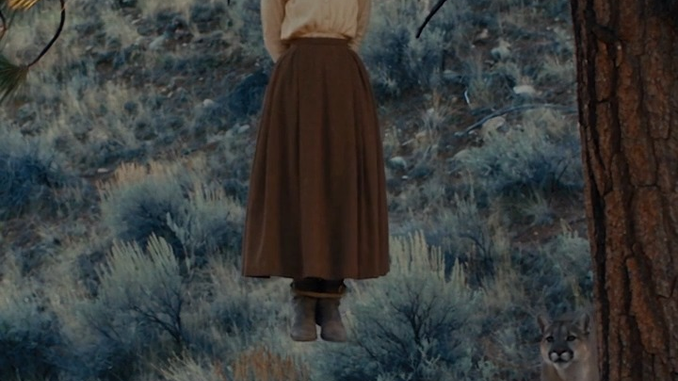
“Please! Somebody help me!”
Clara Bennett hung from a rope beneath the great pine. The loop passed under her arms and across her chest; her wrists were tied behind her back, and thick leather straps held her ankles together. Daniel had hauled her high enough that her boots swung beyond the reach of a man standing below. He had left her horse, her money, and the only rifle they owned on the far side of the ridge. Nearly an hour had passed.
A strand of the rope scraped across the branch above her. She heard it part. The remaining fibers tightened with a small, dry creak.
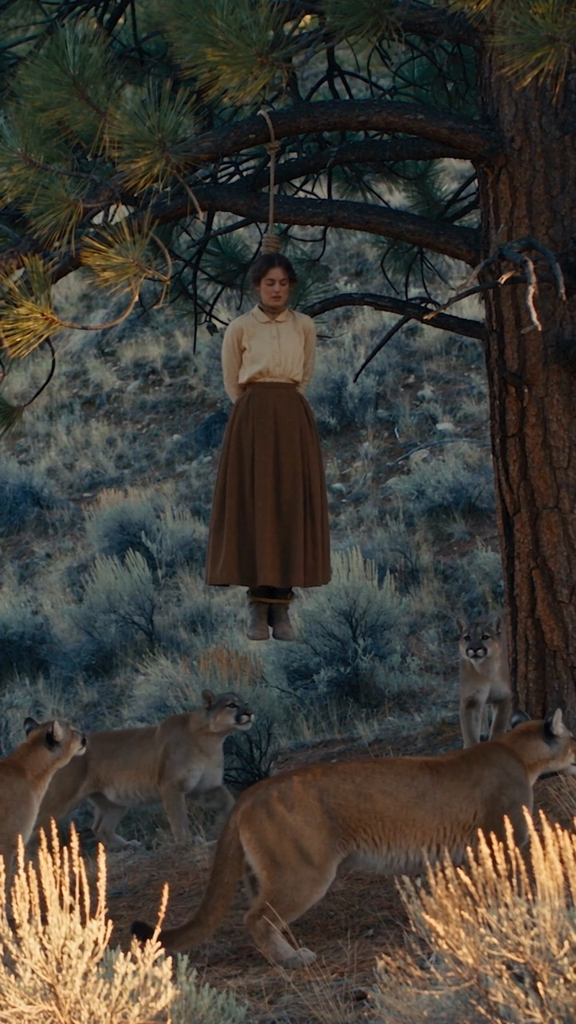
Below her, several mountain lions moved through the grass. One tested the bark with its front claws and slipped back; another jumped at a lower limb. They were close enough that Clara saw the dark rims of their ears. She pulled her bound ankles upward, making the rope rub harder against the branch. She forced herself still.
“Daniel! Please come back!”
There was no answer from the ridge. A cat scrambled onto the low limb. Clara could feel the branch tremble through the line. She closed her eyes as it gathered itself to climb higher.
A gunshot broke over the slope.
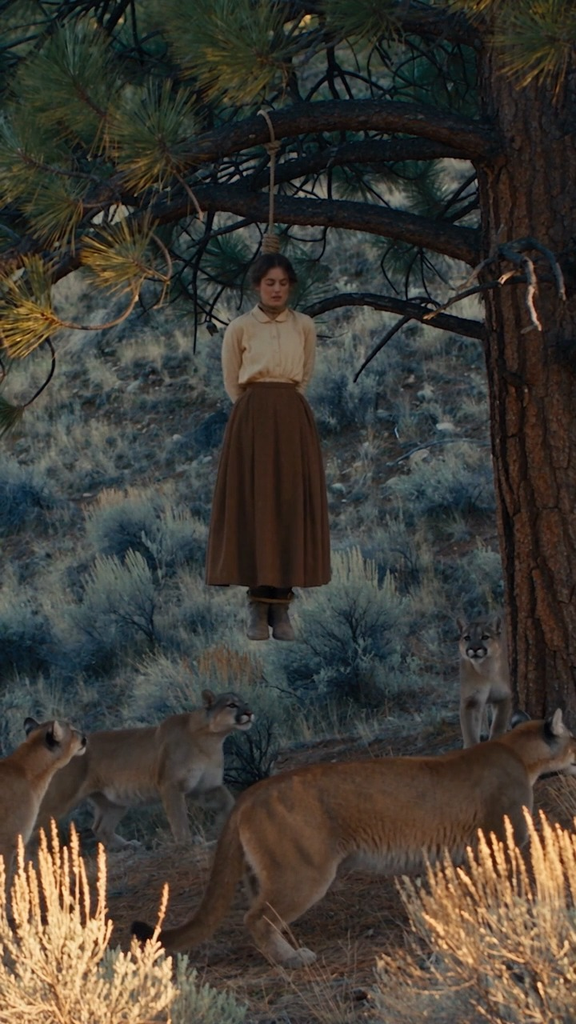
The animal sprang from the limb; the others scattered into the brush. For one breath Clara could hear only the rope sawing against wood. The line held, barely. A gray-haired man came down from uphill left with an old Winchester, his muzzle already lowered. He looked at the cats’ retreat, then at the frayed rope above her.
“Clara Bennett?”
“Help me down.”
He set the rifle against a rock and reached the end of the line Daniel had wound around the trunk. “I’m Samuel Reed. I rode for your father twenty years ago. I can lower you if you hold still.”
Clara remembered the name. She caught the rough bark with the side of one boot while Samuel unwound a turn, braced himself, and fed the rope through his hands. The damaged fibers creaked over the branch. Then her boots met earth. He held the line until she leaned against the pine and could bear her own weight. Her wrists and ankles remained bound.
Samuel studied the rope marks and the straps. His expression turned cold. “Who did this to you?”
Tears she had held back while Daniel worked the knots came now. “My husband.”
Samuel looked toward the distant ridge. He slid a hand into his faded coat.
“Then there’s something you need to know about Daniel,” he said. “He’s been looking for something your father buried before he died.”
He drew out an old leather envelope. Inside was a folded document bearing a signature Clara knew better than her own. The name written at the bottom was not Daniel’s.
It was Clara’s.
For a moment she could only look at the letters. Her father used to leave notes beside the stove in a hand so angular that every word seemed to lean into the next task. She had seen that hand on feed tallies and winter lists, on the backs of seed sacks when paper was scarce. Death had taken his voice; the ink brought his presence back with a force that made the mountains seem to tilt.
The cowboy did not push the page closer. “I’m Samuel Reed,” he said. “I rode for your father twenty years ago.”
She remembered the name from a story about a broken water trough and a man who had stayed up all night to keep the stock from wandering. Her father had told it when she was little. There had been other stories, less clear. Samuel was a real man in front of her now, with a rifle and a document he had not yet explained. Daniel had been a real man beside her at breakfast, too.
“Read it to me,” she said. “Every word.”
Samuel glanced at her bound hands. “I’ll get you loose.”
“First tell me what you have.”
He met her gaze and unfolded the page, careful of the old crease. Before he spoke, Clara saw the beginning of a description of the ranch, and below it the shape of her father’s last deliberate signature. How had she come to this pine without knowing that such a paper existed?
That morning, before the mountain and the cats, she had thought the worst thing hidden from her was the loss of fourteen cattle.
The day had begun with frost at the edge of the stock trough. Clara broke the thin ice with the heel of a bucket and watched the water clear beneath it. October could make the country look generous at noon and take the warmth out of a man’s fingers by dusk. She had brought the cows down from the higher grass two days earlier, counting as they passed the gate in a patient line. Seventy-two had been on the last sound tally. Fifty-eight had passed her, including the limping roan cow she could recognize from half the range.
She counted again the next morning. Fifty-eight. There could be strays in the draw, but fourteen strays did not go missing together without tracks. The hoofmarks from the lower gate ran along the wagon road. The gate latch was closed on a loop Daniel used when he expected to open it again soon. He had said the herd was spread out and that she was wearing herself thin over numbers. She knew the difference between a wandering animal and a driven group.
Her father had taught her to count at the narrow crossing, where no two could pass abreast. As a child she had called the animals by their colors. Later she had learned to mark what could be sold, what was nursing, what had to be kept through a hard winter. A tally did not make a person rich. It told her whether there would be feed enough until spring.
Daniel came into the kitchen with dust on his riding trousers and set his hat beside the stove. His face was broad and wind-reddened. He kissed her cheek without noticing that she held the ranch book in her lap.
“You were out early,” he said.
“So were you.”
“Looking at that gate.” He poured coffee. “It wants a new hinge.”
“The hinge is sound.”
He smiled the way he did when he wanted a question to pass by. In the first year of their marriage she had mistaken that smile for ease. Lately it appeared whenever a bill, a visitor, or a missing tool needed explaining.
She turned the book toward him. “Seventy-two at the crossing after the last gather. Fifty-eight in the lower pasture. I followed the hoofmarks to the road.”
“Cattle move, Clara.”
“Fourteen of them were driven through the gate.”
He took his cup and sat. “If you’ve already decided what happened, why ask?”
She heard the first note of anger and kept her voice level. “Because I want you to tell me.”
Daniel had been handling market errands since her father died. Clara handled feed, the garden, the house, the sick animals and, as often as not, the counting. They had spoken of selling a few steers before snow, but had agreed to inspect the herd and settle the winter feed first. The pages before her contained no agreed sale. She had looked twice, then a third time while the coffee warmed.
“I took them to a buyer,” Daniel said. “We needed cash.”
“How much? And where is it?”
“Spent on things this place needs.”
“The meal account is still open. The roof still leaks over the tack room.” She laid a finger against the blank line in the book. “Which buyer?”
He set the cup down hard enough to spill coffee. “Morrow. He was moving a string through the valley. I made the best price I could.”
She knew Morrow by sight, a quiet man who kept a written account of what passed through his hands. Daniel had mentioned seeing him on the road three days earlier and nothing more. A buyer who took fourteen cattle would have a tally. So would the seller, if the sale were meant to withstand daylight.
“You should have told me before they went,” Clara said.
“I told you we needed money.”
“That isn’t the same thing.”
He got up. “You don’t know the price of keeping a ranch.”
“I know the cost of fourteen head.”
He looked at her then, not as he had when he first came to the house and offered to mend the gate without being asked, but as if her knowledge were a trespass. It startled her more than the raised voice. Her father’s ranch was not a room she had entered by mistake. She had walked its winter edges before Daniel knew the road to it.
“There are other papers,” Daniel said. “Your father left things in a state no one could untangle. I have to find what he put away.”
“What papers?”
He turned his face to the window. “Never mind. Put the book back.”
Clara closed it without moving from her chair. “Tell me what you took for the cattle.”
He came around the table. She expected another argument, perhaps the long silence with which he could make a day heavy. He caught her upper arm. She rose because remaining seated hurt more. When she pulled away, his grip tightened.
“You’ve forgotten how a wife speaks to her husband,” he said.
“I asked about a sale.”
“You questioned me as if I were a hired man.”
“You made a bargain with what belongs to this ranch. I have every reason to question you.”
“Then you’ll learn never to do it again.”
He took the book from her and set it on the shelf beyond the stove. She tried once more to speak, but he had already fetched her coat and pushed her toward the door. Outside, the morning light lay flat over the yard. Her horse was tied near the hitching rail. Daniel had saddled his own. Against his saddle lay the leather case for the one rifle they kept in the house.
“Where are we going?” she asked.
“You can come up the ridge with me and cool your temper.”
“I don’t need a ride. Let go.”
His answer was to put her on her horse while the yard and the empty pasture swam in her sight. There was no one at the far fence. She could have shouted; the nearest occupied place was too far to hear. He led her horse out, then mounted. Once they were beyond the buildings, he released the lead and told her to ride ahead. She considered turning downhill. He rode close enough to catch the rein, and the case at his saddle reminded her what he had chosen to bring.
The path climbed through yellow grass to the pines. Clara tried to fix every turn in her mind. Her father had ridden this country with her when she was young, but the light and the steep angle made familiar slopes strange. Daniel spoke only once, to tell her to stop beside a great pine overlooking a dry hollow. She dismounted. He took her rein, then pulled a length of rope from his saddle.
“No,” she said.
“It’ll give you time to think.”
“Daniel, listen to yourself.”
He bound her wrists behind her back and fastened thick leather straps around her ankles. Then he cast the end of a longer rope over a heavy branch, drew a loop around her chest and beneath her arms, and used the horse to pull until her boots left the ground. He wound the free end twice around the trunk and secured it. There was no ceremony in it. He worked quickly, as he did with a balking animal, and that ordinary competence made what he was doing harder to understand.
“When you come back, we’ll speak about the cattle,” she said. She still believed he intended to frighten her and return.
“You’ll speak when I say so.”
He searched the pocket of her coat. The small roll of money she had saved for supplies went into his own pocket. He took the reins of her horse and checked that the rifle case was secure on his saddle. Her horse turned its head toward her when he led it away. Clara called its name. Daniel did not stop.
The ridge swallowed him, two horses, the money and the only rifle she had thought might be within reach. She tried to free her wrists until her hands went numb. Each swing made the branch rub the rope, so she held herself as still as she could. She told herself he would ride back when the anger went out of him. She told herself she would not mistake his return for an apology.
As time passed, she began to listen for every living thing on the slope. A jay cried far uphill. Grass brushed against grass below her. She saw one tawny shape among the stalks, then another. A third moved toward the tree, where a low branch gave it a way upward. Above her, the rope began to fray against the bark.
Now, back in the afternoon at the pine, Samuel read the signed paper in a voice kept low and steady. It named Clara as the person her father had intended to hold and manage the ranch after him. It described the land and the herd without claiming to settle every question a stranger might raise. Her father had written that the original ranch papers and his stock book were put where an old spring fed the east fence line. He gave a measured direction from a split cedar post he had repaired himself. The words were ordinary, practical, his way of leaving a route a daughter who knew the ground could follow.
“Why give this to you?” Clara asked.
“He handed me the envelope before he died,” Samuel said. “He asked me to keep it until you needed to know where the records were. I thought he was being careful with papers. A man who survived dry summers can get particular about keeping things safe.”
“You didn’t tell me.”
“I should have.” He accepted the weight of it. “I hadn’t seen you in years. By the time I heard Daniel was looking for a buried packet, I was trying to find out whether he’d come near it. I rode this way because I saw your horse tracks climbing with his. Then I heard you.”
She looked at his rifle. “You didn’t hit any of them?”
“I fired into the bank beyond them. They had a way out.”
Her father’s name was still visible where Samuel held the paper. Clara wanted to reach for it, and the rope made the desire almost unbearable. The document had been in a pocket far from her while she counted cattle and asked for the truth at her own table. It could not give her back the hour at the pine. It could not tell her whether Daniel had found the buried packet first.
Clara tried to remember the last conversation she had had with her father about the ranch. He had been sitting by the stove with a blanket across his knees, asking if the lower pasture held enough water for another dry week. She had answered him, and they had argued gently about whether a trough should be moved. If he had spoken then of a hidden book, she would have known where to go when Daniel first took over the market trips. Instead he had left a route in an envelope, entrusted to a man she had not seen since childhood. The arrangement made her feel protected and overlooked at once. She did not want to choose between those feelings merely because one of them was more grateful.
Samuel kept the page steady despite the breeze. He could have told her that her father had loved her and asked her to accept the delay on that account. He said nothing. Clara saw the wind move the paper’s edge against his thumb and the pale marks where the old fold had nearly worn through. It was evidence she could read, not a command she had to obey. She would decide what it meant after she understood where the rest of the records lay.
“Let me see the last line,” she said.
Samuel stepped close enough to angle the page into the light. Beneath her name, her father had added a brief instruction about the spring, the fence, and keeping a clear count. Clara read it twice. She knew the split post. Daniel had ridden past it often. If he guessed what her father had hidden, the distance from this mountain to that piece of fence was suddenly the measure of everything she might still lose.
She remembered the spring in August, little more than water seeping out between two stones. Her father had laid flat rock beside it so an animal could drink without turning the place to mud. The cedar post beyond it split one winter under a drift. He had bound it with wire and laughed when Clara asked why he did not replace the whole thing. “A repair tells you where to look,” he had said. “A new post looks like every other post.” She had forgotten the words until now.
Daniel had asked about the east fence in the weeks before the sale. He had taken a spade to the lower ground one afternoon, saying he wanted to test how deep a new post would have to go. At the time she had thought the question tiresome because the old wire was still sound. The thought of him moving from one patch of earth to another while her father’s papers lay hidden nearby made her throat tighten. She would have to tell Samuel what she remembered. She would also have to decide whether Samuel’s account of the envelope was enough. He had kept a paper her father meant for her, and now his arrival seemed so well timed that she could not set aside doubt merely because he had driven off the cats.
“Was there another person when he gave it to you?” she asked.
“No. It was at his kitchen table. He’d put his stock book away already, he said. I didn’t know the place.” Samuel folded the paper along its existing crease. “You don’t have to take my word for what he meant. Read it yourself when your hands are free.”
He put the page back in its envelope rather than slipping it into her coat, which he could not reach without touching her. Clara watched each movement. Samuel left his Winchester against the rock a few steps away, muzzle tilted safely toward the empty slope. He took a small knife from his own pocket. She stiffened before she could stop herself.
“I’ll cut the wrist rope,” he said. “Then the straps. Is that all right?”
Clara nodded. The courtesy was so plain that it hurt. Daniel had not asked before putting the rope on her. There was no way Samuel could undo that fact, but he had given her a small choice at the point where she could still exercise one.
The knife went behind the trunk. While he worked, she looked downhill toward the brush. No tawny shape returned. Her wrists still held the weight of the knot, and her legs shook beneath her. She could imagine the packet at the spring, protected in earth or already gone. She could imagine Daniel at that same fence, reading her father’s count and deciding which page to destroy. The document in Samuel’s envelope named her. What it might enable her to do depended on what still lay buried, and on whether she could stand long enough to reach it.
The wrist rope came away in two pieces. Clara tried to bring her arms forward and felt the muscles across her shoulders seize. Samuel waited while she worked one elbow around at a time. The skin under the rope was striped and raised, but nothing felt broken. He crouched at her feet and held up the knife so she could see it before cutting the leather straps. When the second strap fell, her knees gave. She caught the pine with one hand; Samuel offered his arm but did not pull her toward him.
“I can stand,” she said, though the ground shifted under her.
“Then stand awhile. There’s no prize for hurrying the first step.”
She remained against the trunk. Downhill, the grass had settled. The cats had gone into the brush, and she was still here. She wanted to feel grateful. Instead she was angry that a stranger had seen her tied like a stray calf, that she had cried in front of him, that Daniel had taken even the ordinary ability to walk away.
Samuel took his Winchester from the rock and slung it over his shoulder. “My horse is tied above us,” he said. “I left him where the trail narrows. We can get down before dark if you can ride.”
“Which of us?”
“You. I’ll walk him.”
Clara shook her head. “I can walk the easy ground.”
“We’ll decide at the easy ground.”
It was the first time he had contradicted her since reaching the tree, and even that sounded less like an order than a promise to look at the actual slope. He handed over the envelope. She tucked it inside her coat, against a pocket Daniel had already emptied. The leather was warm from Samuel’s hand and light for something that had altered the weight of the day.
They began uphill because Samuel’s horse was there. Every few yards Clara stopped to stretch her ankles. The straps had left dark marks above her boots. Samuel moved slowly enough that she did not need to ask him to wait. At the narrow turn he pointed out a level rock and went ahead to bring down a compact bay gelding with a water-scarred saddle. Clara recognized the animal from distant rides across the valley. Samuel let her take a long drink from a canteen before helping her into the saddle. He did not touch her until she held out a hand.
From the height of the horse she saw the hollow where the cats had gathered. It was no larger than an ordinary stretch of range. That bothered her. The worst hour of her life had taken place in a patch of country she could have crossed without seeing anything remarkable in it.
“Where were you riding?” she asked as Samuel led the bay downhill.
“To the lower creek. I’ve been helping a man mend a line of fence on the other side. I cut over when I saw two sets of tracks coming up where people don’t often ride this late in the year.”
“You said you saw my horse.”
“I knew her shoe. The near fore has a little nick on the outside. Your father showed me how to read a shoe against stone. I saw Daniel’s mount beside her and thought you might be looking at the upper grass. Then I heard a voice.”
He had not come as a miracle summoned by her call. He had been close, observant, and carrying a rifle of his own. She could hold on to that explanation, though it did not make her forget that he had kept her father’s envelope.
“Why wait until today to find me?” she asked.
“I didn’t know where you’d be. I was going to ride to the ranch tomorrow. Daniel asked me about your father’s buried papers two days ago. Not where I thought they ought to be kept, but where your father went with a spade before he died. I wouldn’t tell him what I didn’t know.”
“What did you tell him?”
“That your father trusted his own memory more than anyone else’s.”
Clara almost smiled. “That much was true.”
Samuel continued, “I should have taken the envelope to you that evening. I was trying to learn whether Daniel had any right to ask. The question was wrong enough without an answer.”
“You could have asked me.”
“Yes.”
She did not need a second apology. She needed him to understand what his delay had cost, and he seemed willing to let the fact stand between them. They rode beneath the pines in a silence broken by the bay’s breathing and the small knocks of stone underfoot.
At the lower bend she slid down to walk. Her feet were unsteady but usable. Samuel tied the lead loosely to the saddle horn and kept pace beside her. The sun went behind the western ridge earlier than the open sky promised. She had spent enough autumn evenings outside to know how quickly a person in damp clothing could begin to shake. Her blouse was dry, but fear had left a chill that the walking did not entirely cure.
She opened the envelope again at a level place in the path. The paper named the ranch by its boundary descriptions, then said her father wished Clara to keep and manage what he had made there. Beneath her name was his signature. He had included a separate paragraph about the stock book and older papers being sealed near the east spring. It was a statement of his intention and a map in words, not a magic key that could put fourteen cattle back behind a gate.
“Would anyone else know he wrote this?” she asked.
“I can’t tell you.”
“Then Daniel can say it means nothing.”
“He can say a great many things. What he cannot change is a count you make with your own eyes.”
She refolded the page. “Counts need someone willing to hear them.”
“Morrow keeps a written tally. If he bought your stock, he’d have put down how many and who brought them.”
Clara looked up sharply. “You know he bought them?”
“I heard a string went down the road. Didn’t know whose. You told me fourteen were gone.”
She was glad he had not claimed knowledge he lacked. Samuel had seen tracks and heard Daniel’s question; Clara had counted the herd and heard Daniel name Morrow. Between those separate pieces was the beginning of a picture, not yet proof of every thing she feared.
They reached the road at dusk. The ranch lay beyond a low fold in the land, a roof and pen she could not yet see. Samuel suggested stopping by the creek to rest. Clara wanted to reach her own door before full dark, though the thought of Daniel behind it made her hesitate.
“He might be there,” she said.
“I’ll go with you as far as the yard. If you want me to wait outside, I will.”
“If he’s there, he knows you found me.”
“He’ll know that whether I stand beside you or not.”
She considered going somewhere else. There was no money in her pocket and no other horse. Samuel might have offered his place, but she would have had to accept shelter in a stranger’s house on a night when trusting another man felt beyond her. The ranch was where the book and the remaining cattle were. Daniel had driven her out of it that morning; she wanted to enter it on her own feet.
They saw no horse at the rail when they came around the last bend. A lamp burned faintly in the kitchen. Samuel stopped at the gate, letting Clara look first. The latch on the stock pen stood in the position she had left it. A cow sounded from inside, and the homely complaint made her want to sit down and weep more than the danger had.
“Wait here,” she told Samuel.
She walked to the house and pushed the door open. The kitchen was empty. Her book remained on the shelf behind the stove where Daniel had put it. A plate from breakfast sat unwashed. There was no sign of his coat or rifle case. Clara checked the side room and the small store closet, then returned to the yard and waved Samuel in. She was ashamed of the relief she felt when he came, and determined not to let shame dictate what she did next.
She lit the lamp properly. The glass needed cleaning; a rim of soot dimmed the flame. She scrubbed it with an old cloth while Samuel carried a bucket from the well. The work took less than a minute, but afterward the room had edges again. Her wrists looked worse in the light. Samuel found clean water and left it on the table, telling her he would look at the horse. Clara washed the broken skin herself. She wrapped it in soft strips from a worn shirt, flexed each finger and found that she could hold a pencil.
The first thing she did with it was write fourteen in the margin of the stock book. She added the date, a note that she had counted fifty-eight at the crossing, and Daniel’s admission that he had taken the missing cattle to Morrow. She did not write that Morrow had cheated or that a court would believe her. She wrote what she knew. The distinction steadied her.
Samuel came in carrying kindling. “The bay is watered. I’ll keep him at the rail if we need him.”
“We?”
“I can stay until you say you don’t need another pair of hands. The fence at the lower creek will stand one more day.”
“Daniel may return in the night.”
“I know.”
“I don’t want you sleeping in this house.” She heard how sharp it sounded. “There is a lean-to by the pen. The roof is sound enough.”
“Then I’ll use it.”
He did not ask why. Clara had known Samuel for an afternoon and Daniel for years; neither length of acquaintance made a promise of safety. She set a pot of beans on the stove, sliced the last of a loaf and placed two plates at opposite ends of the table. Samuel accepted food without turning her hospitality into an agreement that he should make her decisions.
When he had eaten, he told her about the summer he had worked for her father. They had ridden fences after a late storm and discovered a broken trough before the cattle reached it. Her father had insisted on saving the boards because timber cost more than patience. Samuel smiled at the memory, then looked down at his hands.
“He talked about you even then,” he said. “You were a little girl who could tell a sick calf by how it held its ears.”
“He was proud of small things.”
“He was proud that you noticed.”
Clara wanted the comfort of that sentence, but she also remembered her father letting someone else hold the envelope addressed to her. “He didn’t tell me where the papers were,” she said.
“No. He made a choice for reasons I don’t know.”
“Daniel had already begun asking him about the accounts,” she said, remembering old conversations cut short when she entered the room. “Perhaps Pa thought the paper would be safer away from the house. Perhaps he thought I wouldn’t need it.”
“Perhaps. We can ask what the papers say. We can’t ask him now.”
It was the first thing Samuel had said about her father that did not try to improve him by memory. Clara appreciated it. She had loved the man and been frustrated by his silences. A signed page could be a gift and still be late.
After Samuel went to the lean-to, Clara took the lamp into the small room where her father had kept tools and records. His old desk held receipts for feed, mending twine and salt. Daniel had handled market money, but he had not tended this desk. There were years of ordinary entries, the kind that showed how much hay had been cut and which calf had been treated for a swollen leg. The newer pages were thinner. She found no record for the fourteen cattle. She did find a note in her own hand about a needed repair to the east fence, written the previous month. Daniel had made a mark beside it without telling her the work was done. He had gone near the spring, at least.
She put the papers down and walked outside with the lamp shaded by her hand. The pen smelled of hay and warm hide. The limping roan cow shifted near the trough. Clara knew each small patch on its face. She had once held the animal through a night when it would not eat, then spent the next morning chasing it out of her garden. Its weight was real. Fourteen missing animals were not a figure in a book to be pushed across a table. They were winter feed already purchased, calves that might have followed, work done before dawn.
Samuel emerged from the lean-to at the sound of her step. He kept his distance. “Need something?”
“Another count in the morning. At the crossing. I want you to stand where I can see you and make your own tally.”
“I will.”
“If they match, we go to the spring.”
He tilted his head. “Before speaking to Morrow?”
“Before asking anyone to believe that paper. If Daniel found what Pa buried, we need to know. If he hasn’t, I want the original book in my hands before he guesses where it is.”
Samuel looked toward the dark line of the east fence. “He was searching the upper mountain two days ago. He may still be looking in the wrong place.”
“Then we have one morning.”
She went inside, barred the door and set the envelope beside her stock book. For the first time since Daniel had taken her up the mountain, she made a plan measured by work she could do, not by the chance of his mercy. At dawn she would count. Then she would dig.
Sleep did not come when she lay down. Each time a board settled she heard Daniel at the door. She got up twice to test the bar. The second time she found herself standing with her bandaged hands pressed against the wood, waiting for a command that did not come. The house had been hers before marriage, yet he had made its rooms feel borrowed. She could remember when that change began in small, agreeable ways. He had offered to take the heavy market trips so she could stay with an ailing calf. He had said the figures tired her when a column took a long evening to reconcile. She had let him speak to buyers because the work at home did not pause for a drive to the valley. None of those acts had seemed like surrender while they were happening. They had given him room to decide which facts reached her.
She lit the lamp again and set out the next day’s work on a scrap of paper. First, water the pen and open the crossing. Second, make a mark for every animal, without assuming the old number was right. Third, go to the east spring with a spade and the envelope. She hesitated before the fourth line. Morrow. A buyer could say he had purchased honestly from a man who called himself the ranch’s representative. She did not yet know whether Morrow would show her his book. She knew only that he had one, because she had watched him write in it on an earlier visit when he bought salt and talked price with her father. A written record mattered if people could see it. Her own count would have to be equally plain.
The envelope lay open on the table. Her father’s hand on the page did not make him infallible. He could have told her more before he died. She allowed herself to be angry with him for a moment without withdrawing the love she felt. The two could stand together. She had spent too many days trying to make every disagreement with Daniel disappear under a useful chore. The mountain had taught her what happened when she ignored the shape of an argument because she was afraid of its end.
A footstep sounded beyond the window. Clara froze. Then Samuel’s low voice came from the yard. “Just checking the bay. I won’t come to the door.”
She said nothing until she saw him pass the lit square of the window, headed back to the lean-to. He had announced himself because he understood what an unseen step would mean to her tonight. It did not make the memory of the pine disappear. It made the next breath easier to draw.
In the morning, she would have to trust him with the gate while she watched the cattle pass. That was a particular, bounded trust. She could ask him to count without handing him the book. She could let him walk beside her to the spring and still choose where to put the spade. The distinction seemed almost fussy until she recalled the careless faith she had once placed in Daniel’s assurance that the accounts were his concern. Small boundaries were how a person found the edges of her own life again.
She banked the stove and lay down with the lamp extinguished. Outside, the bay shifted once and the cattle settled. The east fence waited in the dark. Whether a packet lay beneath it or only an empty patch of earth, Clara would see it for herself.
At first light she washed at the basin and changed the bandages. The stripes on her wrists had darkened, and she could not close one hand without a pull along the skin. She folded strips of clean cloth so the work of counting would not rub the wounds open. From the kitchen window she saw Samuel leading the bay toward water. He paused when he noticed her watching and raised his empty hand, asking without words whether he should come to the house. Clara opened the door. He stopped at the step rather than entering.
“The crossing will be ready once the herd moves,” she told him.
“I’ve got chalk and a board. You keep the book.”
She handed him a piece of bread. He accepted it and went back to the horse. The exchange was unremarkable enough to give her courage. They were going to do a day’s work, not hold a ceremony over her return. She ate standing at the counter, looked once at the envelope, and left it in her coat. The paper could wait while the living animals passed in front of her. She had a count to make before she touched a spade.
The crossing was a narrow place between a bank and a strip of fence. Clara had chosen it because an animal might dodge a rider in open country, but it could not become two animals in a passage only one could use. She stood on the bank with the stock book. Samuel took the far side with a piece of chalk and a board. When she opened the pen, the first cow came through slowly, suspicious of a task it had performed without complaint all its life.
Clara made a mark. Samuel made one. The next animal crowded forward, and the line began to move. The roan cow with the uneven gait put her nose against Clara’s boot before passing. Clara counted her with a small, unreasonable relief. The calf behind it tried to go back to its mother, making both counters wait until the two passed in order. No number mattered more because it was tidy on a page. Each was an animal that had to be fed.
Fifty-eight came through. Clara checked Samuel’s chalk marks against her own pencil strokes. He had marked fifty-eight. She walked the pen and the lower draw to be sure nothing had been left behind. Two animals stood in shade beyond a bend, but both had already crossed and worn her marks in memory: a white-faced steer with a broken horn and a narrow cow whose ear had healed with a fold. She did not add them twice.
“The count holds,” Samuel said.
“It holds for this morning.”
“That is enough to go on.”
Clara closed the gate and tested the latch. Daniel had always reached for the gate ahead of her, even when she was closer. She did not invite Samuel to do the same. He held the chalkboard while she set the loop. The simple arrangement pleased her more than it should have.
They put water within reach of the penned animals and opened the far side to the lower pasture. There was hay to bring from the stack and a section of wire that had sagged after the previous week’s wind. Clara wanted to run straight to the spring, but the cattle did not know that her father had hidden papers. They knew a fence that would not hold if she left it until tomorrow. She worked beside Samuel, twisting the wire with pliers while he steadied the post. Her wrists complained with every turn. When she could not grip strongly enough, she told him to take the pliers and showed him how tight she wanted the line.
“You learned that from him?” Samuel asked.
“I learned after doing it badly once. He watched me cut the wire twice as long as it needed to be and said I could use the extra on another fence.”
Samuel grinned. “He watched me make the same mistake. Told me to keep the pieces because I was paying for them.”
The memory opened a space where they could talk of her father as a worker and a man, not only as a signature. Clara asked what he had been like when Samuel rode for him. He had been careful with supplies and careless with sleep. He had sung to a frightened horse although he could not keep a tune. He hated being given advice until he had failed at his own way first. Clara recognized all of it. She thought of how much easier it was to love a remembered man when someone else admitted his faults.
At midday she packed bread, beans and a small jug of water. Samuel brought a short spade from the tool room. Clara carried the envelope; it stayed inside her coat where she could feel the fold of leather with each step. They took the east path on Samuel’s bay, Clara riding until the rough ground made walking easier. Samuel led the gelding to a patch of grass and tied him far enough from the spring that he would not pull at the old fence.
The split cedar post stood where Clara remembered it. Wire had darkened against the pale wood. The spring seeped out between flat stones below it, thin but persistent. She found the repaired rock her father had laid for the cattle to drink. Beyond the rock, the ground bore traces of recent disturbance in two shallow patches. One was too close to the fence, the other nearer the trickle of water. Daniel had dug here, or someone else had. The marks were old enough for dry leaves to settle in them, but not old enough to lose the sharp edge left by a spade.
“He found the place,” she said.
“Perhaps. The page says to measure from the split post toward the old water course. We should read his words before deciding where to dig.”
Clara drew the document out and held it flat under the clear light. Her father’s directions were precise until the last line: at the post, turn toward the water that runs only in spring, then count nine ordinary paces to the stone laid with its broad face down. The trickle before them ran all year. The spring run appeared after snowmelt, a shallow groove that curved away toward the pasture. Daniel’s two holes lay beside the visible water. He had followed the obvious spring and missed the seasonal course.
“I used to sail bark in that dry channel,” Clara said. “When it filled in April, Pa said it could carry a boat as far as the sea if the boat was small enough.”
“And where does it start?”
She pointed beyond a tussock of grass. They paced from the post, not side by side but one after the other so the distance would not shift. At nine paces, one stone lay with its broad face down among smaller pieces. She knew it because the narrow edge showed a seam of white quartz. Samuel set down the spade.
Clara dug first. The earth was dry on top and dark below. Her fingers stiffened around the handle. Samuel offered to relieve her after a few minutes, and she accepted, not because she had given up but because the packet would not be found faster through pride. He worked the blade from the side to avoid striking anything beneath. She took the loosened soil away with her hands. At the depth of her forearm, metal sounded faintly under the point.
They stopped. Clara knelt and cleared the last earth with her fingers. A small tin box rested against a flat stone, its lid wrapped in oilcloth gone stiff at the folds. She lifted it with both hands. It was heavier than paper alone and lighter than the fear she had carried up the path.
“Let us open it at the house,” Samuel said. “The wind will take loose pages.”
Clara studied the tin. There was no sign the lid had been disturbed since it was wrapped. Daniel might still have seen their tracks, might come back once he learned he had dug in the wrong place. She did not want to turn away with the packet unopened. She set it behind the lee of the cedar post and carefully peeled back a corner of cloth. The tin lid came free. Inside, under another layer of dry wrapping, lay a small book and several folded sheets. No gold, no secret fortune, no answer to a marriage. Just paper preserved by the labor of a man who had thought numbers and names were worth keeping.
Samuel turned his eyes toward the path while she looked. Clara opened the first sheet. It recorded a purchase of a narrow piece of grazing ground by her father years earlier, with boundary descriptions she knew by their rocks and fence corners. Another was a plain list of improvements, hands employed, supplies bought and stock wintered. None declared that anyone who held it could speak for the entire country. They were the ordinary history of a working ranch. The stock book carried her father’s entries in that same angular hand, its final pages filled with her later additions before he took it away for safekeeping.
“He didn’t finish this,” she said.
“He was ill when he gave me the envelope. Perhaps he meant you to finish it.”
Clara leafed through the last sound count, then the entry for calves marked after it. There had been seventy-two in the group she had recently moved down from the upper grass. He had written identifying marks beside the number, including the roan cow’s limp. She could compare that entry with what had passed the crossing yesterday and today. Her father had not left a fixed answer for all seasons. He had left a method.
She wrapped the papers again before standing. The disturbed holes by the visible spring made her uneasy. She told Samuel to smooth the earth where they had dug, then stopped herself.
“If Daniel is searching, covering it tells him we found something anyway,” she said. “We should fill the hole so a hoof won’t break a leg. Let him see it if he comes. The papers won’t be here.”
Samuel did as she asked. They put the flat stone back, not to conceal the work perfectly but to keep the path usable. Clara carried the tin beneath her coat while Samuel took the spade. As they walked to the bay, she looked once over her shoulder at the two empty holes Daniel had made. She had followed the words more carefully because she knew the ground. Knowledge he had dismissed at the kitchen table had led her nine paces farther.
At the ranch they put the papers on the scrubbed kitchen table and weighted each corner with a clean stone. Clara made tea and let her hands rest long enough for the shaking to pass. She wanted to read every page before dark, but the book had years in it. She began with the count she had just confirmed. Fifty-eight present; fourteen absent. She made columns for the cattle she could identify and those whose marks had been recorded before the drive. The correspondence was imperfect: one calf had grown, a white patch had changed shape with shedding. The difference in total was plain.
Samuel brought the bay’s feed and checked the door of the lean-to. He returned without hovering over her shoulder. “Does it tell you what he sold?”
“It tells me what was here before.”
“What about the sale?”
“No entry. Daniel said Morrow took fourteen. I need Morrow’s number, his marks and what he paid. Then we’ll know whether Daniel’s account of the money can be followed.”
She remembered Morrow at the kitchen table months earlier, writing down a price for a few salt sacks Samuel had brought through. He had counted the sacks twice and made Daniel acknowledge the total. At the time she had thought him slow. Now the habit might keep a dispute from turning entirely on her word against her husband’s.
The papers in the tin included her father’s notes about older sales, always a date and a buyer. Clara compared the pattern with the empty line Daniel had left. She could already imagine his answer: he had intended to put it down later; she had made too much of a delay. But the sale had happened before the morning confrontation, and his first response had been to tell her not to question him. He had not even claimed to have forgotten the entry. He had claimed she had no place asking for it.
She was about to ask Samuel how far Morrow had gone when hoofbeats sounded on the road. Both looked toward the window. A rider passed the outer gate without turning in, heading west with a pack animal and no interest in the house. Clara let out a breath and disliked the relief. She did not want every rider to have Daniel’s face for the rest of her life.
“There will be people on that road tomorrow,” Samuel said. “Morrow was taking the cattle to the valley pasture for a few days before moving farther. I heard his men talk about repairing a wagon wheel. He may still be there.”
“Did you hear how many he bought?”
“No. His book will say.”
Clara put her pencil down. A second person’s account was exactly what she needed and exactly what she feared. Morrow had dealt with Daniel, not with her. He might decide that a husband’s word was sufficient and refuse to let her see a line. He might be honest and still have no cattle left to return. She could not control any of that by staring at her father’s page.
“You’ll come?” she asked Samuel.
“If you want me there.”
“To help with the horse. To listen. I will ask him myself.”
“Then that’s what we’ll do.”
She packed the originals back in the tin, keeping the signed page in its envelope where the crease would not deepen. Her father had protected his records against damp and careless hands. Tomorrow she would take a count made in her own, and ask a buyer to open a book he had no reason to have written for her benefit. The space between seventy-two and fifty-eight could finally be given a date, a price and a name.
Before she closed the tin, she found a page she had overlooked. It was not a deed or a declaration, only a list of tools in her father’s hand: two shovels with sound handles, one with a split; a set of worn harness that needed oil; three rolls of wire stored above the stall. Beside the harness he had drawn a small mark Clara recognized from the days she followed him through the yard. It meant a repair could wait until rain made outside work impossible. She looked up at the wall where the harness still hung, and there it was, leather dry at the bend. Daniel had spoken of needing ready money for the ranch, yet the little tasks that money should have served remained undone.
She took one of the sheets from the tin and copied the relevant count into her working book. The original would stay wrapped unless someone needed to see it. Samuel watched her choose which details to carry to Morrow. He had offered no claim that the papers would settle every question. That made it easier to let him see the columns.
“I don’t have all the sale marks,” she said. “Some went through the gate when I was at the upper trough. My count tells me how many left, not which fourteen.”
“Morrow ought to have marked them at the handover.”
“If he didn’t?”
“Then we use what he did write. We don’t put words in his book.”
Clara nodded. An easy certainty would be another thing Daniel could challenge. Her father sometimes made a correction in a ledger so dark that the earlier figure could still be read beneath it. He said a good record showed how a mistake had been found. She had copied that habit without thinking. Now she crossed out a tentative note that assumed the sale price and wrote unknown beside it. She would rather arrive with a blank than with a number she had wished into being.
They spent the remainder of the light at the pen. The west corner had enough old hay to feed the remaining herd for a few days, but not for a long freeze. Clara knew she would have to buy more if winter came early, and the cash Daniel had taken from her coat was money she had set aside for that purpose. A price on Morrow’s page could tell her how much Daniel had received. It would not fill the hay stack. She cut twine from a bale and carried feed to the animals that could not push into the main group. Samuel held the gate without stepping through it until she told him where to put the bale.
“You can leave tomorrow if your own work needs you,” she said as they walked back.
“My fence will take another day,” he answered. “And I gave my word I’d help with the horse.”
“I don’t want you staying because you feel you owe Pa something.”
“I do owe him things. That’s not the reason I’m here.”
“What is?”
Samuel considered. “I had a paper meant for you and waited too long to bring it. I can help you get an answer from the buyer. After that, you may tell me to go.”
It was not a grand pledge. It had a clear end, and he placed the choice in her hands. She could accept it without accepting everything he believed about her father. At the house she made sure the tin was dry, then set it in the desk drawer beneath the feed receipts. Daniel knew the desk. A hiding place in a familiar room was poor protection against a determined search, but she would be taking the important pages with her in the morning. She barred the door again, aware that a wooden bar would not solve a conflict with the man who had once slept beside her. It did allow her one night’s rest while she thought.
The page with her name lay under the lamp. She read her father’s sentence of intention aloud, quietly, to hear whether it sounded different in her own voice. It did not promise ease. It asked her to keep the place and its accounts honestly. He could not know she would one day read it with bandages on her wrists. She turned the paper over and wrote a short note on a separate sheet: the count made in Samuel’s presence, the condition of the east spring, the fact that the buried tin had been recovered unopened until she lifted its lid. She dated it. If she had to tell the story to another person, she wanted to know which things she had seen and which she had been told.
Only then did she put the lamp out. Morrow’s book would be the next piece of the account, and it belonged to a man who had no promise to Clara at all.
Morrow’s temporary pasture was a broad, stubbled field beside the valley road. A wagon stood at its edge with one wheel off and a man working the hub. Clara and Samuel arrived before noon. Six cattle grazed beyond the near fence; the rest of the field was empty. Clara studied the animals without counting them as hers. A white blaze looked familiar, but another ranch could raise a steer with the same mark. She had come for a written account.
Morrow rose from the wheel when they called. He was a spare man with a weathered face and ink darkening the side of one thumb. He recognized Daniel’s wife and nodded to Samuel. He did not ask after her bandaged wrists, though his eyes went there briefly.
“I bought cattle from your husband,” he said when Clara stated her purpose. “If you want to know the number, it’s in my book.”
“I do. I also need the date, the price, and the marks you wrote down.”
He considered her. “Daniel didn’t say there was a dispute.”
“He didn’t tell me there was a sale until after he’d delivered them.”
“That sounds like a matter between you.”
“It is a matter between us. Your account is the record of what passed through your hands.”
Morrow wiped his thumb on a cloth and went to the wagon. He returned with a narrow ledger bound in dark board. Clara stood where he opened it, making no move to take it before he offered. The page showed fourteen head received three days before, each described by a mark or color. Daniel Bennett had signed beneath the line. The price was eighteen dollars a head, two hundred fifty-two in all, paid to Daniel in cash. Clara had never seen the money. She knew three of the marked animals at once. One was a steer she had pulled from mud at the creek in spring.
“May I copy it?” she asked.
“You can, if you put my entry down as I wrote it.”
“I will.”
She sat on the tail of the wagon, laid her working book across her knees and copied every line. Samuel held the bay while she wrote. Morrow went back to his wheel. Once he corrected a mark she had mistaken for a letter; he showed her the animal at the fence to make the distinction clear. She thanked him and made the correction visible rather than rubbing the first version away.
“You have six here,” she said when she finished. “Where are the other eight?”
“Moved on with my first string yesterday. They’ll be mixed with another lot by now.”
“Could I buy these six back?”
“I paid for them. I have feed and a drive arranged.”
“I know. I’m asking what you would take, if the money can be found.”
He looked toward the fence. “My purchase price and the cost of keeping them these days. I’m not charging you for a quarrel I didn’t start. I won’t hold them indefinitely.”
She had no money for even one animal. Daniel had taken the small roll she had kept for hay, and two hundred fifty-two dollars had gone into his hands before that. She did not expect Morrow to give away animals he had paid for. A fair price could be painful without being cruel.
She walked to the fence and asked which six had remained behind. Morrow pointed them out one at a time, checking his page as he went. Clara recognized the steer with the white blaze and a dark cow whose calf had died in an early storm. She did not know the other four as intimately. In a herd, a person could think she knew every back and horn until the animals stood on unfamiliar ground. She had to distinguish what she recognized from what the book identified. Morrow had marked a notch in one ear and a slant to another animal’s horn; the descriptions matched what she could see. They were six of the fourteen, not six she had picked because they looked like home.
“When Daniel brought them, did he say why he was selling?” she asked.
“Winter feed, as most people say this time of year. I didn’t ask for the family history.”
“You’d dealt with Pa.”
“Yes. I knew the brand. Daniel had come to market with him once, years back. That’s why I didn’t think to ask more.”
Clara could see how an ordinary transaction had become a way for Daniel to take what she counted. Morrow had not crept through a gate at night. He had met a man in daylight who had a familiar name and the cattle to sell. It made her task harder because the buyer’s honesty could not be made into the cause of her injury. She would need to explain why a wife standing beside her husband was not necessarily being asked what she agreed to. She had stood beside Daniel on that earlier market day and carried a sack of salt to the wagon. Anyone watching might have assumed he spoke for both of them thereafter.
“If you had seen me this morning before Daniel came,” she asked Morrow, “would you have shown me your book?”
“If you asked about your own stock, likely. I might have told you to speak to him first.”
“That’s what everyone has been telling me in one way or another.”
Morrow shut the ledger without offense. “I can’t speak for everyone. I can tell you what I wrote.”
It was a useful limit. She did not ask him to become a judge of a marriage he had never seen from the inside. He could tell the date, the number, the price and the person who received the cash. Clara could tell how she had learned of the sale and what happened when she questioned it. Samuel could tell what he had found on the mountain. None of them had to pretend to know what Daniel had thought in every hour between those facts.
“Would you bring your book to the ranch this afternoon?” she asked.
Morrow closed it. “Why?”
“Daniel will say a different number if he thinks I have only my own count. I want him to see the entry he signed.”
“I don’t want to be in the middle of a fight.”
“Neither do I. He has the rifle from our house. I won’t ask you to stand in front of him. If you come, stand where you can leave. Show the page only if he denies the sale.”
Morrow studied Samuel. “You’re carrying a rifle.”
“Mine,” Samuel said. “I won’t point it at a man over a book.”
“You can keep it on your saddle,” Clara added. She turned back to Morrow. “You dealt with Daniel on the strength of what he said. I’m giving you a chance to hear what I say before the remaining six go down the road. You may decide for yourself what is fair.”
Morrow turned the ledger in his hands. “I’ll come after I fix the wheel. I want no shouting at the gate.”
“I’ll try to keep it to questions and answers.”
“That would be a novelty.” He did not smile, but his tone had softened.
Clara and Samuel rode back by the lower road. She took the bay for the first stretch while Samuel walked. When the track widened, she got down and let him ride to rest his legs. Neither called it a favor. They needed the horse sound for another day, and both had work ahead of them.
“The six may still be there tomorrow,” Samuel said.
“If I can pay. I don’t want to ask Morrow to undo an honest sale without returning his money.”
“Daniel has some of it.”
“Perhaps. He took my supply roll as well. I don’t know what he has spent. We can ask him.”
She heard how ordinary the words sounded. At the pine, asking Daniel anything had brought her no answer except rope. On the road she had Morrow’s copied page beneath her coat and an account of her own. The memory still lived in her wrists, but she would not let it make every question forbidden.
At the ranch she put the copied transaction beside her morning count and the signed statement. The three pages did different work. Her count established the shortage. Morrow’s entry gave the date, buyer and money. Her father’s statement and the buried papers explained why she had a stake in the ranch and why she would not let Daniel dispose of it without her knowledge. She refused to pretend that any one sheet could force him to behave. Together they made it harder for him to make her doubt what she had seen.
She took the smaller cash book from the kitchen drawer and turned back through the last month’s expenses. There was a charge for flour, paid with money she had left in a jar. The feed merchant’s account was still open. The farrier had not come since the summer. Daniel might have spent some of Morrow’s payment on work she had not seen, but the particular examples he had used at breakfast would leave marks somewhere. She made a short list of things to ask him, then crossed out every question whose answer would not change what she needed now. It was tempting to demand an explanation for every afternoon he had been absent. It was more important to recover what could still be recovered and stop the next sale.
Samuel saw the paper. “You don’t have to settle the whole marriage in front of Morrow.”
“I couldn’t, even if I wanted to.” Clara folded the list. “The cattle and the money are enough for him to hear. What Daniel did on the mountain is mine to speak of when I choose.”
“If he denies it, I can say what I saw.”
“You saw the rope, not the hand that tied it.”
“That’s true.”
“You can say what you saw. I will say who put it there.”
Samuel nodded. He returned to the water trough without giving her the comforting assurance that Daniel would confess once faced with witnesses. She had no reason to expect that. A person could argue against a fact while looking at it, as Daniel had argued against fourteen missing animals. She practiced stating the count plainly, without asking him to recognize her right to speak before she began.
Samuel cleaned the trough while Clara prepared the pen for the six cattle she hoped to recover. They might never return, but if they did, she wanted a safe place for them. A loose board on the near side took three nails. She hammered with the hand whose wrist hurt less and gave Samuel the last nail when her grip slipped. He set it without comment.
She checked the gate from the inside, the way she would if she were bringing cattle home. Its swing stopped short where earth had built up at the hinge. She scraped the dirt away with a shovel until the gate moved freely, then laid the shovel by the fence instead of carrying it toward the house. She did not want a tool in her hands when Daniel arrived, or any reason for the talk to become about whether she had threatened him. Samuel understood when she asked him to keep his rifle on the horse. She had needed its report on the mountain. In the yard she needed people to listen.
The bay was tied where a frightened animal would not be caught among the wagon team. Her own horse, if Daniel brought it, would have a clear place at the rail. Clara pictured herself taking the reins without rushing toward him. She had rehearsed the moment several times on the ride home and disliked that her body still answered the thought of Daniel’s voice with a tightness in her chest. She could feel afraid and keep her account straight. She had already done the counting with sore wrists; speaking might require the same unglamorous persistence.
Morrow’s six were not standing at the gate ready to be led back. The buyer had promised only to name a price and remain long enough for an answer. Even if Daniel returned the full payment, they would have to decide how much hay to buy instead of cattle. Clara made a note of the choice beside her tally. Keeping the ranch was not the same as recovering every thing removed from it.
“What if he tells Morrow I agreed?” she asked.
“Then you say whether you did.”
“What if he says a husband can do what he pleases?”
“I don’t know what a distant official would make of every paper here,” Samuel answered. “I know I watched you count, and I heard you tell me he took you up the mountain. Morrow knows what he paid. Daniel can give his own account in front of us.”
That was a smaller assurance than a promise of justice. It was also the one she could use. Clara did not want Samuel to defeat Daniel on her behalf. She wanted the lies to stop taking the shape of household facts nobody questioned.
In the afternoon Morrow arrived with his repaired wagon and tied his team outside the yard. Samuel left his Winchester in the bay’s saddle scabbard, as they had agreed. Clara noticed Daniel’s horse first, coming along the upper track toward the house. Her own horse followed on a lead. The rifle case was still fastened to his saddle. Daniel saw the wagon, then Samuel beside the pen, and slowed. He entered the yard with the guarded look of a man who had expected it empty.
Clara stepped out of the kitchen. She did not walk toward him. She wanted the distance between them to be visible, and she wanted a clear path back to the open door.
“I see you found your way home,” Daniel said.
“Samuel found me.”
His gaze moved to the bandages on her wrists. For an instant she thought he might ask how badly she was hurt. He looked at Morrow instead. “What’s this about?”
“The cattle you sold.”
“I told you about them.”
“After I found fourteen missing. You said we needed money and that it was spent on the ranch. Morrow’s book says he paid you two hundred fifty-two dollars in cash three days ago.”
Daniel’s jaw tightened. “A man can have expenses without giving his wife an account of each penny.”
“These are my father’s cattle. I kept the herd count, and I never agreed to sell them.”
“My wife doesn’t have to agree to every bargain I make.”
Clara felt the old temptation to argue about what a wife ought to be, a road with no end. She stayed with the work. “What did you buy with the money?”
Daniel glanced at the repaired trough. “Feed. Supplies. The horse needs shoeing.”
“The feed account is unpaid. Samuel and I repaired that trough this morning. If you bought supplies, tell me where they are.”
He looked toward Morrow again. “You came here to make me a fool in front of a buyer.”
“I came to ask you to account for cattle you took from this place.”
Morrow opened his book. He showed Daniel the line and the signature. “I paid what we agreed. She copied the entry this morning. I want to know whether the six animals still with me are under dispute.”
Daniel set his hand on the rifle case. Samuel did not move toward his saddle. Clara saw the gesture and made herself breathe before speaking.
“Leave that where it is,” she said. “No one here is threatening you.”
Daniel took his hand away. “You brought a witness to my own yard.”
“I brought a record. He came because he made it.”
She took the envelope from her coat, then the small stock book from the table just inside the door. She kept the buried originals inside, safe from the wind and any sudden movement. The signed page was enough for this conversation. She held it out, not close enough for Daniel to snatch it, but close enough to read her father’s signature and her name.
Daniel stared. “Where did you get that?”
“Samuel had it. Pa gave it to him before he died.”
“Samuel should have stayed out of our affairs.”
“He should have brought it to me sooner. He has said so. That doesn’t change what Pa wrote.”
Daniel read the first lines. He knew the handwriting; she could see it in the way he stopped searching for a joke or a forgery. “He was old and sick,” he said.
“He described the land and the herd. He left records I have checked against my own count. If you think some part of this paper is mistaken, say which part. Don’t tell me I can’t read it because I’m your wife.”
A breeze lifted the edge of Morrow’s ledger. The buyer set a hand on it and said nothing. Samuel stood near the pen, close enough to hear, far enough to leave Clara the space she had chosen.
Daniel looked at the page again. “Those papers you found—where are they?”
Clara did not answer. She had shown him what bore directly on the sale. She would not give him the location of every original because he demanded it. The papers were no longer in the earth, and he knew that much from her confidence. It was enough.
“You dug at the spring,” she said. “You knew Pa had put something away. You never asked me whether I knew where it was.”
“I was trying to keep this place running.”
“Then help me see how you did it. Give me the money you took. Tell me what was spent, and return my horse and the rifle to the yard.”
“My horse is tied behind you,” he said, as though that answered the rest.
“It was mine when you took it. I want the reins in my hand.”
He held still. Clara could see the moment when he understood that she had not come to ask him to admit an error and then resume the same life. The bandages beneath her cuffs, Morrow’s book, the empty space where fourteen animals should have stood: all of them were present in the yard with her.
“I want you to stop handling the cattle,” she said. “No more sales in my name or Pa’s. Give back what you took, and leave the running of this ranch to me.”
Daniel’s eyes went from Clara to the signed page, then to the horse he still held by its lead. He opened his mouth. For once she would not supply the answer he wanted her to hear.
Để lại một phản hồi