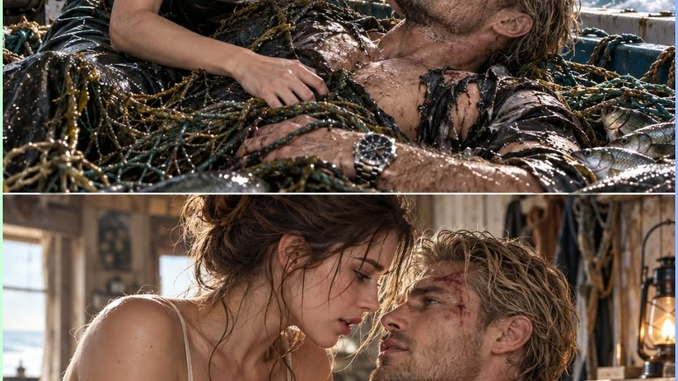
The first thing I noticed about the dead man in my net was that he was still breathing.
The second thing I noticed was the watch on his wrist.
Even half-covered in eelgrass, blood, and Atlantic muck, it looked expensive enough to pay the mortgage on my house twice.
“Ben!” I screamed.
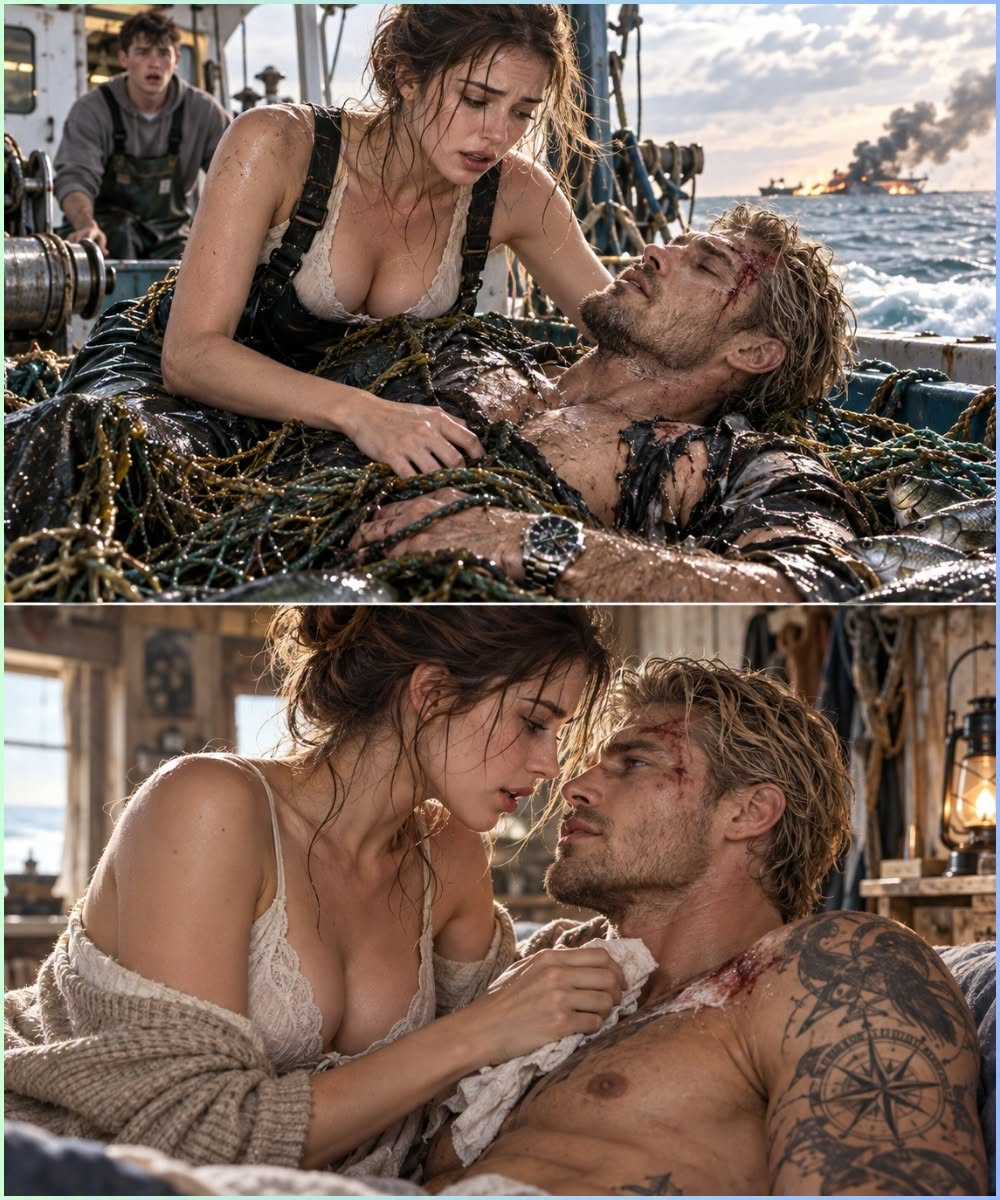
My seventeen-year-old brother stumbled from the wheelhouse of our thirty-two-foot fishing boat, nearly slipping on a pile of wet rope.
“What?”
“Kill the winch!”
The engine coughed down.
The net stopped rising.
And there he was.
A man tangled between bluefish, torn rope, and a sheet of blackened canvas, facedown in the gray water six miles off Grayhaven, North Carolina.
For half a second neither of us moved.
Then the man coughed.
Not dramatically.
Not like people did in movies.
It was a wet, broken sound, as though his lungs were filled with sand.
“Oh, God,” Ben whispered.
We dragged him aboard.
He was tall, broad-shouldered, maybe late thirties, with pale skin gone nearly blue from the cold. One side of his dress shirt had burned away. Angry red burns climbed his shoulder. There was a deep cut above his right eyebrow and another along his ribs.
His left shoulder sat at an angle that made my stomach twist.
“Call harbor rescue,” Ben said.
I reached for the radio.
The stranger’s hand shot out and caught my wrist.
His grip was weak but desperate.
“No.”
His eyes opened.
Gray-blue.
Terrified.
“Please,” he whispered. “No harbor.”
Then he passed out.
Ben stared at me.
“Mara, that is exactly the kind of sentence that means we should call the harbor.”
Normally I would have agreed.
But twenty minutes earlier we had seen black smoke on the horizon.
And less than an hour before that, every radio station along the coast had been talking about the explosion.
The Celestine, a one-hundred-and-forty-foot private yacht belonging to billionaire shipping heir Adrian Vale, had blown apart somewhere east of Cape Merritt.
No survivors had been reported.
I looked at the burned man lying among my fish.
Then at the black soot beneath his fingernails.
“Get the first-aid kit,” I said.
Ben swore under his breath.
“Mara—”
“Now.”
I wasn’t brave.
People later called me brave because that sounded better in newspapers.
The truth was simpler.
I had watched my father die because powerful people said an ambulance needed authorization to enter a restricted loading zone.
By the time somebody with the correct badge signed the correct form, he was gone.
Since then, whenever a human life and a rule stood in front of me at the same time, I had trouble respecting the rule.
We took the stranger home.
Home was a weather-beaten cedar house behind Collins Fish & Bait, where my father had once repaired nets and my mother had once complained that the entire kitchen smelled like men who had forgotten soap existed.
Both were dead now.
Dad had been crushed at Pier Nine eleven years earlier.
Mom lasted three years after him.
Cancer.
That left me, Ben, the mortgage, one aging fishing boat, and a business that made just enough money to make bankruptcy feel like something scheduled for next month instead of tomorrow.
Dr. Elaine Porter ran a private clinic twelve miles inland. She had delivered Ben and stitched me up after enough fishing accidents to know better than to ask too many questions.
She examined the stranger.
“Dislocated shoulder. Smoke inhalation. Burns. Hypothermia. Two cracked ribs, maybe three.”
“Will he live?”
She looked at me.
“If he had spent another hour in that water, probably not.”
Then she gave me the bill.
I nearly laughed.
Not because it was funny.
Because the number matched almost exactly what I had saved for a replacement transmission.
Ben saw it too.
“If we pay that, the Molly Rose stays tied up.”
“I know.”
“We don’t fish, we don’t get paid.”
“I know.”
“We don’t get paid, the bank takes the house.”
“I know, Ben.”
He looked at the unconscious stranger.
For eighteen seconds I hated him for making me choose.
Then I paid.
Two days later, the stranger woke in my father’s old net room.
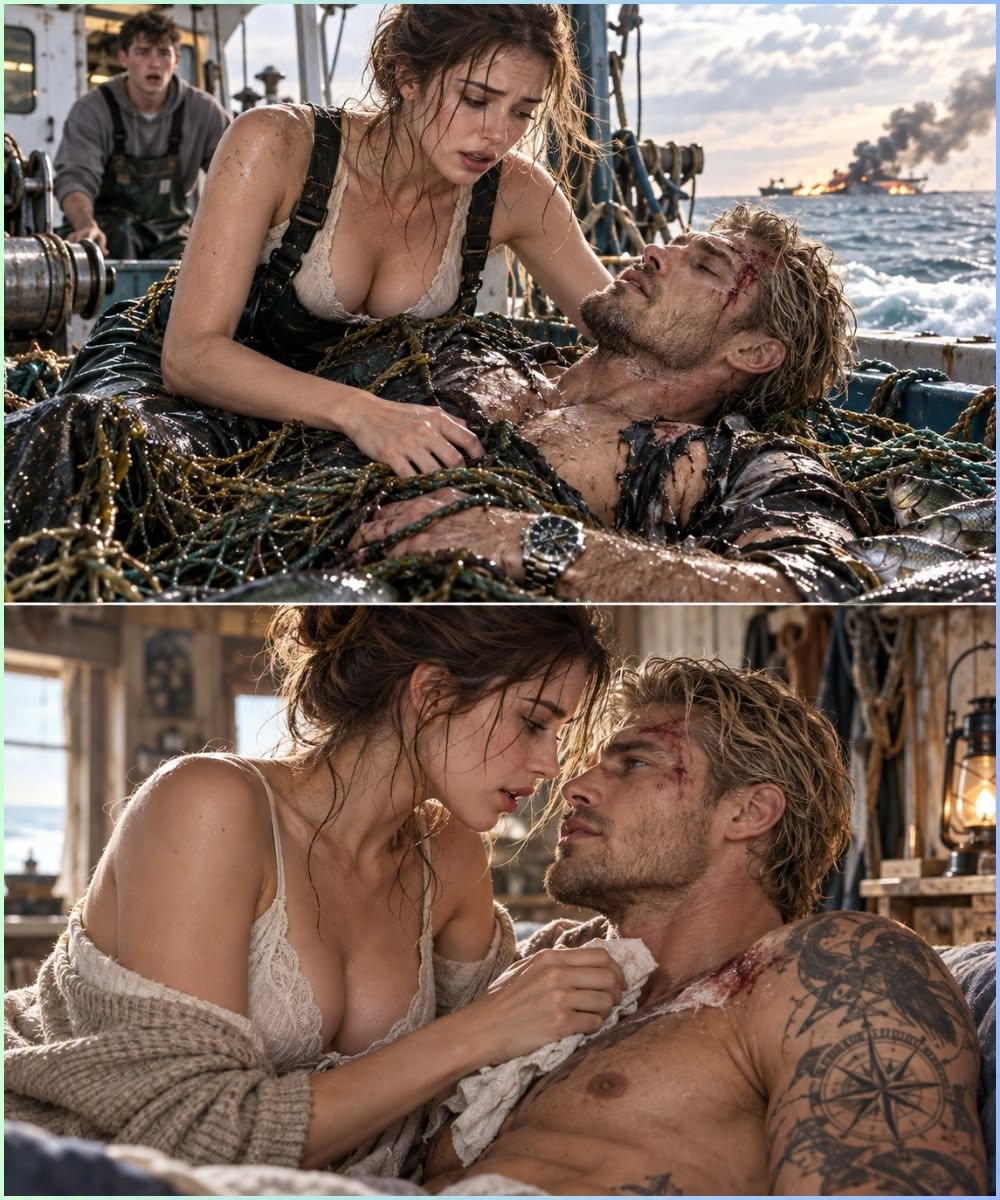
I was changing the dressing on his shoulder.
He flinched when he saw me.
“You’re safe,” I said.
He looked toward the window first.
Not the door.
The window.
Like a man calculating whether he could jump through it.
“What day is it?”
“Thursday.”
His face changed.
“How long?”
“Almost three days.”
He shut his eyes.
“Damn.”
“What happened to you?”
“Boat accident.”
“You have burns.”
“Yes.”
“There was a yacht explosion Tuesday night.”
Nothing.
Not even a blink.
That frightened me more than surprise would have.
“What is your name?”
He hesitated.
“Adam.”
“Adam what?”
Another pause.
“Reed.”
“You had to invent that?”
His mouth almost smiled.
“I had a concussion.”
“Convenient injury.”
He tried sitting up, immediately went white, and dropped back onto the pillow.
I crossed my arms.
“My brother thinks you’re a criminal.”
“Smart brother.”
“I think you are either a criminal or somebody criminals are looking for.”
His expression hardened.
“Smarter sister.”
“Which is it?”
He stared at the ceiling.
“I don’t know yet.”
I should have thrown him out.
Instead I heard my father’s voice in my head.
Nobody gets made less human because trouble knows their name.
So I gave him rules.
He could stay until he was strong enough to leave.
He would work when Dr. Porter allowed it.
He would not bring weapons into my house.
He would not touch my accounts.
He would not ask me for money.
And when I asked a question that affected our safety, he would answer it.
“That last one may be difficult,” he said.
“Then sleeping outdoors may be easier.”
He looked at me for several seconds.
“Understood.”
Adam Reed lasted six days before I knew he was lying about more than his name.
He couldn’t bait a crab pot properly.
He tied fishing knots like somebody remembering childhood lessons from another lifetime.
His hands were soft except for one old scar across his palm.
But he could rebuild a carburetor.
He could look at a shipping invoice for three seconds and tell me the port surcharge was fraudulent.
He knew precisely which offshore current would turn after a north wind.
And when Ben mentioned that my father’s death had happened at a terminal controlled by Vale Atlantic Logistics, Adam dropped a coffee mug.
It shattered on the floor.
“You knew the company?” I asked.
“I knew people there.”
“My father’s death report came from them.”
“I know.”
My skin went cold.
“How?”
Để lại một phản hồi