PART 1: The Ten Dollars That Silenced Cedar Ridge
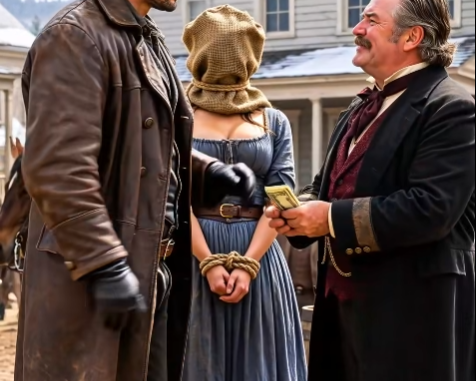
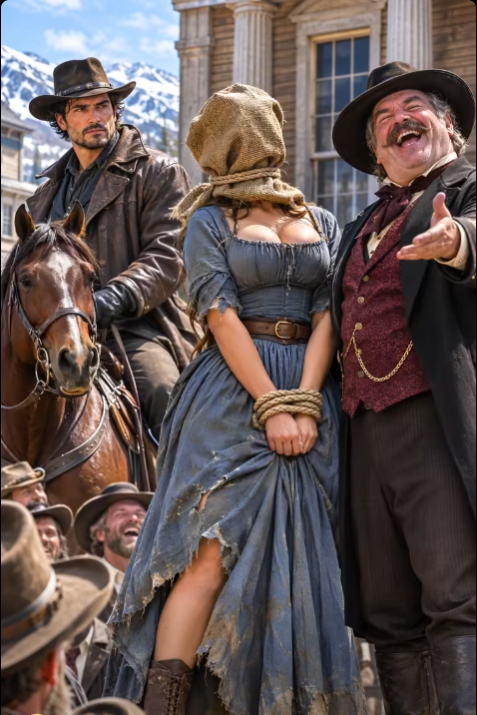
The first time I saw the woman who would change my life, her hands were tied, a filthy grain sack covered her face, and an entire town was laughing as though her humiliation were the finest entertainment money could buy.
I had come down from the mountains that freezing November morning to purchase enough supplies to survive another Wyoming winter, not to witness a human being sold from a platform made of rotten planks and whiskey barrels.
My name is Jed Halverson, and at forty-two years old, I had spent six winters learning that loneliness could become as familiar as the sound of your own breathing.
The trail into Cedar Ridge was slick with frost, and my bay mare picked her way carefully between frozen wagon ruts while the pelts strapped behind my saddle stirred in the wind.
I needed flour, salt, lamp oil, and a handful of nails before the mountain passes disappeared beneath snow deep enough to swallow a horse.
I had ten dollars hidden inside my coat, and I had calculated every purchase so carefully that there would be almost nothing left when I rode home.
Six years earlier, I might have enjoyed visiting town, listening to music drifting from the saloon, or sharing a meal with someone who remembered my name.
That was before Sarah died.
My wife had been the only person who ever made the wilderness feel less like a place of survival and more like a place where a man could build a life.
She had filled our cabin with laughter, wildflowers, and the smell of fresh bread, and she had possessed the extraordinary gift of finding something beautiful even in the hardest winters.
Then one terrible November afternoon, everything changed.
I buried her beneath a stand of pines overlooking the valley, and afterward I discovered that grief was not something a man survived once.
It was something he survived every morning.
Her blue shawl remained folded inside the cedar chest beside our bed, and her favorite tin coffee cup still occupied its place on the kitchen shelf.
I never used that cup.
I never moved the shawl.
I never learned how to sleep without reaching toward the empty side of our mattress.
For six years, I had convinced myself that a man who had already lost everything important had little reason to become involved in anyone else’s troubles.
Then I heard the laughter.
It rolled across the courthouse square in a thunderous wave that made my mare lift her head and flatten her ears.
At first, I assumed somebody was entertaining the crowd with a drunken performance or a particularly cruel joke.
Then I saw the platform.
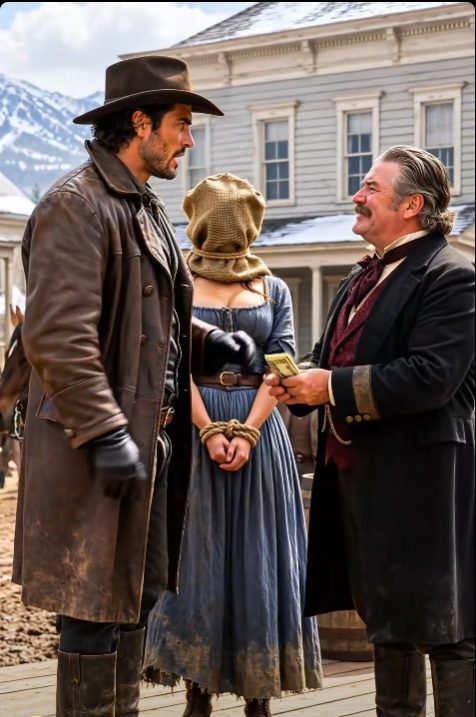
Three rough boards had been laid across two whiskey barrels beneath the courthouse steps, and a woman stood in the center with her wrists bound behind her back.
Her dress was brown and faded, torn along one hem, and her boots were coated with mud that had dried into pale cracks.
A grain sack had been pulled over her head and tied loosely around her neck, hiding her face completely.
What caught my attention was not the rope, the sack, or the disgraceful spectacle surrounding her.
It was the way she stood.
Her shoulders were straight, her feet were planted firmly, and although the November wind tugged at her clothing, she refused to bow her head.
Beside her stood Howard Briggs, the richest rancher in Cedar Ridge and a man whose name appeared on nearly every disputed property claim in the valley.
Briggs had grown wealthy buying cattle, lending money, and acquiring land from families who discovered too late that the fine print of a contract could be more dangerous than a winter storm.
His black coat was expensive, his boots were polished, and his smile belonged to a man who believed every person in the world had a price.
He slapped the woman’s shoulder and turned toward the crowd.
“Strong as a mule, gentlemen, and considerably cheaper to feed,” he shouted.
Several men roared with laughter.
“She cooks, scrubs floors, washes clothes, milks cows, chops wood, and apparently works harder than most hired hands.”
Someone near the saloon called out, “Then why’s she wearing that sack?”
Briggs grabbed the burlap and shook it for emphasis.
“Because even charity has its limits.”
The laughter became louder.
I stopped my mare beside the watering trough and felt my hands tighten around the reins.
Briggs continued describing the woman as though she were an animal being sold at a livestock auction.
“She traveled all this way to marry a respectable gentleman, but the poor fellow took one look at her face and decided he’d rather spend winter sleeping with the hogs.”
The men laughed again.
“Who was the lucky fellow?” another voice demanded.
Briggs pointed toward a thin man in a dark waistcoat standing near the courthouse entrance.
“Daniel Crowe, who has apparently discovered that good eyesight can save a man from a lifetime of regret.”
Crowe gave an uncomfortable smile while refusing to look directly at the woman.
I noticed that he did not laugh as enthusiastically as the others.
I also noticed that Briggs kept glancing toward him, as though silently reminding the man of something important.
“Now, gentlemen, she’s got a debt to settle, and I intend to recover what was spent bringing her out here.”
Briggs spread his arms.
“Who will offer five dollars for a hardworking bride?”
A man near the front raised two fingers.
“I’ll give two dollars if you throw in a broken saddle.”
Another shouted, “I’ll take the saddle and leave the woman.”
The woman did not react.
Not when the crowd laughed.
Not when Briggs grabbed her arm.
Not even when somebody tossed a rotten apple that struck the boards beside her boots.
I had witnessed hunger, poverty, desperation, and more cruelty than I cared to remember throughout the frontier.
But I had never seen an entire town gather to enjoy stripping another human being of her dignity.
Something inside my chest tightened.
I remembered Sarah standing beside our stove with flour on her cheek, telling me that the measure of a man was not how he treated the powerful but how he treated someone who had no power at all.
For six winters, I had tried to bury the pain of remembering her.
That morning, her voice returned with such clarity that I could almost hear it above the crowd.
“Ten dollars,” I said.
My words were not especially loud, but they carried across the square with enough force to cut through the laughter.
Every head turned.
Briggs stared at me from the platform.
“Well, if it isn’t Jed Halverson.”
I remained in the saddle.
“I said ten dollars.”
The smile on Briggs’s face widened.
“Mr.
Halverson, I didn’t realize you were shopping for a wife.”
“I wasn’t.”
A few men chuckled nervously.
Briggs rubbed his hands together.
“Ten dollars from our mountain recluse, gentlemen, so do I hear eleven?”
Nobody answered.
The silence was so complete that I could hear my mare shifting her weight against the frozen ground.
The townspeople knew I kept to myself.
They also knew I had once dragged an injured trapper through sixteen miles of blizzard without stopping, and that I had little patience for men who mistook cruelty for courage.
Briggs waited another moment.
“Going once.”
Nobody moved.
“Going twice.”
Crowe lowered his eyes.
“Sold to Jed Halverson for ten dollars.”
I dismounted and walked toward the platform.
Every step felt heavier because I understood exactly what I was giving away.
Those ten dollars were the flour that would keep hunger from my door, the oil that would brighten the long winter nights, and the nails I needed to repair my cabin before the first heavy storm.
Yet when I looked at the woman standing motionless beneath that filthy sack, I knew I would regret keeping the money far more than spending it.
I climbed onto the boards and placed the coins and bills into Briggs’s waiting hand.
He counted them twice.
“Looks like you’ve bought yourself a bargain.”
I looked at the rope cutting into the woman’s wrists.
“Untie her.”
Briggs smirked.
“You paid for her, mountain man, so you can untie her yourself.”
I stepped closer.
The woman smelled faintly of cold rain, dust, and the damp burlap covering her head.
Angry red marks surrounded her wrists where she had struggled against the bindings.
I kept my voice low.
“I’m going to loosen this rope, and I won’t touch you anywhere else.”
She remained still.
My fingers worked carefully beneath the first knot.
The rope had been pulled so tightly that I could barely fit a fingertip between the fibers and her skin.
Behind me, Briggs began joking about what kind of wife a mountain man might need during the winter.
I ignored him.
The woman suddenly leaned toward me.
At first, I thought her knees were buckling.
Then I realized she was trying to bring her covered face close enough that nobody else could hear her speak.
Her breathing came in quick, frightened bursts.
“Please,” she whispered.
I stopped moving.
“What is it?”
She tilted her head toward the courthouse, where Briggs stood counting my money.
“Don’t let him hear.”
I bent closer.
The woman spoke one word, so quietly that the wind nearly swallowed it.
“Sarah.”
My hands froze against the rope.
The name struck me harder than any blow I had ever received.
For six years, I had heard it only in my memories, in my prayers, and in the lonely silence beside my wife’s grave.
Yet this bound stranger, standing beneath a filthy sack before a town full of strangers, had just whispered the name of my dead wife.
And when I turned toward Briggs, I discovered that he was no longer smiling.
PART 2: A Dead Woman’s Name Beneath Burlap
For one terrible moment, I forgot the courthouse square, the cold wind, and the dozens of people watching me, because all I could hear was the name that stranger had whispered.
Sarah.
It was a name that belonged to the happiest years of my life and to the worst day I had ever endured.
I tightened my grip on the rope and leaned closer to the woman.
“How do you know that name?”
Her answer came through the burlap.
“Because she tried to stop him.”
I felt the world shift beneath my boots.
Across the platform, Briggs slipped the money into his pocket and cleared his throat.
“Well, Halverson, are you taking your purchase home or planning to keep the whole town entertained?”
I looked at him.
“Give us a moment.”
His expression hardened slightly.
“Don’t forget whose town you’re standing in.”
I returned my attention to the knot.
“Nobody owns a town, Briggs.”
His smile returned, but it did not reach his eyes.
I finally loosened the rope enough to pull it free.
The woman’s wrists fell forward, and she drew a sharp breath as blood returned to her hands.
She rubbed one wrist against the other, then reached toward the knot securing the sack.
I lifted my hand.
“May I help?”
She hesitated before nodding.
I untied the rough cord and carefully raised the burlap.
The first thing I saw was a pair of striking green eyes, bright with exhaustion and something that looked very much like anger.
She appeared to be in her early thirties, with chestnut hair that had escaped its pins and fallen in loose strands around her face.
A pale, uneven burn scar followed the right side of her jaw and disappeared beneath her collar.
It was noticeable, certainly, but it did nothing to erase the strength or beauty of her features.
She blinked against the sudden daylight.
For a moment, she looked at me as though expecting another insult.
I offered my hand.
“My name is Jed Halverson.”
She stared at me.
“I know.”
“What’s yours?”
“Nora Price.”
Her voice was hoarse, but it carried a steadiness that reminded me of the way she had stood beneath the sack.
I helped her step down from the platform.
Briggs immediately moved to block our path.
“Now, remember, Halverson, the bargain doesn’t include any of her belongings.”
I stopped.
“What belongings?”
Briggs shrugged.
“A trunk, a traveling bag, and some papers she owes me.”
Nora went rigid beside me.
I noticed the movement.
“What papers?”
“Private business,” Briggs replied.
“Then I suppose it doesn’t concern me.”
His face brightened.
“Exactly.”
“Unless you’re keeping something that belongs to her.”
Briggs’s smile disappeared.
“She owes me for transportation, lodging, and trouble.”
I glanced toward the platform.
“Your auction settled whatever debt you claimed.”
A murmur moved through the crowd.
Briggs took a step closer.
“You’re beginning to try my patience.”
I held his gaze.
“Then we have something in common.”
For several seconds, neither of us moved.
Finally, Briggs stepped aside with a contemptuous laugh.
“Take your ugly little bride into the mountains, Halverson, and don’t bring her back when you discover what she’s worth.”
I turned toward Nora.
“Come with me.”
She followed without speaking.
The crowd parted as we crossed the square, although several men continued staring at the scar along her cheek.
I wanted to challenge every one of them.
Instead, I concentrated on getting her away from Briggs.
My mare stood where I had left her, breathing white clouds into the freezing air.
I removed my spare wool coat from behind the saddle and held it open.
“You’re cold.”
Nora looked at the coat.
“You don’t have to.”
“I know.”
She accepted it slowly.
The sleeves covered most of her hands, and the heavy wool swallowed her thin traveling dress.
I moved the pelts to make room behind the saddle.
Before helping her mount, I glanced toward the general store.
The supplies I needed were still inside.
My last ten dollars were in Briggs’s pocket.
Nora followed my gaze.
“That was all your money, wasn’t it?”
I looked back at her.
“Enough of it.”
Her face tightened.
“You shouldn’t have paid.”
“Maybe not.”
“He’s going to make you regret it.”
I checked the saddle strap.
“He can stand in line.”
For the first time, something almost resembling a smile touched her lips.
It disappeared when she noticed Daniel Crowe crossing the square toward us.
Crowe looked younger up close than he had from the platform, perhaps thirty-five, with narrow shoulders and pale, restless eyes.
He stopped several feet away.
“Nora.”
She stepped behind my shoulder.
“Stay away from me.”
Crowe glanced at me.
“She’s confused, Halverson.”
I said nothing.
“She came out here under an understanding that didn’t work out.”
Nora’s voice sharpened.
“You promised me a home.”
Crowe looked uncomfortable.
“Things changed.”
“You wrote that you respected a woman who could read accounts, manage a household, and work beside her husband.”
“I did.”
“You wrote that appearances meant nothing to a man of character.”
Crowe’s expression twisted.
“That was before I saw you.”
I took one step forward.
He took one step back.
Nora touched my sleeve.
“Don’t.”
The word was quiet, but I understood what she meant.
She did not want another public spectacle made of her life.
Crowe looked toward the courthouse.
“Mr.
Briggs only wants the documents your father left.”
Nora went pale.
“I told him they’re not his.”
“Then this could become unpleasant.”
I stared at Crowe.
“She seems to think things have already become unpleasant.”
Crowe swallowed.
“You don’t understand what you’re interfering with.”
“Then explain it.”
He glanced toward Briggs, who was watching us from the courthouse steps.
Instead of answering, Crowe turned and hurried away.
Nora stood silently beside my horse.
I watched the exchange between the two men.
Something was wrong here, something far more serious than a cruel rancher humiliating a woman who had been rejected by her intended husband.
I lowered my voice.
“Tell me what Sarah has to do with those papers.”
Nora studied the square before answering.
“My father was a records clerk, and before he died, he left me copies of documents that should have been delivered to a judge years ago.”
I felt my heart begin beating harder.
“What documents?”
“Land records.”
I waited.
“Affidavits.”
She looked directly into my eyes.
“And a statement signed by Sarah Halverson.”
My breath caught.
“Where did you get it?”
“From my father’s papers.”
“Why didn’t anyone send it to me?”
Nora lowered her gaze.
“I don’t know everything yet.”
The honesty of that answer frightened me more than a rehearsed explanation would have.
I glanced toward the courthouse.
Briggs was still watching.
Nora followed my gaze.
“He doesn’t know exactly what I brought.”
“Then don’t tell him.”
“I haven’t.”
I helped her into the saddle and climbed up behind her.
She sat stiffly, keeping as much distance between us as the narrow saddle allowed.
I turned the mare away from the square.
A cold gust swept between the buildings, carrying the smell of chimney smoke and wet horses.
We had traveled less than a hundred yards when Nora spoke again.
“Mr.
Halverson.”
“Jed.”
“Jed, I need you to understand something.”
I waited.
“I didn’t come here looking for trouble.”
“Neither did I.”
“I answered Daniel Crowe’s marriage advertisement because I thought I could build a decent life in Cedar Ridge while settling my father’s unfinished business.”
She paused.
“Now I believe the advertisement was written to bring me here.”
I looked toward the reflection in a nearby shop window.
A man was walking quickly behind us.
He wore a dark hat pulled low over his face.
I recognized him as one of Briggs’s ranch hands.
Nora’s voice became urgent.
“I think they knew about the papers before I arrived.”
I guided my mare toward the narrow alley beside the feed store.
The man behind us quickened his pace.
“Hold on,” I whispered.
Nora gripped the saddle horn.
As we entered the alley, I heard a sharp metallic sound behind us.
I twisted in the saddle just as the ranch hand raised a rifle.
And I realized the woman I had bought out of humiliation was about to get us both killed.
Để lại một phản hồi