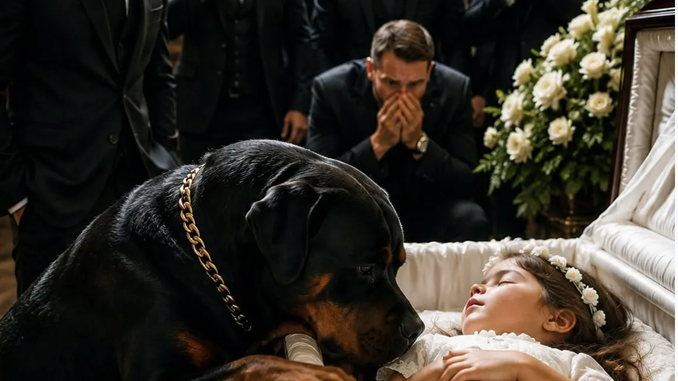
The bell tolled once, and the dog wept.
It was not a sound anyone in the church had expected. They had come to bury a child. They had come in black wool and black lace, in their good coats and their dark gloves, with their handkerchiefs ready and their faces arranged. They had sat down in the long, polished pews of Saint Agnes of the Harbor and bowed their heads and waited for the priest. And then, from the front of the nave, from beside the white casket, there rose a thin, high, broken whimper, so small and so human that a woman in the sixth pew put her hand to her mouth and began to cry.
It was the Rottweiler.
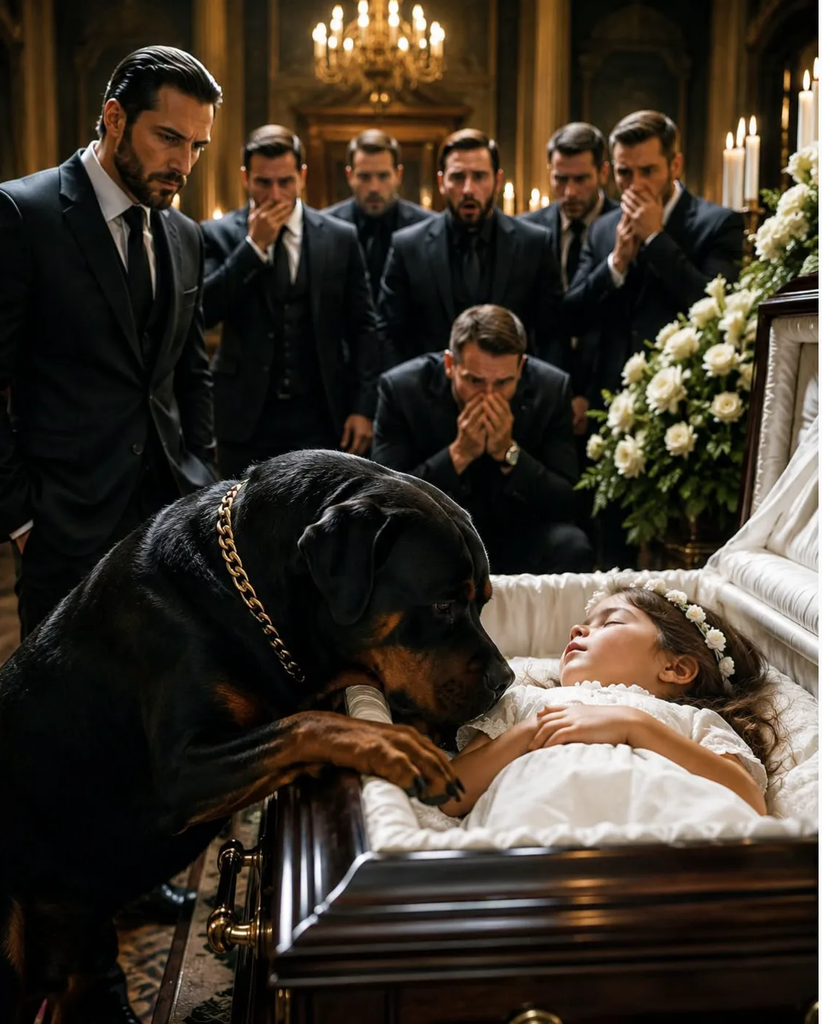
He stood on his hind legs with his great forepaws on the edge of the stand, a huge black-and-tan dog with a broad head and a thick gold chain around his neck, and he had pushed his nose into the white flowers. He did it very gently. He rested the side of his muzzle against the cheek of the little girl in the casket, and closed his eyes. A tear slid down through the short black fur beside his nose, and fell, and was lost in the satin.
*Whimper.*
The bell tolled again. The sound rolled down the aisle and out among the high stone arches, through the red and gold light that poured from the tall stained-glass windows, over three hundred bowed heads. Candles burned in every sconce. The air smelled of lilies, beeswax and cold stone. And in the silence between the bell strokes, the dog went on weeping, quietly, steadily, the way people weep when they have been doing it for days.
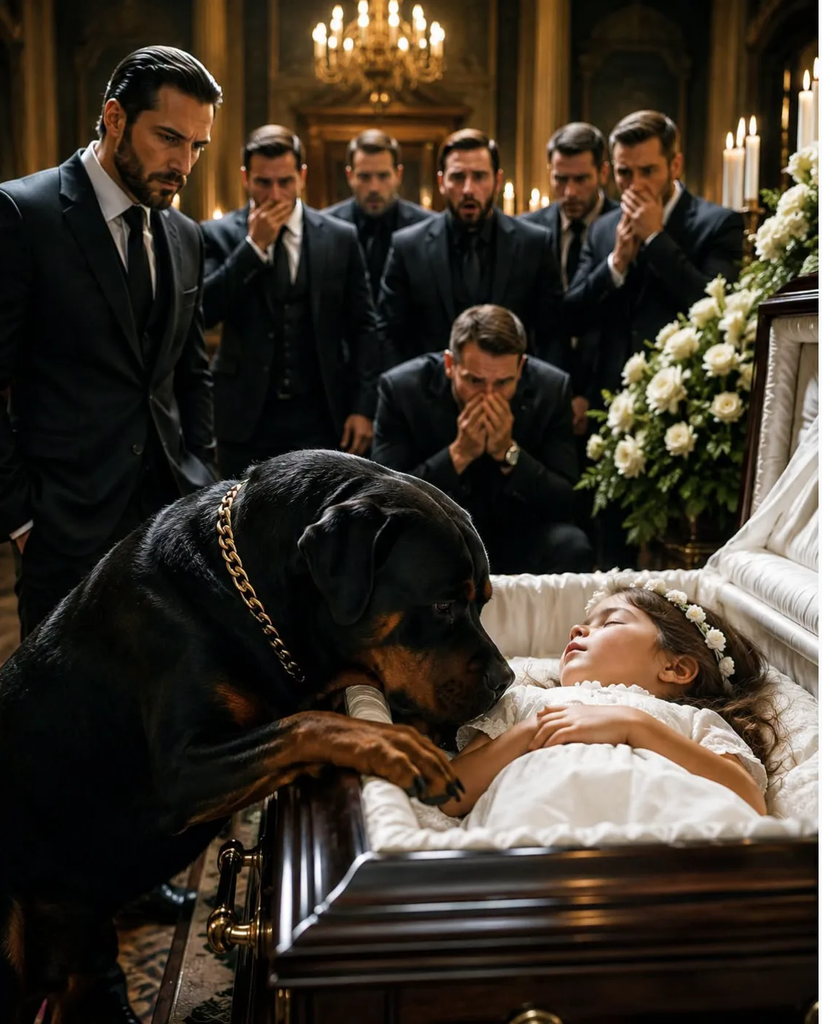
His name was Bruno. He had been Lily Marlowe’s dog for six years, since the afternoon her father had carried home a squirming black pup in the pocket of his overcoat and set it down in her lap. She had been one. She had laughed so hard she hiccuped. He had slept at the foot of her bed every night of his life.
He had not slept since Tuesday.
Lily lay in the white casket in a white satin dress.
She was seven years old. Her long blonde hair had been brushed until it shone and spread across the pillow in soft waves, and on her head someone had set a crown of tiny white flowers, baby’s breath and stephanotis, delicate as snow. Her hands lay folded on her chest. Her lashes rested on her cheeks, long and pale gold, the way they did when she slept. The color had gone from her face, but not the sweetness. She looked like a girl in a picture book, waiting for someone to wake her with a kiss.
Nobody could look at her for very long.
A man stood in front of the stained-glass window, apart from the rest.
Victor Marlowe was fifty years old, and the red and gold light fell on him as if on a statue. He was tall and broad-shouldered, in a black suit, a black shirt and a black tie, knotted so perfectly that it might have been drawn on. His hair was silver, swept back from a strong brow, and his beard, neat and gray, framed a jaw that had been called, in newspapers over the years, *granite* and *unforgiving.* On the knuckles of both hands, black ink showed beneath a plain black wedding ring. His eyes were red-rimmed and swollen. Tears ran openly down his face, into his beard, and he did not wipe them away.
He had been the most feared man on the Eastern Seaboard for twenty years. Men crossed the street when he walked past. Judges returned his calls. And on the Friday before, a doctor in a hospital corridor had looked at him with a face full of pity and said, *Mr. Marlowe, there was nothing more we could do,* and Victor Marlowe had stood in that bright hallway and learned what it was to have nothing left.
He opened his mouth.
“Bruno.”
It came out as a croak. He swallowed, and tried again.
“Bruno. Come here, boy.”
The dog did not move.
“Come here.” His voice cracked. It was low and gravelly and thick with sobs, and the whole church heard the way it shook. “Come on. Come to me.”
Slowly, as though it cost him something, the Rottweiler lifted his head from the casket.
He turned. His dark eyes, huge and liquid and bright with tears, found his master’s face. The sorrow in them was so naked, so utterly unguarded, that a man in the front row bowed his head. Bruno made a small broken sound. He dropped to all four paws. His claws clicked on the stone floor as he stepped away from the stand, one pace, two, and stopped, looking back.
“That’s it,” whispered Victor. “That’s my good boy.”
He walked down the aisle.
He took his time. His black shoes were silent on the old flagstones. His right hand, big and tattooed, with the wedding ring catching the light, hung open at his side. The mourners watched him go. Behind the pews, in the shadows of the side aisles, stood a dozen of his men, in black, with their hands folded in front of them and their faces like closed doors. In the front pew, among the family, sat a woman in a black lace veil.
Serena Marlowe was thirty-eight, and still. She wore a black dress cut high at the throat and a black hat with a net that fell to her chin. Her gloved hands rested in her lap. Through the veil, the shape of her face was a pale smudge: high cheekbones, a full mouth. She had been Victor’s wife for two years. She had held a handkerchief all morning, and she had not used it.
He stopped beside the casket.
“Come here,” he said again, softly, pleading. He held out his hand.
Bruno came to him.
He leaned his full weight against Victor’s leg, a hundred and thirty pounds of dog, and pushed his head up under the man’s palm. Victor’s fingers curled in the thick fur of his neck. His shoulders began to shake. He tried to say something and could not. He bent over the casket and put his other hand, trembling, on the dog’s broad back, just above the heavy gold chain, and stroked. Tears fell from his beard onto the black coat.
“That’s a good boy,” he said, in broken half-breaths. “It’s all right.”
The dog whimpered.
“It’s all right. She’s just resting now.”
The last word cracked in half.
Somewhere in the church, a child sobbed aloud, and was hushed. The priest, an old man with a white beard and a gold-embroidered stole, bowed his head and began to murmur a prayer. The choir hummed, low and mournful. A single piano note fell from the loft, and then another, and then a soft, aching phrase from a cello.
And Bruno stopped whimpering.
It happened all at once. His whole body went still. Under Victor’s hand, the great muscles of his back tightened like cables. His ears, which had lain flat against his skull in grief, rose slowly, slowly, and snapped upright.
“Bruno?” Victor said.
The dog did not look at him.
He was staring into the casket. His eyes were fixed on Lily’s face with a terrible, quivering intensity. His nostrils flared. His lips parted, and he drew in a long, slow breath through his nose, as though he had caught a scent from very far away.
“Boy?”
Bruno’s head dipped.
He thrust his muzzle against the child’s cheek, hard, almost roughly, and snuffled once at the corner of her mouth.
Then Victor saw it.
It was so small that he thought at first he had imagined it. A little hand lay on the white satin, pale, motionless, curled like a flower. The first finger of the right hand, the one with the faint pink scar from the time she had caught it in the car door, was resting on the fabric.
It twitched.
Just once.
Victor stopped breathing.
In the front pew, behind the black lace of her veil, the woman’s cold smile faltered.
Bruno turned his head.
He did it very slowly. His eyes left the child. They swept down the aisle, across the first row of pews, past the aunts and the uncles and the cousins, past the white-haired priest, until they came to rest on a black hat with a black net, and a pair of pale gloved hands folded in a lap.
His lips peeled back from his teeth.
A sound came out of him then that no one in the church had ever heard from a dog. It began deep in his chest and rose, low and rumbling and endless, like a slow earthquake. It filled the nave. It rattled the glass in the tall windows. In the silence it was the loudest thing in the world.
*Grrrrrrrrr.*
Three hundred heads came up.
Victor Marlowe lifted his own, slowly, and his silver eyes were wide.
Để lại một phản hồi