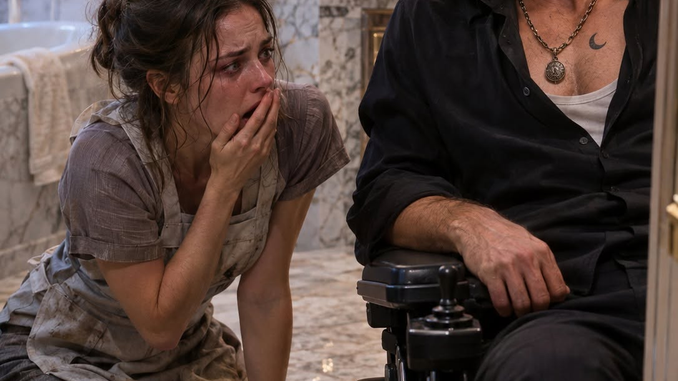
Chapter 1: The Crescent Moon Beneath His Shirt
I took a job bathing a paralyzed billionaire because my children were starving and I had no other choice. I told myself it was only work, only a paycheck—but the moment I unbuttoned his shirt and saw what was hidden beneath it, my legs gave out. In one terrifying instant, I realized the man I was supposed to care for was tied to the darkest secret of my entire life.
Mom… I’m cold.
My eight-year-old son, Brandon, could barely get the words out. He lay shivering beneath a worn-out blanket on a stained mattress while rain dripped through the cracked ceiling into a bucket I’d placed there two nights earlier. Our tiny apartment smelled of damp walls, watered-down soup, and hopelessness.
I stood there feeling completely helpless.
There was no money for a doctor.
No medicine.
No food worth cooking.
Across the room, my five-year-old daughter, Emma, quietly brushed the tangled hair of her broken doll, too young to understand why the lights might be shut off or why I kept pretending I wasn’t hungry.
I’d already sold everything that meant anything to me.
My grandmother’s gold earrings.
My father’s old watch.
Even the nice shoes I’d saved for church and job interviews.
Every memory had turned into rent, overdue bills, or another desperate attempt to keep my children alive.
That morning, after leaving Brandon asleep with a fever and asking my upstairs neighbor to watch Emma, I walked through downtown Chicago searching for any job that would pay immediately. Pride had become a luxury I could no longer afford.
Outside an upscale café, I overheard two well-dressed women talking.
I need someone immediately, the older woman said. Mr. Bennett fired three caregivers last month.
What’s the problem? the younger woman asked.
He was paralyzed after the accident. He’s only forty, but no one can handle him. The salary is exceptional… if they survive the first week.
Exceptional salary.
That was all I heard.
I walked straight inside before fear could stop me.
I’m sorry, I said, my voice trembling. I couldn’t help overhearing. Are you still looking for someone?
The older woman looked me up and down, taking in my faded clothes and exhausted face.
This isn’t an easy position.
I’ll learn.
Do you have medical training?
No.
Experience caring for someone who’s paralyzed?
Again, I shook my head.
Then why should I hire you?
Because my son needed medicine.
Because my daughter deserved dinner.
Because I would do anything to keep them alive.
Instead, I answered with the only truth I had left.
Because I won’t quit.
She studied me for several long seconds before sliding a business card across the table.
Be here at four o’clock. If Mr. Bennett approves, the job is yours.
That afternoon, I stood outside iron gates guarding one of the most magnificent estates I’d ever seen. Marble fountains sparkled beneath the sun, perfectly trimmed hedges stretched for acres, and the mansion looked more like a palace than a home.
A housekeeper led me upstairs to a quiet bedroom.
There he is, she whispered. One piece of advice… don’t pity him. He hates that.
Then she disappeared.
In the center of the room sat a man in a motorized wheelchair.
He wasn’t elderly or frail.
He looked powerful despite being unable to move.
When I introduced myself, he gave me a cold smile.
So… they found another caregiver.
I need the job, I answered honestly.
For the first time, his expression softened—just slightly.
Later that evening, another staff member explained my responsibilities.
Medication.
Daily care.
And bathing him.
When everything was ready, they left us alone in the luxurious marble bathroom.
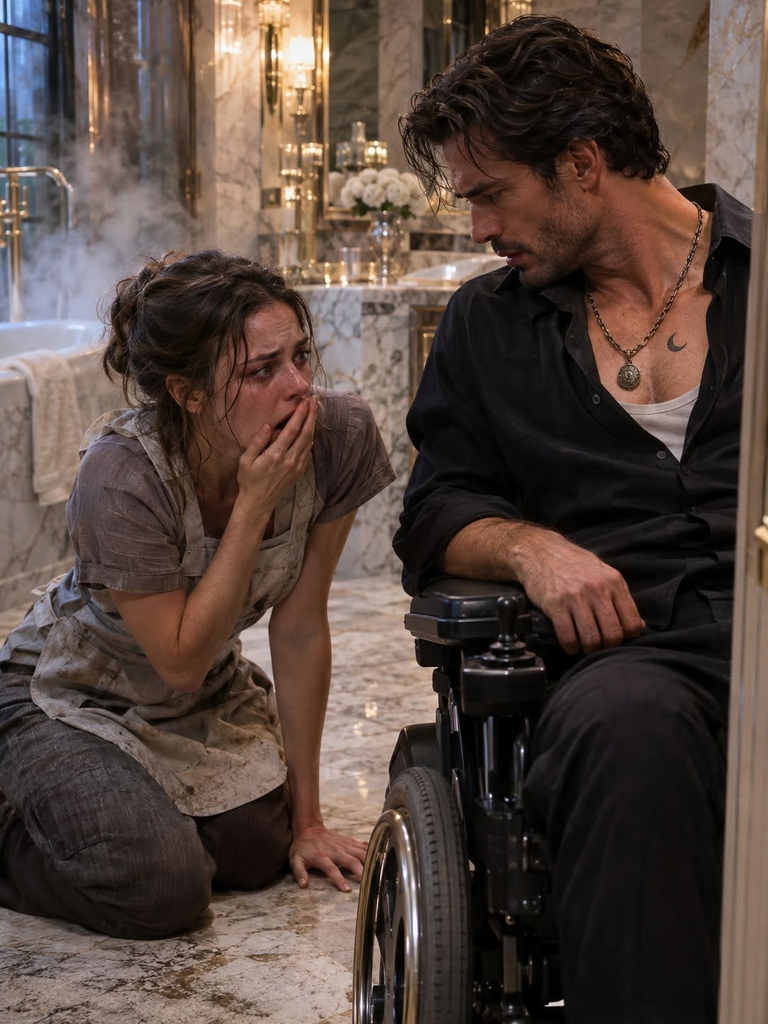
Steam filled the room as I carefully began unbuttoning his shirt with trembling hands.
This wasn’t personal.
It was work.
Nothing more.
Then I saw it.
Just below his collarbone was a small, dark birthmark shaped like a crescent moon.
My heart stopped.
Hanging around his neck was an old chain.
Not one like it.
The one.
The exact chain I’d believed had disappeared forever.
The room began spinning.
Twenty years earlier…
A violent storm.
A promise.
A man who vanished without a trace.
And a secret I’d buried so deeply that I’d convinced myself it had died with the past.
My knees buckled.
I collapsed onto the floor, shaking uncontrollably.
Mr. Bennett’s voice instantly lost its cold edge.
What happened?
I couldn’t answer.
Because the paralyzed billionaire I had been hired to bathe…
Chapter 2: The Brother Who Died in the Storm
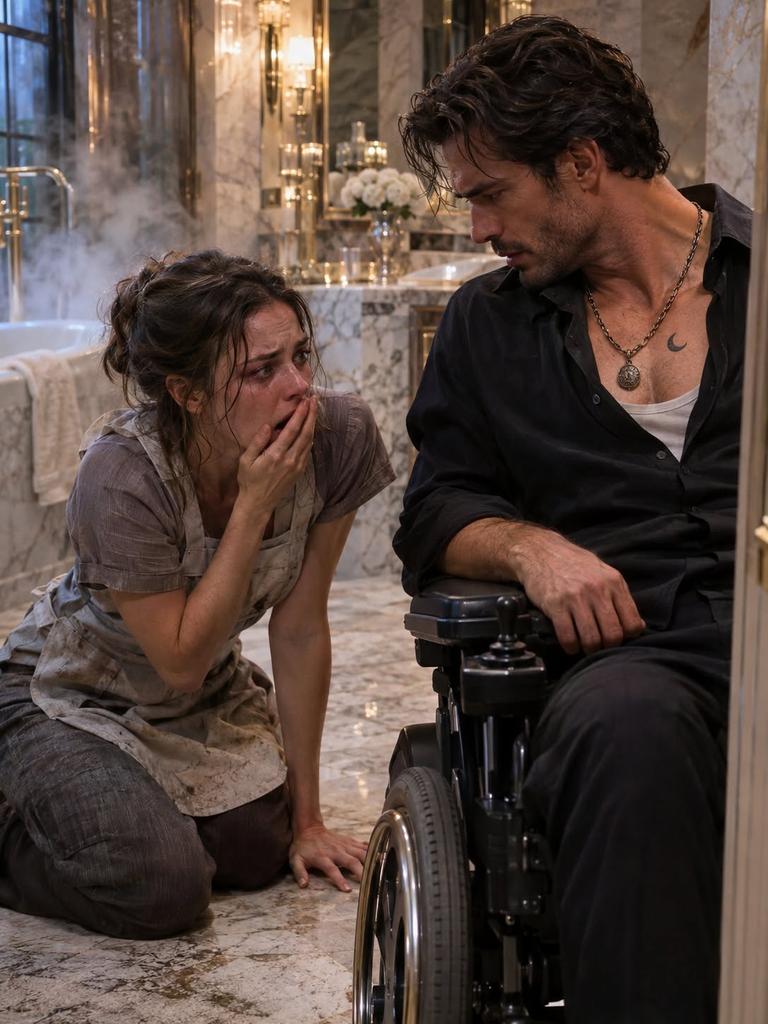
…was my older brother.
The brother I’d mourned for twenty years.
The brother whose name I’d whispered into empty rooms whenever I wished there were still someone in the world who remembered the little girl I’d once been.
Nathan Ellis.
He had been twenty when the storm took him.
I had been seventeen.
And now, at forty, he was sitting in a wheelchair beneath a name I didn’t recognize, staring at me as though I had lost my mind.
“Miss Reyes?”
His voice reached me through the ringing in my ears.
“Can you hear me?”
I couldn’t move.
I stared at the crescent-shaped birthmark beneath his left collarbone.
When we were children, I’d called it his little moon.
Our father used to joke that Nathan had been born with a piece of the night sky attached to him.
Then my eyes dropped to the chain.
The silver links were worn, and one near the clasp had been repaired with a tiny piece of copper-colored metal.
I remembered that repair.
Our father had made it at the kitchen table when Nathan was fourteen.
There was no mistaking it.
“Nate?” I whispered.
The man’s expression changed.
Nobody in that mansion had called him Nate.
Not the housekeepers, the nurses, or the business executives who appeared with expensive folders.
He looked at me.
“What did you call me?”
My throat tightened.
“Nate.”
He swallowed.
“Who are you?”
I tried to stand, but my legs wouldn’t support me.
“My name isn’t just Mara Reyes.”
His fingers tightened around the wheelchair armrest.
I forced the words out.
“I was Mara Ellis before I got married.”
For several seconds, he didn’t speak.
Then he whispered, “Ellis?”
I nodded.
“From Millhaven.”
His breathing changed.
I could see recognition struggling through disbelief.
“The river,” he said.
Tears streamed down my face.
“The storm.”
He stared at me.
Then, so quietly I almost didn’t hear him, he said, “Mara?”
I covered my mouth.
His voice broke.
“Little Sparrow?”
Nobody had called me that since I was seventeen.
I began sobbing.
Nathan looked as though he wanted to reach for me, but he was positioned too far away.
“Mara, come here.”
I moved toward him on shaking knees.
He took my hand.
His fingers were warm.
Real.
Alive.
For twenty years, I had dreamed about that moment.
Sometimes I imagined finding him beside a railroad station.
Sometimes I imagined him standing at our childhood front door.
Other times, I imagined hearing his voice in a crowded room.
But never like this.
Never in a marble bathroom belonging to a billionaire.
Never while I was wearing an inexpensive caregiver’s uniform and worrying about how to feed my children.
“I thought you were dead,” I whispered.
His eyes filled.
“I thought you were dead too.”
I stared at him.
“What?”
His face tightened.
“They told me you didn’t survive.”
I shook my head.
“No. I was taken to a shelter. Aunt Ruth found me two weeks later.”
He closed his eyes.
For a moment, his expression looked almost unbearably young.
“I spent years looking for you.”
My chest hurt.
“Then why didn’t you come home?”
He looked away.
“Because I couldn’t remember where home was.”
Before he could explain, someone knocked at the bathroom door.
“Mr. Bennett? Is everything all right?”
It was Mrs. Weller, the older woman who had offered me the interview.
Nathan released my hand.
His expression changed.
“Come in.”
She opened the door and stopped when she saw me sitting on the floor.
“What happened?”
I tried to stand.
Nathan answered before I could speak.
“Miss Reyes became dizzy. Please help her get some water.”
Mrs. Weller looked alarmed.
“Perhaps this position is too demanding.”
“No,” Nathan said sharply.
Then he looked at me.
“She stays.”
Mrs. Weller hesitated.
“But sir—”
“Please ask one of the trained aides to finish the bathing assistance. Miss Reyes and I need to speak afterward.”
She nodded reluctantly.
I stepped into the hallway and sat on a bench.
For several minutes, I stared at my hands.
My brother was alive.
The boy who’d taught me to ride a bicycle.
The young man who’d carried me through a flooded street.
The brother who’d promised never to leave me alone.
Alive.
I wanted to laugh.
I wanted to scream.
I wanted to ask a thousand questions.
Then my phone rang.
It was Mrs. Alvarez, my upstairs neighbor.
“Mara, sweetheart, I’m worried about Brandon.”
My heart dropped.
“What happened?”
“He’s still feverish. He’s coughing more, and he hasn’t wanted to get out of bed.”
I stood immediately.
“I’m coming.”
Mrs. Weller approached as I reached the stairs.
“You’re leaving?”
“My son is sick.”
She frowned.
“Mr. Bennett hasn’t approved—”
“Then tell him I’m sorry.”
I turned toward the front door.
I had found my brother after twenty years, but Brandon was eight years old and waiting for his mother.
Nothing could come before that.
“Mara.”
I stopped.
Nathan had appeared in the upstairs doorway, his wheelchair moving slowly toward the landing.
He looked at my face.
“What’s wrong?”
“My son has a fever. I need to get him medical care.”
His expression softened.
“You have a son?”
I nodded.
“Two children. Brandon and Emma.”
For a moment, he looked stunned.
Then he said, “My niece and nephew.”
I nearly started crying again.
“Yes.”
He looked toward Mrs. Weller.
“Arrange a car to take Mara home. Let her decide what help she needs. I’ll cover the transportation.”
I hesitated.
“Nathan, I can’t—”
He shook his head.
“Let me do one thing for my sister.”
I looked at him.
For twenty years, I had been making decisions alone.
There was something almost painful about having someone offer to stand beside me.
“All right,” I whispered.
I took Brandon to a neighborhood urgent care clinic, where a physician assessed his fever and cough.
He had a respiratory infection that required monitoring, rest, fluids, and treatment according to the clinician’s instructions.
The doctor also asked about our living conditions.
I told her about the leaking ceiling and damp walls.
She connected me with a social worker who explained emergency housing and food assistance resources.
For the first time in weeks, I accepted help without apologizing for needing it.
That evening, I bought groceries.
Chicken.
Rice.
Eggs.
Fresh fruit.
Medicine recommended for Brandon.
And a new box of crayons for Emma.
When I arrived home, Brandon was resting beneath a clean blanket Mrs. Alvarez had brought downstairs.
Emma ran toward me.
“Mommy, did you get a job?”
I knelt and hugged her.
“I think so, sweetheart.”
She looked inside the grocery bag.
“Bananas!”
I laughed through tears.
“Yes, bananas.”
Brandon lifted his head.
“Are we going to have dinner?”
I kissed his forehead.
“Every night, if I have anything to say about it.”
I made chicken soup while Emma colored at the kitchen table.
For the first time in days, there was enough food for all three of us.
I ate with my children.
I didn’t pretend I wasn’t hungry.
And after they fell asleep, I sat beside the window holding the business card Mrs. Weller had given me.
BENNETT ESTATE — PRIVATE RESIDENTIAL SERVICES.
I turned it over.
There was a handwritten number on the back.
My phone vibrated.
An unfamiliar number appeared.
I answered cautiously.
“Hello?”
“Mara.”
Nathan.
My chest tightened.
“Hi.”
For several seconds, neither of us spoke.
Then he asked, “How’s Brandon?”
“Better. He’s resting.”
“Good.”
A pause followed.
Then Nathan whispered, “I’ve been staring at the ceiling for six hours trying to understand how you’re alive.”
I closed my eyes.
“I’ve been doing the same thing.”
He gave a weak laugh.
“Do you remember the night of the storm?”
My smile disappeared.
“Every second.”
He became quiet.
Then he said, “I remember our father telling me to get you out.”
My hands tightened around the telephone.
I hadn’t spoken about that night in twenty years.
“I remember you going back for him,” I whispered.
Nathan was silent.
Then he asked, “Mara, what happened after you reached the road?”
I looked toward the dark window.
The rain outside had begun falling harder.
I could almost smell the flooded streets of Millhaven again.
“I told the rescuers you were still inside.”
“Did they search?”
“Yes.”
I swallowed.
“Then the bridge collapsed.”
Nathan took a slow breath.
“I remember the bridge.”
Tears filled my eyes.
“I waited three days for someone to bring you home.”
His voice cracked.
“Mara, there’s something else I remember.”
I sat perfectly still.
“What?”
“A man standing beside Father’s truck. He was arguing with him before the water reached the warehouse.”
A terrible chill moved through me.
Because I’d seen that man too.
And for twenty years, I had never told anyone what he’d said.
Nathan continued.
“He wasn’t a stranger. He worked for the company that owned the river warehouses.”
I closed my eyes.
The memory rose from somewhere I’d buried it.
A dark raincoat.
A silver ring.
Our father shouting.
And a warning spoken just before the lights went out.
“Mara?”
I could barely breathe.
“His name was Gordon Price,” I whispered.
Nathan went silent.
Then he said something that made my blood run cold.
“That’s impossible.”
“Why?”
“Because Gordon Price’s son is the man currently managing my companies.”
Để lại một phản hồi