The first woman looked dead.
The second looked even worse.
Elias Ward stared through the screaming snow, barely able to see the two dark shapes curled beneath a cluster of bent pine trees.
For one terrible second, he considered riding past.
Not because he was cruel.
Because the Arizona frontier had taught him that stopping for strangers could get a man killed.
But then his horse refused to move.
Elias climbed down.
Snow reached halfway up his boots as he pushed through the drift.
He knelt beside the first body.
A young woman.
Dark hair frozen against her face.
Skin pale beneath the frost.
He held one gloved hand beneath her nose.
Nothing.
Then—
A faint breath.
“Dear God.”
Alive.
He crawled toward the second woman.
Same face.
Same dark hair.
Same high cheekbones.
Twins.
The second woman was breathing too, but barely.
Elias looked toward the horizon.
The storm was getting worse.
His ranch stood nearly three miles away.
His horse could carry him easily.
Three people?
Maybe.
But leaving either woman behind meant certain death.
Elias shut his eyes for half a heartbeat.
“Do the next thing,” he whispered.
It was what he always told himself when life became too large.
He lifted the first woman.
She weighed almost nothing.
The second stirred when he picked her up.
Her eyes opened a fraction.
“Stay with me,” Elias said.
He did not know whether she understood.
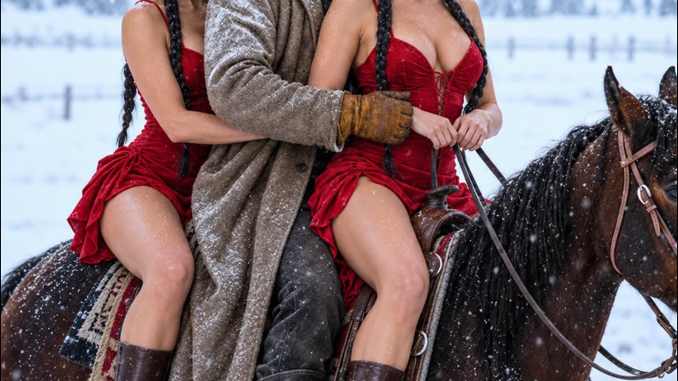
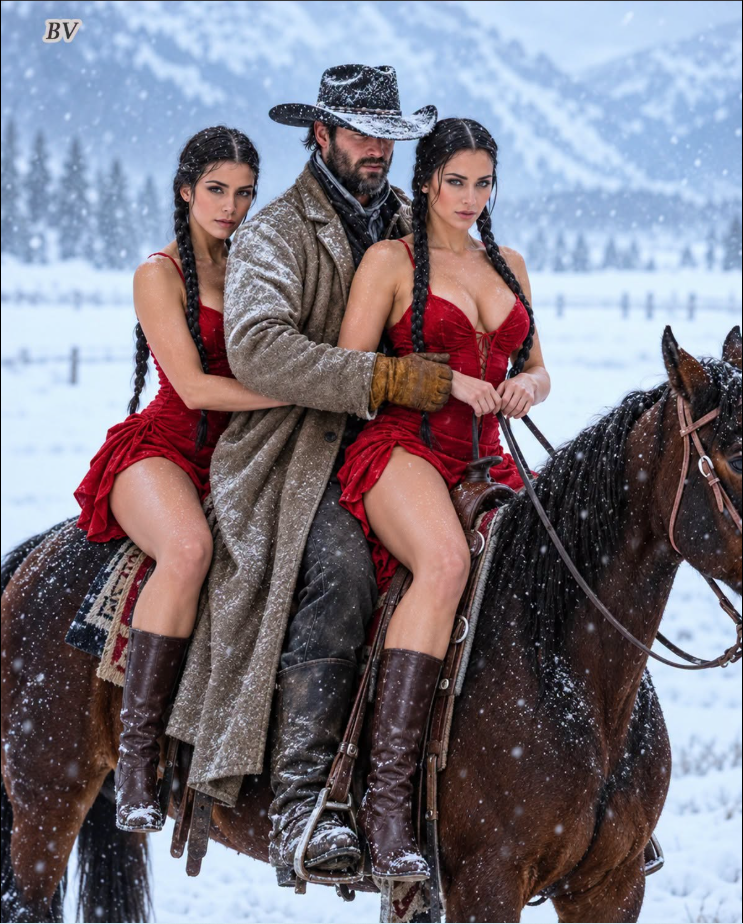
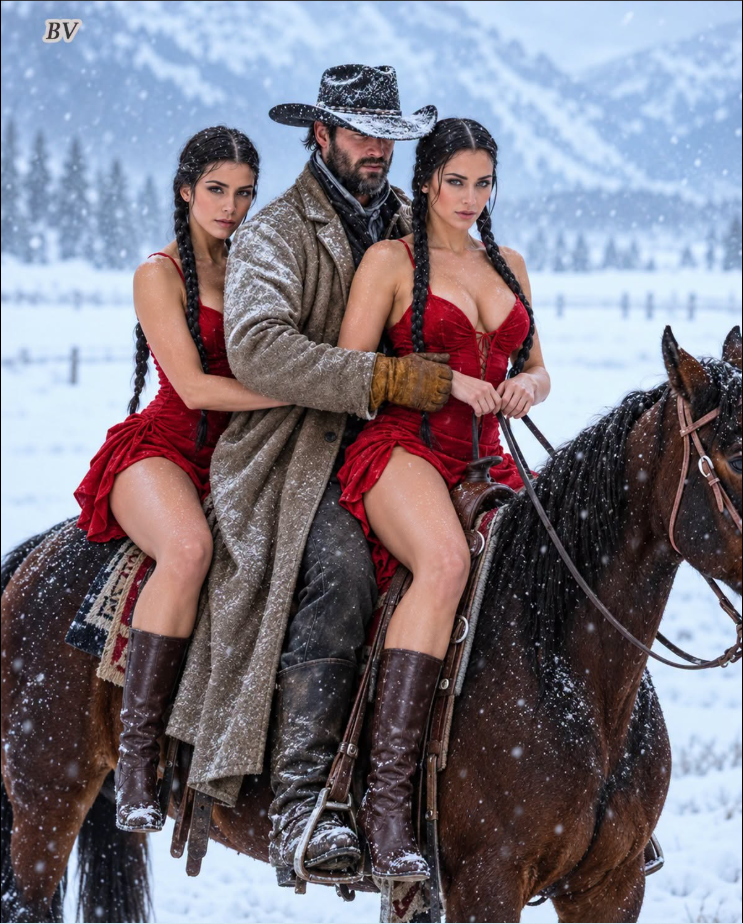
He secured both women across the saddle, climbed behind them and turned his horse toward home.
The wind struck like knives.
Elias bent over the sisters, shielding them with his body.
For seven years, he had lived alone.
His wife, Miriam, had died during another brutal winter.
He had buried her behind the cabin and never moved her sewing basket.
Never replaced her quilt.
Never changed the tin cup she had always kept beside the stove.
Silence had become easier than risking love again.
But now two dying strangers were pressed against him while he begged a horse to keep moving.
“Come on.”
The cabin finally appeared through the whiteout.
Elias almost laughed with relief.
He carried the women inside one at a time.
Blankets.
Fire.
Warm broth.
Dry cloth.
He worked for hours.
When the older-looking sister opened her eyes, she immediately grabbed the younger woman’s hand.
Elias backed away.
“You’re safe.”
Her eyes followed him suspiciously.
He understood.
A strange white rancher.
A locked cabin.
Two injured Apache women.
His word meant nothing yet.
So Elias kept his hands visible.
He left food beside them.
And he waited.
By morning, both were conscious.
“My name is Elias Ward,” he said.
The stronger twin studied him.
Finally she touched her chest.
“Naira.”
Then she nodded toward her sister.
“Talia.”
Talia attempted to stand.
Pain shot through her ankle.
She nearly collapsed.
Elias caught himself before reaching for her.
“May I?”
Talia looked at Naira.
Naira gave the smallest nod.
Only then did Elias examine the swollen joint.
“Badly twisted. Not broken.”
Talia watched him carefully.
“You live alone?”
“Yes.”
“Why?”
The question stopped him.
Elias looked toward the folded quilt on the shelf.
“My wife died.”
Neither sister offered pity.
Instead Naira lowered her eyes with quiet understanding.
That somehow hurt more.
Later, when they were strong enough to eat properly, Naira finally told him why they had been in the storm.
Raiders had attacked their band before dawn.
Horses stolen.
Food taken.
People scattered.
Naira and Talia had run north.
Then snow erased every trail.
“We walked until Talia could not walk,” Naira said.
Talia stared into the fire.
“We thought cold would finish us.”
Elias felt his jaw tighten.
“Did the men follow you?”
“We don’t know.”
The answer sat heavily in the cabin.
Days passed.
The storm sealed them in.
Naira regained strength quickly.
Talia’s ankle slowly improved.
They began helping.
Sweeping melted snow from the floor.
Sorting food.
Stacking blankets.
They even pulled Miriam’s old second chair away from the wall and placed it beside the fire.
Elias stopped when he saw it.
For seven years, that chair had remained empty.
Talia noticed his face.
“We can move it.”
Elias swallowed.
“No.”
He looked at the two chairs beside the fire.
“Leave it.”
Something in his house was changing.
Not replacing Miriam.
Nothing could.
But breathing again.
One afternoon Elias brought out Miriam’s old quilt.
He had kept it folded for years.
He placed it around Naira and Talia.
Talia traced one uneven stitch.
“Someone made this carefully.”
“My wife.”
Talia’s hand stopped.
Naira looked at him.
“You give this to us?”
“You’re cold.”
That was all Elias said.
But he knew it was more.
Weeks of grief he had preserved like a locked room were beginning to open.
When the sisters were finally strong enough to travel, Elias sat across from them.
“You can stay until you decide where you want to go.”
Naira and Talia exchanged a long glance.
“We already decided,” Talia said.
Elias frowned.
Naira leaned forward.
“We don’t want to leave.”
“You don’t owe me anything.”
“This is not debt,” Naira replied.
Talia nodded.
“We feel safe here.”
Elias looked toward the door.
The idea frightened him more than he wanted to admit.
He had spent years learning not to need anyone.
Now two women were asking not to disappear from his life.
“If you stay,” he said carefully, “this becomes your home too.”
Naira smiled for the first time.
Then Talia said something that made Elias nearly drop his coffee.
“We choose this place.”
Naira looked directly into his eyes.
“And we choose you.”
Before Elias could answer, he saw something through the window.
A thin column of smoke rising beyond the northern ridge.
His expression changed instantly.
Naira stood.
“What is it?”
Elias reached for his rifle.
“No settler lives out there.”
Talia went pale.
“The raiders.”
Elias stepped toward the door.
Outside, the wind had stopped.
The prairie was silent.
Too silent.
Then three black figures appeared on the distant ridge.
And Naira whispered the words Elias had feared since the night he rescued them: “They found us”
And Naira whispered the words Elias had feared since the night he rescued them: “They found us”—find Part 2 in the comments. Elias did not waste time.
He checked his rifle. Loaded every chamber. Secured the shutters. Naira stacked firewood against the weak side of the door. Talia pulled blankets over the windows to hide their movement.
No screaming. No panic. They had survived too much for panic. “We should see how many,” Naira said. “I’ll ride toward the creek.” “We come.” “No.” Talia’s eyes hardened. “We are not waiting here wondering whether you died.”
Elias looked at both women. Something inside him surrendered. “All right. But if I tell you to return, you return.” They rode toward the creek. Near the tree line, Elias raised a hand.
Three men. Possibly more beyond them. Mismatched coats. Rifles. Naira’s face became hard. “Same men.” Elias immediately turned them back. By sunset, the cabin was prepared. Then they heard it.
Crunching snow. A shadow crossed the barn. Another moved near the water barrel. Someone knocked on the cabin door. Once. Almost politely. “Anybody alive in there?” Talia flinched. Naira took her hand.
The latch moved. Locked. A man laughed. “We’re only looking for two lost Apache girls.” Elias raised his rifle. “They’re not lost.” Silence. The voice outside changed. “They belong to us.”
Naira’s fingers curled into fists. Elias opened the shutter an inch. His shot exploded through the evening. Snow jumped inches from the raider’s boot. “You take another step,” Elias called, “and the next one won’t hit the ground.”
The leader backed away. Then Naira stepped beside Elias. “You left us to die.” The raider recognized her voice. His face twisted. “Well, look at that.” He raised his rifle.
“You found yourself a protector.” “No,” Naira answered. Talia came to the other window. “We found a home.” The man laughed. But there was uncertainty in it now. Elias could see him calculating.
One rancher. Two women. A cabin with limited exits. He probably thought the odds were still good. Then movement appeared on the far ridge. Two more riders. Five against three.
Elias’s stomach dropped. The leader smiled. “There they are.” Naira looked at Elias. “We fight together.” He wanted to tell them to hide. Instead, he realized he no longer had that right.
Để lại một phản hồi