
PART 1 — THE WIFE HE LEFT BEHIND
At 12:18 A.M., my husband finally remembered he had a wife.
“Sofia is safe.
I’m coming home.”
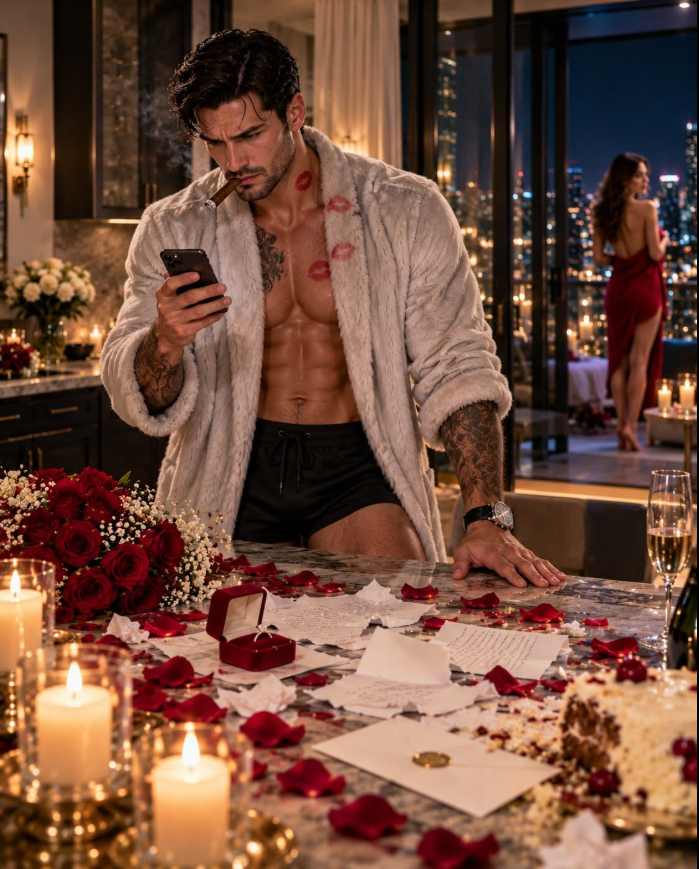
Seven words.
That was all Adrian Bellandi had to offer after three nights away, one forgotten wedding anniversary, and seventy-six hours during which every conversation we’d had revolved around the woman he’d once planned to marry.
I sat at our dining table in the quietest room of our Philadelphia mansion.
Six cream-colored envelopes lay before me.
Five were signed.
The sixth remained sealed beneath my left hand.
Across the table sat a white anniversary cake decorated with nine delicate sugar roses.
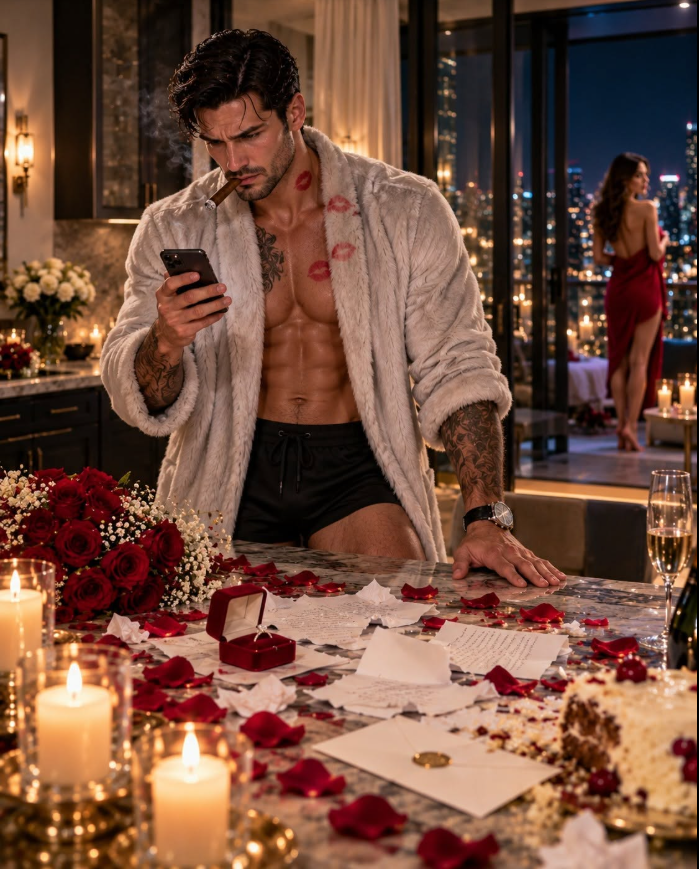
The frosting had begun to harden.
One candle leaned sideways, its wick blackened from the night I’d lit it and waited for a man who never came home.
My phone illuminated again.
Adrian was calling.
I watched his name appear beneath a photograph taken on our honeymoon.
In it, he was standing behind me on a windy beach, his dark hair hopelessly disheveled, laughing because I’d threatened to throw him into the ocean.
I remembered that laughter.
I remembered believing it belonged to me.
The phone continued vibrating.
For nine years, I’d answered whenever Adrian called.
Sometimes from grocery stores.
Sometimes from the shower, reaching blindly for my phone with wet hands.
Once from an emergency room while a nurse stitched my palm after a kitchen accident.
Because in Adrian’s world, unanswered calls could mean terrible things.
And because loving him had taught me to be available.
Always.
Tonight, I let it ring.
Then I typed two words.
“Too late.”
I pressed send.
And for the first time in our marriage, I turned off my phone before my husband could answer.
My name is Mara Bellandi.
I’m thirty-seven years old.
For nine years, I’ve been married to one of Philadelphia’s most feared men.
People know Adrian Bellandi as a mafia boss who owns restaurants, construction companies, transportation firms, and enough secrets to make powerful men reconsider their decisions.
They see the expensive suits.
The black cars.
The men who stand when he enters a room.
They know he can make a room fall silent without raising his voice.
But I knew the man who slept with one hand resting on my hip.
The man who hated strawberries but stole them from my plate because he liked watching me complain.
The man who pretended decorative pillows were ridiculous, then carefully arranged them whenever he made our bed.
And the man who once drove forty minutes through a snowstorm because I mentioned wanting cinnamon rolls.
That was my Adrian.
Or at least, that was the Adrian I thought I’d married.
Nine years earlier, we exchanged vows in a small courthouse outside Lancaster.
It was raining.
My dress cost eighty-nine dollars, and the hem kept catching beneath my shoes.
Adrian wore a charcoal suit with a crooked tie because he’d refused to let anyone help him dress.
Just before the ceremony, he took my hands.
His palms were warm.
His expression wasn’t.
“Mara, listen to me.”
I smiled nervously.
“That sounds terrifying.”
“I’m serious.”
“So am I.”
He looked toward the courthouse window.
Outside, two men waited beside a black sedan.
Even then, Adrian lived in a world that followed him everywhere.
“You know what my life is,” he said.
“I know.”
“There are things I can’t promise you.”
“Like remembering to put your socks in the laundry basket?”
He didn’t smile.
“I can’t promise there won’t be danger.”
“Adrian—”
“And I can’t promise that loving me will always be easy.”
I stepped closer.
“I’m not asking for easy.”
His jaw tightened.
“If you want to walk away, Mara, I’ll understand.”
I remember looking into his eyes and feeling something almost unbearable.
Not fear.
Not uncertainty.
Love.
The kind that makes you believe another person’s happiness is a responsibility you would gladly carry.
I touched his cheek.
“I already chose you.”
He closed his eyes.
For a moment, the dangerous man disappeared.
He was simply a frightened young man being loved.
Then he kissed my forehead and whispered, “I’ll spend the rest of my life making sure you never regret that.”
For nine years, I believed him.
Our marriage wasn’t perfect.
Adrian worked too much.
He carried secrets.
There were nights when he came home with blood on his cuff and wouldn’t tell me whose it was.
We argued about his business, his temper, and the security guards who followed me whenever I went shopping.
But we also built something real.
I helped transform several of his legitimate companies from chaotic cash businesses into respectable enterprises.
I studied accounting at night.
I negotiated contracts.
I hired lawyers who weren’t afraid to tell Adrian no.
Together, we opened restaurants that employed hundreds of people who had nothing to do with his criminal organization.
And every year, on our anniversary, Adrian promised that no matter what happened outside our home, the day belonged to us.
“One day a year,” he’d say.
“The world can survive without me.”
Until our ninth anniversary.
The Friday before it, I was standing in our kitchen arguing with a bakery.
“White frosting,” I repeated into the phone.
“Not ivory.
White.”
Adrian leaned against the counter, drinking coffee.
“Sweetheart, I think you’re threatening a pastry chef.”
I covered the phone.
“They sent me a photograph.
It’s beige.”
“Tragic.”
“Adrian.”
“Should I send Leo to negotiate?”
I threw a dish towel at him.
He caught it against his chest and laughed.
That was the last ordinary sound I remember hearing from him.
Because seconds later, his cousin Leo entered the kitchen.
Without knocking.
Leo never entered our home without knocking unless something was wrong.
Adrian straightened.
“What happened?”
Leo glanced at me.
Then back at Adrian.
“Daniel Moreno was shot outside his restaurant.”
Adrian set down his coffee.
“Alive?”
“Barely.
They took him to Jefferson.”
“Who did it?”
“We don’t know.”
Leo hesitated.
Then he added the words that changed everything.
“Sofia was with him.”
I felt the air leave the room.
Sofia Moreno.
Adrian’s first love.
The woman he’d once planned to marry.
I knew her history almost as well as my own.
Her father, Rafael Moreno, had taken Adrian in when he was seventeen, after his mother died and his father disappeared into alcohol and debt.
Rafael gave him a job.
A bedroom.
A family.
Sofia was Rafael’s daughter.
She and Adrian grew up together, fell in love, and planned to leave Philadelphia.
Then Rafael was murdered.
Adrian chose revenge.
Sofia begged him to come away with her.
He refused.
She left alone.
He told me that story on our fourth date.
We were eating cheeseburgers in his car because he’d taken me to an expensive restaurant and I’d hated everything on the menu.
“Do you still love her?”
I’d asked.
He’d looked at me for a long moment.
“No.”
“Are you sure?”
“I’ll always regret how I hurt her.
But regret isn’t love.”
I’d believed him.
I still believed him when Leo stood in our kitchen.
Adrian reached for his jacket.
“Mara—”
“Go,” I said.
He paused.
“Our anniversary is tomorrow.”
“I know.”
“I’ll be back.”
He came toward me and kissed my forehead.
Then my mouth.
“I love you.”
“I love you too.”
I meant it.
That was the terrible part.
I meant every word.
At 2:37 Saturday morning, Adrian called.
I was sitting in bed wearing the silk pajamas he’d bought me for Christmas.
“Daniel survived surgery,” he said.
“Sofia’s shaken.
We moved her somewhere safe.”
“Is she hurt?”
“Not physically.”
“That’s good.”
He exhaled.
“I don’t know how long I’ll need to stay.”
I looked at the anniversary decorations I’d hung in our bedroom.
Nine photographs.
One for each year.
“Okay,” I whispered.
“Mara, I know tomorrow—”
“It’s already tomorrow.”
Silence.
Then, “Right.”
I waited.
For an apology.
For him to ask whether I’d eaten.
For him to remember that I’d spent weeks planning a celebration.
Instead, he said, “Sofia hasn’t slept.
She keeps asking if Daniel’s going to die.”
My fingers tightened around the phone.
“Then you should help her.”
“You understand?”
I stared at our wedding photograph.
“I understand what you’re choosing.”
He didn’t hear the difference.
“Thank you, sweetheart.”
The call ended.
At seven that morning, I woke to an empty bed.
At noon, the florist delivered white roses.
At four, I put on a navy-blue dress Adrian loved.
At six, I lit the dining room candles.
At seven, our chef asked whether he should serve dinner.
“Give him another hour,” I said.
At eight, I sent Adrian a photograph of the cake.
He replied eleven minutes later.
Beautiful.
Sofia finally fell asleep.
I read the message twice.
Then I placed my phone face down.
At nine, I asked the chef to go home.
At ten, I removed my earrings.
At eleven, I blew out the candles.
At midnight, our anniversary was over.
And I realized my husband had spent the entire day telling me how Sofia felt without once asking how I felt.
Sunday morning, I received another message.
Daniel’s condition is improving.
Sofia is terrified someone will come after her.
I replied:
I’m glad he’s better.
Adrian sent a heart.
A small red heart.
The same symbol he’d sent me on the morning of our wedding.
I stared at it until my eyes burned.
Then I opened the bottom drawer of my desk.
Inside was a thin blue folder.
I’d been avoiding it for eleven days.
The folder contained the results of a medical examination, several financial documents, and a letter I’d written but never found the courage to give my husband.
I took everything out.
Spread it across the desk.
And finally allowed myself to read the words I’d been trying not to understand.
The doctors had found something wrong with my heart.
Not a metaphor.
Not a broken heart.
An actual problem with the organ beating beneath my ribs.
And I’d been waiting for my husband to come home so I could tell him.
Eleven days earlier, I’d collapsed in the parking garage outside Bellandi Hospitality.
I remembered the concrete rushing toward me.
The sound of my keys striking the floor.
The strange sensation of being awake but unable to move my arms.
A security guard found me.
At the hospital, doctors discovered a dangerous cardiac arrhythmia associated with a structural heart condition I’d never known I had.
More tests followed.
Then a consultation.
Then another.
The cardiologist, Dr.
Eleanor Hayes, spoke gently.
“We need to take this seriously, Mara.”
“How seriously?”
She folded her hands.
“Seriously enough that I don’t want you postponing treatment.”
I remember laughing.
Not because it was funny.
Because I was thirty-seven.
Because I exercised.
Because I ate vegetables and took vitamins and spent years telling Adrian he needed to reduce his stress.
“Am I dying?”
Dr.
Hayes didn’t give me a comforting lie.
“You have a treatable condition, but the risks are significant if we don’t intervene.
We need to stabilize your rhythm and plan the next steps.”
I asked whether I could wait until after our anniversary.
She studied me.
“Why?”
“Because my husband and I have plans.”
Her expression softened.
“Mara, you deserve to make plans for many more anniversaries.”
I left the hospital with medication, strict instructions, and a follow-up appointment.
I intended to tell Adrian that evening.
But he came home furious after a meeting, carrying news that one of his men had betrayed him.
I watched him pace our study.
I listened to him threaten people.
Then I tucked the medical folder beneath a stack of invoices.
Tomorrow, I told myself.
I’ll tell him tomorrow.
Then Daniel Moreno was shot.
And tomorrow never came.
On Sunday evening, I sat in our dining room and looked at the anniversary cake.
Something inside me had gone very quiet.
I wasn’t angry anymore.
I wasn’t even crying.
I was remembering the night Adrian promised to choose me.
And wondering when I’d begun believing that being a good wife meant making myself smaller whenever someone else needed him.
At 8:46 P.M., I called my attorney, Rebecca Shaw.
She answered on the second ring.
“Mara?”
“I need you to prepare the documents.”
A pause.
“All of them?”
“Yes.”
“Does Adrian know?”
“No.”
Rebecca inhaled slowly.
“Are you certain?”
I looked at the nine sugar roses.
“I’m certain I can’t keep waiting for my husband to notice I’m disappearing.”
By Monday morning, six envelopes lay across our dining table.
Five were signed.
The sixth remained sealed.
And when Adrian finally texted that he was coming home, I understood that there were some doors love could no longer keep open.
But what Adrian didn’t know was that the six envelopes weren’t all divorce papers.
One contained a secret that would destroy the last nine years of our marriage.
And another contained a truth that would make him question the night he first fell in love with me.
PART 2 — THE SIX ENVELOPES
At 1:06 A.M., Adrian Bellandi came home.
I heard his car before I saw it.
The familiar crunch of tires against the gravel driveway.
The low murmur of security guards.
A car door closing.
Then his footsteps.
For nine years, I could recognize those footsteps anywhere.
Even half asleep, I knew when my husband entered a room.
That night, I sat motionless at the dining table while the front door opened.
“Mara?”
His voice carried through the foyer.
“Mara, sweetheart?”
I didn’t answer.
He appeared in the doorway wearing the same charcoal coat he’d worn on Friday.
His dark hair was untidy.
Stubble shadowed his jaw.
He looked exhausted.
And the moment he saw me, relief crossed his face.
“There you are.”
He stepped forward.
I raised one hand.
“Don’t.”
He stopped.
His gaze dropped to the envelopes.
Then the cake.
Then my face.
“What is this?”
I looked at him.
“Sit down, Adrian.”
He gave a tired laugh.
“Mara, I’ve had three days from hell.
Can we please—”
“Sit.”
Something in my voice made him obey.
He pulled out the chair opposite mine.
The same chair that had remained empty on our anniversary.
I watched him sit.
It was strange how much that small action hurt.
I’d wanted him in that chair so desperately two nights earlier.
Now I could barely stand to look at him.
“Are you angry about Saturday?” he asked.
I stared at him.
He rubbed his forehead.
“Of course you are.
I’m sorry.
I know I missed our anniversary.”
“You know?”
“Mara.”
“No, tell me.
When did you remember?”
He looked away.
I felt my throat tighten.
“Saturday morning?
Saturday night?
Or when you saw the cake photograph?”
His silence answered.
I nodded.
“That’s what I thought.”
Adrian leaned forward.
“Daniel nearly died.”
“I know.”
“Sofia witnessed the shooting.”
“I know.”
“Someone was threatening her.”
“I know, Adrian.
You told me everything that happened to Sofia.”
“Then why are you acting like I abandoned you?”
The question struck harder than shouting would have.
I looked down at my wedding ring.
A simple platinum band.
Adrian had offered to replace it several times.
I’d always refused.
It was the ring he’d bought when we had very little money and far too many enemies.
I slid it off.
Placed it on the table.
“Because you did.”
His face changed.
“Mara.”
“You called me six times in three days.
Every conversation was about Sofia.
You never asked whether I was okay.
Not once.”
“I thought you were safe.”
“Safe?”
I laughed, and the sound frightened me.
“Is that all you think a wife needs?
A locked house and men with guns outside?”
“That’s not fair.”
“No.
It isn’t.”
He reached for my hand.
I pulled it away.
“You knew I was waiting for you.
You knew what Saturday meant to me.”
“I was trying to keep someone alive.”
“And I was trying to tell you something.”
He went still.
“What?”
I looked toward the first envelope.
“Open it.”
He hesitated.
Then tore it open.
Inside were copies of my medical reports.
He scanned the first page.
His eyebrows drew together.
Then he read the second.
And the color drained from his face.
“Mara?”
I said nothing.
He looked at the diagnosis.
The dates.
The physician’s recommendations.
His hand began to shake.
“What is this?”
“My cardiologist’s report.”
“You have a heart condition?”
“Yes.”
“Since when?”
“Eleven days ago.”
He stared at me.
“Eleven days?”
“I tried to tell you.”
“When?”
“The night you came home angry about Marcus betraying you.
You told me you couldn’t deal with another problem.”
His eyes closed.
I remembered his exact words.
Please, Mara.
Not tonight.
I have enough on my plate.
I’d been holding the blue folder.
He hadn’t noticed.
“Why didn’t you call me?” he whispered.
“I did.”
“When?”
“Saturday morning.
I called twice.
You texted that Sofia was having a panic attack.”
He looked down at his phone.
I watched him search.
Then stop.
He found the messages.
I knew because his shoulders collapsed.
“Mara, I didn’t know.”
“That’s the problem.”
His voice broke.
“Are you going to be okay?”
The question came three days too late.
I wanted to tell him yes.
I wanted to believe it myself.
Instead, I said, “The doctors think treatment can help.
But they can’t promise anything.”
He pushed back his chair.
“We’re going to the hospital.”
“No.”
“I’ll call the best specialists in the country.”
“I already have specialists.”
“I can get you—”
“Adrian, I don’t need you to buy me another doctor.
I needed you to come home.”
He froze.
I slid the second envelope toward him.
He opened it.
Inside was a notarized document transferring my ownership interests in Bellandi Hospitality into an independently managed trust.
His eyes narrowed.
“What have you done?”
“Protected the employees.”
“From what?”
“From whatever happens next.”
He looked up.
“Mara, you’re scaring me.”
“Good.”
The word surprised us both.
I hadn’t intended to sound cruel.
But for three nights, I’d been terrified alone.
I wanted him to understand even a fraction of it.
“The restaurants are legitimate,” I continued.
“The hotel contracts are clean.
The construction subsidiaries we rebuilt are financially independent.
I won’t let them become collateral if your other business collapses.”
“My business isn’t collapsing.”
I studied him.
“Are you sure?”
He frowned.
I pushed the third envelope forward.
Inside were copies of suspicious payments.
Shell-company transfers.
Invoices approved under the name of a man Adrian trusted.
Leo Bellandi.
Adrian’s cousin.
His closest adviser.
The man who’d entered our kitchen on Friday.
Adrian scanned the documents.
His expression hardened.
“Where did you get these?”
“From our accounting system.”
“Why were you looking?”
“Because someone moved almost four million dollars through companies that don’t exist.”
He looked at the signatures.
“Leo wouldn’t do that.”
“I thought so too.”
Adrian reached for his phone.
“I’m calling him.”
“Don’t.”
He looked at me.
“Why?”
“Because I haven’t shown you the fourth envelope.”
He stared at it.
For the first time that night, I saw fear in my husband’s eyes.
Not the cold calculation he wore when facing enemies.
Real fear.
The kind that makes a person suddenly aware that the ground beneath them may not be solid.
He opened the fourth envelope.
Inside were photographs.
One showed Leo outside Daniel Moreno’s restaurant three hours before the shooting.
Another showed him meeting a man associated with a rival organization.
A third showed a black sedan registered to a Bellandi shell company parked near the scene.
Adrian’s jaw tightened.
“Where did these come from?”
“Security footage from a restaurant across the street.”
“How did you get it?”
“I own that restaurant.”
He stared at me.
I continued.
“Daniel Moreno was shot because someone wanted you to leave our house.”
“That’s speculation.”
“Then explain the timing.”
Adrian looked at the photographs again.
I watched the truth begin to form.
Friday afternoon.
Leo arriving with terrible news.
Adrian leaving immediately.
Sofia needing protection.
Three nights away.
And while my husband was distracted, someone had been moving money and altering company records.
“Leo wanted you occupied,” I said.
Adrian shook his head.
“He’s family.”
“So am I.”
He flinched.
I hadn’t meant it as a weapon.
But it landed like one.
Adrian stood.
“Where is Leo now?”
“I don’t know.”
He began dialing.
I reached across the table and placed my hand over his phone.
“Adrian, listen to me.”
He looked at my fingers.
Then my face.
“There’s something else.”
I pushed the fifth envelope toward him.
He opened it.
Inside was a letter from Rebecca Shaw.
A formal petition for legal separation.
Adrian read the first paragraph.
Then stopped.
“No.”
His voice was barely audible.
I watched him read it again.
“No, Mara.”
He shook his head.
“You’re sick.
You’re frightened.
You’re angry with me.
I understand all of that.
But we’re not doing this.”
“We are.”
“No.”
“Adrian—”
“I won’t sign.”
“You don’t have to sign tonight.”
He stood so abruptly that his chair struck the wall.
“I’m not losing my wife because I made one mistake.”
I felt tears gather.
“One mistake?”
He dragged a hand through his hair.
“I should have come home.
I should have called.
I should have remembered Saturday.
I know.”
“You’re listing the things you forgot.”
“Then tell me what you want me to say.”
I looked at him.
“I wanted you to remember without being told.”
The room went silent.
He sat down slowly.
I watched him look at the ring.
The cake.
The papers.
And finally, me.
“Do you still love me?” he asked.
The question nearly broke me.
Because the answer was yes.
It had always been yes.
Even now, with my chest aching and my hands trembling, I loved him so much I could barely breathe.
“Loving you has never been my problem, Adrian.”
He covered his mouth.
I looked away.
For a long time, neither of us spoke.
Then he noticed the sixth envelope.
The only one still sealed.
“What is that?”
I placed my hand over it.
“Something I haven’t decided whether you deserve to know.”
He stared at me.
“Mara.”
I swallowed.
“Go find out what Leo did.”
“I’m not leaving you.”
“You already did.”
His eyes filled.
I had seen Adrian angry.
Violent.
Cold.
I’d seen him stand over enemies without blinking.
But I’d never seen him cry.
Not until that moment.
A tear slipped down his cheek.
He wiped it away almost angrily.
“Please don’t do this.”
I stood.
My legs felt weak.
The room tilted slightly, and I caught the back of my chair.
Adrian moved instantly.
“Mara?”
“I’m fine.”
“You’re pale.”
“I’m tired.”
He reached for me.
I stepped back.
“Go, Adrian.”
He stared at me as though I were speaking a language he’d forgotten.
Then he looked at the sixth envelope one final time.
And left.
I waited until I heard his car disappear.
Then I walked upstairs.
I packed a small suitcase.
Not the expensive luggage Adrian bought me in Paris.
An old yellow suitcase I’d owned before our marriage.
I filled it with comfortable clothes, my medication, photographs of my mother, and a paperback novel I’d never finished.
At the bottom of the suitcase, I placed our wedding photograph.
Then I removed it.
I couldn’t decide whether taking it meant I still hoped.
Or whether leaving it meant I was finally free.
In the end, I set it on the dresser.
I walked through our bedroom one last time.
Adrian’s watch rested beside the bed.
His slippers were tucked beneath the chair.
A half-finished crossword lay on his nightstand.
Everything looked ordinary.
That was what hurt most.
A marriage could end while the house remained exactly the same.
At 4:12 A.M., Rebecca arrived.
She stood beside her car in the driveway, wearing a coat over her pajamas.
When she saw my face, she opened her arms.
I stepped into them.
And finally cried.
Not delicate tears.
Not the controlled sadness I’d practiced for three days.
I cried until my knees weakened.
Rebecca held me.
“I’ve got you,” she whispered.
I shook my head against her shoulder.
“I wanted him to choose me.
Just once, without someone having to die first.”
She held me tighter.
We drove away before sunrise.
I didn’t look back.
Three hours later, Adrian called Rebecca.
She answered on speaker while I sat beside her in a small rented apartment overlooking the Schuylkill River.
“Where is she?”
His voice sounded destroyed.
Rebecca glanced at me.
“She is safe.”
“I need to see her.”
“She doesn’t want to see you.”
“Tell her I found Leo.”
My stomach tightened.
Rebecca waited.
Adrian continued.
“He arranged the shooting.
Daniel wasn’t supposed to die.
The whole thing was staged to get me away from home.”
I closed my eyes.
I’d been right.
“Leo was moving money,” Adrian said.
“He was planning to take control of the legitimate companies while I was distracted.”
Rebecca looked at me.
Then asked, “And Sofia?”
Silence.
Too much silence.
Finally, Adrian said, “She knew something was wrong.”
My heart began to pound.
“What does that mean?”
Rebecca asked.
Adrian exhaled shakily.
“Leo told her someone was threatening Daniel.
He convinced her I was the only person who could protect them.”
I opened my eyes.
“And she believed him?”
Rebecca asked.
“At first.”
“At first?”
Another pause.
Then Adrian said something that made my blood turn cold.
“Sofia found out the shooting was staged on Saturday morning.”
I sat upright.
Rebecca’s expression changed.
“Saturday morning?”
“Yes.”
“And she didn’t tell you?”
“No.”
I stared at the river.
Saturday morning.
Our anniversary.
The day Sofia knew the immediate danger had been manufactured.
The day Adrian could have come home.
Rebecca asked the question I couldn’t speak.
“Why didn’t she tell you?”
Adrian’s voice dropped.
“Because she wanted me to stay.”
The apartment seemed to shrink around me.
I thought of every message.
Sofia finally fell asleep.
Sofia is terrified.
Sofia needs me.
I thought of the white cake.
The candles.
The empty chair.
Then Adrian spoke again.
“But that’s not the worst part.”
Rebecca looked at me.
“What is?”
His next words came slowly.
“Leo told me why he chose that weekend.”
I stopped breathing.
Adrian swallowed.
“He knew Mara had been to the hospital.”
Rebecca’s hand tightened around the phone.
“How?”
“He’d accessed her medical insurance records through the company.”
I pressed my palm against my chest.
Adrian continued.
“He knew she was sick.
He knew I hadn’t been told.”
A horrible understanding moved through me.
Leo hadn’t merely chosen our anniversary.
He’d chosen the weekend when I needed Adrian most.
Because a frightened, distracted wife might make mistakes.
Because a husband occupied with his first love might not notice documents disappearing.
Because emotional chaos was the perfect cover for financial betrayal.
But something still didn’t make sense.
“Why would Sofia help him?”
Rebecca asked.
Adrian hesitated.
Then whispered, “Because Leo promised her something.”
“What?”
“A future with me.”
I looked at the wall.
For a moment, I felt nothing.
Then a strange, exhausted laugh escaped my throat.
Nine years.
Nine years of marriage.
And somewhere in Philadelphia, people had been treating my life like a chair that could simply be emptied for someone else.
Rebecca ended the call.
She sat beside me.
Neither of us spoke.
Then she asked, “Do you want to open the sixth envelope?”
I looked at the yellow suitcase by the door.
“No.”
“Are you sure?”
I nodded.
“Not yet.”
Because the sixth envelope wasn’t about Leo.
It wasn’t about Sofia.
It wasn’t even about the divorce.
It was about a promise Adrian had made to another woman before he ever made one to me.
And the truth inside it was something I’d discovered only after my heart began failing.
Something that had made me question whether our entire marriage had begun with a lie.
PART 3 — THE PROMISE BENEATH THE LIE
I spent the next five days learning how to live without waiting for Adrian.
It sounds simple.
It wasn’t.
For nine years, my days had revolved around the rhythms of another person’s life.
I knew when Adrian took his coffee.
When he became restless.
When he needed silence.
When he wanted me beside him but didn’t know how to ask.
I knew how to recognize his mood from the sound of a door closing.
And I knew how to make myself useful when he was frightened.
Without him, the hours stretched strangely.
I woke at six and reached across the bed.
Empty.
I made coffee for two.
Then poured one cup down the sink.
I checked my phone whenever a car passed outside.
And every evening, when the sun lowered over the river, I felt the same terrible impulse.
Go home.
Make dinner.
Wait for him.
I didn’t.
Instead, I took my medication.
Attended appointments.
Walked slowly when my doctor allowed it.
And began learning that being alone was not the same as being abandoned.
Adrian sent messages every day.
Not dozens.
Not desperate demands.
One in the morning.
One at night.
Did you sleep?
Please tell Rebecca if you need anything.
I spoke to Dr.
Hayes.
She said your treatment plan is appropriate.
I know you don’t want to see me.
I’m respecting that.
On the fourth evening, he sent a photograph.
It showed our dining room.
The cake was gone.
The table was empty.
Only my wedding ring remained.
Beneath the photograph, he wrote:
“I finally understand that coming home isn’t the same as being there.”
I cried for almost an hour.
Then I put the phone away.
Because understanding wasn’t the same as changing.
And love wasn’t a cure for everything.
On Friday morning, Dr.
Hayes told me the medication was helping, but my condition remained unstable enough to require a procedure.
She explained the risks.
The benefits.
The possibility that further intervention might eventually be necessary.
I listened carefully.
For once, I didn’t ask how the news would affect Adrian.
I asked what it meant for me.
“How much time do I have to decide?”
“A little time,” she said.
“But not indefinitely.”
I nodded.
Then asked the question I’d been carrying for days.
“If I do everything right, can I have a normal life?”
Dr.
Hayes leaned forward.
“Mara, I can’t promise you a perfectly normal life.
But I believe we have good reasons to hope for a long one.”
Hope.
Such a small word.
Such a frightening thing to accept.
I left the hospital and went directly to Rebecca’s office.
The sixth envelope waited in her safe.
She placed it on the desk.
“Are you ready?”
I stared at it.
“I think so.”
Inside were three items.
An old photograph.
A handwritten letter.
And a copy of a document dated nine years earlier.
The photograph showed Adrian at twenty-six.
He was standing beside Rafael Moreno, Sofia’s father.
Both men were smiling.
Behind them stood a woman I’d never met.
She had dark curly hair, warm brown eyes, and a small scar above her left eyebrow.
I recognized her immediately.
Not because I knew her.
Because she looked exactly like the woman in the photograph my mother kept beside her bed.
My mother’s younger sister.
Elena.
My aunt.
The woman who disappeared when I was seventeen.
For years, my family believed she’d run away.
Then, when I was twenty-four, we learned she’d been murdered.
Her body was never recovered.
My mother died believing she’d never know what happened to her sister.
And now Elena stood in a photograph beside my husband.
A photograph taken years before Adrian claimed to have met me.
I unfolded the letter.
It was written in Rafael Moreno’s handwriting.
I’d compared it with old documents before placing it in the envelope.
The first sentence made my hands tremble.
Adrian, if anything happens to me, you must keep your promise about Elena’s niece.
I read it again.
Then again.
The room seemed to tilt.
The letter continued.
The girl knows nothing about what happened.
Elena made me swear she would never be drawn into our world.
If the people responsible for her death discover where the girl is, they will use her to finish what they started.
Her name is Mara Bennett.
You know what Elena did for us.
You know what we owe her.
Keep Mara safe, Adrian.
Even if she never knows why.
I lowered the paper.
Rebecca watched me.
“I don’t understand,” I whispered.
She said nothing.
I turned to the third document.
A copy of a private security report.
Dated nine years and eight months earlier.
Four months before Adrian and I supposedly met by chance at a bookstore in Old City.
The report contained my photograph.
My workplace.
My address.
My daily schedule.
And beneath it, one handwritten instruction.
PROTECT MARA BENNETT.
NO DIRECT CONTACT UNTIL AUTHORIZED. — A.B.
I stared at Adrian’s initials.
My breath came too quickly.
He’d known who I was.
Before our first date.
Before the courthouse.
Before the cinnamon rolls and the stolen strawberries.
Before he told me I was the first good thing that had happened to him in years.
He’d known.
And he’d never told me.
Rebecca reached for my hand.
“Mara?”
I couldn’t speak.
All I could see was the bookstore.
Nine years earlier.
I was standing in the history section, reaching for a novel on the highest shelf.
Adrian appeared beside me.
“Need help?”
I’d looked at his expensive coat and handsome face.
“Are you offering because I’m short?”
He smiled.
“I’m offering because you’ve been glaring at that book for three minutes.”
He took it down.
We started talking.
He asked me to coffee.
I said no.
He came back the next Saturday.
And the Saturday after that.
Eventually, I said yes.
I’d told that story hundreds of times.
Our accidental meeting.
Our improbable romance.
The dangerous man who fell in love with an ordinary woman.
But it hadn’t been accidental.
Adrian Bellandi had been sent to find me.
I folded the letter carefully.
Then I asked Rebecca to call him.
He arrived forty minutes later.
For the first time since leaving our house, I saw my husband in person.
He looked older.
Not physically.
Something in him had changed.
His shoulders were slightly bowed.
There were shadows beneath his eyes.
He wore no watch.
And when he entered Rebecca’s office, he didn’t come toward me.
He stood by the door.
Waiting.
“Mara.”
I looked at him.
“Sit down.”
He obeyed.
I placed the photograph on the desk.
His expression changed instantly.
Then he saw Rafael’s letter.
He went very still.
“Where did you get that?”
“Answer my question first.”
He swallowed.
“What question?”
“Did you know who I was before we met?”
Silence.
I watched his face.
The smallest movement around his mouth.
The way his eyes lowered.
And I knew.
“Yes,” he whispered.
The word hurt more than I expected.
I pressed my hands together.
“How long?”
“Four months.”
I laughed once.
A terrible sound.
“Four months.”
“Mara—”
“Were you watching me?”
“Yes.”
“Following me?”
“I had people making sure you were safe.”
“Did you arrange the bookstore?”
His eyes filled.
“Yes.”
I looked away.
I had imagined many things about my husband.
That he still loved Sofia.
That he’d grown tired of me.
That our marriage had become an obligation.
But never this.
Never that the beginning itself might have been manufactured.
“Why?”
I whispered.
Adrian leaned forward.
“Because Elena saved Rafael’s life.”
I looked at him.
He continued slowly.
“Your aunt worked as a bookkeeper for a man named Victor Salerno.
She discovered he was using his businesses to move money for people who were planning to kill Rafael.”
I stared at the photograph.
“Elena tried to warn him,” Adrian said.
“She brought us copies of the records.
Enough to expose the people involved.”
“What happened?”
“Salerno found out.”
His voice broke.
“She disappeared two days later.”
I covered my mouth.
For years, my mother had blamed herself.
She believed Elena had called for help and she’d failed to answer.
Adrian looked at me.
“Rafael spent years trying to find out what happened to her.
Before he died, he learned Salerno’s men had killed her.”
My eyes burned.
“And you knew?”
“Yes.”
“You knew what happened to my aunt, and you let my mother die without answers?”
Adrian flinched.
“I didn’t know the full story until after your mother passed.”
“Then why didn’t you tell me afterward?”
“Because the people involved were still alive.
Because I thought telling you would put you in danger.”
I shook my head.
“You keep using protection as a reason to take away my choices.”
He lowered his eyes.
“I know.”
I picked up the security report.
“Did Rafael order you to marry me?”
Adrian looked genuinely shocked.
“No.”
“Did he tell you to make me fall in love with you?”
“No, Mara.”
“Then what was the plan?”
“To make sure you were safe.”
“By pretending to meet me?”
“Yes.”
“And then?”
He rubbed his hands together.
“I was supposed to establish contact, determine whether anyone was watching you, and keep my distance.”
“What changed?”
He looked at me.
“You.”
I almost laughed.
It sounded like something a guilty man would say.
He saw the disbelief on my face.
“I know how that sounds.”
“Then tell me something I can believe.”
He nodded slowly.
“The first day at the bookstore, you told me I was holding the wrong book.”
I remembered.
I’d wanted a historical novel.
He’d handed me a gardening manual from the next shelf.
“You laughed at me,” he said.
“You deserved it.”
“I did.”
His mouth trembled.
“And then you spent fifteen minutes telling me about your mother.
About how she grew tomatoes in coffee cans on your apartment windowsill because she couldn’t afford a garden.”
I looked down.
He continued.
“You said she’d taught you that growing something was an act of faith.”
I remembered that conversation.
I’d forgotten how much I’d told him.
“I went home that night and couldn’t stop thinking about you,” Adrian whispered.
“Not because of Rafael.
Not because of Elena.
Because you talked to a stranger as though the world hadn’t given you any reason to be afraid.”
A tear slipped down my cheek.
“I came back the next Saturday because I wanted to see you.”
“Were you still protecting me?”
“Yes.”
“Were you already in love?”
“No.”
He swallowed.
“But I wanted to be.”
I stared at him.
“Why didn’t you tell me after we married?”
“Because every year that passed made the lie harder to confess.”
He looked at his hands.
“And because I was afraid you’d believe I married you out of obligation.”
“Did you?”
His answer came immediately.
“No.
Protecting you was a promise I made to Rafael.
Marrying you was the only promise I ever made entirely for myself.”
I wanted to believe him.
God help me, I did.
But the truth had broken something that couldn’t be repaired by beautiful words.
I stood.
Adrian stood too.
“Please,” he whispered.
I shook my head.
“I need time.”
He nodded.
“I know.”
“And I need you to stop deciding what I can handle.”
“I will.”
“You don’t get to protect me from the truth anymore.”
His eyes filled.
“I understand.”
I walked toward the door.
Then stopped.
“Adrian?”
“Yes?”
“Did Sofia know?”
His expression changed.
And I understood before he answered.
“Yes.”
I closed my eyes.
Sofia had known.
All these years.
She’d known the beginning of my marriage contained a secret.
And when she wanted Adrian back, she’d helped create a crisis that pulled him away from me.
I turned around.
“Did she ever threaten to tell me?”
Adrian’s silence was answer enough.
“When?”
“Years ago.”
“How many?”
He swallowed.
“Five.”
I stared at him.
Five years.
Five years of my husband knowing another woman held a truth about our marriage that I didn’t.
“What did you do?”
I asked.
“I told her to stay away from you.”
I shook my head.
“You should have told me.”
“I know.”
“No, Adrian.
You don’t.”
I opened the door.
“Because if you’d told me, I might have forgiven you.”
He looked up.
“But you let her keep the truth.”
And I walked away.
That evening, I sat beside the river until the sky turned purple.
I thought about Elena.
My mother.
Rafael Moreno.
The strange threads connecting people who never knew how deeply their lives had touched.
Then I thought about Adrian.
I didn’t know whether I could remain married to him.
But I knew something else.
The man I’d loved wasn’t entirely imaginary.
He had lied about how we met.
But he hadn’t invented our laughter.
He hadn’t manufactured nine years of breakfasts, arguments, tenderness, grief, and ordinary happiness.
Those moments were real.
So was the betrayal.
Both truths could exist.
And I was finally beginning to understand that loving someone didn’t require pretending one of them wasn’t true.
Two weeks later, I underwent the cardiac procedure.
Adrian didn’t come into my hospital room.
I’d asked him not to.
But Rebecca told me he’d spent the entire morning sitting in the waiting area.
He didn’t demand updates.
Didn’t threaten doctors.
Didn’t use his influence to make the hospital revolve around him.
He simply waited.
When the procedure was over, Dr.
Hayes told me it had gone well.
There would be follow-up appointments.
Medication adjustments.
Careful monitoring.
But my heart had responded.
For the first time in weeks, I felt something loosen inside my chest.
I was going to have a chance.
Not a guarantee.
A chance.
And I wanted to use it.
Three days later, Adrian sent a message.
Leo has been arrested.
Daniel is recovering.
Sofia has left Philadelphia.
I’ve given the authorities the financial evidence and stepped away from the parts of the organization that kept putting us in danger.
I read it slowly.
Then another message arrived.
I don’t expect you to come home.
A pause.
Then:
I only want you to know I’m finally trying to become the man you thought I was.
I placed the phone beside me.
For the first time, I didn’t feel compelled to answer.
A month passed.
Then another.
I moved into a small townhouse with blue shutters and a narrow garden.
I bought tomato plants.
Six of them.
I planted them in terracotta pots beneath the kitchen window, just as my mother had.
I began consulting part-time for a nonprofit that helped women rebuild their finances after leaving difficult marriages.
I went to therapy.
I cried.
I laughed unexpectedly.
Sometimes I missed Adrian so badly that I sat on the kitchen floor and pressed my face against my knees.
Other days, I felt lighter than I had in years.
We weren’t divorced yet.
The separation remained in place.
Adrian signed the documents without a fight.
He transferred the clean businesses into the independent structure we’d established.
He cooperated with the investigations into Leo’s financial crimes.
And for the first time in his adult life, he began living without expecting fear to solve every problem.
We spoke occasionally.
About practical things.
Then about books.
Then about nothing important.
He never asked me to return.
That mattered more than I expected.
One afternoon in early spring, I found a package on my doorstep.
No expensive jewelry.
No flowers.
No grand gesture.
Just a small cardboard box.
Inside was a book.
The same historical novel I’d been reaching for on the day we met.
On the first page, Adrian had written:
I can’t give you back the beginning you thought we had.
But if you ever choose to speak to me again, I promise the next beginning will contain no lies.
I held the book for a long time.
Then I called him.
He answered on the first ring.
“Mara?”
His voice shook.
I looked out at my tomato plants.
“Would you like to have coffee?”
He was silent.
Then, quietly, “Yes.”
“Saturday.
Two o’clock.
The little café on Walnut Street.”
“I’ll be there.”
“Adrian?”
“Yes?”
“Don’t bring security into the café.”
A soft, broken laugh.
“I won’t.”
“And don’t buy the place.”
He laughed again.
This time, it sounded like the man I’d once known.
“I promise.”
I ended the call.
For the first time in months, I smiled without feeling guilty.
Saturday arrived warm and bright.
I wore jeans, a white blouse, and the small silver earrings my mother had given me.
Adrian was already at the café when I arrived.
He stood when he saw me.
Then stopped himself from approaching.
He looked nervous.
It was strangely beautiful.
The most feared man in Philadelphia, standing beside a small wooden table, uncertain whether his own wife would allow him to pull out her chair.
“Hi,” he said.
“Hi.”
He gestured toward the chair.
“May I?”
I nodded.
He pulled it out.
We ordered coffee.
Talked about my garden.
His therapy.
The restaurant employees.
The absurd amount of rain we’d had that spring.
For almost an hour, we didn’t discuss our marriage.
Then Adrian reached into his pocket.
My heart tightened.
He placed a small object on the table.
My wedding ring.
“I didn’t bring this to ask you to wear it,” he said.
I looked at him.
“Then why?”
“Because it’s yours.
And because I don’t want to keep anything that belongs to you unless you choose to give it to me.”
I stared at the ring.
The platinum caught the afternoon light.
Nine years.
So much love.
So much pain.
I touched it with one finger.
Then pushed it gently back toward him.
“Keep it for now.”
His expression fell.
I reached across the table and took his hand.
“Not because I’m promising to come back.”
He nodded.
“But because I’m not ready to decide what happens next.”
His fingers closed around mine.
“That’s enough,” he whispered.
I studied his face.
“Is it?”
He nodded.
“For today.”
We sat there holding hands.
Not husband and wife pretending nothing had happened.
Not strangers.
Something more complicated.
Two people standing among the ruins of a life they’d built, uncertain whether the foundation could hold anything new.
And for the first time, neither of us tried to force an answer.
Three months later, I received a letter from a woman named Teresa Moreno.
Sofia’s mother.
She was living in a care facility outside Lancaster.
She wrote that she’d heard about my illness and wanted to give me something Rafael had left behind.
I drove there on a quiet Thursday morning.
Teresa was small and silver-haired, with trembling hands and eyes that seemed to carry an entire lifetime of sorrow.
She held a wooden box.
“I should have given you this years ago,” she said.
Inside were several photographs of Elena.
My aunt.
Laughing in a restaurant kitchen.
Standing beside Rafael.
Holding a baby wrapped in a yellow blanket.
I stared at the last photograph.
“Who’s the baby?”
Teresa looked at me strangely.
“You don’t know?”
I shook my head.
Her eyes filled.
“Oh, sweetheart.”
She reached for my hand.
“Elena wasn’t only Rafael’s bookkeeper.”
I felt my stomach tighten.
“She was his sister.”
I stared at her.
“What?”
“His younger half sister.
They had different mothers.
Very few people knew.”
I looked down at the photograph.
Elena.
Rafael.
The baby.
My mind raced.
If Elena was Rafael’s sister, then Rafael was my mother’s half brother too.
My uncle.
Which meant Sofia and I were related.
Cousins.
I pressed my hand against my mouth.
Teresa continued.
“Rafael loved your family.
He wanted to tell you the truth, but Elena begged him not to.
There were people who would have used the connection against you.”
I looked at the baby.
“Who is this?”
Teresa smiled through tears.
“That’s Adrian.”
I froze.
“Adrian?”
She nodded.
“His mother was ill.
Rafael and Elena helped care for him when he was little.
Long before he came to live with us.”
I stared at the photograph.
A baby with dark hair.
Wrapped in a yellow blanket.
Held gently in my aunt’s arms.
Then I noticed something written on the back.
For little Adrian, who deserves a home where nobody leaves.
My throat closed.
Teresa touched the photograph.
“Elena used to say that boy was going to spend his whole life trying to save people because nobody had ever made him feel safe.”
I began to cry.
Not because it excused him.
It didn’t.
But because I suddenly understood something I’d never seen clearly.
Adrian hadn’t simply chosen Sofia because she was his first love.
He’d returned to the people who had once rescued him.
When Daniel was shot, Adrian had become seventeen again.
A frightened boy trying desperately to keep the only family he’d known from disappearing.
And in trying to save his past, he’d nearly destroyed his future.
Teresa squeezed my hand.
“There’s one more thing.”
She reached beneath the photographs.
And handed me a small envelope.
On the front, in Elena’s handwriting, were two words.
For Mara.
I opened it with shaking fingers.
Inside was a letter written shortly before Elena disappeared.
My darling Mara,
You are still so young that you don’t understand why grown-ups sometimes make promises they cannot keep.
I hope you never have to learn that love can become frightening when people mistake protecting someone for controlling them.
If I cannot be there when you’re older, I want you to remember something.
The people who love you may fail you.
Sometimes terribly.
You are allowed to leave.
You are allowed to forgive.
And you are allowed to love someone without giving them the right to decide your life.
Whatever you choose, make sure it is yours.
Love, Aunt Elena.
I pressed the letter against my chest.
For years, I’d wondered why my aunt disappeared.
Why my mother cried whenever her name was mentioned.
Why so many people in my life seemed to carry secrets I wasn’t allowed to know.
And here, at last, was Elena’s voice.
Not asking me to repay a debt.
Not telling me to protect a man.
Not asking me to stay.
Telling me I was free.
I cried until Teresa held me.
Then I drove home.
That evening, Adrian came to my townhouse.
Not because I was frightened.
Not because someone had been hurt.
Not because duty demanded it.
Because I’d invited him.
He stood on the porch holding a small paper bag.
“Cinnamon rolls,” he said.
I laughed.
“Did you drive forty minutes?”
“Forty-three.”
I stepped aside.
“Come in.”
He entered slowly.
Looked at the tomato plants.
The books.
The yellow suitcase beside the stairs.
My new life.
A life that didn’t revolve around him.
“It’s beautiful,” he said.
“Thank you.”
I handed him Elena’s letter.
He read it standing beside the window.
When he reached the final lines, tears filled his eyes.
He folded the paper carefully.
“She was right,” he whispered.
I nodded.
“Yes.”
He looked at me.
“I thought loving you meant making sure nothing could hurt you.”
“And you hurt me.”
“I know.”
“I thought loving you meant never leaving.”
He swallowed.
“And staying nearly destroyed you.”
I stepped closer.
“Maybe we were both wrong.”
Adrian’s eyes searched mine.
“What happens now?”
I looked at the man I’d loved for nine years.
The man who had betrayed me.
The man who had changed.
The man who was still changing.
I didn’t have a perfect answer.
But I had something better.
A choice.
“Now,” I said, “we start with the truth.”
He nodded.
“No secrets.”
“No decisions made for me.”
“Never again.”
“And Adrian?”
“Yes?”
“If we try again, we do it slowly.”
His eyes filled.
“As slowly as you need.”
I took his hand.
Outside, the evening sunlight fell across the garden.
For a moment, I thought happiness might be possible again.
Not the innocent happiness we’d once had.
Something quieter.
Something earned.
Then Adrian reached into his pocket.
He took out my wedding ring.
But he didn’t offer it.
Instead, he placed it on the windowsill beside the tomato plants.
And said, “You can decide when, or whether, that belongs on your hand again.”
I looked at the ring.
Then at him.
And smiled.
Because for the first time in our marriage, Adrian Bellandi had given me something more precious than protection.
He had given me the freedom to choose.
We spent the evening eating cinnamon rolls and talking.
About Elena.
About Rafael.
About the family history neither of us had understood.
About Sofia, who had finally admitted her role in keeping Adrian away and was cooperating with the investigation.
About Leo, whose betrayal had forced Adrian to confront the violence he’d spent years pretending he could control.
We didn’t solve everything.
There were still wounds.
Still difficult conversations.
Still nights when I would remember the cake and feel that old ache return.
But we were no longer pretending love could erase the truth.
At ten o’clock, Adrian stood to leave.
I walked him to the door.
He kissed my forehead.
Not my lips.
Not yet.
“Goodnight, Mara.”
“Goodnight, Adrian.”
He stepped outside.
Then turned.
“Can I ask you something?”
I smiled faintly.
“You just did.”
He laughed.
Then grew serious.
“Do you think we’ll ever be happy again?”
I looked at the garden.
At the little house.
At the life I’d almost lost.
And I answered with the only truth I had.
“I think we can be.
But not by becoming who we were.”
He nodded.
Then left.
I watched him walk to his car.
No bodyguards.
No waiting convoy.
Just one man driving home alone.
I closed the door.
And went upstairs.
On my bedside table lay the old photograph of Elena holding baby Adrian.
Beside it was her letter.
I read the final lines again.
Whatever you choose, make sure it is yours.
Then I turned off the light.
For the first time in years, I fell asleep without waiting for anyone to come home.
And the next morning, something extraordinary happened.
I woke to sunlight.
Birdsong.
The smell of rain drifting through my open window.
My heart was beating steadily.
I got out of bed.
Made coffee.
Watered the tomatoes.
And found a tiny green fruit growing beneath the leaves.
I stood there staring at it.
A small, ordinary miracle.
For so long, I’d believed the greatest proof of love was someone choosing me.
But I finally understood the truth.
The greatest proof of love was learning that I could choose myself—and still leave room for someone else to love me freely.
I touched the little tomato gently.
And thought of my mother.
Of Elena.
Of all the women who had loved fiercely, lost terribly, and kept going anyway.
Then I looked toward the windowsill.
My wedding ring rested beside the plants.
I didn’t put it on.
Not that morning.
Maybe someday.
Maybe not.
But I left it where the sunlight could reach it.
Because there was no longer any need to hide it.
And somewhere inside me, beneath the scars and the fear and the grief, a quieter kind of hope had begun to grow.
Nine years ago, I promised Adrian Bellandi I would never walk away; now, with my wedding ring resting beside the first green tomato of spring, I finally understood that the promise worth keeping was the one I’d made to myself—to stay alive, to stay free, and never again mistake being needed for being loved.
Để lại một phản hồi