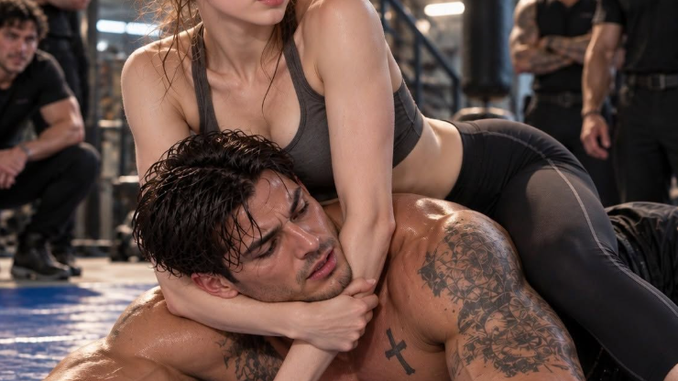
The first time I touched Mateo Moretti’s back, he stopped breathing.
Not because I hurt him.
Because I had found something he had spent twelve years teaching himself to hide.
His body went rigid beneath my palms.
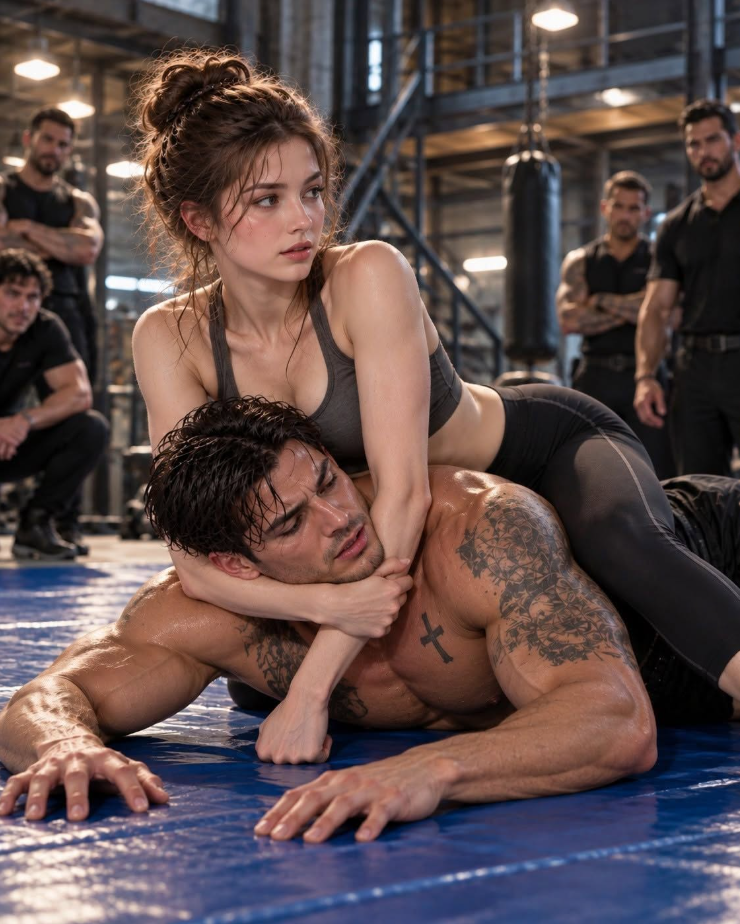
The muscles along his spine tightened like cables pulled too far, and somewhere behind me, three armed men stopped laughing.
“You don’t sleep,” I said.
Mateo slowly turned his head.
“What?”
“You don’t sleep in a bed.
Lying flat makes something worse.”
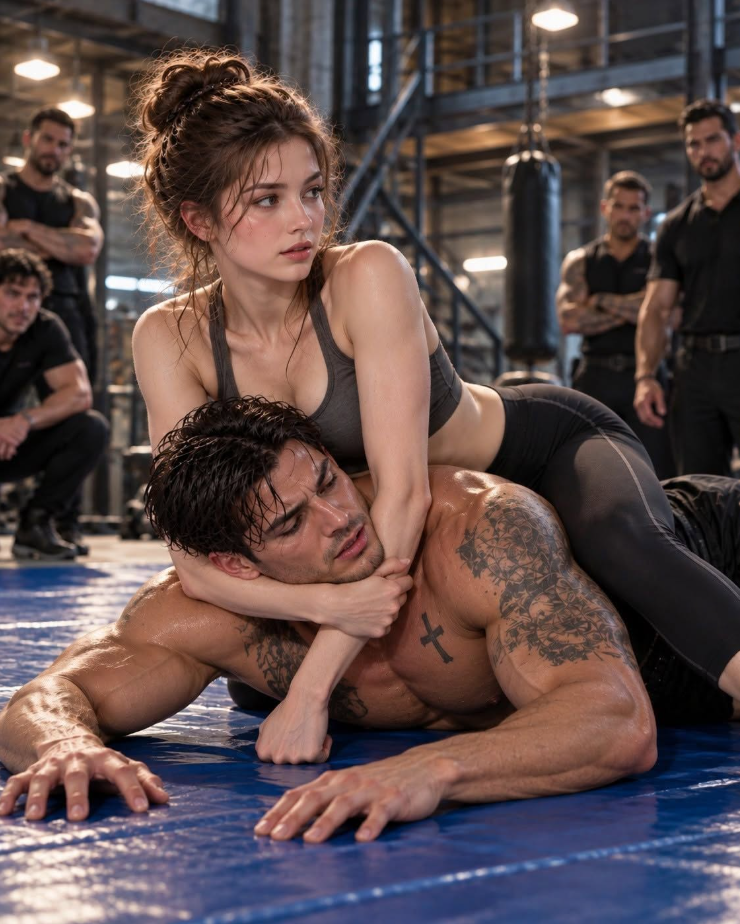
For a moment, nobody moved.
Rain tapped against the high warehouse windows.
The ventilation system hummed overhead.
A basketball bounced somewhere outside, then rolled to a stop.
Mateo Moretti stared at me with dark, exhausted eyes.
“Who told you about the chair?”
I was twenty-eight years old, standing barefoot on a wrestling mat in front of the most feared man in Chicago, and I had absolutely no idea what chair he meant.
But I knew pain.
I knew what it did to a person’s walk, how it changed the position of their shoulders, how it taught muscles to guard injuries long after the original damage had supposedly healed.
And I knew that the man standing in front of me was suffering far more than he wanted anyone to understand.
“Nobody told me anything,” I answered.
His jaw tightened.
“Then explain.”
I glanced toward the three men by the garage entrance.
“Do you want me to explain in front of your employees?”
One of them, a broad-shouldered man named Enzo, took a step forward.
“Careful how you speak to him.”
Mateo raised one finger.
Enzo stopped.
“Answer her question,” Mateo said quietly.
The guard looked confused.
“What question, boss?”
“Whether I asked you to speak.”
Enzo lowered his eyes.
“No, sir.”
“Then don’t.”
I should have been frightened.
Instead, I found myself studying the way Mateo shifted his weight away from his left leg.
The movement was almost invisible.
Almost.
“Your shoulders stay elevated even when you’re standing still,” I said.
“Your left foot doesn’t clear the floor properly.
You brace before turning, and every time you take a full breath, your right side tightens.”
Mateo said nothing.
“Whatever happened to you, your body learned to protect itself from a position that causes pain.
You probably avoid lying flat because you can’t relax those muscles without triggering something.”
His expression changed.
Only slightly.
But I saw it.
“You’re describing an injury,” he said.
“I’m describing what your body is doing.
I can’t diagnose the cause by touching your back.”
“Six specialists have examined me.”
“Then you should listen to what they’ve found.”
“They found nothing that explains twelve years of pain.”
I looked toward the empty mat.
“Maybe there’s a piece of the story they haven’t heard.”
Something cold passed across his face.
It wasn’t anger.
It was recognition.
And for the first time since I’d entered his warehouse, I understood that Mateo Moretti was not simply a dangerous man with a damaged back.
He was a man who had survived something he could not bring himself to describe.
Three hours earlier, I had arrived at the warehouse with a canvas gym bag, a folder of training plans, and exactly seventy-three dollars in my checking account.
My car needed a new transmission.
The wrestling program I’d spent six years building was losing its rented space.
And the mother of one of my youngest students had cried in my office the previous Friday because she couldn’t afford another month’s fees.
So when a private security company offered me a generous contract to coach one fourteen-year-old boy three afternoons a week, I took it.
The paperwork said his name was Leo Moretti.
I recognized the surname.
Everyone in Chicago recognized it.
Moretti was also my surname, although my family had never owned anything more impressive than a small house with a leaking roof and a secondhand washing machine.
My father used to say there were two kinds of Morettis in Chicago.
The ones who made the newspapers.
And the ones who cleaned up after them.
He preferred the second kind.
My father had been dead for twelve years.
I hadn’t thought about his little saying in a long time.
Not until I walked through the warehouse doors and saw a charcoal-colored sedan guarded by men who kept their hands close to their jackets.
Leo was waiting on the blue mat.
He was tall for fourteen, thin through the shoulders, with dark hair that refused to stay out of his eyes.
He looked at my gym bag.
Then at me.
“You’re the coach?”
“Unless you’re expecting someone else.”
“You’re shorter than I thought.”
“That’s what people usually say right before they discover how far the floor is.”
He almost smiled.
Almost.
Then he looked toward the men by the garage.
I followed his gaze.
Three guards.
One folding table.
Four untouched coffees.
And an atmosphere that felt less like a training facility than a room waiting for bad news.
“Your father coming?”
I asked.
Leo shrugged.
“He said he might.”
“Okay.”
“You don’t have to be nervous.”
I looked at him.
“Are you trying to reassure me or yourself?”
That earned me the beginning of a real smile.
We started with footwork.
No dramatic throws.
No demonstrations meant to impress the audience by the garage.
Just balance.
Position.
Patience.
Leo moved like a boy who’d spent too much time being told that strength meant hitting harder.
He charged.
He overcommitted.
He forgot his feet.
Every mistake came with a glance toward the watching guards.
Finally, I stopped him.
“Leo, who are you wrestling?”
“You.”
“Then why do you keep looking at them?”
He swallowed.
“Because they’re watching.”
“They can watch all afternoon.
They aren’t on this mat.”
Enzo laughed.
“Listen to your little coach, kid.”
The other guards joined him.
“Don’t hurt her,” one said.
“She looks expensive.”
I ignored them.
Leo didn’t.
His ears went red.
I lowered my voice.
“Can I tell you something?”
He nodded.
“People who need an audience to feel powerful are usually terrified of being ordinary.”
His eyes moved toward Enzo.
Then back to me.
“You’re not scared of them?”
“I’d be more concerned if they were on the mat and knew what they were doing.”
He laughed.
The sound startled him.
It seemed to surprise the guards, too.
We practiced again.
This time, when Leo rushed me, I turned with his momentum, lowered my center of gravity, and brought him safely down.
He landed on his back, blinking at the rafters.
For several seconds he didn’t speak.
Then he grinned.
“Again.”
I held out my hand.
“Again.”
We worked until sweat darkened his shirt.
Then footsteps sounded on the metal staircase.
The atmosphere changed so quickly I could almost feel the temperature drop.
Leo straightened.
The guards stopped talking.
A tall man emerged from the office level, one hand sliding along the railing.
Mateo Moretti.
I’d seen photographs.
Photographs did not capture the exhaustion around his eyes.
He was forty-two, dressed in an immaculate charcoal suit and black leather shoes.
Silver barely touched his temples.
His expression had the controlled stillness of someone accustomed to ending arguments without raising his voice.
But something about the way he descended those stairs caught my attention.
His left foot lagged.
His breathing shortened near the bottom.
His right shoulder held itself slightly higher than his left.
The most powerful man in the building moved like someone afraid his own body might betray him.
“Leo,” he said.
“Hey, Dad.”
“How was training?”
Leo glanced at me.
“She threw me.”
Mateo examined him.
“Did she hurt you?”
“No.”
“Did you learn anything?”
Leo considered the question.
“That being bigger doesn’t mean being better.”
For the first time, Mateo looked directly at me.
“I’ve been told you’re the best grappling instructor in the city.”
“My students improve.”
His gaze rested on my face for a beat longer than expected.
“Gia Moretti.”
“That’s right.”
He repeated the name softly.
“Gia.”
Something passed through his eyes.
I thought it might have been surprise.
Then it disappeared.
“Prove it,” he said.
He stepped onto the mat.
Enzo immediately straightened.
“Boss, maybe you shouldn’t—”
Mateo didn’t look at him.
“Is there a problem?”
“No, sir.”
I studied the expensive shoes.
Then his shoulders.
“I don’t recommend wrestling in leather soles.”
“I didn’t ask for a recommendation.”
“No.
But you hired me because I give them.”
Leo made a strangled noise, somewhere between amusement and terror.
Mateo’s expression remained unreadable.
“You’re confident.”
“I’m careful.
There’s a difference.”
“Show me.”
I approached without touching him.
“Can you turn to your left?”
He did.
His jaw tightened.
“Now to your right?”
He turned more smoothly, although his breathing changed.
“Raise both arms.”
He complied.
The right rose less easily.
“What exactly are we doing?” he asked.
“Finding out whether putting you on the mat would be a terrible idea.”
His eyes narrowed.
I stepped closer.
“May I check the muscles around your shoulders?”
A pause.
Then a nod.
I placed my hands against his upper back.
And felt the tension.
Not the ordinary stiffness of someone who spent too much time sitting.
This was different.
Muscles around his right shoulder blade remained engaged even while he stood still.
His breathing was shallow.
When I guided him into a small, supported movement, his entire torso braced.
I’d seen versions of this in injured wrestlers.
Athletes protecting cracked ribs.
Veterans protecting shoulders.
People whose nervous systems had learned to anticipate pain before it arrived.
But Mateo’s reaction was more profound than any I’d encountered.
I asked about sleeping.
He answered with silence.
I mentioned lying flat.
His breathing stopped.
And then came the question about the chair.
After I told him what I had noticed, Mateo stood motionless for several seconds.
Then he stepped away.
“Training is finished for today.”
Leo’s face fell.
“Dad—”
“Go upstairs.”
“But—”
“Leo.”
The boy picked up his water bottle.
He looked at me before leaving.
There was something strange in his expression.
Not disappointment.
Fear.
As though I’d opened a door he desperately wanted someone to open, and now he was afraid of what might come through it.
When his footsteps disappeared upstairs, Mateo turned toward the guards.
“Leave us.”
Enzo hesitated.
“Sir, I don’t think—”
“That’s becoming a habit.”
Within moments, the three men were gone.
The warehouse seemed enormous without them.
Mateo walked to a bench along the wall and lowered himself onto it with obvious care.
“How long have you been coaching?”
“Professionally?
Nine years.”
“And before that?”
“I started wrestling when I was thirteen.”
“Why?”
I thought of my father.
His broad hands tying my shoes.
The smell of coffee on his breath.
The way he used to stand in the doorway of our little neighborhood gym, smiling as if the world had given him something extraordinary.
“Because my father thought every girl should know how to fall without being afraid of getting back up.”
Mateo went still.
“What was his name?”
I hesitated.
It was an odd question.
“Paolo.”
His eyes moved to mine.
“Paolo Moretti?”
I felt my pulse shift.
“Yes.”
He looked away.
For a long moment, he studied a dark stain on the concrete floor.
“Where is he now?”
“He died.”
Mateo swallowed.
“When?”
“Twelve years ago.”
Silence.
Then he asked, very carefully, “How?”
I folded my arms.
“There was a fire.”
The muscles in his jaw tightened.
“A warehouse?”
“A neighborhood gym.”
He closed his eyes.
Only briefly.
But something in his expression made my stomach turn.
“Did you know him?”
I asked.
Mateo did not answer.
Instead, he stood, moving with the same guarded stiffness I’d noticed on the staircase.
“Come back tomorrow, Miss Moretti.”
“Mr.
Moretti—”
“Tomorrow.
Six o’clock.”
He started toward the stairs.
Then stopped.
Without turning around, he asked, “Did your father ever teach you what to do when someone grabs your wrist?”
The question made the air feel suddenly thin.
I stared at his back.
“Yes.”
“What did he teach you?”
“Don’t fight the hand.
Find the space.”
Mateo gripped the railing.
His knuckles turned white.
“He always said that,” Mateo whispered.
And then he climbed the stairs.
I watched until he disappeared behind the office door.
My father had died when I was sixteen.
For twelve years, I had believed that the fire which took him had also taken my two-year-old brother.
A little boy with soft black curls.
A crooked smile.
And a habit of squeezing my hand three times whenever he was frightened.
His name had been Nico.
I had never spoken that name to anyone in Mateo Moretti’s warehouse.
But when Leo came downstairs to collect his forgotten sweatshirt, I noticed something I hadn’t noticed before.
He was standing beside the mat, staring toward his father’s office.
His face was pale.
And without seeming to realize it, he pressed his thumb against his fingertips.
Once.
Twice.
Three times.
PART 2: THE CHILD THEY BURIED WITHOUT A BODY
I didn’t sleep that night.
At two in the morning, I sat on the kitchen floor of my apartment with an old metal box balanced between my knees.
Inside were the things I’d saved from my childhood.
A photograph of my father standing outside his gym.
My first wrestling medal.
A birthday card signed in his uneven handwriting.
And a tiny red mitten.
Just one.
The other had disappeared in the fire.
I picked it up.
The wool was faded now, the thumb stretched from years of a toddler pulling it into his mouth.
Nico had hated wearing mittens.
He hated vegetables, loud vacuum cleaners, and the green dinosaur pajamas my father bought him for his second birthday.
But he loved music.
He loved watching me wrestle.
And whenever he felt frightened, he would find my hand and squeeze three times.
I’d taught him that.
One squeeze meant I’m here.
Two meant Don’t leave.
Three meant I love you.
The memory came so suddenly that I pressed the mitten against my mouth.
For twelve years, I’d avoided remembering the final afternoon at my father’s gym.
The smell of rubber flooring.
The buzzing fluorescent lights.
The little plastic train Nico carried everywhere.
My father arguing with a man near the loading entrance.
Then the smell of smoke.
I remembered someone shouting.
I remembered my father pushing me toward the rear exit.
And I remembered Nico crying.
Not loudly.
Just a small, frightened sound.
“Gia!”
I had turned toward him.
Then something struck my head.
When I woke up, I was in a hospital with a bandage above my eyebrow.
My aunt Elena held my hand.
My father was dead.
My brother was dead.
That was what everyone told me.
They said the fire had spread too quickly.
They said the building had collapsed.
They said there had been nothing anyone could do.
I spent the next twelve years believing my last failure as a sister had been letting go of a little boy’s hand.
I looked down at the mitten.
Then at the small white scar across my left wrist, where falling debris had cut me.
Why had Mateo Moretti reacted as though he knew my father?
And why had a fourteen-year-old boy I’d only just met squeezed his fingers the way Nico used to?
I told myself it was coincidence.
I repeated the word until morning.
I didn’t believe it once.
The next afternoon, I went to see my aunt.
Elena lived in the same narrow brick house on the South Side where she’d taken me after the fire.
She was sixty-six now, with silver hair she dyed unsuccessfully every spring and hands that smelled permanently of lemon soap.
She opened the door wearing slippers and a cardigan.
“Gia?
Honey, what happened?”
“Did Dad have a brother?”
Her smile disappeared.
It happened so quickly that I knew the answer before she spoke.
“Come inside.”
“Aunt Elena.”
“Please.”
I followed her into the kitchen.
The same yellow curtains hung above the sink.
The same wooden table stood beneath the window.
I remembered sitting there at sixteen, staring at the empty chair where Nico should have been.
Elena filled the kettle.
“Your father had family he didn’t talk about.”
“Was one of them named Mateo?”
The kettle slipped against the countertop.
She steadied it.
“Where did you hear that name?”
“I’m coaching his son.”
Elena turned.
For the first time in my life, I saw genuine terror on her face.
“You’re working for Mateo Moretti?”
“Three afternoons a week.”
“You need to stop.”
“Why?”
“Because nothing good ever happens when that family starts remembering its own blood.”
I moved closer.
“Was Mateo Dad’s brother?”
She sat down.
Then she nodded.
“Mateo was your father’s younger brother.”
The room seemed to tilt.
I gripped the back of a chair.
“You’re telling me the man I’ve been working for is my uncle?”
“Your father hadn’t spoken to him properly in years.”
“Why?”
“Because Paolo wanted an ordinary life.
Mateo chose a different one.”
I thought of Mateo’s guarded movements.
His eyes when I’d mentioned the fire.
The way he’d repeated my father’s name.
“Did Mateo know about us?”
“He knew Paolo had children.
I don’t know how much else he knew.”
“Why didn’t you tell me?”
Elena’s eyes filled.
“Because your father asked me not to involve you in that world.
After the funeral, men came to the hospital asking questions about you.
I thought they were trying to finish what the fire started.”
“What men?”
“I never learned their names.”
She twisted her wedding ring.
“Someone sent documents saying your brother hadn’t survived.
Someone else told me that if I wanted you alive, I should take you away and never ask another question.”
I felt something hard forming beneath my ribs.
“What documents?”
Elena looked toward the hallway.
Then she stood and disappeared into her bedroom.
When she returned, she carried a brown envelope.
My name had been written on the front in blue ink.
Not Gia Moretti.
Gia Marino.
The surname I’d used during the years Elena was my legal guardian.
Inside were hospital discharge papers, insurance records, and a photocopied death notice.
The notice identified a two-year-old male victim.
No first name.
No photograph.
No medical examiner’s signature.
Just a date and a stamp.
I read it twice.
“Why doesn’t it say Nico?”
Elena’s face crumpled.
“They told me his records were incomplete because of the fire.”
“Who told you?”
“A man came from your father’s old employer.”
“My father owned a gym.”
“He also kept accounts for his brother’s business, before he tried to leave.”
I looked at the envelope.
There was a printed company name in the upper corner.
MORETTI SECURITY SERVICES.
And beneath it, a handwritten initial.
E.
My heart began beating harder.
“Did the man have a scar beside his mouth?”
Elena stared at me.
“Yes.”
I saw Enzo standing by the warehouse door.
Laughing.
Calling me sweetheart.
Telling Leo that his little coach couldn’t fight a real man.
And suddenly his mockery no longer felt like an ordinary insult.
It felt like a warning.
At six o’clock, I returned to the warehouse.
Enzo was waiting near the entrance.
“Well, look who came back.”
I walked past him.
He stepped into my path.
“Boss is busy.”
“I’m here for Leo.”
“Maybe you should find another client.”
I stopped.
“Move.”
He smiled.
“You’re getting awfully comfortable around here.”
“And you’re standing awfully close.”
His smile thinned.
For a moment, his right hand moved toward my arm.
Then he seemed to reconsider.
“Some families are better left alone,” he said.
The words chilled me.
Before I could respond, Leo appeared at the top of the stairs.
“Gia!”
Enzo stepped aside.
Leo hurried down.
“You’re late.”
“By four minutes.”
“That’s still late.”
I tried to smile.
“What are we working on?”
“Escapes.”
I looked at Enzo.
“Good choice.”
We practiced until Leo’s breathing became heavy and his movements lost their nervous urgency.
He was improving.
More importantly, he was beginning to trust himself.
After one successful escape, he sprang to his feet.
“Did you see that?”
“I did.”
“I didn’t panic.”
“No.”
“I waited until I felt the opening.”
“Exactly.”
His grin faded as he studied me.
“Are you okay?”
“Why?”
“You keep looking at me like you know me.”
I felt my throat tighten.
“Do I?”
He shrugged.
“I don’t know.”
Then, quietly, he asked, “Did you ever have a brother?”
My hands went cold.
“Why would you ask that?”
“Just wondering.”
“Yes,” I said.
“I did.”
“What happened to him?”
I looked at the blue mat.
“He died when he was little.”
Leo nodded.
His eyes shone.
“I’m sorry.”
I couldn’t tell whether he was comforting me or himself.
Then he asked something stranger.
“Do you ever stop missing someone if you were too young to remember them?”
I stared at him.
“No,” I whispered.
“I don’t think you do.”
He looked away.
We ended practice early.
Mateo was waiting in his office.
The room occupied the upper floor of the warehouse, behind thick glass overlooking the mat.
A dark wooden desk.
Shelves of financial records.
A charcoal sofa.
And beside the window, an enormous leather recliner.
Its armrests were worn smooth.
A folded blanket rested across the back.
There was a glass of water beside it, a bottle of medication, and a small brass lamp.
No bed.
No pillows except the narrow cushion supporting the chair’s lower back.
I stood in the doorway.
Mateo followed my eyes.
“Now you’ve seen it.”
“Does that bother you?”
“Very few people are allowed in this room.”
“Maybe that’s part of the problem.”
He gave a humorless smile.
“You really don’t know when to stop.”
“I’ve been told that before.”
He gestured toward a chair across from his desk.
I remained standing.
“Paolo was your brother.”
His expression changed.
There was no point pretending otherwise.
“Yes.”
“Which makes you my uncle.”
“Yes.”
“How long have you known?”
He looked toward the rain-streaked window.
“I suspected the moment I saw your name.”
“Suspected?”
“For twelve years, I believed my niece was dead.”
The words struck like cold water.
I moved closer.
“What?”
“I was given a report after the fire.
Paolo had died.
His daughter had died.
His little boy…”
He stopped.
“His little boy what?”
Mateo pressed his lips together.
For the first time, I saw the powerful man struggle to form a sentence.
“Gia, sit down.”
“No.”
“Please.”
That word.
Please.
Not a command.
Not a threat.
A request from a man who seemed unfamiliar with making them.
I sat.
Mateo lowered himself into the recliner.
His face tightened as his back met the leather.
“Your father called me that afternoon,” he said.
“He said he’d found something in the company accounts.
Something dangerous.
He wanted to meet.”
“What did he find?”
“Money being moved through businesses that had nothing to do with the transactions on paper.
Someone was stealing from my organization and hiding the trail.”
“Who?”
“I didn’t know then.”
“And now?”
He looked at me.
“I’m beginning to.”
I thought of the death notice.
The handwritten initial.
Enzo’s warning.
“My father was at the gym,” I said.
“I was there with Nico.”
Mateo’s eyes closed.
“Nico.”
He said the name as though it had been buried beneath years of silence.
“You knew him?”
Mateo opened his eyes.
“Paolo sent me photographs.”
The room seemed suddenly too small.
“Why didn’t you ever come?”
“Your father wanted you far away from me.”
“He was right.”
“Yes,” Mateo whispered.
“He was.”
That simple admission hurt more than an argument would have.
I folded my hands to stop them shaking.
“What happened the night of the fire?”
Mateo looked at the chair beneath him.
Then at me.
“I arrived after the fire started.
The front entrance was blocked.
I got inside through the loading bay.”
His voice grew rough.
“Part of the storage racks had fallen.
Your father was trying to hold open a narrow space beneath a security shutter.”
I felt the kitchen memories shift.
My father’s voice.
Smoke.
Nico crying.
“He saw me,” Mateo continued.
“He shouted for me to take the little one.”
I could barely breathe.
“And you did?”
Mateo nodded.
“I reached him.”
My fingers dug into my palms.
“Was he alive?”
Mateo stared at me.
A long silence.
Then:
“Yes.
He was alive when I carried him out.”
The room disappeared around me.
For twelve years, I had imagined Nico dying alone in smoke, frightened and searching for me.
Now Mateo was telling me he’d been carried out.
Breathing.
Alive.
“Then what happened?”
Mateo’s eyes filled.
I’d never seen a man look so exhausted.
Not physically.
Morally.
As though he had spent twelve years carrying a weight that no amount of strength could lift.
“There’s something I need to show you,” he said.
He reached into his desk drawer.
But before he could remove whatever was inside, the office door opened.
Leo stood there.
His face was pale.
“Dad,” he said.
Mateo froze.
“You were supposed to wait downstairs.”
“I heard her.”
Leo looked at me.
Then at the envelope in my hands.
His eyes dropped to the little red mitten protruding from my bag.
His expression broke.
“Where did you get that?”
I followed his gaze.
“This?”
I pulled out the mitten.
“It belonged to my little brother.”
Leo brought one hand to his mouth.
For a moment, he looked impossibly young.
Then he reached beneath the collar of his sweatshirt.
He withdrew a leather cord.
Hanging from it was a tiny brass train whistle, darkened with age.
My knees weakened.
I’d bought that whistle at a Christmas market when Nico was eighteen months old.
My father had complained that the sound would drive him insane.
Nico had loved it anyway.
On the underside, I’d scratched three crooked letters with a borrowed key.
N.
M.
And a tiny star.
Leo turned the whistle over.
The marks were still there.
I made a sound I didn’t recognize.
Leo was crying now.
He looked from the whistle to the mitten.
Then he asked in a voice barely louder than the rain:
“Was your little brother’s name Nico?”
PART 3: THE TWELVE YEARS THEY STOLE
“Yes.”
It was the only word I could manage.
Leo stood motionless in the doorway.
The whistle trembled between his fingers.
“My brother’s name was Nico,” I whispered.
“Nico Moretti.”
Leo looked at Mateo.
“Dad?”
Mateo bowed his head.
The silence that followed was almost unbearable.
Then Mateo said the words that split my life into everything before and everything after.
“Gia, your brother didn’t die in that fire.”
I stared at him.
He seemed to be waiting for me to understand.
But I couldn’t.
My mind refused to fit the pieces together.
The whistle.
The familiar gestures.
The boy who kept studying me as though he recognized something he had forgotten.
Mateo’s reluctance to speak.
Twelve years.
Fourteen years old.
Nico had been two.
I slowly turned toward Leo.
“No.”
He was crying silently.
“No,” I said again.
Not because I didn’t want it to be true.
Because wanting something for twelve years teaches you to fear the moment it appears in front of you.
Mateo rose from his chair.
He winced, but he didn’t sit back down.
“When I brought Nico out of the fire, he was barely breathing.
I took him to a private hospital.
I kept him with me because I believed someone had tried to murder my brother’s entire family.”
My eyes remained fixed on Leo.
“Why does he have a different name?”
“I changed it.”
“Why?”
“To protect him.”
I turned toward Mateo.
“Protect him from whom?”
“From whoever ordered the fire.”
“And me?”
Mateo’s face crumpled.
“They told me you were dead.”
I took a step backward.
“But I wasn’t.”
“I know that now.”
“I was sixteen.”
My voice cracked.
“I was sixteen years old, and I spent twelve years believing my baby brother burned to death because I let go of his hand.”
Mateo flinched.
I looked at Leo.
He was standing with his shoulders hunched, as if expecting me to reject him.
I remembered Nico at two years old.
The way he used to wobble across the kitchen after me.
How he’d fallen asleep with his fist tangled in my shirt.
I searched Leo’s face for the baby I’d lost.
The baby wasn’t there.
In his place stood a boy almost as tall as I was.
A boy with twelve years of birthdays I hadn’t attended.
Twelve years of scraped knees I hadn’t kissed.
Twelve Christmas mornings when I’d placed flowers beside a cemetery marker that never had a body beneath it.
They hadn’t only stolen my brother.
They had stolen the years in which I would have known him.
“Gia?”
Leo whispered.
I looked at him.
His voice was trembling.
“Can I ask you something?”
I nodded.
“Did you used to sing to me?”
My knees nearly gave way.
“What?”
“When I was little.
I remember somebody singing when it rained.”
He swallowed.
“Dad said it was probably a memory from before the fire.”
I pressed one hand over my mouth.
Nico had been afraid of thunderstorms.
I used to hold him against my chest and sing the same ridiculous song my father made up while fixing our kitchen sink.
It was about a tiny train that wasn’t afraid of the dark.
I hadn’t sung it in twelve years.
Leo took a small step toward me.
“Was that you?”
I nodded.
Tears blurred his face.
He gave a broken little laugh.
“I thought I made you up.”
That was when I moved.
I crossed the office and wrapped my arms around him.
He froze for half a second.
Then his arms locked around my waist.
He buried his face against my shoulder.
And the sound he made was the sound of a little boy finally finding something he hadn’t known he’d spent his whole life looking for.
“Nico,” I whispered into his hair.
He held on tighter.
“Is it okay if you call me that?”
I laughed through my tears.
“It’s your name.”
“But Leo’s my name too.”
I pulled back enough to see his face.
“Then you can have both.”
He nodded.
Then he took my hand.
And squeezed.
Once.
Twice.
Three times.
I broke.
Not delicately.
Not quietly.
I cried with the raw, ugly desperation of someone who had been holding her breath for twelve years.
Leo cried with me.
And across the room, Mateo Moretti lowered himself into his worn leather chair, put both hands over his face, and wept.
I don’t remember how long we stayed in that office.
Time stopped behaving normally.
Leo kept asking questions.
Did he really have a red toy train?
Yes.
Had he always hated carrots?
Absolutely.
Had he been afraid of dogs?
Only the big one that lived across the street.
He laughed when I told him he used to call our father “Papa-O” because he couldn’t pronounce Paolo.
Then he asked about our father.
That question changed the room.
“What was he like?”
I stared at him.
“Do you mean before the fire?”
Leo nodded.
I looked toward Mateo.
He was watching us without speaking.
I turned back to my brother.
“He was terrible at cooking.”
Leo laughed.
“Really?”
“Unbelievably terrible.
He burned spaghetti once.”
“How do you burn spaghetti?”
“I still don’t know.”
Leo smiled.
Then I told him about our father’s hands.
How they were always scratched from repairing gym equipment.
How he smelled of coffee and cedar soap.
How he pretended not to notice when we took money from his coat pocket to buy candy.
And how, whenever I lost a match, he never asked why I hadn’t won.
He asked whether I’d learned something.
Leo listened as though each word was a photograph being placed carefully into his hands.
Finally, he whispered, “I wish I’d known him.”
I kissed the top of his head.
“He would have loved you.”
Mateo made a small sound.
We both looked at him.
He was staring at the floor.
“He did love you,” he corrected.
Then he looked at me.
“And he loved you enough to make me promise something.”
“What?”
Mateo shook his head.
“Not yet.”
I felt anger rising beneath my grief.
“No more secrets.”
He looked at Leo.
Then at me.
“You’re right.”
He reached into his desk and removed a photograph.
The edges were blackened.
It showed my father standing outside the old gym with me on one side and Nico in his arms.
I remembered the day.
It had been unbearably hot.
Nico had spilled orange juice down my shirt.
My father had laughed until he cried.
Someone had taken the photograph just before we went inside.
Mateo handed it to me.
“I found this in Paolo’s office after the fire.”
I traced my father’s face with one finger.
“Why did you keep it?”
“Because I thought it was all I had left of you.”
Then Mateo told us the rest.
He told us about the phone call from Paolo.
About the suspicious accounts.
About the fire.
About carrying Nico through smoke so thick he could barely see.
And about the steel security shutter that had collapsed as he tried to get back inside.
“It caught me across the ribs and upper back,” he said.
“I was trapped beneath it until the firefighters reached me.”
I looked at his shoulders.
The guarded movement.
The way he avoided lying flat.
“The injury,” I whispered.
Mateo nodded.
“I had broken ribs, damaged nerves, and injuries around my spine.
They operated on me.
Eventually, everything that could heal was supposed to have healed.”
“But it didn’t feel that way.”
“No.”
He rubbed his right side.
“When I lie down, it feels like I’m under that shutter again.”
His eyes met mine.
“Sometimes the pain is enough to stop me breathing properly.
Other times I wake before I fall asleep because I can smell smoke.”
Leo moved toward him.
“Dad.”
Mateo looked at his son.
“I didn’t want you to know.”
“Why?”
“Because you were two years old when I took you out of that building.
You deserved a childhood that wasn’t built around what happened there.”
Leo knelt beside the chair.
“You were hurting the whole time?”
Mateo nodded.
Leo’s eyes filled.
“And you still came to all my games.”
Mateo’s mouth trembled.
“Of course.”
“And when I had nightmares, you stayed up with me.”
“Of course.”
Leo reached for his hand.
“Then you weren’t alone because of the chair, Dad.
I was there.”
Mateo folded forward and held him.
I watched them.
And for the first time, I understood something about this feared, ruthless man.
He had made terrible choices.
He had built his life inside a dangerous world.
But he had also raised a frightened child who wasn’t biologically his own, loved him without reservation, and become the only father that child remembered.
Mateo hadn’t replaced my father.
He had spent twelve years trying to give my brother the life our father couldn’t.
It didn’t erase what had happened.
But it mattered.
The truth about Enzo came four days later.
We found it because I refused to accept the death notice Elena had kept.
Mateo brought in an attorney who specialized in old criminal records.
I gave her every document my aunt possessed.
She traced the notice to a private reporting service that had never been authorized to issue death certificates.
The medical examiner’s records showed no identified two-year-old male victim from the fire.
The report declaring me dead had been altered too.
There had been one surviving teenage girl, transported to a different hospital after the first emergency room filled.
My name had been changed in the paperwork to Gia Marino when Elena obtained custody.
Two different sets of records had been created.
One for my aunt.
One for Mateo.
Both had come through the same man.
Enzo.
The attorney also found transfers from the accounts my father had been investigating into companies controlled by Enzo’s associates.
The evidence did not explain every detail of the arson, but it gave investigators enough to reopen the case.
Enzo had been stealing from Mateo’s businesses.
My father had discovered it.
And someone had set the gym on fire before he could expose the theft.
For twelve years, Enzo had stood beside Mateo, carrying a gun, collecting a paycheck, and listening while the man who trusted him suffered.
He had known I survived.
He had known Nico survived.
And he’d kept us apart because two living children might eventually lead someone back to the truth.
When the police arrived to question him, Enzo tried to leave through the warehouse’s side entrance.
I was coming out of the locker room.
He stopped in front of me.
“You should’ve stayed away,” he said.
I felt no fear.
Only an anger so steady it seemed almost cold.
“You told my aunt my brother was dead.”
He glanced behind him.
“Watch what you say.”
“You stood in that warehouse and laughed at me.”
“You’re making a mistake.”
“No, Enzo.
The mistake was believing a frightened sixteen-year-old girl would stay frightened forever.”
He caught my wrist.
Hard.
For one instant, I was back in the burning gym.
The smell of smoke.
The crash of metal.
My little brother crying.
Then I heard my father’s voice.
Don’t fight the hand.
Find the space.
I shifted my weight.
Turned toward the opening instead of pulling away.
And broke his grip.
When Enzo lunged again, I controlled his arm and used his forward momentum to bring him down onto the padded edge of the training area.
He hit the mat with a startled grunt.
I kept enough pressure to prevent him from getting up.
Nothing dramatic.
Nothing theatrical.
Just fifteen years of practice against a man who’d mistaken size for control.
Mateo appeared in the doorway.
Leo was behind him.
Two officers hurried forward.
Enzo twisted beneath my grip.
“Tell her to get off me!”
Mateo looked at him.
Then at me.
He didn’t smile.
But something in his face softened.
“She’s the coach,” he said.
“Ask her.”
I released Enzo when the officers took control.
They secured his hands and led him away.
He kept shouting that he hadn’t done anything.
Mateo watched until the doors closed.
Then he turned toward me.
“Are you hurt?”
“No.”
He looked at my wrist.
I followed his gaze.
The old scar was pale beneath the fluorescent lights.
“I should’ve known,” he said.
“You trusted the wrong man.”
“I let him stand beside my son.”
His voice broke.
“I let him near both of you.”
I looked at Leo.
He was standing a few feet away, trembling but upright.
“Then make sure he can’t hurt anyone else.”
Mateo nodded.
Over the following weeks, he turned over the records his attorneys had uncovered and began cooperating with investigators.
It meant exposing crimes committed inside his own organization.
Some of the evidence would bring consequences for him as well.
He didn’t pretend otherwise.
One evening, while his lawyers were downstairs, I asked why he was willing to risk losing everything.
He watched Leo through the office window.
Our brother was practicing a wrestling escape on the mat.
“Paolo spent his life trying to get out of the business I brought him into,” Mateo said.
He swallowed.
“I told myself I was protecting him.
All I did was make it harder for him to leave.”
He turned toward me.
“I can’t undo that.”
“No.”
“But I can stop asking his children to pay for it.”
I had no answer.
Some promises sound beautiful because they cost nothing.
This one would cost him nearly everything he’d built.
And for the first time, I believed he understood the difference.
The medical appointments began the following Monday.
Mateo hated every minute.
He hated the hospital smell.
He hated the examination gowns.
He hated admitting that his pain was sometimes so severe he couldn’t button his own shirts.
But he went.
A spine specialist reviewed his old records alongside new imaging.
A pain physician examined the healed rib injuries and the sensitivity along his right side.
There were mechanical restrictions around his rib cage, signs of longstanding nerve irritation, and profound muscle guarding.
The doctors also recognized something that had received too little attention.
His trauma.
For years, Mateo had described his pain without describing the event that caused it.
He’d hidden the details of being trapped beneath the shutter because explaining them would have meant talking about the fire.
Now, with the whole history available, the team could approach his condition differently.
It wasn’t a miracle.
There wasn’t a single bone I could push into place.
No secret wrestling maneuver that could erase twelve years of damage.
Treatment meant careful rehabilitation, pain management, gradual work on breathing and movement, and therapy to address the terror his body associated with lying down.
Some days were awful.
Some nights he still slept in the chair.
Sometimes he snapped at me because the exercises hurt, and I told him precisely how little his reputation impressed my nervous system.
Once, after a particularly difficult session, he threw a towel across the room.
“I’m done.”
I picked it up.
“With the exercise or with being told what to do?”
“Both.”
“Fine.”
I set the towel beside him.
He stared at me.
“That’s it?”
“You’re allowed to stop.”
“I thought you were supposed to push me.”
“I’m supposed to help you regain control.
Not take it away.”
He looked down at his hands.
After a long silence, he whispered, “I don’t know how to do this.”
“Do what?”
“Need people.”
I sat beside him.
“Start small.”
He gave a faint, exhausted smile.
“How small?”
“Ask me to stay for ten minutes.”
He closed his eyes.
Then said, “Stay.”
So I did.
Three months later, Leo competed in his first wrestling tournament.
The gymnasium smelled of popcorn, rubber mats, and cheap coffee.
Parents shouted from metal bleachers.
Whistles shrilled.
Sneakers squeaked across the polished floor.
Mateo sat beside me wearing a simple black sweater instead of a suit.
There were no armed guards hovering near him.
No entourage.
Just a tired man holding a bottle of water and trying not to look nervous.
Leo stepped onto the mat.
He looked taller now.
Stronger.
Not because his muscles had changed dramatically, but because he’d learned to stand without apologizing for taking up space.
His opponent was bigger.
Faster.
Aggressive.
In the first period, Leo went down.
Mateo gripped his knees.
I leaned forward.
“Don’t rush, Leo!”
He heard me.
He slowed his breathing.
Waited.
Found the opening.
And escaped.
In the final period, he earned the points he needed to win.
The whistle blew.
Leo stared at the referee.
Then he looked toward us.
Mateo was already standing.
Not slowly.
Not gracefully.
But standing.
His face was wet.
He shouted my brother’s name.
“LEO!”
Then, without thinking, he added something I’d never heard him say aloud.
“That’s my boy!”
Leo ran straight toward us.
He threw his arms around Mateo.
The impact made Mateo gasp.
Leo immediately stepped back.
“Sorry!
Your back!”
Mateo caught him before he could retreat.
“No.”
He pulled him close.
“Never apologize for that.”
I stood beside them with tears running down my face.
Leo reached for me too.
For a moment, the three of us stood together amid the noise of the gym.
An uncle who had become a father.
A sister who had spent twelve years grieving a living brother.
And a boy whose childhood had been built on a name given to keep him safe.
None of us could recover the missing years.
But there were more years ahead.
And for the first time, that thought felt like a gift instead of an accusation.
Six months after I first walked into the warehouse, Mateo slept in a bed.
Not for an entire night.
Not at first.
Thirty-seven minutes.
That was all.
He knew because he’d placed his phone beside the pillow before lying down.
When he woke, he called me.
It was 2:13 in the morning.
I answered on the fourth ring.
“Is something wrong?”
Silence.
Then I heard him breathing.
“Mateo?”
“I fell asleep.”
I sat up.
“What?”
“In the bed.”
He laughed.
It was a strange sound.
Small.
Unbelieving.
Almost embarrassed.
“Thirty-seven minutes.”
I pressed a hand over my eyes.
“That’s wonderful.”
“It hurt when I woke up.”
“I know.”
“I was afraid.”
“I know.”
Another silence.
Then he whispered, “But I slept.”
I could hear him crying.
I let him.
A man who had ordered rooms into silence with a glance was crying because he’d managed thirty-seven minutes of ordinary human rest.
And I understood that recovery was rarely the dramatic moment people imagined.
Sometimes it was a man lying down.
Sometimes it was a boy learning to trust his own feet.
Sometimes it was a woman finally putting away the little red mitten she’d carried like a wound for half her life.
The last thing Mateo gave me belonged to my father.
It was a letter.
He handed it to me on a cold Sunday afternoon after Leo had gone downstairs to practice.
We were in Mateo’s office.
The leather chair remained by the window.
But it no longer dominated the room.
A narrow daybed stood against the opposite wall, placed there so he could practice resting without forcing himself to remain in one position for too long.
Mateo held out an old envelope.
The corners were dark with smoke.
“I found this in Paolo’s jacket after the fire.”
I stared at it.
“Why didn’t you give it to me sooner?”
His eyes lowered.
“Because I couldn’t bear reading it aloud.
And after I learned you were alive, I kept thinking there would be a better time.”
“There isn’t a better time.”
“I know.”
He placed it in my hand.
“Your father gave it to me before the shutter fell.
He said it was for you if anything happened.”
My fingers trembled as I opened it.
The paper smelled faintly of dust.
My father’s handwriting leaned sharply to the right.
I knew every crooked letter.
I began reading.
My beautiful Gia,
If you’re reading this, something has gone wrong, and I am so sorry.
There are things grown men do that children should never have to carry.
I made mistakes trying to build a better life for you and your brother.
I trusted people I shouldn’t have trusted.
But loving you was never one of my mistakes.
My vision blurred.
I wiped my cheeks and continued.
You always think you’re supposed to be the strong one.
You take care of Nico.
You help me with the gym.
You pretend you’re not frightened because you think I have enough to worry about.
But you’re sixteen, sweetheart.
You’re allowed to be a child.
I made a broken sound.
Mateo moved closer but didn’t interrupt.
If anything happens today, I need you to remember something.
You are not responsible for protecting everyone you love.
Sometimes we choose to protect someone because we love them.
And if that choice costs us something, the people we protect do not owe us their happiness in return.
My hands shook so badly that the paper rattled.
At the bottom was one final paragraph.
If I can’t come home, take your brother somewhere he can grow up without fear.
Teach him to be kind.
Teach him to stand up when he falls.
And please, Gia, don’t spend your life punishing yourself for the people you couldn’t save.
I love you more than every victory, every dollar, and every breath I’ve ever taken.
Papa.
I pressed the letter against my chest.
For twelve years, I had believed my father died without knowing whether either of his children survived.
Now I understood.
He’d known exactly what he was risking.
And he had left me the one thing I hadn’t known how to give myself.
Permission to live.
I looked up at Mateo.
“Why did he give this to you?”
Mateo’s eyes filled.
“Because he believed I’d get you both out.”
His voice broke.
“I couldn’t save him.”
I reached for his hand.
“Did you try?”
He nodded.
“Until the firefighters pulled me away.”
“Then you did what he asked.”
Mateo began crying.
Not loudly.
Just tears sliding down the face of a man who had spent most of his life believing grief was something to hide.
I held his hand until the shaking stopped.
Then I asked him the question I’d been afraid to ask since the first day.
“Did my father suffer?”
Mateo looked at me.
“He knew Nico was out.”
I waited.
“He made me promise to tell you something.”
“What?”
Mateo took a shaky breath.
“That when the smoke came, you didn’t abandon your brother.”
My chest tightened.
“He said you kept trying to go back for him, even after the debris struck you.
He had to push you toward the rear exit because you wouldn’t leave.”
I stared at him.
The memory returned in fragments.
Heat.
A hand against my shoulder.
My father shouting.
My feet sliding across the floor.
I remembered thinking I’d run away.
That I’d chosen air over my baby brother.
That some terrible instinct for survival had made me selfish.
Mateo held my gaze.
“Gia, your father didn’t die because you let go.
He died holding the way open so the two of you could live.”
Something inside me finally gave way.
Not broke.
Released.
I bent forward and sobbed.
Mateo put one arm around me.
We stayed like that until the afternoon light faded behind the warehouse windows.
That evening, Leo came upstairs carrying three mugs of hot chocolate.
He’d made them himself.
There were marshmallows everywhere.
One mug had twice as many as the others.
“That one’s mine,” he announced.
I laughed.
“Obviously.”
Mateo accepted his mug.
Leo looked at the daybed.
“Are you trying again tonight?”
Mateo nodded.
“I think so.”
“Want us to stay?”
Mateo looked from Leo to me.
There had been a time when he would have said no.
When he would have insisted he needed nothing.
When the entire world could have burned around him and he would still have sat upright in that chair, convinced that weakness was more dangerous than pain.
Now he simply nodded.
“Yes.”
Leo placed his mug on the table.
I folded the blanket.
Mateo eased himself onto the mattress.
His movements were careful.
His breathing uneven.
He closed his eyes.
A minute passed.
Then another.
Leo sat on the floor beside him.
I sat against the opposite wall.
Nobody spoke.
Outside, rain began tapping against the warehouse windows.
The same sound I’d heard the day Mateo first stepped onto my wrestling mat.
Only now, the warehouse was different.
The guards were gone.
The laughter was gone.
And the boy beside me was no longer a stranger I had been hired to teach.
He was my brother.
My Nico.
Leo leaned his head against my shoulder.
“Gia?”
“Yeah?”
“Will you sing the train song?”
I looked at him.
He smiled shyly.
“Just once.”
I felt tears rising again.
Then I began singing.
Softly.
The silly little song about a train traveling through the dark.
Leo joined in on the last line.
He remembered more than he realized.
Across the room, Mateo’s breathing gradually deepened.
His shoulders relaxed.
His hands unclenched.
And as the rain moved softly over the city, the man who had spent twelve years unable to lie down finally drifted into sleep.
Leo reached for my hand beneath the blanket.
He squeezed it three times.
I squeezed back.
And in the corner by the darkened window, the old leather chair stood empty, holding nothing at last but the twelve years we could never get back.
Để lại một phản hồi