The pistol did not shake.
That was what frightened everyone.
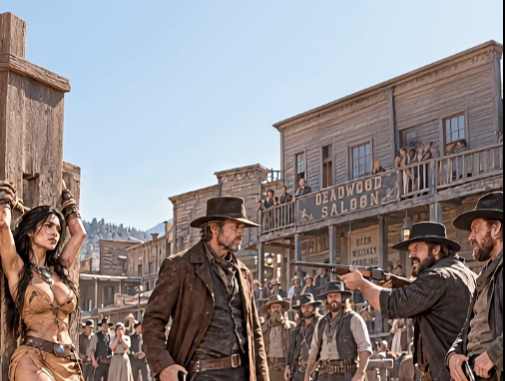
Silas Marrow stood in the middle of Widow’s Bend with his revolver hanging low beside his thigh, while two of the territory’s most feared men stared at him as if they had not yet realized they were already dead.
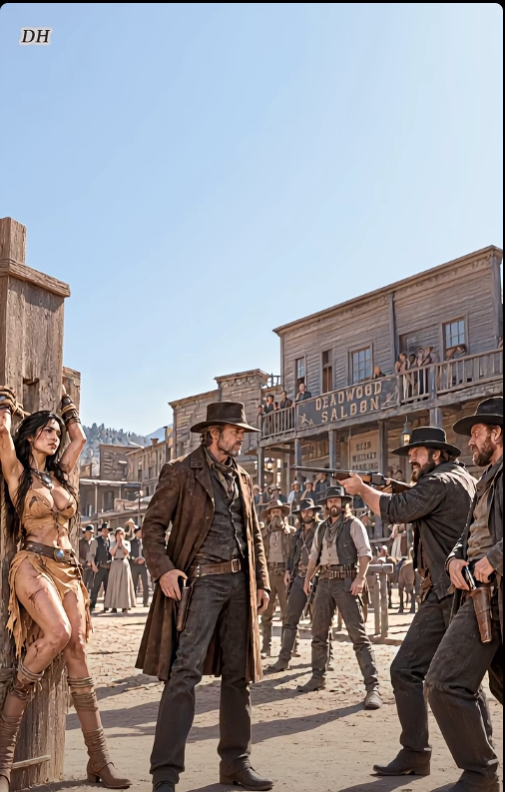
Behind them, tied upright to a wooden frame beneath the merciless afternoon sun, was a young Apache woman named Anaba.
Her wrists were raw.
Blood had dried along the rope burns.
Her dress was torn at one shoulder.
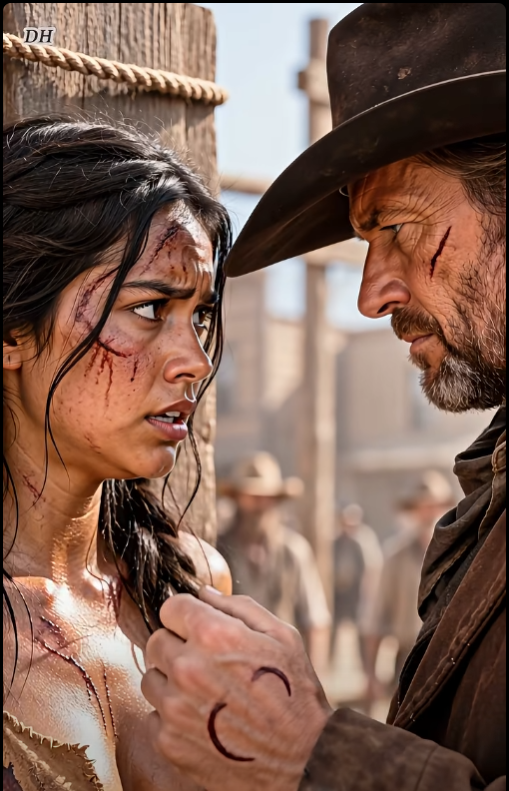
But her eyes were still burning.
That was why they hated her.
Judge Slocum had spent half an hour trying to make her beg.
Otis Marsh had thrown coins into the dirt and invited the crowd to wager on how long she would last.
Nobody had stopped them.
Not the shopkeepers.
Not the ranch hands.
Not even Sheriff Emmett Halloway, who stood beneath the awning of his office with one hand resting uselessly beside his revolver.
Widow’s Bend had learned a terrible lesson during Garrick Crane’s two-year reign over the town.
Survival meant silence.
Then Silas rode in.
Gray horse.
Dust-colored coat.
Hat pulled low.
A stranger who looked at shadows before people and rooftops before doors.
He stopped at the edge of the crowd.
For several seconds, he said nothing.
Slocum pushed his rifle beneath Anaba’s chin.
“Take a good look,” he announced. “This is what happens when people forget who runs this town.”
Anaba’s knees buckled.
The ropes caught her.
A few men laughed.
Then Silas moved.
Slowly.
His horse carried him straight through the crowd.
People stepped aside without knowing why.
Maybe it was the way he sat the saddle.
Maybe it was the fact that he never once looked nervous.
Or maybe people recognize danger long before they understand it.
Silas stopped three paces from Anaba.
His eyes moved over the ropes cutting her skin.
Something flickered in his expression.
Not pity.
Something older.
Something almost like recognition.
Slocum noticed.
“Wrong street, old man.”
Silas finally looked at him.
“Release her.”
The laughter died instantly.
Marsh stepped forward.
“Or what?”
Silas climbed down from the saddle.
“I don’t repeat myself.”
Even Sheriff Halloway straightened at that.
He had seen men stand like that once, years ago.
Men who had learned to fire before fear finished telling them to.
Slocum smiled.
Then his hand dropped.
Nobody saw Silas draw.
There was only a gunshot.
Slocum staggered backward.
His rifle fell from his hands.
He collapsed into the dust.
Marsh reached for his revolver.
A second shot cracked.
He dropped before his gun cleared leather.
Two men.
Two bullets.
Silas’s breathing never changed.
Nobody screamed.
A gunfight required two sides.
This had been something closer to a judgment.
Then another voice came from behind the crowd.
“That’s enough.”
People moved aside.
Garrick Crane walked into the street.
Tall.
Thin.
Winter-cold eyes.
He looked at his dead men as if checking numbers in a ledger.
Then he looked at Silas.
“You just killed two men who belonged to me.”
Silas holstered his revolver.
“They made their choice.”
Crane smiled without warmth.
“Five o’clock.”
Silas waited.
“Right here.”
Crane stepped closer.
“I’ll kill you where everyone can watch.”
Then he turned and walked away.
Silas did not follow.
Instead, he went to Anaba.
He pulled a knife from his boot and cut the ropes.
The moment her ankles were free, her legs gave out.
He caught her.
“Can you walk?”
She nodded.
Barely.
That was enough.
He carried half her weight toward Adeline Callahan’s saloon.
As they crossed the street, Anaba looked up at him.
For one brief second, their eyes met.
And something inside both of them stopped.
Silas felt it first.
A door in his memory.
One he had nailed shut fifteen years earlier.
Smoke.
Screaming.
A burning valley.
A woman running toward rocks with a child.
He shoved the memory down.
Not now.
Inside the saloon, Adeline Callahan took one look at Anaba and cleared a table.
“Put her here.”
She cleaned the wounds without questions.
Silas watched the rope burns disappear beneath white bandages.
Then he walked across the street to Halloway’s office.
The sheriff was waiting.
“You let that happen,” Silas said.
Halloway’s jaw tightened.
“You don’t understand Crane.”
“I understand men who survive because everyone else is afraid to stand up.”
Halloway opened a desk drawer.
Inside was an old leather notebook.
He pushed it across the desk.
Silas opened it.
Names.
Dozens.
Dead ranchers.
Missing workers.
Families driven from their land.
People killed because they resisted Garrick Crane.
“I’ve been keeping records for two years,” Halloway said.
“Why?”
“My brother.”
Silas looked up.
“Ezra.”
Everyone in Widow’s Bend believed Ezra Halloway was dead.
He was not.
He had spent two years inside Crane’s organization, pretending loyalty and feeding information to his brother whenever he could.
“Crane owns the town because someone richer owns Crane,” Halloway said. “I’m trying to find out who.”
Silas shut the notebook.
“Then today you stop waiting.”
Outside, the sun crawled lower.
Five o’clock approached.
Inside Adeline’s saloon, Anaba sat by the window, watching Silas.
There was something about him.
Something familiar.
Not his face.
His hands.
The way he moved.
The way he had looked at her before cutting the ropes.
She had spent fifteen years hunting answers about the valley where her mother died.
Three years searching land registries and company records.
That search had brought her to Widow’s Bend.
She had asked the wrong clerk about the wrong property.
Crane’s men had found her before she reached the next town.
But the stranger who saved her had brought another memory back.
A soldier.
Smoke.
A crescent-shaped mark burned into one leather glove.
A child hiding among rocks.
Her mother screaming for her to run.
At four-thirty, the street went too quiet.
Silas looked toward the church steeple.
Something flashed.
A rifle barrel.
He moved as the shot exploded.
Wood splintered where his chest had been.
“LEFT WINDOW!” Anaba screamed from the saloon.
Silas fired twice.
A rifleman toppled from the church tower.
Crane had promised five o’clock.
He had tried to murder Silas before it arrived.
When five finally came, Silas stood alone in the street.
Crane never appeared.
And for the first time in two years, everyone in Widow’s Bend saw something they had forgotten was possible.
Garrick Crane could be afraid.
Silas returned to the saloon.
Anaba rose when he entered.
“You’re alive.”
“I am.”
She approached him.
Her face had gone pale.
“Take off your left glove.”
Silas froze.
“Why?”
“Please.”
Slowly, he removed it.
A pale crescent-shaped scar curved across his wrist.
Anaba stopped breathing.
Fifteen years vanished.
Smoke filled her memory.
Her mother’s hands pushed her toward the rocks.
A frightened young soldier raised a rifle.
And on his glove—
that same crescent.
Her eyes lifted to Silas.
“It was you.”
Silas said nothing.
“You were there.”
His face changed.
And the truth was suddenly visible before he ever spoke.
“Yes.”
Anaba stepped backward.
“My village.”
“Yes.”
“My mother.”
Silas closed his eyes.
“I was a cavalry scout.”
Anaba’s voice broke.
“Don’t explain it.”
“I won’t.”
“You fired into that smoke.”
He could barely answer.
“Yes.”
Her eyes filled.
Silas had ridden into Widow’s Bend believing Garrick Crane was his problem.
He was wrong.
Because beyond Crane stood another man.
A man from Silas’s past.
A man whose orders had burned Anaba’s childhood to the ground.
And before sunset, Silas would discover that the woman he had just saved carried the one memory he had spent fifteen years trying to bury
Để lại một phản hồi