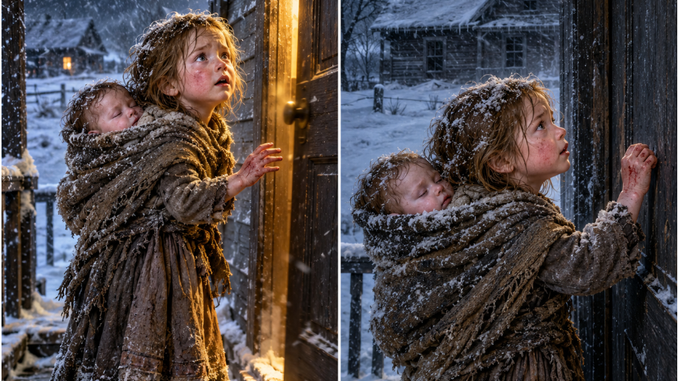
The latch lifted.
Emily Carter stopped breathing.
For one trembling second, the little girl expected exactly what she had found behind every other door that night—a frightened face, a hard expression, and another command to disappear into the storm.
Instead, the door swung inward and revealed a man so large that he filled the doorway.
He was perhaps forty-eight, broad through the shoulders, with silver beginning to thread through dark hair that fell untidily across his forehead. A jagged scar ran from his left temple toward his jaw. He wore a faded wool shirt, suspenders, and one boot, as though Emily’s knocking had dragged him from sleep before he could finish dressing.
His eyes were the strangest thing about him.
Gray.
Sharp.
And immediately terrified.
Not of Emily.
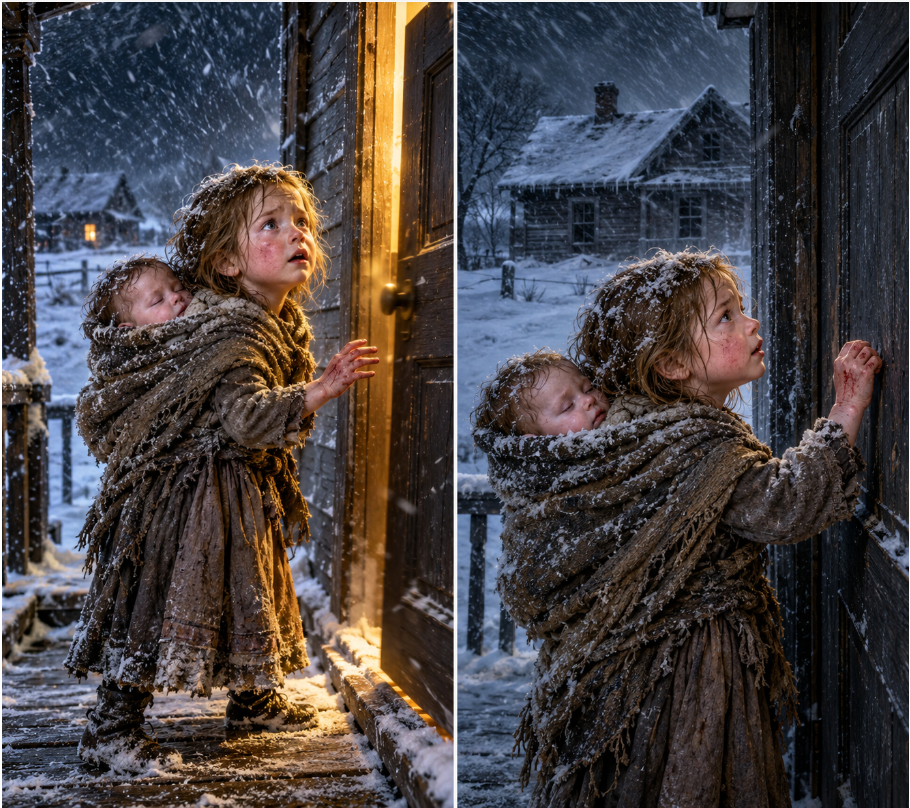
For Emily.
The man looked at the blood on her fingers.
Then at the tiny bundle tied to her back.
His face changed.
“Dear God.”
Emily tried to say the words she had practiced.
“Emily. Noah. Food.”
Her knees buckled before she could add that she could work.
The stranger lunged forward.
He caught her an instant before her face struck the porch.
Emily felt enormous arms close around her.
Warmth.
After hours of wind, rejection, and snow, the warmth hurt almost worse than the cold.
She struggled weakly.
“Noah.”
“I’ve got you.”
“My brother.”
“I’ve got him.”
“Don’t let him sleep.”
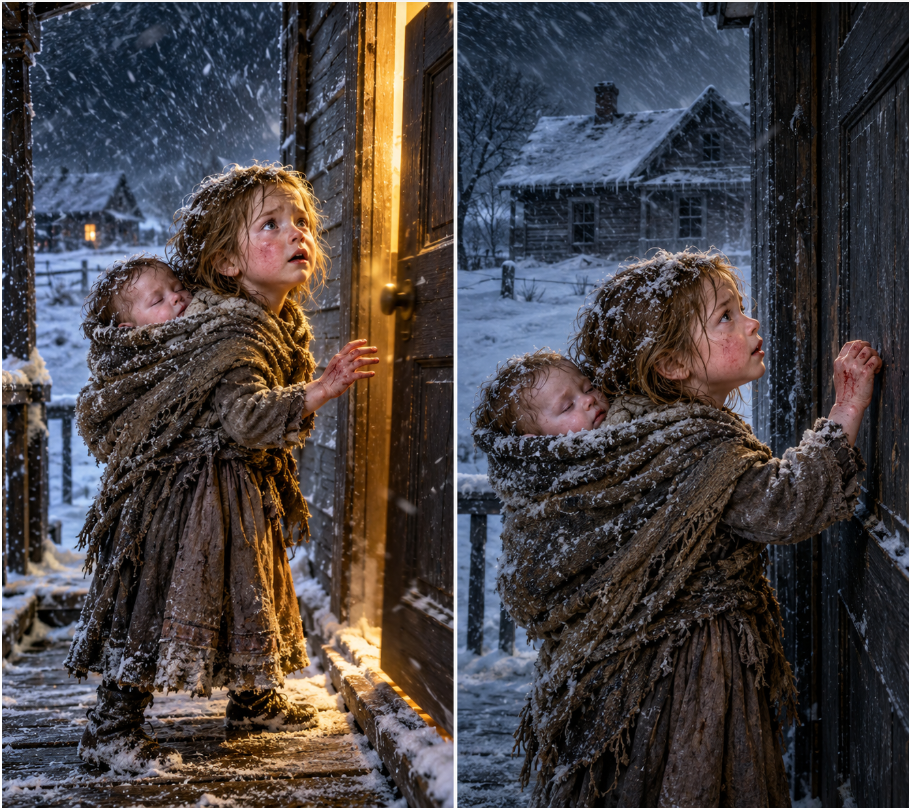
The man froze.
Slowly, carefully, he carried Emily inside and kicked the door shut against the blizzard.
The farmhouse was dark because the fire in the hearth had nearly died, but the stranger crossed the room in three enormous strides and laid Emily on a narrow sofa.
Then he untied the frozen shawl.
The infant against Emily’s back did not move.
The stranger’s expression became frighteningly calm.
He placed two fingers beneath Noah’s jaw.
Emily watched.
“Is he dead?”
The man did not answer.
“Please.”
Still nothing.
Emily pushed herself upright.
“Please don’t let him be dead.”
The stranger ripped open a cupboard, pulled out blankets, then crouched beside the hearth and began feeding wood into the embers.
Flame caught.
He wrapped Noah in warm cloth—not hot, Emily noticed, just warm—and rubbed the baby’s chest with slow, careful strokes.
Minutes passed.
Emily’s teeth chattered uncontrollably.
The stranger leaned close to Noah’s mouth.
Then suddenly—
a thin, furious cry broke through the room.
Emily gasped.
Noah cried again.
Weak.
Hoarse.
But alive.
The sound was the most beautiful thing Emily had ever heard.
She burst into tears.
For the first time that night, she allowed herself to be four years old.
The stranger closed his eyes.
His huge shoulders sagged.
“That’s it,” he whispered to the baby. “Complain all you like, little man.”
Emily sobbed into her hands.
The stranger covered her with another blanket.
“What’s your name?”
“Emily Carter.”
“Emily Carter.”
He repeated it strangely.
“And the baby is Noah?”
She nodded.
“Where are your parents?”
Emily’s crying stopped.
The man’s eyes sharpened.
“Emily?”
“Mama is home.”
“How far?”
She pointed vaguely into the white darkness beyond the window.
“Past the crooked tree. Then the broken fence.”
“Is your father with her?”
Emily shook her head.
“Papa went under the ground.”
The man’s jaw tightened.
“How long ago?”
“Before Noah learned to smile.”
He swallowed.
“And your mother sent you out in this storm?”
“Mama wouldn’t wake up.”
The stranger went completely still.
Emily continued, “There was a man.”
“What man?”
“He came before the snow got bad.”
“What did he want?”
“I don’t know.”
“Did he hurt your mother?”
Emily looked down.
“He yelled.”
The stranger crouched until his face was level with hers.
“What did he look like?”
“I don’t know.”
“Think.”
She squeezed her eyes shut.
“He had shiny boots.”
“Anything else?”
“A ring.”
“What kind?”
Emily opened her eyes.
“A wolf.”
Something flickered across the stranger’s face.
Recognition.
Then fear.
He stood.
“Emily, I need to go find your mother.”
Emily grabbed his sleeve.
“No.”
“I have to.”
“They’ll shut the door.”
Her tiny fingers tightened desperately.
“Everybody shuts the door.”
The man looked down at her hand.
For several seconds he said nothing.
Then he lowered himself beside her again.
“Listen to me.”
His voice became gentle.
“My name is Silas Mercer.”
He pointed toward the floor.
“This is my house.”
Then he looked directly into her eyes.
“And as long as there is breath in my body, this door will never close on you again.”
Silas wrapped Emily in three blankets, placed Noah in a wooden box padded with wool beside the hearth, and fed them both warm goat’s milk sweetened with a little honey.
Then he pulled on his coat.
Emily immediately began struggling from the blankets.
“I’m going too.”
“No.”
“I know the way.”
“You can barely stand.”
“I know the way.”
Silas studied her.
There was something almost unnatural about the determination in that small face.
No.
Not unnatural.
Familiar.
He had seen it before.
Twenty-one years earlier.
In another face.
Another pair of gray-blue eyes.
Silas pushed the thought away.
“Show me from the window.”
Emily pointed.
“Road goes that way.”
“There isn’t a road anymore.”
“The fence.”
Silas peered through blowing snow.
Barely visible beneath the drifts were the tops of fence posts.
“Your mother told you to follow them?”
Emily nodded.
“Find the north house.”
Silas slowly turned toward her.
“What?”
“Mama said if she didn’t wake up, follow the posts north.”
Silas’s heartbeat changed.
“Did she tell you whose house?”
Emily frowned.
“She said…”
Her forehead wrinkled in concentration.
“Mercy.”
Silas felt the room tilt.
“Mercer?”
Emily brightened.
“Yes.”
His blood went cold.
“Your mother told you to find Mercer?”
“Yes.”
“How does she know my name?”
Emily shrugged.
Silas stared at her.
Nobody came to his farmhouse anymore.
Half the county believed him mad.
The other half thought he was dangerous.
Children were warned not to wander near his property.
Yet somewhere in the storm was a woman who had deliberately sent her four-year-old daughter searching for him.
Silas saddled his mare.
Emily described the crooked cottonwood repeatedly until he understood the route.
Before leaving, he knelt beside her.
“Bolt the door.”
She stared at him.
“Don’t open it for anyone except me.”
“What if they say they’re nice?”
Silas looked at her for a long moment.
“Especially then.”
The Carter cabin stood nearly three miles away.
Silas almost missed it.
Snow covered half the roof, and the chimney had stopped smoking.
The front door hung crookedly from one hinge.
His hand moved toward the revolver beneath his coat.
Inside, furniture had been overturned.
A table lay on its side.
A shattered oil lamp covered the floor.
Blood darkened the wooden boards.
Silas followed it toward the bedroom.
A woman lay beside the bed.
She wore only a torn nightdress and wool stockings.
One side of her face was bruised.
“Ma’am?”
No response.
Silas dropped beside her.
Pulse.
Weak.
But there.
He pulled off his coat and wrapped it around her.
As he lifted her, something fell from beneath her dress.
A small silver locket.
Silas stared.
The world disappeared.
He lowered the woman back to the floor.
His fingers trembled as he picked up the locket.
On its surface were three tiny engraved lilies.
Silas had ordered those lilies himself.
He had stood inside a jeweler’s shop in St. Louis twenty-four years earlier while the craftsman carved them.
One lily for his wife.
One for himself.
And one for their daughter.
His daughter had worn that locket on the night his house burned.
The night both his wife and his three-year-old child were supposedly killed.
Silas had dug through the ashes with bleeding hands until sunrise searching for their bodies.
They had found bones.
The sheriff had told him there was nothing left to identify.
Silas had believed him.
For twenty-one years.
His eyes dropped to the unconscious woman’s face.
“No.”
He pushed damp hair away from her temple.
Behind her right ear was a pale crescent-shaped birthmark.
Silas stopped breathing.
His daughter had possessed the same mark.
A mark his wife used to kiss every night.
Silas staggered backward.
“No.”
The word broke inside him.
The woman stirred.
Her eyelids fluttered.
For half a second, her unfocused eyes found his.
“Emily…”
“She’s safe.”
The woman’s breathing caught.
“Noah?”
“Safe.”
Tears immediately slipped down her temples.
Silas held up the locket.
“Where did you get this?”
Her gaze moved toward it.
Then toward his face.
She whispered a single word.
“Father?”
Silas Mercer, who had survived war, fire, grief, accusations, and twenty-one years of loneliness, fell to his knees.
Her name was Mara Carter.
At least, that was the name she had known most of her life.
Silas brought her back through the blizzard on horseback, holding her unconscious body against his chest.
When Emily saw them through the window, she screamed.
“Mama!”
Silas barely opened the door before Emily threw herself into the snow.
He caught her.
“Inside.”
“My mama!”
“She needs warmth.”
For the next six hours, Silas became the doctor he had once been.
Long before grief had made him a recluse, Dr. Silas Mercer had been considered one of the finest physicians in the territory.
He had abandoned medicine after the fire.
People said his hands had become unreliable.
That was not true.
His hands remained steady.
It was his heart he no longer trusted.
Yet that night, beside the woman who might somehow be his daughter, the old instincts returned.
Mara had suffered a blow to the head and a shallow bullet wound along her ribs.
She was also dangerously cold.
But she would live.
Near dawn, her eyes opened.
Emily was asleep beside her.
Noah lay in a basket nearby, sucking greedily from a cloth soaked in warm milk.
Silas sat across the room.
Mara looked at him.
For a while, neither spoke.
Finally she said, “Agnes told me you would look older.”
Silas almost laughed.
Instead, he cried.
It happened without warning.
One moment he sat perfectly still.
The next his face folded, and twenty-one years of grief poured out of him.
Mara reached weakly toward him.
Silas crossed the room and took her hand.
“Who is Agnes?”
“The woman who raised me.”
“Agnes Pike?”
Mara’s eyes widened.
“You knew her?”
“She delivered you.”
Silas’s voice hardened.
“She was there the night of the fire.”
Mara closed her eyes.
“She confessed before she died.”
“To what?”
“She saved me.”
Silas stared.
Mara explained.
On the night the Mercer house burned, Agnes Pike had been passing along the south road when she saw flames.
She entered through a kitchen window.
Silas had been away treating a rancher’s injured son.
Agnes found three-year-old Lily Mercer unconscious near the pantry.
She carried the child outside.
Then she saw a man leaving through the rear door.
Horace Bell.
Silas’s brother-in-law.
His wife’s older brother.
The richest man in the county.
Agnes knew Horace had spent months arguing with Silas’s wife, Evelyn, over property their father had left jointly to Evelyn and her daughter.
If Evelyn and Lily died, Horace controlled everything.
Agnes became frightened.
Instead of going to the sheriff, she took Lily to another county.
She intended to return when the danger passed.
But two days later, newspapers reported that Silas Mercer had murdered his family in a drunken rage before setting fire to the house.
Agnes believed Silas might be responsible.
So she kept Lily.
She changed the child’s name.
Raised her as Mara Pike.
And remained silent.
“Why didn’t she ever tell me?”
“She was afraid,” Mara whispered. “Then ashamed. She told herself every year that it was too late.”
Silas stared into the fire.
“Twenty-one years.”
“I found her letter after she died last spring.”
“And you came here.”
“With my husband.”
Silas looked toward Emily.
“Daniel Carter.”
Mara nodded.
“He believed me when no one else did.”
“What happened to him?”
Her mouth trembled.
“His wagon went over Blackstone Ridge six weeks ago.”
“Accident?”
“I thought so.”
Her hand moved toward her bandaged ribs.
“Until tonight.”
Silas leaned forward.
“Who attacked you?”
“I never saw his face.”
“Emily saw a wolf ring.”
Mara’s eyes widened.
“A wolf?”
“Yes.”
She went pale.
“Horace Bell wears no ring like that.”
Silas watched her carefully.
“But somebody does?”
Mara nodded.
“The sheriff.”
Sheriff Caleb Voss arrived shortly after sunrise.
Silas saw him through the window.
He rode through the storm on a black gelding, accompanied by two deputies.
Mara tried to rise.
Silas stopped her.
“Stay here.”
Caleb pounded on the door.
“Mercer!”
Silas opened it only halfway.
Sheriff Voss was thirty-two, handsome in the polished way politicians often were. His coat was expensive. His beard carefully trimmed.
On his right hand he wore a leather glove.
“Morning, Silas.”
“Bit early for visiting.”
“We’re looking for two missing children.”
“You found them.”
Caleb smiled.
“That easy?”
“Apparently.”
“We’ll take them.”
Silas did not move.
“No.”
The smile disappeared.
“The Carter woman was found unfit weeks ago.”
“By whom?”
“County board.”
“I didn’t hear about that.”
“You don’t attend town meetings.”
“Maybe because the town spent twenty years calling me a murderer.”
Caleb sighed.
“I’m not here to argue old grievances.”
“Good.”
Silas started closing the door.
Caleb shoved his boot into the opening.
“Those children belong in county custody.”
Silas looked at the boot.
Then at Caleb.
“Remove it.”
“Silas—”
“Remove your boot from my house.”
The deputies exchanged glances.
Caleb slowly obeyed.
“Is Mara Carter here?”
Silas said nothing.
Caleb smiled again.
“Interesting.”
“She was assaulted.”
“So you claim.”
“Shot.”
“She may have shot herself.”
Silas’s expression became dangerous.
Caleb’s gaze shifted past him into the room.
Emily had awakened.
She stood beside the sofa.
The moment she saw the sheriff, the color drained from her face.
She backed away.
Caleb noticed.
“Hello, sweetheart.”
Emily screamed.
She ran behind Silas.
Silas felt her tiny hands seize his trousers.
“No.”
Caleb froze.
“No what?”
Emily pointed at him.
Her finger shook violently.
“The wolf.”
Silence.
Every person on the porch looked at Caleb’s gloved hand.
Caleb laughed.
“Child’s half frozen. She doesn’t know what she’s saying.”
Silas’s voice lowered.
“Take off your glove.”
Caleb’s eyes met his.
“Excuse me?”
“Take it off.”
One deputy shifted uncomfortably.
“Sheriff…”
Caleb slowly pulled off the glove.
There was no ring.
Only a pale band around one finger.
A place where a ring had recently been removed.
Emily began crying.
“He had it.”
Caleb’s face hardened.
“Children imagine things.”
Silas closed the door.
This time Caleb did not stop him.
From outside came the sheriff’s final warning.
“You can’t keep them forever, Mercer.”
Silas placed the heavy crossbar into position.
Behind him, Mara whispered, “He’s right.”
Silas turned.
“No.”
“He controls the jail. The deputies. Half the county commissioners.”
“Then we’ll use the half he doesn’t control.”
“There isn’t one.”
Silas looked toward Emily.
The child who had crossed a blizzard because six adults had chosen safety over compassion.
Something old and fierce awakened inside him.
“Then we’ll make one.”
By afternoon the storm weakened.
Silas rode into town.
He took Emily with him because she refused to remain anywhere he could not see her.
Noah stayed with Mara.
The town of Willow Bend emerged beneath snow like something freshly dug from a grave.
People watched Silas from windows.
He had not walked openly down Main Street in years.
Emily held his hand.
Her mitten disappeared inside his enormous palm.
At the general store, conversation stopped.
At the blacksmith shop, three men turned away.
Near the church, Silas saw the Henderson farmhouse wagon.
Emily suddenly tightened her grip.
“That one.”
“What?”
“First door.”
Silas stopped.
Mrs. Henderson stood near the wagon.
The moment she saw Emily, shame flooded her face.
Silas approached.
“Mrs. Henderson.”
She swallowed.
“Doctor Mercer.”
“You saw this child last night?”
Mrs. Henderson looked toward Emily.
“I…”
“You closed the door.”
Her husband emerged from the store.
“What business is it of yours?”
Silas stared at him.
“She was four years old.”
Henderson looked uncomfortable.
“We were warned.”
“By whom?”
Nobody answered.
Silas’s eyes narrowed.
“Warned about what?”
Mrs. Henderson began crying.
Her husband snapped, “Mary.”
She ignored him.
“The sheriff came before sundown.”
Silas felt Emily’s hand tighten.
“He said the Carter household had scarlet fever. Said if anyone sheltered them, we’d lose our homes under quarantine.”
Silas went still.
“Scarlet fever?”
Mrs. Henderson nodded.
“He told every house along the north road.”
Suddenly the six doors made sense.
Not entirely.
Fear did not excuse leaving children to freeze.
But someone had made certain fear would be waiting ahead of Emily.
“Did you see the children before the storm?”
“No.”
“Did Sheriff Voss?”
“He knew they were missing.”
“How?”
Mrs. Henderson stared at him.
“I don’t know.”
Silas did.
Because Caleb had been at the Carter cabin before Emily left.
The sheriff had not been searching for the children.
He had been making sure nobody saved them.
Emily tugged Silas’s coat.
“The biscuit lady.”
“What?”
“She was nice a little.”
“Which house?”
She pointed toward the southern road.
They found Esther Lane before sunset.
She had been the third door.
The woman who gave Emily half a biscuit.
Esther began sobbing the moment she saw them.
“I should have let you inside.”
Emily did not answer.
“I wanted to.”
“My husband said—”
Silas interrupted.
“Did Voss visit you?”
She nodded.
“Did he show you anything?”
“A county order.”
“Signed?”
“By Judge Bell.”
Silas’s stomach dropped.
Horace Bell.
The man Agnes accused of starting the fire.
Maybe Mara had been wrong.
Maybe Horace and Caleb were working together.
Horace Bell received Silas in a mansion on the hill.
He was sixty-four.
Age had bent one shoulder, and a stroke two years earlier had left his left arm nearly useless.
But his eyes remained sharp.
When Silas entered the library, Horace stared at him as if seeing a ghost.
“Twenty years,” Bell said.
“Twenty-one.”
Horace glanced at Emily.
“Who’s this?”
“You know.”
“No.”
Silas put the silver locket on the table.
Horace’s face collapsed.
Not surprise.
Terror.
“Where did you get that?”
“Lily.”
Horace closed his eyes.
“So Agnes finally talked.”
“You knew she lived?”
“No.”
Silas seized the older man by the coat.
“You burned my house.”
Horace did not resist.
“Yes.”
The confession was so immediate that Silas nearly released him.
Emily stared.
Horace whispered, “I burned it.”
Silas wanted to kill him.
For Evelyn.
For Lily.
For every night he had awakened smelling imaginary smoke.
Instead he asked, “Why?”
Horace sank into a chair.
“Money.”
The ugliest answer was also the simplest.
Their father had left a tract of nearly twelve thousand acres in Evelyn and Lily’s names.
Horace had debts.
Enormous ones.
He intended to frighten Evelyn into signing control to him.
He set a fire in an empty storage room believing it would force the family outside while he stole documents.
But winter wind carried sparks through the walls.
Within minutes, the house became an inferno.
“I didn’t know Evelyn was still upstairs,” Horace whispered.
“You left her.”
“I panicked.”
“You let me believe I killed them.”
“The sheriff at the time hated you. He created that story himself.”
“And Lily?”
“I thought she died.”
Silas slammed both hands onto the desk.
“Then explain the quarantine order.”
Horace looked genuinely confused.
“What order?”
Silas stared.
“The one with your signature.”
“I signed no quarantine.”
“Voss showed it to half the county.”
Horace went pale.
Silas slowly straightened.
Something was wrong.
“Where is Caleb?”
“I haven’t seen him since yesterday morning.”
“What’s his relationship to you?”
Horace’s expression changed.
“My son.”
Silas blinked.
The entire county believed Caleb Voss was Horace Bell’s nephew.
Horace laughed bitterly.
“Another respectable lie. His mother was one of my household servants.”
“Does Caleb inherit from you?”
“Everything.”
Silas felt the final pieces shifting.
“If Lily is legally alive?”
Horace stared toward the locket.
“Then much of what I own isn’t mine.”
“How much?”
“Almost all of it.”
Silas’s blood turned cold.
“And if Lily dies?”
Horace whispered, “Her children inherit.”
Emily stood silently beside Silas.
“And if her children die?”
Horace looked at Emily.
For the first time, fear appeared in his face.
“Then the Mercer line ends.”
“And the estate?”
“Remains with me.”
“Then passes to Caleb.”
Silas grabbed Emily’s hand.
They were already running when Horace shouted after them.
“Silas!”
He stopped.
Horace’s voice cracked.
“I destroyed your family once.”
His eyes filled with tears.
“Don’t let my son finish it.”
They returned to the farmhouse after dark.
Too late.
The front door stood open.
Silas drew his revolver.
“Stay behind me.”
“Mama!”
“Emily, no.”
She tore free.
Silas caught her around the waist.
The room had been wrecked.
Noah’s basket was overturned.
Blood spotted the floor.
Mara was gone.
So was Noah.
On the table lay a wolf-shaped silver ring.
Beside it was a note.
Silas unfolded the paper.
BRING THE LOCKET AND AGNES PIKE’S LETTER TO THE OLD MERCER HOUSE BEFORE MIDNIGHT.
COME ALONE.
Emily looked up.
“Where’s Mama?”
Silas couldn’t answer.
The old Mercer house.
The burned ruins where his wife had died.
Caleb had chosen the place deliberately.
Silas checked the clock.
Eleven fifteen.
Forty-five minutes.
A horse could make it in thirty.
Maybe.
He knelt before Emily.
“I need you to stay with Mrs. Lane.”
“No.”
“Emily.”
“You said the door wouldn’t close.”
“It won’t.”
“You’re leaving.”
“To bring your mother home.”
“And Noah?”
“Him too.”
She began trembling.
Silas placed his hands around her tiny shoulders.
“Emily Carter, you walked three miles through a blizzard carrying your brother.”
She sniffed.
“You knocked on seven doors.”
Her eyes met his.
“Tonight I only need you to do one thing.”
“What?”
“Believe the seventh man comes back.”
For the first time, Emily wrapped her arms around his neck.
Silas held her.
Then he rode into the darkness.
The ruins had not changed as much as he expected.
Stone walls still rose around blackened foundations.
Snow filled what had once been Evelyn’s kitchen.
Caleb waited beside a lantern.
Mara sat against the remains of the fireplace with her hands tied.
Noah lay wrapped inside her coat.
Alive.
Silas almost collapsed from relief.
“You came alone?” Caleb asked.
“Yes.”
“The locket?”
Silas raised it.
“The letter?”
“Safe.”
Caleb smiled.
“You always were stubborn.”
“You never knew me.”
“My father talked about you constantly.”
“Horace is finished.”
“No.”
Caleb’s expression sharpened.
“Horace Bell will die respected.”
“You murdered Daniel Carter.”
Caleb’s face revealed nothing.
“You attacked Mara.”
Silence.
“You spread the scarlet fever lie.”
Still nothing.
Silas stepped closer.
“You sent a four-year-old child into a blizzard because you were afraid of losing money.”
Caleb smiled faintly.
“No.”
The answer surprised Silas.
Caleb’s gaze moved toward Mara.
“I didn’t send her anywhere.”
Mara stared back.
“I told Lily to sign away her claim.”
“My name is Mara.”
“Your legal name is Lily Mercer.”
Caleb continued.
“She refused. I struck her. Then the baby started screaming.”
His face twisted.
“I went outside to bring the wagon around.”
Mara’s voice shook with hatred.
“And I sent Emily away.”
Silas looked at her.
Mara nodded.
“I knew she might die.”
Tears streamed down her cheeks.
“But I knew he would kill them if they stayed.”
Caleb sighed.
“When I returned, the girl and baby were gone.”
“So you warned the houses.”
“I couldn’t have somebody finding them.”
Silas felt sick.
“And Daniel?”
Caleb’s smile disappeared.
“He should have minded his own business.”
Mara sobbed.
Silas’s hand moved toward his revolver.
Caleb raised his pistol.
“Careful.”
A second man stepped from the darkness behind Silas.
One of Caleb’s deputies.
Gun raised.
“Drop it.”
Silas obeyed.
Caleb approached.
“The locket.”
Silas tossed it onto the snow.
Caleb picked it up.
“The letter?”
“I lied.”
Caleb’s head snapped up.
Silas smiled.
“There is no letter here.”
Caleb struck him with the pistol.
Silas fell.
Mara screamed.
Caleb kicked him in the ribs.
“Where is it?”
“Somewhere you’ll never find.”
Caleb lifted the pistol.
A voice suddenly sounded from the darkness.
“He doesn’t need to tell you.”
Caleb spun.
Horace Bell stood on the ridge.
Behind him were nearly twenty townspeople.
Mrs. Henderson.
Esther Lane.
The blacksmith.
Both deputies who had accompanied Caleb that morning.
And at the front—
Emily.
Silas stared in horror.
“What is she doing here?”
Esther Lane shouted, “Try stopping that child when she decides to follow somebody!”
Emily stood wrapped in an enormous coat.
Caleb dragged Mara upright and pressed the pistol against her neck.
“Nobody moves!”
Horace stepped forward.
“It’s over.”
Caleb laughed.
“You pathetic old man.”
“You forged my name.”
“I learned from you.”
The words hit Horace harder than a bullet.
Caleb’s smile grew.
“You forged death records. Stole property. Lied to an entire county.”
“I never murdered anyone.”
“You left a woman inside a burning house.”
Horace flinched.
Caleb nodded.
“Don’t pretend we’re different.”
Horace’s voice broke.
“We are.”
For the first time, Caleb looked angry.
“I spent thirty years being introduced as your nephew because you were too ashamed to call me your son.”
Silence.
“You promised all of this would be mine.”
Horace whispered, “I was wrong.”
“No. You were weak.”
Caleb looked toward Mara.
“She comes back with some old woman’s confession, and suddenly everything changes?”
“It never belonged to us.”
Caleb tightened his grip.
Mara cried out.
Emily stepped forward.
“Don’t hurt my mama.”
Everyone froze.
Caleb stared at the child.
Something cold entered his eyes.
Silas knew that look.
“Emily,” he said quietly. “Don’t move.”
But she did.
One step.
Then another.
Caleb aimed the pistol toward her.
Silas launched himself from the ground.
The gun fired.
Mara screamed.
Silas hit Caleb at the waist.
They crashed into the snow.
Another gunshot exploded.
Then another.
Caleb rolled away and scrambled toward the ruins.
Silas looked down.
Blood covered his shoulder.
But he could move.
Emily ran toward Mara.
Then Caleb kicked over the lantern.
Flames raced across spilled kerosene.
The old Mercer house began burning for the second time.
“Get out!” Silas shouted.
Wind carried fire into rotted beams.
Within seconds the ruins became an orange furnace.
Silas dragged Mara toward safety.
Then he heard Emily scream.
“Noah!”
The baby was gone.
Mara’s coat had opened during the struggle.
Noah lay beyond a fallen burning beam.
Silas started forward.
The roof groaned.
Someone grabbed him.
Horace.
“You’ll die.”
Silas shoved him away.
“That’s my grandson.”
He crossed the flames.
Smoke blinded him.
Twenty-one years disappeared.
Again Silas heard Evelyn screaming.
Again he smelled burning wood.
Again he was searching for a child.
But this time there would be no grave.
No empty coffin.
No twenty-one years of wondering.
He found Noah beneath a collapsed chair.
The baby’s blanket had begun smoking.
Silas lifted him.
A beam crashed behind them.
The doorway vanished in flame.
No escape.
Then, through the smoke, Silas saw a figure.
Horace Bell.
The old man stood inside the burning ruins.
“This way!”
Silas stumbled toward him.
Horace pulled aside part of a stone wall, revealing the opening of an old root cellar.
“I remember the passage!”
Silas clutched Noah.
“You’ll come too.”
Horace shook his head.
“The beam won’t stay up.”
“Horace!”
The older man smiled sadly.
“I’ve spent twenty-one years closing doors, Silas.”
Flames climbed his coat.
“Let me hold one open.”
Silas crawled through the passage.
Behind him, the roof collapsed.
Caleb Voss survived.
That was important.
Death would have been easier.
Instead he stood trial.
Agnes Pike’s letter had been hidden inside Mara’s cabin beneath a loose floorboard.
Daniel Carter had made two copies before his death.
One had been sent to a lawyer in St. Louis.
Caleb never knew.
The letter exposed Horace Bell’s original crime and established Mara’s identity as Lily Mercer.
But it was not the evidence that condemned Caleb for murder.
That evidence came from somewhere nobody expected.
The second door.
The broad man who had shouted, “Ain’t no charity house,” had been named Walter Briggs.
He had seemed cruel.
Emily remembered him as one of the worst.
Yet on the night Daniel Carter died, Walter had been hunting near Blackstone Ridge.
He had seen another rider following Daniel’s wagon.
Walter had kept silent because the rider was Sheriff Voss.
When Walter learned what had happened to Emily, shame broke something inside him.
“I closed a door on a baby,” he told the courtroom. “I ain’t closing my mouth too.”
He testified.
So did Mrs. Henderson.
Esther Lane.
The deputies.
Horace’s attorney delivered his private financial ledgers.
Caleb was convicted.
The county papers called it the greatest scandal the territory had ever seen.
Emily did not care.
She cared about doors.
After the trial, people suddenly wanted to welcome her everywhere.
Mrs. Henderson baked pies.
Walter Briggs carved Noah a wooden horse.
Families who had hidden from the storm brought blankets and toys.
Emily accepted some.
Others she simply watched with solemn blue eyes that made grown adults look away.
One afternoon Mrs. Henderson knelt before her.
“I am sorry.”
Emily said nothing.
“I was afraid.”
“I was afraid too.”
The woman began crying.
Emily considered this.
Then she hugged her.
Not because Mrs. Henderson deserved forgiveness.
Emily was too young to think in those terms.
She hugged her because she had learned something adults often took a lifetime to understand: being hurt did not mean she had to become hard.
Spring reached Willow Bend slowly.
Snow melted.
Grass appeared.
The roads returned.
Silas repaired the old farmhouse.
At first Mara insisted she and the children would move once she recovered.
Silas said nothing.
He repaired another bedroom anyway.
Then another.
He built Emily a small bed beneath the window.
He made Noah a cradle from walnut.
One evening Mara found him carving tiny lilies into its side.
She watched silently.
“You knew,” Silas said.
“Knew what?”
“That I wanted you to stay.”
Mara smiled.
“You aren’t subtle.”
“Doctors aren’t required to be.”
“You aren’t a doctor.”
Silas looked toward his hands.
“No.”
“Why not?”
He did not answer.
Mara approached.
“The town needs one.”
“They have Dr. Perkins.”
“Dr. Perkins thinks whiskey cures pneumonia.”
“Sometimes it makes dying less irritating.”
She laughed.
Silas stared.
He had never heard his daughter laugh before.
Not as an adult.
For twenty-one years, that sound had been stolen from him.
“Father?”
His throat tightened every time she said it.
“Yes?”
“You didn’t lose your family.”
Silas looked at her.
“You lost years.”
She took his hand.
“That’s different.”
He swallowed.
“You can’t get years back.”
“No.”
Mara smiled through tears.
“But you can decide what happens to the ones still coming.”
Silas returned to medicine that summer.
At first only poor families came.
Then ranchers.
Then merchants.
Eventually even people who had once whispered that he murdered his wife sat in his waiting room and trusted him with their children.
Silas never mentioned the irony.
Emily did.
Frequently.
“That lady said you were crazy.”
“Emily.”
“She did.”
“I remember.”
“Now she wants medicine.”
“Yes.”
“Charge her extra.”
Silas nearly choked.
Mara covered her mouth to hide a smile.
“Emily Carter!”
“What?”
“That’s wicked.”
Emily frowned.
“Just a little extra.”
Silas laughed so hard he had to sit down.
By autumn, the Bell estate had been returned to Mara.
It made her one of the wealthiest women in three counties.
She sold most of it.
People thought she was insane.
With the money, Mara built a new school.
A clinic.
A shelter for widows.
And a small house beside the northern road.
Above its entrance was a simple wooden sign:
THE SEVENTH DOOR HOUSE
Travelers could sleep there without payment.
Children were fed without questions.
No person was turned away in winter.
Emily insisted on one rule.
“Doors stay unlocked during storms.”
Silas objected.
“That’s dangerous.”
Emily crossed her arms.
“You said.”
“Said what?”
“The door never closes.”
Silas sighed.
“Fine.”
Mara laughed.
Emily won.
Again.
Five years passed.
Noah grew into a noisy, fearless boy who climbed everything.
Emily became nine.
She remained small for her age.
But nobody mistook smallness for weakness anymore.
One December evening, another blizzard swept toward Willow Bend.
Silas stood at the clinic window watching snow cover the road.
Mara sat nearby reading.
Noah built a fortress from medical books.
Emily helped prepare soup at the shelter.
Then someone knocked.
Three faint taps.
Silas froze.
For an instant, he was back five years earlier.
The darkness.
The storm.
The tiny girl standing on his porch.
He opened the door.
A young woman stood outside holding a child.
Behind her were two more.
Her husband had died on the trail.
She had no money.
No relatives.
No idea where to go.
Her lips trembled.
“I can work.”
Silas’s chest tightened.
Before he could answer, Emily appeared beside him.
She looked at the woman.
Then the children.
Then the snow.
“Come inside.”
The woman began crying.
“You don’t understand.”
Emily smiled.
“I do.”
She took the smallest child by the hand.
Behind them, Mara added wood to the fire.
Noah fetched blankets.
Silas stood by the open door watching snow whirl beneath the porch light.
Something inside him finally became peaceful.
He reached for the latch.
Then he noticed Emily watching him.
Silas grinned.
“I’m closing it because everyone’s inside.”
Emily considered this carefully.
“All right.”
He closed the door.
Softly.
Later that night, after everyone had gone to sleep, Mara approached Silas carrying an old envelope.
“I’ve been saving something.”
He looked up.
“What?”
“Agnes’s letter had another page.”
Silas frowned.
“You never showed me?”
“I wasn’t ready.”
“For what?”
She handed it to him.
Silas unfolded the paper.
The writing belonged to Agnes Pike.
The final paragraph was short.
He read it once.
Then again.
His hands began trembling.
Mara sat opposite him.
“What does this mean?”
Silas could barely speak.
The letter said:
There is one truth I kept even from Lily. Evelyn did not die inside the Mercer house.
Silas stopped breathing.
He continued.
I saw her escape through the east window after I carried Lily outside. She was burned and injured, but alive. Horace’s men reached her before I could. Years later, I learned she survived under another name. I was too frightened to search further. If Silas Mercer ever reads this, tell him I am sorry. His wife may have lived many years after the fire.
Silas stared at Mara.
“No.”
Mara placed another paper on the table.
“I wrote to every hospital and church registry Agnes mentioned.”
Silas couldn’t move.
“Three months ago, someone answered.”
She slid the paper across the table.
It was from a convent hospital in Missouri.
A woman named Evelyn May Harper had worked there for nineteen years.
Her age matched.
Her description matched.
And according to the letter—
she was still alive.
Silas stood so suddenly his chair fell.
Mara was crying.
“Why didn’t she come back?”
“We don’t know.”
“Does she remember me?”
“We don’t know.”
“Does she know about you?”
“We don’t know.”
Silas stared toward Emily’s room.
Twenty-one years earlier he had believed every person he loved had disappeared behind one terrible night of flame.
Then a four-year-old child crossed a blizzard.
She knocked on his door.
And one by one, the dead had begun returning.
His daughter.
His grandchildren.
Now perhaps—
His wife.
Silas pressed the letter against his chest.
“When do we leave?”
Mara smiled.
“Morning.”
From the hallway came a sleepy voice.
“No.”
They turned.
Emily stood in her nightdress.
Her hair stuck out wildly.
Silas blinked.
“No?”
“You taught me.”
“Taught you what?”
Emily yawned.
“When somebody’s alone, you don’t wait.”
She disappeared into her bedroom.
A moment later she returned wearing boots over her nightdress.
“Let’s go now.”
Mara laughed through her tears.
“In a blizzard?”
Emily looked offended.
“Grandpa.”
Silas smiled.
Five years earlier, Emily Carter had approached seven houses believing she was begging strangers to save her family.
She had been wrong.
She had not merely been looking for warmth.
She had not simply been carrying her brother toward survival.
With every bleeding step through the snow, Emily had unknowingly been carrying a broken family back toward itself.
Six doors had closed.
The seventh opened.
And once it did, the truth refused to remain buried.
Years later, when people asked Emily what she remembered most clearly about that terrible winter night, they expected her to mention hunger.
Or fear.
Or the blizzard.
She never did.
She remembered the sound of doors closing.
Because that sound taught her what kind of woman she wanted to become.
She became a physician like Silas.
She opened clinics throughout the territory.
Above every clinic entrance hung the same small wooden plaque.
Three words.
THE SEVENTH DOOR.
And beneath those words was a sentence Emily wrote herself when she was sixteen:
If you have reached this door, you have already been turned away too many times. Come inside.
But there was one detail Emily almost never told anyone.
On the night she knocked on Silas Mercer’s farmhouse, exhausted and nearly frozen, she had believed she chose the seventh house because it was simply the next one she could reach.
She hadn’t.
Years afterward, Mara admitted the truth.
Before Emily left the cabin, as Mara drifted in and out of consciousness from Caleb’s attack, she had pulled her daughter close and whispered directions into her ear.
Follow the fence north.
Pass every house if you must.
Keep going until the road ends.
Find the dark farmhouse.
Find Mercer.
Emily had forgotten the words in the terror of the storm.
But some part of her had remembered.
That was why she kept walking after the sixth rejection.
Why she did not lie down in the snow.
Why she dragged herself toward a house with no lights.
No smoke.
No visible sign of life.
A four-year-old child had not been wandering blindly through the storm.
She had been trying to bring her mother home to the father she had lost twenty-one years earlier.
And when Silas finally located Evelyn in Missouri that winter, he discovered the last truth.
She remembered him.
She remembered everything.
Horace’s men had found her after the fire and convinced her that Silas and Lily were dead. Horribly burned and grieving, she had left the territory because she believed there was nothing to return to.
No one had ever told her Silas survived.
No one had ever told her Lily survived.
For twenty-one years, two people had mourned each other while living only hundreds of miles apart.
When Silas entered the hospital chapel, Evelyn was kneeling beside a window.
Her hair had turned white.
One side of her face bore faint scars.
He stopped twenty feet away.
“Evelyn.”
She froze.
Slowly, she turned.
The book fell from her hands.
Neither moved.
Then Evelyn whispered the name she had not spoken aloud in two decades.
“Silas?”
He began crying.
She ran.
Age disappeared.
Years disappeared.
Fire disappeared.
They met halfway across the chapel and held each other while Mara sobbed behind them.
Emily watched from the doorway.
Noah stood beside her.
Finally he whispered, “Is that Grandma?”
Emily nodded.
“How did Grandpa find her?”
Emily looked back toward the open chapel door.
Snow drifted outside.
Cold wind moved along the corridor.
But the door remained open.
Emily smiled.
“Same way he found us.”
Noah frowned.
“How?”
Emily took his hand.
“Somebody finally opened the right door.”
And from that day forward, in the Mercer family, doors were never considered ordinary things again.
They could reject.
They could protect.
They could separate people for decades.
Or they could bring the dead back into the lives of those who had never stopped loving them.
Emily would live another seventy-two years.
She would see railroads replace wagon trails.
Electric lights replace candles.
Automobiles replace horses.
She would deliver more than two thousand babies.
She would bury Silas at ninety-one, with Evelyn beside him until his final breath.
She would watch Noah become a lawyer who spent his life defending children no one else wanted.
And whenever winter came, Emily kept one tradition.
No matter where she lived, no matter how old she became, whenever snow began falling after dark, she placed a lamp in the window and left the porch light burning.
Because somewhere beyond that light, she knew, someone might be walking through the cold.
Someone might be hungry.
Someone might be frightened.
Someone might have already heard six doors slam shut.
And they might have strength for only one more knock.
Emily Carter made sure that if that final knock ever came to her—
Để lại một phản hồi