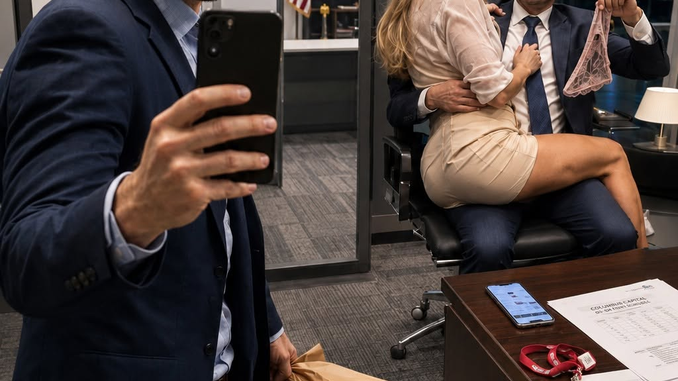
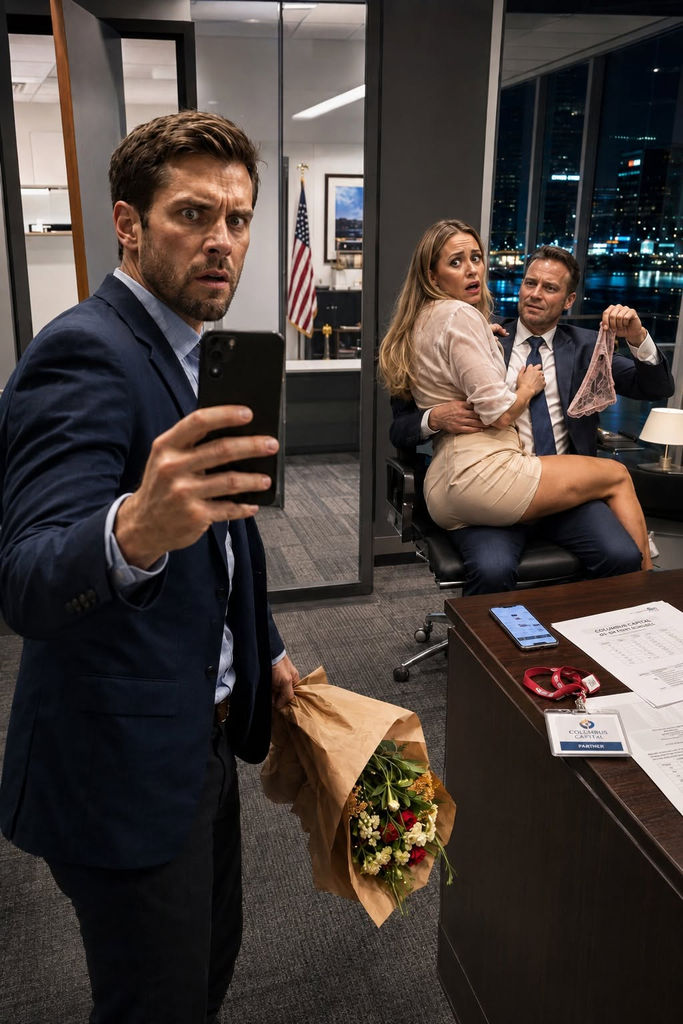
I brought flowers to my wife’s office to surprise her while she was working late, thinking she would hug me tightly with happiness. But when I opened the door, I saw her sitting on her boss’s lap, while he held up her lace panties and laughed out loud: “You’re interrupting our private moment. Be smart and go home.” I walked away… but not before taking a photo, and by the next morning, that photo had destroyed both of them.
At first, I thought I had misunderstood what I was seeing.
That is what the mind does when the truth arrives too suddenly. It tries to protect you for one last second.
The hallway outside Claire’s office was silent, the kind of silence that belongs to downtown buildings after the elevators have stopped opening every few minutes and the cleaning crew has already moved on to another floor.
A small American flag stood beside the reception desk downstairs. Through the glass wall behind me, the lights of Columbus, Ohio, shimmered across the wet parking lot.
I still had the flowers in my hand.
White roses and soft pink tulips, wrapped in brown paper from the grocery store near our house. Nothing expensive. Nothing dramatic. Just the kind of simple bouquet a husband buys when he thinks his wife needs comfort.
Claire had texted me two hours earlier.
Terrible day. I’ll be late again.
That was all.
No heart. No explanation. No “don’t wait up.” Just five words that made me picture her alone at her desk, exhausted, maybe close to tears.
So I drove downtown.
I thought I would walk in, surprise her, maybe make her laugh. I thought she would roll her eyes and say, “Fallon, you didn’t have to,” and I would answer, “I wanted to.”
That was the version of the night I carried with me.
The elevator ride to the eighth floor felt ordinary. I remember watching my reflection in the silver doors, seeing a tired man in a navy jacket holding flowers, trying to be better at marriage than he had been at anything else.
The doors opened with a soft chime.
The office floor was dim, lit only by the long strip of windows facing the city. Somewhere in the distance, an air conditioner hummed. Rain tapped lightly against the glass.
Claire’s office door was not fully closed.
That was the first thing that felt wrong.
She always closed her door when she worked late. She said it helped her focus. She said her boss liked the floor quiet after hours.
Her boss.
Orion Vance.
I had heard that name so many times over the past year that it had started living in our house like an invisible guest.
Orion thinks I’m ready for leadership.
Orion wants me on the Northgate account.
Orion says I should stop doubting myself.
At first, I was proud of her.
Claire had worked hard. She had fought for every promotion, every title, every room where men spoke over her and then acted surprised when she had better ideas.
So I told myself Orion was simply the first person at that company who finally saw what I had always seen.
I told myself that until her late nights became routine.
Until she started taking calls in the garage.
Until her phone began sleeping face down.
Until “terrible day” became something she said too often for someone who never wanted to explain why.
Still, suspicion is ugly.
So I buried it.
Then I pushed the door open.
For one second, no one moved.
Claire was not at her desk.
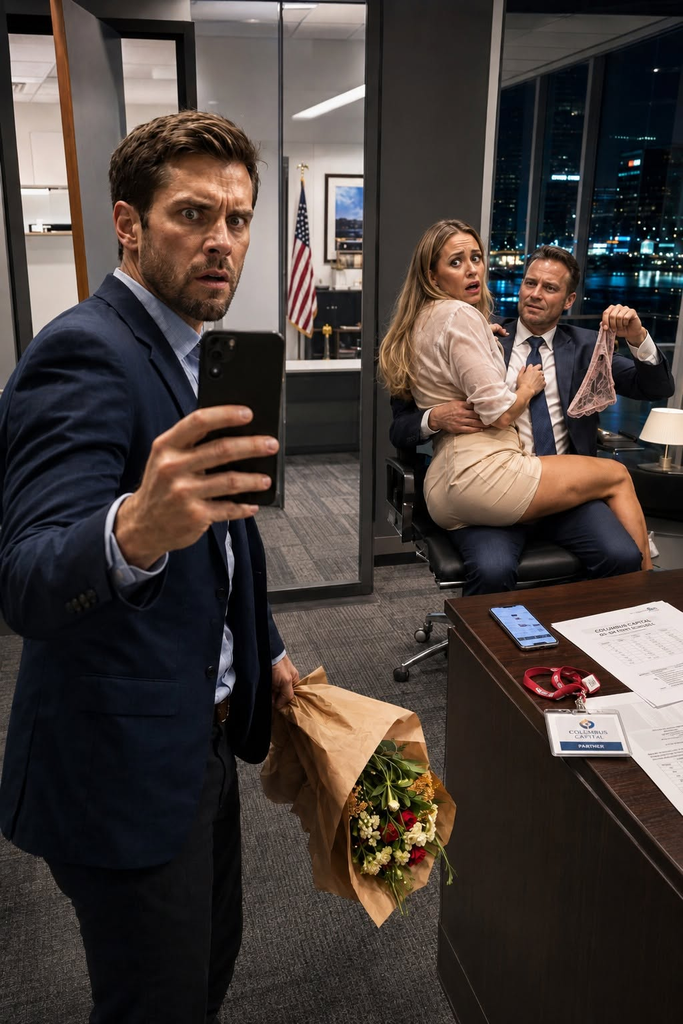
She was sitting on Orion’s lap, one hand braced against the edge of his chair, her face going empty the moment she saw me.
Empty first.
Then terrified.
Orion leaned back like he owned the room, his shirt collar open, his smile slow and cruel. In his hand was a piece of lace I recognized before my mind was ready to admit it.
He held it up between two fingers.
Then he laughed.
“You’re interrupting our private moment,” he said. “Be smart and go home.”
The flowers felt suddenly ridiculous in my hand.
Claire whispered my name.
“Fallon…”
Not sorry.
Not wait.
Not it is not what it looks like.
Just my name, as if saying it softly could undo the image already burning itself into my memory.
I looked at her, then at him, then at the office around them.
The framed business award on the wall. The glass desk. The company badge beside his laptop. The printed schedule for some executive breakfast the next morning.
Everything looked organized.
Everything except my life.
Orion’s smile widened when I did not speak.
“Come on,” he said. “Don’t make this embarrassing.”
That word almost broke something in me.
Embarrassing.
My wife was sitting on his lap, in his office, after texting me that she was having a terrible day, and somehow I was the embarrassment.
Claire pushed herself up slightly.
“Fallon, please,” she said. “Not here.”
I stared at her.
“Not here?” I asked.
Her eyes filled, but she did not answer.
Orion sighed like I was wasting his time.
“She’s asking you to leave,” he said. “You should listen.”
For a moment, I wanted to throw the flowers at him.
I wanted to grab him by the collar. I wanted to scream until every office door on that floor opened and the whole building saw what I had seen.
But something colder than anger moved through me.
Clarity.
The kind that comes when humiliation becomes so complete that it no longer has anywhere to go except into action.
I lowered the bouquet onto the cabinet near the door.
Claire watched my hands carefully.
Orion did too.
That was when I noticed the window behind them.
The rain-dark glass did not only reflect the city. It reflected the office.
It reflected Orion’s desk.
It reflected his half-open laptop.
And in that reflection, blurred but visible, was a folder title on the screen.
Northgate Renewal.
I knew the name because Claire had mentioned it at dinner two weeks earlier. She had called it boring. A municipal development project. Paperwork. Vendor approvals. Nothing I would care about.
But beside that folder title, in the reflection, I saw another word.
Whitaker.
My last name.
Not Claire’s first name.
Not her employee file.
My last name.
A strange coldness moved down my spine.
I did not understand what it meant, but I knew instantly that it did not belong there.
Then I saw Claire’s phone lying face up near Orion’s keyboard.
Still unlocked.
A message thread was open.
I could not read the full text from where I stood, but I saw one name at the top.
Not Orion.
Someone else.
Before I could look longer, the screen dimmed.
Orion snapped his fingers once.
“Fallon,” he said, his voice harder now. “Are you deaf? Go home.”
I lifted my phone.
Claire’s eyes widened.
“No,” she whispered.
Orion stopped smiling.
I took one photo.
Just one.
No flash. No sound. No warning.
But the moment I lowered my phone, the room changed.
Claire stood so quickly she nearly stumbled.
Orion dropped the lace item onto his lap and pushed back from the desk.
“Delete that,” he said.
His voice was no longer amused.
That was the first time I heard fear in him.
Not much.
Just enough.
I looked at him and said, “You told me to go home.”
Claire stepped toward me.
“Fallon, please. You don’t understand.”
That sentence landed harder than an apology would have.
I did not understand what?
What I had seen?
What she had done?
Or what was hiding in the photo?
I looked at her one last time.
Her blouse was uneven. Her hair was loose. Her eyes were wet. She looked guilty, yes, but also afraid in a way that seemed older than this moment.
Orion moved around the desk.
“You’re making a mistake,” he said.
“No,” I said quietly. “I made a mistake when I brought flowers.”
Then I walked out.
Claire followed me into the hallway.
“Fallon,” she said, her voice shaking. “Don’t send that photo to anyone.”
The elevator was still at the far end of the hall.
I pressed the button.
“Why?” I asked.
She looked back toward Orion’s office, then at me.
“Because you don’t know what’s in it.”
The elevator doors opened.
I stepped inside.
Her face folded with panic.
“Please,” she whispered. “If you send it, he’ll know what to destroy.”
The doors slid shut before I could answer.
I stood alone in the elevator with my phone in my hand and my heartbeat pounding so loudly I could barely hear the numbers counting down.
Eight.
Seven.
Six.
By the time I reached the lobby, I was no longer thinking only about my wife on Orion’s lap.
I was thinking about the reflection.
The folder.
My name.
Mr. Dawson, the night security guard, looked up from behind the front desk when I stepped out.
He had known me from previous visits.
“Everything all right, Mr. Whitaker?” he asked.
I almost said yes.
That old habit was still alive in me, the instinct to protect the shape of my life even after the inside had collapsed.
Instead, I asked, “Do you know Orion Vance?”
Mr. Dawson’s hand paused over his newspaper.
He looked toward the elevators, then back at me.
“I know who he is.”
“That’s not what I asked.”
The lobby was quiet.
Rain slid down the glass doors.
Mr. Dawson lowered his voice.
“I know enough to keep my job.”
That answer followed me into the parking lot.
I sat in my car without starting the engine. The bouquet was still upstairs. My wife was still upstairs. The marriage I thought I had was somewhere behind me, breaking into pieces under fluorescent light.
I opened the photo.
At first, I could not look directly at the obvious part.
Claire. Orion. The chair. His hand. His smile.
A photograph is cruel because it does not soften anything for you.
It does not explain. It does not apologize. It does not say there is context. It simply keeps what happened exactly where it happened.
But then I zoomed in on the window reflection.
The laptop was there.
So was the Northgate folder.
So was the partial spreadsheet.
And near the corner of the screen, faint but readable when I enlarged it, was my last name beside a row of numbers.
Whitaker Consulting.
My stomach tightened.
I had never owned a consulting company.
I had never signed anything connected to Northgate.
I had never even heard the project name until Claire started saying it at dinner like it was nothing.
I zoomed farther.
The image blurred, but something else appeared near the far edge of the reflection.
A woman standing in the hallway behind me.
She was half visible in the glass, near the copy room, holding a large envelope against her chest.
I knew her.
Elaine Porter.
The company’s chief financial officer.
I had met her once at a summer barbecue. She had been polite, watchful, the kind of person who noticed more than she said.
In the reflection, Elaine was not looking at me.
She was looking at Orion.
And her expression was not surprise.
It was recognition.
My phone buzzed.
Claire.
I let it ring until it stopped.
Then Orion called.
That froze me for a different reason.
I had never given Orion my number.
When the call ended, a message appeared.
Delete the photo. This is a private matter. Do not make this worse for your wife.
I stared at the words.
Private matter.
That was what powerful people called a problem when they believed they could bury it.
Another message came from Claire.
Please come home. I can explain. There are things you don’t know.
I almost threw the phone onto the passenger seat.
Instead, I backed up the photo.
I sent it to an old email account.
I saved it to a private drive.
Then I drove to my brother’s house.
Nathan opened the door in sweatpants and a Cleveland Browns hoodie, annoyed until he saw my face.
“What happened?” he asked.
I stepped inside.
His wife, Mara, was in the kitchen. She turned off the faucet when she saw me.
I placed my phone on the table.
“I need you both to look at something,” I said. “And I need you to tell me if I’m losing my mind.”
Nathan looked at the photo first.
His jaw hardened.
Mara looked away from the obvious part, then forced herself to look again when I said, “Not that. Look behind them.”
I zoomed in on the reflection.
Nathan leaned closer.
“Northgate Renewal,” he read.
Mara frowned.
“Claire mentioned that last month. She said Orion was making her handle approvals late at night.”
I pointed to the spreadsheet.
Nathan’s face changed when he saw my name.
“Why is your name there?”
“I don’t know.”
Mara pointed to the edge of the reflection.
“Who’s the woman?”
“Elaine Porter. CFO.”
Nathan leaned back slowly.
“This isn’t just about Claire.”
The sentence made the room feel smaller.
My phone buzzed again.
Unknown number.
A text appeared.
Do not trust your wife’s explanation.
I looked at Nathan.
He looked at me.
Another message came seconds later.
I was in the building. I saw what happened after you left.
I typed back, Who is this?
No answer.
That night, I slept on Nathan’s couch, though sleep is too generous a word.
Claire called seven times.
Orion sent three messages.
The unknown number sent nothing else.
At 7:30 the next morning, Nathan called an attorney he knew from an old business case.
David Rusk listened to the basics over speakerphone, then asked me one question.
“Have you posted the photo anywhere?”
“No.”
“Good. Do not post it. Do not send it to family. Do not send it to coworkers. If that image contains what you think it contains, it is evidence, not revenge.”
That word stopped me.
Evidence.
Until then, part of me still wanted revenge.
I wanted Claire’s parents to see it. I wanted Orion’s company to see it. I wanted everyone who had ever smiled at him in a conference room to see what kind of man he was after hours.
But David’s voice made the choice clear.
If I used the photo carelessly, they would make me the story.
Angry husband.
Private humiliation.
Domestic drama.
They would bury the reflection.
They would bury Northgate.
They would bury my name on that screen.
David told me to come to his office at nine with my phone, charger, and every message I had received.
At 8:05, Claire arrived at Nathan’s house.
We saw her through the front window before she rang the bell.
She stood under the porch light, wearing jeans and a beige sweater, looking smaller than she had in Orion’s office.
Nathan said, “You don’t have to talk to her.”
But I opened the door.
Not because I forgave her.
Because I needed to see what her fear looked like without Orion beside her.
“Fallon,” she said.
I waited.
Her eyes flicked past me to Nathan.
“I need to speak to you alone.”
“No.”
She flinched.
“Please. You don’t understand what last night was.”
“I understand what I saw.”
“That part was real,” she said, and her voice broke. “And I won’t insult you by pretending it wasn’t.”
The honesty hurt more than denial would have.
I looked at her.
“How long?”
She closed her eyes.
“Too long.”
That was an answer and a confession at once.
I almost shut the door.
Then she said, “But Orion is not just my boss.”
“No,” I said. “Apparently he’s more than that.”
She shook her head quickly.
“I hate him.”
Those three words were the first thing she said that surprised me.
They did not sound like defense.
They sounded like exhaustion.
“I hate him,” she repeated. “And I hate myself for letting him make me useful.”
Nathan stepped closer behind me.
“Useful how?”
Claire looked toward the quiet street.
A school bus rolled past the corner. A neighbor pulled a trash bin back from the curb. The morning looked painfully normal.
“Northgate Renewal,” she said.
The name settled between us.
“What is it?” I asked.
“A contract,” she said. “A fake vendor chain. Orion used city development money and routed it through consulting accounts.”
My throat tightened.
“And my name?”
She looked at me then, and I saw the answer before she said it.
“He used household records,” she whispered. “Emergency contact files. Old reimbursement documents. Spouse information. He created vendor profiles that looked real enough to pass internal checks.”
“You’re saying he used my identity.”
“I’m saying your name was one of several.”
Nathan cursed under his breath.
I stepped back from the doorway.
“And you knew?”
Claire’s face crumpled.
“Not at first.”
“At first,” I repeated.
The words tasted bitter.
She wiped her cheek.
“I signed a conflict disclosure months ago. Orion told me it was routine, that because you had once done freelance accounting work, HR needed household verification for compliance.”
“I did freelance tax prep for five people ten years ago.”
“I know.”
“So why didn’t you ask me?”
She looked down.
“Because by then he already had enough on me.”
The air changed.
I hated that part of me wanted to understand.
I hated that her fear seemed real.
I hated even more that real fear did not erase real betrayal.
“What did he have?” I asked.
“Messages. Approvals under my login. Hotel receipts from conferences. Things that made me look like I was part of it.”
“And were you?”
She looked at me for a long time.
“Yes,” she whispered. “At the beginning, I thought I was helping my career. Later, I thought I was surviving. Neither one makes it right.”
That answer was the first one that did not sound rehearsed.
My phone rang.
Unknown number.
Then a text appeared.
Answer. It’s Elaine.
I showed Nathan, then answered on speaker.
A woman’s voice came through, tight and controlled.
“Mr. Whitaker?”
“Yes.”
“This is Elaine Porter. I believe you took a photograph in Orion Vance’s office last night.”
Claire went completely still.
I said, “Maybe.”
“I need to know if my face is visible in it.”
“Why?”
“Because Orion just accused me of entering his office after hours and stealing confidential files. Security is being asked to pull footage.”
Claire whispered, “No.”
Elaine heard her.
“Claire is there?”
No one answered.
Elaine exhaled sharply.
“Then she needs to stop protecting him.”
Claire closed her eyes.
“I’m not.”
“Yes, you are,” Elaine said. “You still haven’t told Fallon what Orion made you sign.”
I turned slowly toward my wife.
“What did you sign?”
Claire began to cry.
Not softly.
Not prettily.
Like someone whose last wall had finally cracked.
“I thought I was protecting you,” she said.
My skin went cold.
“From what?”
Elaine answered before Claire could.
“From being blamed.”
The silence after that was worse than any scream.
At David Rusk’s office, everything became quieter and more dangerous.
His building stood two blocks from the courthouse, red brick and old stone, with a flag moving slowly outside the second-floor window.
David looked at the original photo for several minutes.
He did not react to the obvious part.
He zoomed past Claire and Orion.
He went straight to the window reflection.
“Good,” he said.
That word angered me.
“Good?”
“Good for evidence,” he said. “Not good for your marriage.”
Claire sat across the room with both hands locked together.
Elaine joined through a video call from her car. She said she no longer trusted her office computer.
For nearly an hour, the story widened.
Northgate Renewal was a city redevelopment contract.
Orion had built a vendor chain under several names, some real, some false, some connected to employees’ spouses or old addresses.
Claire’s login had approved documents she claimed she had not seen.
Elaine had flagged irregularities twice, then watched both reports disappear inside upper management.
And my name was on a vendor profile.
Whitaker Consulting Services.
A company I had never created.
Attached to an address I had not lived at since before I married Claire.
David asked Claire where Orion got my old address.
She covered her mouth.
“From me.”
I stared at her.
She shook her head, crying again.
“I didn’t know what he would use it for. He said HR needed old household verification for conflict forms. I gave him a mortgage pre-approval file from when we were buying the house.”
“You handed him my documents.”
“I know.”
The room blurred at the edges.
That was when I understood that betrayal does not always happen in one dramatic moment.
Sometimes it happens through paperwork.
Through silence.
Through one form handed over.
One lie accepted.
One secret kept because telling the truth would cost too much.
David leaned forward.
“Fallon, listen carefully. Your photo may prove three things. Orion was in possession of active Northgate documents last night. Elaine was present before he accused her of theft. And your name appeared in a file you never authorized.”
“And Claire?” I asked.
David looked at her.
“Claire has exposure.”
She lowered her head.
I waited for her to protest.
She did not.
At 11:18 that morning, Orion made his mistake.
He sent an email to the executive team, copying legal, Claire, and Elaine.
David read it aloud.
Orion claimed that a non-employee spouse had entered the office after hours, taken unauthorized photographs, and threatened to distribute private and confidential material.
He claimed Elaine had been seen near his office without permission.
He claimed Claire had been distressed by my unstable behavior.
Then he wrote the line that changed everything.
Immediate legal containment is recommended before Mr. Whitaker attempts to use a private domestic issue to interfere with the Northgate Renewal account.
David stopped reading.
Elaine said, “He named the account.”
David nodded.
“Yes, he did.”
I did not understand.
David looked at me.
“He just connected you, the photograph, Elaine, Claire, and Northgate in writing. Confident people often document their own panic.”
By noon, the company’s legal department requested a meeting.
David agreed only if it was recorded.
At 1:10 p.m., I walked back into the same building where my marriage had collapsed the night before.
The lobby looked different in daylight.
Employees moved through security with coffee cups and laptop bags. The flag beside reception stood in the same place. The bowl of peppermints was still on the desk.
Mr. Dawson looked at me as I passed.
For half a second, his face tightened.
Then he gave me a small nod.
On the tenth floor, the conference room had a long table, a wall of windows, and a framed photograph of the Columbus skyline.
Orion was already there.
He wore a dark suit and a blue tie. His hair was perfect. His expression was calm.
Professional.
Rehearsed.
“Fallon,” he said. “I’m glad you chose to handle this maturely.”
I did not answer.
David placed a folder on the table.
Elaine sat at the far end with her laptop open. Claire sat beside me, though every part of me wanted space between us.
A woman from legal began by saying the company was concerned about privacy violations.
David thanked her politely, then said he was concerned about fraud, retaliation, false accusations, and misuse of employee household information.
Orion smiled thinly.
“I think we should avoid dramatic language.”
“I agree,” David said.
Then he placed Orion’s email on the table.
“Let’s start with yours.”
For twenty minutes, Orion performed.
He said I had arrived emotional.
He said Claire was frightened.
He said Elaine’s presence near his office was suspicious.
He said the photograph, if it existed, had been taken during a private domestic misunderstanding.
He never explained why Claire was on his lap.
He never explained what he had been holding.
He never explained Northgate.
Then David asked, “Was your laptop open when Mr. Whitaker entered your office?”
Orion leaned back.
“I don’t recall.”
“Was the Northgate folder open?”
“I don’t recall.”
“Was a vendor spreadsheet visible?”
“I don’t recall.”
“Did that spreadsheet include my client’s name?”
Orion’s eyes moved once toward Claire.
It was small.
But everyone saw it.
“I wouldn’t know,” he said.
Elaine spoke for the first time.
“I would.”
She connected her laptop to the conference screen.
The legal woman stiffened.
“Elaine, before you share anything—”
“No,” Elaine said. “I followed internal reporting protocol for six months. My reports were buried. My access was restricted. This morning Mr. Vance accused me of theft. I will not be quiet now.”
The first document appeared on the screen.
Vendor Exception Report: Northgate Renewal.
My name appeared on the third line.
Whitaker Consulting Services.
Seeing your name inside someone else’s crime is a strange kind of violation.
It feels as if someone reached into your mailbox, your marriage, your old tax records, your ordinary life, and dressed you in guilt while you were not looking.
Claire made a small sound beside me.
I did not look at her.
Elaine clicked again.
Payment dates.
Approval trails.
Login records.
Internal notes.
Claire’s name appeared in several places.
Orion’s appeared almost nowhere.
That was the design.
The man at the center had built the structure so that everyone below him carried the fingerprints.
Then David displayed the photo.
Not the full photo.
Only the window reflection.
The laptop.
The Northgate folder.
The spreadsheet.
The timestamp.
Then he zoomed to the edge of the reflection.
Elaine in the hallway, holding the envelope.
The room went silent.
David said, “This photo was taken before Mr. Vance accused Ms. Porter of theft. It places her in the hallway at the time of a scheduled compliance handoff, while Mr. Vance’s own laptop appears to show the very account he claims was compromised.”
Orion’s voice sharpened.
“That proves nothing.”
“Alone, perhaps not,” David said.
Then he showed the next crop.
Orion’s desk.
The printed schedule.
The company badge.
Claire’s unlocked phone.
A message preview glowed on the screen.
The legal woman leaned forward.
“What is that message?”
Claire went rigid.
Orion said, “That is irrelevant.”
David looked at Claire.
“You should answer.”
Claire’s lips trembled.
“It’s a message thread.”
“With whom?” the legal woman asked.
Claire looked at Orion.
He said sharply, “Don’t.”
The single word did more damage than a confession.
Everyone heard it.
The regional director sitting beside legal turned slowly toward him.
“Don’t?” he repeated.
Orion realized too late what he had done.
Claire took a breath.
“With Mark Ellison,” she said.
The regional director stood so fast his chair rolled back.
“My account?”
Claire nodded.
“Orion had access. He used your name to pressure approvals.”
Orion slammed his hand on the table.
“This is absurd.”
Elaine clicked again.
“I have the access logs.”
For the first time, Orion looked trapped.
Not defeated.
Trapped.
There is a difference.
A defeated man lowers his head.
A trapped man looks for someone else to drag under him.
His eyes moved to Claire.
“You signed,” he said.
Claire flinched.
“You approved the disclosures. You submitted the household file. You knew enough.”
The room went cold.
Claire stared at him, tears on her face.
“Yes,” she said quietly. “I signed things. I hid things. I let you use my fear. But I did not create this.”
Orion laughed once.
“You think they’ll believe you?”
David answered before she could.
“They don’t need to believe her. They need the records.”
The meeting did not end so much as fracture.
Legal requested copies.
David refused to hand over my phone but agreed to preserve the original photo formally.
Elaine’s documents were transferred to outside counsel.
Orion was asked to leave the room.
He stood slowly, straightening his jacket as if dignity could be adjusted at the cuffs.
Before he left, he looked at me.
“You have no idea what you’ve started.”
For the first time since the office, I smiled.
“No,” I said. “But I know what I photographed.”
By evening, Orion was placed on administrative leave.
Claire was suspended pending review.
The phrase sounded too clean for what it meant.
Administrative leave.
As if he had misplaced a document instead of building a machine out of fear, ambition, silence, and other people’s names.
When we walked out of the building, the sky over Columbus had cleared. The sidewalks were still damp, and the small flag near the entrance moved gently under the lights.
Claire stopped near the curb.
“Can I come home?” she asked.
The question was small.
For one painful second, I saw the woman I had married.
The woman who used to steal my hoodies in winter.
The woman who cried during old movies and pretended she had allergies.
The woman who once wrote on a napkin, You are the safest place I have ever known.
But memory is not a verdict.
“No,” I said.
She nodded as if she had expected it.
“I’ll stay with my sister.”
“Okay.”
She looked at me.
“Did I destroy us?”
I could have said yes.
I could have said Orion did.
I could have said the truth was more complicated than either of us deserved.
Instead, I said, “You helped.”
Her face folded, but she did not argue.
Nathan drove me back to his house in silence.
The next morning, the story still had not gone public.
But inside the company, it spread like smoke.
By noon, outside counsel had opened a formal investigation.
By two, Elaine’s security access was restored.
By four, David received confirmation that my vendor profile had been created using documents I never authorized.
By evening, Orion’s wife called me.
Her name was Hannah.
I did not know he had a wife until she introduced herself in a voice too steady to be natural.
“Mr. Whitaker,” she said, “I think my husband has harmed your family.”
I stood in Nathan’s backyard under a maple tree while the sun dropped behind the houses.
“I don’t know what to say to you,” I admitted.
“Neither do I,” she said. “But I found something in his home office.”
My grip tightened on the phone.
“What?”
“A second phone.”
I closed my eyes.
“There are messages,” she continued. “Photos. Names of women from the company. A folder labeled Northgate. And another folder labeled Claire.”
The yard seemed to tilt.
“What is in Claire’s folder?”
Hannah’s voice shook for the first time.
“Dates. Hotel receipts. Performance reviews. Personal records. Things he collected on her.”
I looked toward Nathan’s porch.
He was watching me from the doorway.
Hannah whispered, “She wasn’t the first.”
That sentence changed the shape of everything.
The photo had not destroyed Orion because it showed him with my wife.
It destroyed him because it caught the edge of a system he thought nobody could see.
Claire was guilty.
Claire was broken.
Claire was possibly a victim too.
And I hated that all three things could be true at once.
Before I could answer Hannah, my phone buzzed with a new message.
Unknown number.
A photo appeared.
It was the picture I had taken in Orion’s office.
But someone had circled a part of the reflection I had not noticed.
Not the laptop.
Not Elaine.
Not Claire’s phone.
Behind me, near the emergency exit, there was another figure standing in the hallway.
Watching me take the photo.
Below the image was one sentence.
You still don’t know who was really in the building that night.
Để lại một phản hồi