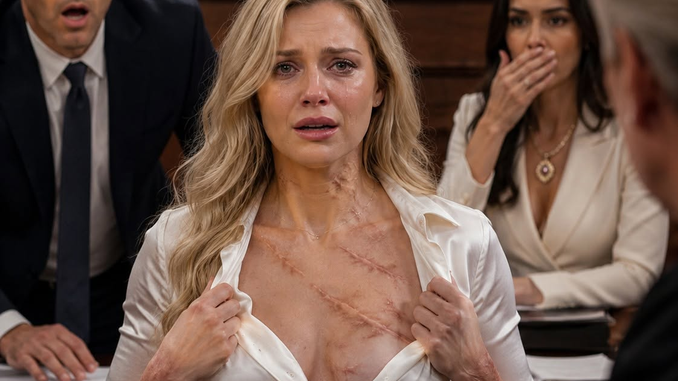
The day my husband walked into divorce court holding his mistress’s hand, he was certain I would lose everything. Smirking, he handed the judge fake psychiatric evaluations and promised I’d leave with nothing but my humiliation. He expected me to fall apart—but the moment I opened my blouse and revealed the scars covering my body, the courtroom went silent, and the case stopped being about divorce.
Richard looked completely at ease as the hearing began.
A smug smile never left his face. Sitting beside him was his mistress, Chloe, dressed elegantly in white silk and wearing the vintage necklace my grandmother had left me before she passed away. Seeing it around Chloe’s neck hurt more than I wanted to admit.
Richard leaned closer, lowering his voice so only I could hear.
“When this is over,” he whispered, “you’ll be lucky if you can afford a cheap motel.”
Across the courtroom, his attorneys confidently presented a thick stack of psychiatric evaluations. According to those reports, I suffered from severe emotional instability, paranoia, and delusions so serious that I couldn’t be trusted with my own finances.
Every page had been carefully crafted to destroy my credibility.
If the judge believed them, Richard wouldn’t just win the divorce.
He would take everything.
During the past year, he had quietly transferred nearly every valuable asset into accounts he secretly controlled. Our investments. Our businesses. Even properties that had belonged to my family for generations. He believed forged signatures, fraudulent paperwork, and carefully rehearsed lies would become permanent facts once the divorce was finalized.
I never reacted.
I simply sat there in complete silence.
Richard laughed softly.
“Nothing to say?” he asked. “You always loved pretending to be the helpless victim.”
Chloe smiled without looking at me.
“I don’t think she even realizes she’s already lost.”
My attorney, Arthur Bennett, calmly opened the file in front of him before turning toward me.
“Mrs. Vance,” he said gently, “the court is ready.”
I slowly stood.
The quiet inside the courtroom became almost unbearable as every pair of eyes followed me.
With steady hands, I reached for the buttons at the collar of my silk blouse.
For the first time that morning…
Richard stopped smiling.
Without saying a single word, I slowly opened the collar.
A wave of shocked gasps echoed through the courtroom.
Long, pale scars stretched across my shoulders. Others crossed my collarbone, disappeared beneath the fabric covering my chest, and continued down both of my arms. Time had softened their color, but not the horror they represented.
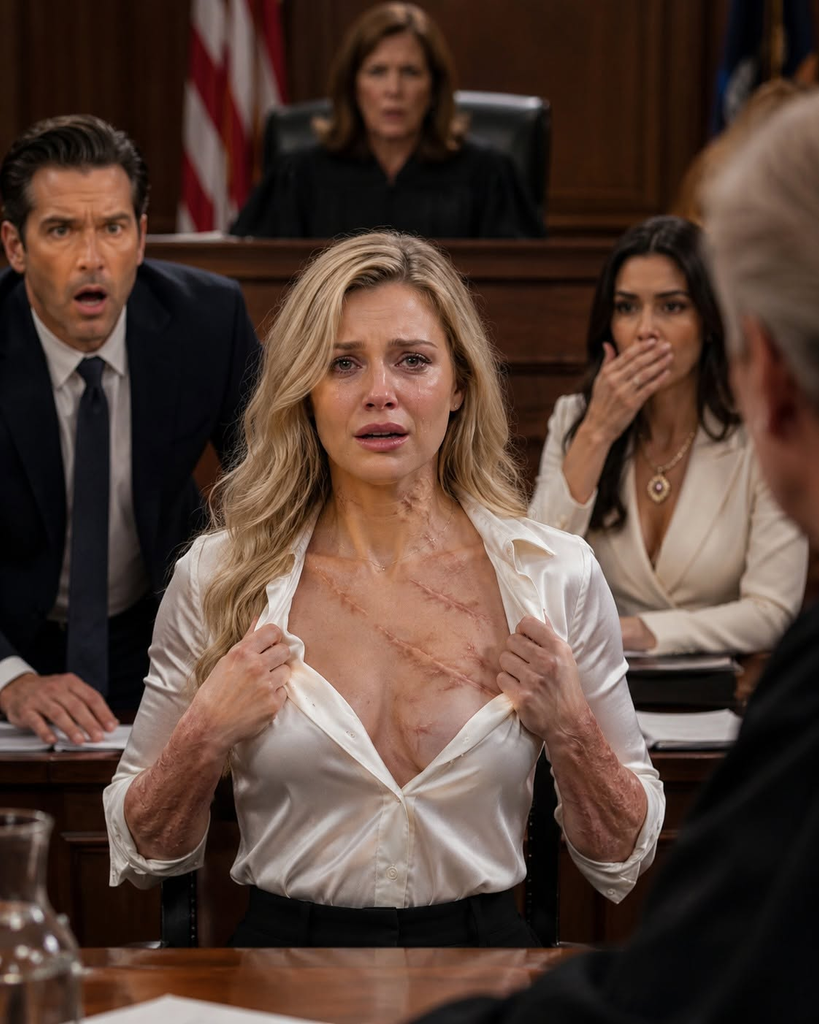
The judge leaned forward, visibly shaken.
“Mrs. Vance…” she whispered.
I rested both hands on the wooden railing before me and looked directly into her eyes.
“Your Honor,” I said calmly, “this hearing is no longer about dividing property.”
The courtroom became so quiet I could hear someone breathing behind me.
“It’s about exposing the truth my husband spent years—and a fortune—trying to bury.”
Richard suddenly shot to his feet.
“Your Honor, I object!”
His voice cracked.
The confidence that had filled his face all morning vanished in an instant.
For the first time since the proceedings began, he wasn’t irritated.
He wasn’t arrogant.
He was terrified.
Because he knew exactly where those scars came from.
He knew what had happened behind the locked doors of our home.
And he knew that the words I was about to speak wouldn’t just destroy his chances of winning the divorce.
They could destroy the life he had spent years building.
The story is too long to post in the caption, so just say you “Yes”.
PART 2: He Brought His Mistress to Divorce Court—Then My Scars Changed the Case3 026
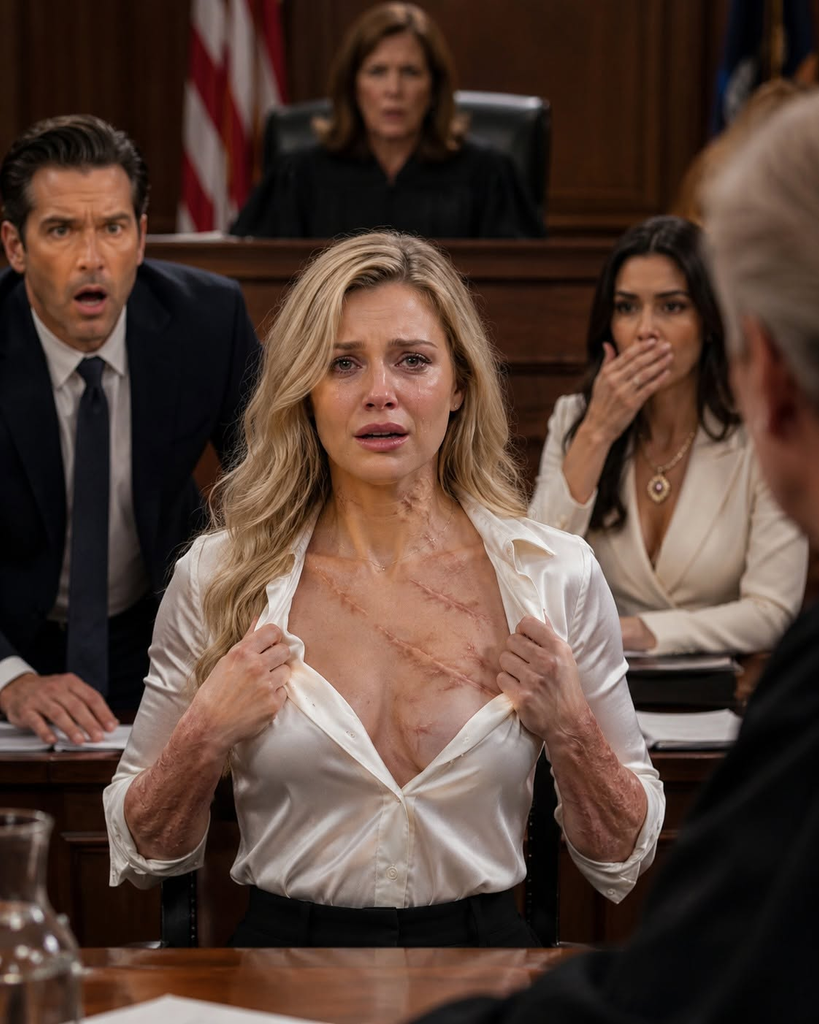
I fastened the buttons with hands that were steadier than I felt. Exposing those scars had not made me feel brave. It had made me feel as though I had stepped back into a life I had spent years trying to escape.
But there was one important difference.
This time, the door was open.
This time, people were listening.
Judge Whitmore turned toward Arthur. “Mr. Bennett, I assume you have a legal basis for what your client has just introduced.”
“We do, Your Honor.”
Arthur rose without haste. He had warned me before the hearing that calmness would matter more than outrage. Richard’s attorneys expected an emotional confrontation. They had prepared to use every tear, every trembling breath, and every moment of confusion as proof that their psychiatric evaluations were accurate.
Arthur had advised me not to give them what they wanted.
So I stood silently beside him while he placed a thin blue folder on the evidence table.
“The scars themselves are not the evidence,” he continued. “They are the reason Mrs. Vance began asking questions that her husband did not want answered.”
Richard leaned toward Crowley and whispered something urgent.
Crowley’s expression changed.
Only slightly, but I saw it.
Judge Whitmore saw it too.
“What questions?” she asked.
Arthur opened the folder.
“Questions concerning a fire at the Vance family lake house three years ago. Questions concerning medical records created after that fire. And questions concerning a series of asset transfers made while Mrs. Vance was hospitalized and legally unable to review or authorize financial documents.”
Richard stood again.
“This is absurd.”
“Sit down, Mr. Vance,” the judge said.
“But she caused that fire.”
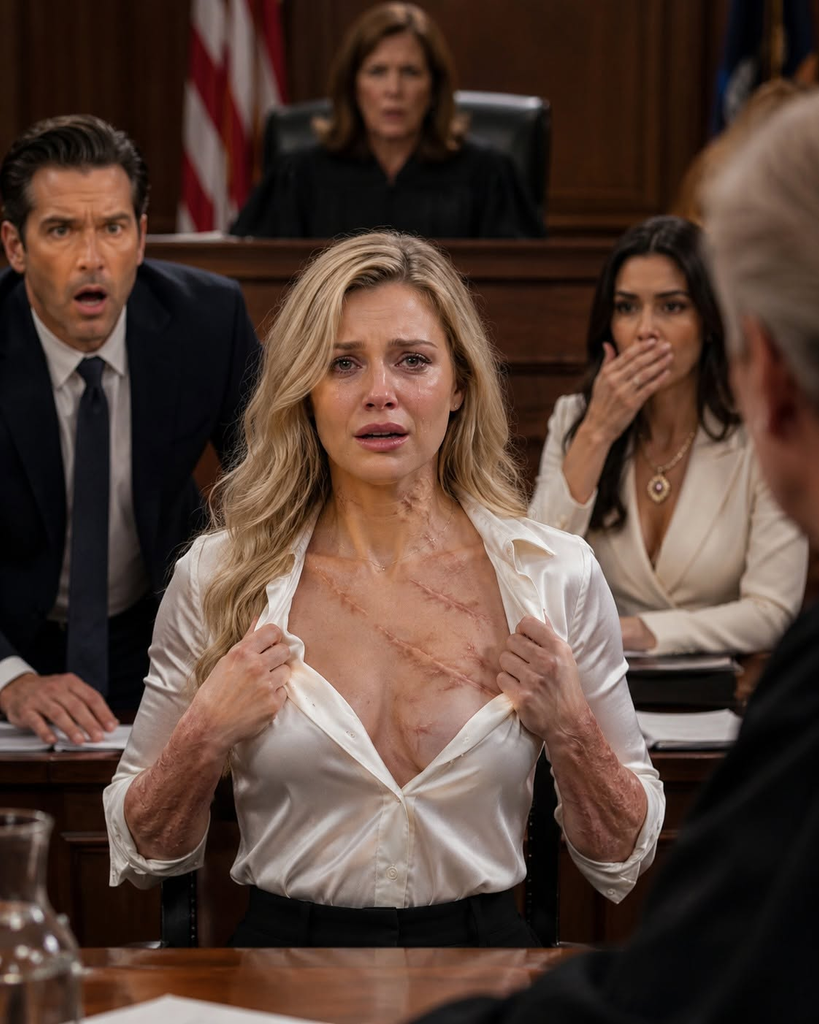
The words left him too quickly.
His own attorney reached for his sleeve, but it was already too late.
The courtroom seemed to shift around us.
Judge Whitmore’s expression became unreadable. “No one asked you how the fire began.”
Richard froze.
For years, he had controlled every room he entered by speaking first, speaking confidently, and making everyone else doubt their own understanding. That morning, he had walked into court believing the same strategy would save him again.
But fear had made him careless.
He lowered himself into his chair.
Chloe no longer smiled.
Her fingers had moved to the necklace at her throat.
My grandmother’s necklace.
The sight of it brought back a memory I had avoided since entering the courtroom: my grandmother standing in front of her bedroom mirror, fastening that same necklace before Sunday dinner. The chain was delicate, but the pendant was heavy—an oval of antique gold engraved with a small branch of winter roses.
She had worn it almost every day.
After she died, it became mine.
Richard knew what it meant to me.
That was why he had given it to Chloe.
Not because it was valuable, though it was. He had given it to her because he wanted me to see it and understand that he believed he could take not only my property, but my history.
Arthur lifted the first document from the folder.
“Your Honor, three years ago, Mrs. Vance suffered extensive injuries in a fire at a residence belonging to the Vance Family Trust. She spent twelve days in a medically induced coma and nearly four months in rehabilitation.”
The air left my lungs as if I were back beneath the smoke.
Arthur’s voice remained measured.
“During that period, Mr. Vance produced a power-of-attorney document allegedly signed by his wife two weeks before the fire. Using that document, he gained control over several family assets.”
Crowley stepped forward. “The power of attorney was notarized.”
“It was,” Arthur agreed. “By an individual who had been deceased for eleven months on the date the document was supposedly witnessed.”
A murmur moved through the courtroom.
Judge Whitmore lifted one hand, and silence returned.
Richard whispered, “That’s impossible.”
I looked at him.
For one brief second, I saw confusion beneath his fear.
It was not the reaction I expected.
Richard knew the document was false. Of that, I had no doubt. But he seemed genuinely surprised by the dead notary.
That detail mattered.
Arthur had told me repeatedly that fraud rarely belonged to one person. Signatures, transfers, medical reports, and hidden accounts required cooperation. Richard may have designed the plan, but someone else had helped build it.
“Your Honor,” Arthur continued, “the notary seal belonged to Paul Simmons, a former employee of Vance Development. Mr. Simmons died following a heart condition almost a year before the document was executed. His seal was reported missing from the company’s legal archives shortly after his death.”
Judge Whitmore looked at Crowley. “Was this information disclosed during discovery?”
Crowley hesitated.
“No, Your Honor. We had no knowledge of it.”
Richard turned sharply toward him. “What do you mean, you had no knowledge?”
Crowley did not answer.
Arthur removed a second document.
“We also have an analysis from a certified forensic document examiner. The signature attributed to Mrs. Vance was digitally reproduced from a charitable foundation agreement she signed five years earlier.”
My eyes moved toward Richard.
He refused to meet them.
I remembered signing that foundation agreement at our dining room table. Richard had poured champagne. He had kissed my forehead and told me my grandmother would have been proud.
At the time, the foundation had seemed like something we were building together.
I had not realized he was studying how easily my name could be removed from my own legacy.
Judge Whitmore read several pages in silence.
Then she looked at me.
“Mrs. Vance, what happened at the lake house?”
The question was simple.
The answer had lived inside me like a locked room.
Arthur touched my elbow gently. Not to direct me. Only to remind me that I was not standing alone.
I moved toward the witness stand.
After I was sworn in, I sat down and placed my hands in my lap.
The courtroom blurred at the edges.
I focused on the judge.
“The lake house belonged to my grandmother,” I began. “She used it as a retreat, but she also kept family records there. Deeds, trust documents, letters, old business ledgers—things she didn’t want stored at the company offices.”
“Why not?”
“Because she didn’t trust Richard’s father.”
Richard’s head lifted.
His father, Charles Vance, had died six years earlier. In public, Charles had been remembered as a visionary developer who transformed neglected neighborhoods into thriving business districts.
Inside the family, the truth was more complicated.
“My grandmother believed Charles had been moving money between family companies without proper authorization,” I continued. “She told me she had found discrepancies, but she became ill before she could finish reviewing them.”
“And you continued her investigation?”
“Not at first. After she died, I was grieving. Richard told me the discrepancies were the result of outdated bookkeeping. I believed him.”
My voice almost broke on those last three words.
I believed him.
That sentence described more than a financial mistake. It described my marriage.
I had believed his explanations when bills disappeared from my desk. I had believed him when employees resigned without warning. I had believed him when he said I was exhausted, forgetful, overly sensitive, and confused.
Every small surrender had prepared me for a larger one.
“What changed?” Judge Whitmore asked.
“A woman named Margaret Ellis contacted me.”
Across the aisle, Chloe’s face lost color.
It happened so quickly that I might have missed it if I had not been watching her.
Richard noticed too.
“Who is Margaret Ellis?” the judge asked.
“She worked for Vance Development for more than twenty years. She managed archived contracts and property records.”
“Why did she contact you?”
“She said she had found documents my grandmother had hidden in a sealed cabinet at the lake house. She would not discuss them over the telephone. She asked me to meet her there.”
Crowley stood. “Your Honor, this is hearsay.”
Arthur responded before the judge could. “Mrs. Vance is explaining why she went to the property, not offering Ms. Ellis’s statements for their truth.”
“Overruled,” Judge Whitmore said. “Continue.”
I looked down at my hands.
“It was raining that evening. I arrived shortly after seven, but Margaret wasn’t there. The front door was unlocked. That was unusual because the house had been empty for months.”
The smell returned first.
Wet cedar.
Dust.
Then the faint chemical sharpness that had lingered near the back hallway.
“I called her name. No one answered. I went upstairs to my grandmother’s study and found the cabinet open. Most of the files were gone, but one ledger was lying on the desk.”
Richard stared at me now.
Not angrily.
Intently.
As if he were hearing part of the story for the first time.
“What was in the ledger?” the judge asked.
“A list of property companies. Some belonged to the Vance family. Others were names I had never seen before. There were transfers between them, all approved by the same three executives.”
“Was your husband one of those executives?”
“Yes.”
Richard closed his eyes briefly.
“The other two were his father and a financial officer named Samuel Hale.”
Judge Whitmore glanced toward the psychiatric evaluations on Crowley’s table.
“Is Samuel Hale related to Dr. Vincent Hale, the psychiatrist who prepared these reports?”
“He is Dr. Hale’s older brother.”
A heavier silence settled over the room.
The reports had described me as irrational, suspicious, and obsessed with imagined financial conspiracies. Dr. Hale had written that I created false memories when confronted with stress.
He had never disclosed that his brother’s name appeared throughout the records I had been accused of imagining.
Arthur approached the witness stand.
“What happened after you found the ledger?”
“I heard the security system announce that the back door had opened.”
“Did you see who entered?”
“No. The lights went out before I reached the hallway.”
I paused.
For three years, my memories of the next few minutes had come in fragments. The scrape of a shoe downstairs. The soft beep of the alarm panel. The metallic click of a lock.
Then darkness.
“I smelled smoke,” I continued. “At first, I thought it came from the fireplace, but the house was getting warmer. When I tried to leave the study, the hallway door would not open.”
A woman in the gallery covered her mouth.
I kept my eyes on Judge Whitmore.
“I don’t know how long I pushed against it. The smoke became thick. I wrapped a curtain around my arms and broke one of the windows.”
Richard shifted in his seat.
“I climbed onto the small roof above the porch. I fell while trying to reach the ground. A neighbor saw the flames and called for help.”
Judge Whitmore’s face had gone pale.
“Was the cause of the fire investigated?”
“Yes. The official report blamed faulty electrical wiring.”
“And did you accept that conclusion?”
“At the time, I could barely remember being in the house. Richard told investigators I had gone there alone because I was emotionally unstable after my grandmother’s death. He said I had become obsessed with old family records.”
I looked toward the psychiatric reports.
“Dr. Hale began treating me while I was still in the hospital.”
That was the part that hurt in a different way.
The fire had damaged my body, but the months afterward had damaged my trust in my own mind.
Dr. Hale spoke softly. He wore gentle gray suits and never raised his voice. He told me trauma could produce false memories. He explained that my suspicion of Richard was a symptom. When I insisted that I had seen a ledger, he asked whether I wanted to destroy my marriage over an image created by an injured brain.
Richard attended every appointment.
He held my hand while the doctor persuaded me not to believe myself.
“Did Dr. Hale prepare evaluations during that period?” Arthur asked.
“Yes.”
“Are those the evaluations now being used against you?”
“Some of them. Others were created later.”
“How much later?”
“One report is dated six months after I stopped seeing him.”
Crowley rose slowly. “We were not informed that Mrs. Vance disputes the dates.”
Arthur turned toward him. “Your office received the treatment termination letter during discovery.”
Crowley looked at one of his assistants. The young attorney began searching through a box.
Richard whispered something sharply.
This time, Chloe moved away from him.
Only a few inches, but the distance was unmistakable.
Arthur placed another folder before the judge.
“Mrs. Vance’s final documented appointment with Dr. Hale occurred on March 14 of last year. Three of the reports submitted by Mr. Vance are dated after that appointment. One contains observations supposedly made during an office visit on June 8.”
Judge Whitmore looked at me. “Were you in Dr. Hale’s office on June 8?”
“No, Your Honor. I was in Seattle attending my cousin’s wedding. There are photographs, hotel records, and airline receipts.”
Crowley’s shoulders lowered.
Richard stared at the table.
I had imagined this moment during countless sleepless nights. In those imaginings, I expected to feel triumphant when the lies began to collapse.
Instead, I felt tired.
Not weak.
Not defeated.
Simply tired of carrying the truth alone.
Judge Whitmore called a recess.
The bailiff instructed everyone to remain orderly as she left the courtroom.
The moment the door closed behind her, voices rose throughout the gallery.
Arthur guided me toward a side conference room. Before we reached it, Richard called my name.
“Evelyn.”
I stopped.
Arthur moved between us, but I touched his arm.
“It’s all right.”
Richard stood several feet away. Crowley was beside him, speaking urgently, but Richard ignored him.
“What happened to the ledger?” he asked.
His voice was low enough that only those nearest us could hear.
I studied his face.
“You tell me.”
“I never saw it.”
“You expect me to believe that?”
“I knew you were looking into the accounts,” he said. “I knew you went to the lake house. But I didn’t know you found anything.”
I almost laughed.
It would have been easier if he had continued pretending.
“You used a false power of attorney while I was unconscious.”
His jaw tightened. “I signed what I was given.”
“By whom?”
He glanced at Crowley.
Crowley shook his head sharply.
Richard lowered his voice. “This is more complicated than you understand.”
“For years, you told me I understood nothing. That excuse doesn’t work anymore.”
Chloe stood behind him, one hand still resting on the necklace.
“Richard,” she said, “you told me the lake house fire happened because Evelyn left a candle burning.”
He turned toward her. “Not now.”
“You said there was no investigation.”
“Chloe.”
She looked from him to me.
The confidence she had carried into the courtroom was gone. In its place was something I recognized immediately.
Doubt.
I had worn that same expression for years.
“I need to ask you something,” I said.
Chloe’s fingers tightened around the pendant.
“Did Richard give you that necklace?”
She looked at him before answering.
“Yes.”
“When?”
“Last month.”
“Where did he get it?”
“He said it belonged to his mother.”
“That necklace belonged to my grandmother.”
Chloe released it as though the metal had suddenly become hot.
Richard stepped forward. “It was in our house.”
“It was in a locked compartment inside my grandmother’s jewelry cabinet.”
“It became marital property.”
“No,” Arthur said. “It did not.”
Richard glared at him.
Arthur remained calm. “The necklace was specifically named in Mrs. Vance’s inheritance documents. It was never marital property.”
Chloe reached behind her neck and struggled with the clasp.
“Take it off,” Richard said.
She looked at him.
There was no affection in his voice. Only command.
That changed something in her expression.
She removed the necklace and held it out to me.
“I didn’t know,” she said.
I wanted to refuse it.
Part of me could not bear to touch something she had worn into court as a symbol of my replacement. But another part of me remembered my grandmother’s hands fastening it around my neck on my twenty-first birthday.
A possession could be stolen.
Its meaning did not have to be.
I took it.
“Thank you,” I said.
Richard stared at both of us. “You think returning a necklace changes what you did?”
Chloe’s eyes narrowed. “What I did?”
“You knew I was married.”
“Yes,” she said quietly. “I knew what you told me about your marriage. I knew you said Evelyn refused treatment and spent money recklessly. I knew you said she had already agreed to the divorce.”
Her voice grew firmer.
“I did not know you were using reports from appointments that never happened.”
People nearby had stopped pretending not to listen.
Richard’s face hardened.
“Be careful.”
It was not a threat. Not exactly.
But Chloe heard what I had heard so many times: the warning beneath the ordinary words.
She stepped farther away from him.
Arthur opened the conference-room door.
“Evelyn, we should prepare for the judge’s questions.”
I followed him inside.
The room was small, with a long wooden table and a narrow window overlooking the courthouse steps. Arthur closed the door, but not before I saw Chloe walk toward the opposite hallway alone.
“You handled that well,” he said.
“I don’t feel as though I handled anything.”
“That is often what courage feels like while it’s happening.”
I set the necklace on the table.
In the quiet room, the pendant seemed different from how I remembered it. The gold appeared darker near the engraved roses, as though dust had collected in the grooves.
Arthur opened his notes.
“The judge has several options. She may suspend the divorce proceeding and refer the documents for investigation. She may allow limited testimony today. She may also exclude the psychiatric reports immediately.”
“What about the assets?”
“We have traced several transfers, but recovery will take time. Some accounts are held through layered companies.”
“Richard said he signed what he was given.”
Arthur leaned back.
“I heard.”
“Do you believe him?”
“I believe people sometimes tell partial truths when complete lies become dangerous.”
I looked toward the closed door.
“What if someone else started this before Richard?”
“Then Richard still chose to participate.”
“I know.”
But the thought would not leave me.
Richard had been terrified when I revealed my scars. Yet when Arthur mentioned the dead notary, he seemed shocked. When I described the ledger, he listened too closely.
He knew enough to be guilty.
But perhaps not enough to be alone.
Arthur’s assistant, Naomi, entered carrying a laptop.
“We just received a response from the security company that maintained the lake house system,” she said.
Arthur stood. “Today?”
“They said the archived data had been purged years ago, but a former technician kept backup service logs during a software migration.”
My pulse quickened.
“What do the logs show?”
Naomi placed the laptop on the table.
“The system was remotely accessed twenty-three minutes before the first fire alarm.”
Arthur leaned toward the screen. “From where?”
“An administrative account registered to Vance Development.”
My stomach tightened.
“Richard’s account?”
“No. The user profile was listed under Margaret Ellis.”
The name seemed to fill the room.
“That’s impossible,” I whispered.
Margaret had asked me to go to the lake house.
Margaret had claimed she was afraid to discuss the documents by telephone.
And Margaret had never arrived.
Arthur examined the report. “Could someone else have used her credentials?”
“Possibly. But there is more. The account did not merely disable the alarm. It unlocked the back entrance, locked the upstairs fire doors, and erased the first twelve minutes of camera footage.”
I gripped the edge of the table.
“Margaret wouldn’t have trapped me.”
Naomi’s expression was sympathetic but cautious.
“We don’t know who used the account.”
“Where is she now?”
Arthur and Naomi exchanged a glance.
“What?” I asked.
Arthur closed the laptop halfway.
“We have been trying to locate Margaret for six weeks.”
“You told me she had moved.”
“She did. But the address on file belongs to a mail-forwarding service. Her pension deposits stopped eighteen months ago. There has been no activity on her driver’s license or primary bank account.”
The room seemed to tilt.
“Are you saying she’s dead?”
“No,” Arthur said. “We are saying we don’t know where she is.”
The bailiff knocked before I could respond.
The judge was returning.
When we entered the courtroom, Richard was seated alone with his attorneys. Chloe had moved to a bench behind them.
She was no longer part of his presentation.
She was watching him.
Judge Whitmore resumed the hearing and spent nearly twenty minutes questioning both legal teams. Her tone remained restrained, but the direction of the case had clearly changed.
She excluded the disputed psychiatric evaluations pending authentication. She ordered a temporary freeze on all accounts and properties connected to the contested transfers. She also directed that copies of the power of attorney, medical reports, and financial records be delivered to the county prosecutor’s financial crimes unit.
Richard’s face grew paler with every instruction.
Yet Judge Whitmore did not declare him guilty.
She did not order anyone arrested.
She did not transform the courtroom into the dramatic spectacle he had feared.
Instead, she did something more important.
She slowed everything down.
She made room for facts.
“This court will not determine criminal liability,” she said. “Nor will it assume that an accusation is proof. However, the discrepancies presented today are substantial. Until they are examined, no final division of property will occur.”
Crowley rose. “Your Honor, the financial freeze will severely affect Mr. Vance’s businesses.”
“The order permits ordinary payroll and documented operating expenses,” she replied. “It does not permit the movement of assets into undisclosed entities.”
Richard looked toward me.
For the first time, there was no smirk, no contempt, and no calculated pity in his expression.
There was something almost like betrayal.
As though I had broken an agreement by refusing to remain silent.
Judge Whitmore then addressed me.
“Mrs. Vance, the court will issue a temporary protective order preventing either party from entering the other’s current residence or accessing personal medical records without authorization.”
I nodded.
“Thank you, Your Honor.”
“The next hearing will take place in thirty days. I strongly advise both parties to preserve every document, device, and communication relevant to these matters.”
Her gaze moved from Richard to his attorneys.
“Any destruction of evidence will be treated seriously.”
The gavel fell.
The sound was not loud.
Still, it felt like the first clean break in a chain I had worn for years.
Outside the courtroom, reporters gathered near the elevator. Arthur had requested privacy, but news of a wealthy real-estate executive facing questions about forged documents had already spread through the courthouse.
We left through a side corridor.
As we reached the stairwell, someone called after us.
“Evelyn.”
It was Chloe.
Arthur gave me a questioning look.
“I’ll be right here,” he said.
Chloe approached slowly. Without the necklace, the open neckline of her white blouse looked strangely bare.
Up close, she seemed younger than I had thought. Not young enough to be innocent of every choice she had made, but young enough to have mistaken Richard’s certainty for safety.
“I owe you an apology,” she said.
I did not rescue her from the discomfort.
“Yes,” I replied. “You do.”
Her eyes lowered.
“I believed him.”
“So did I.”
The words surprised both of us.
She looked back toward the courtroom doors.
“He told me you had hidden the necklace because you wanted to sell it before the divorce. He said he recovered it from a storage box.”
“That cabinet was in a room he knew I could not enter.”
“Why not?”
“Because it was at the lake house.”
Chloe’s face changed.
“He said the necklace was found at your townhouse.”
“Then he lied.”
She pressed her lips together.
“There’s something else.”
Arthur moved slightly closer.
Chloe reached into her handbag and removed an envelope.
“Richard keeps a private apartment downtown. He told me it was used for business guests. Last week, I found this inside a desk drawer.”
She handed the envelope to me.
On the front, written in blue ink, was my name.
Evelyn Vance.
The handwriting was familiar.
Not Richard’s.
Not Chloe’s.
My fingers went cold.
“Where did this come from?” I asked.
“I just told you.”
“No. Who wrote my name?”
“I don’t know.”
I did.
At least, I thought I did.
I had seen that handwriting on birthday cards, old trust documents, and notes tucked into books throughout my childhood.
It belonged to my grandmother.
But my grandmother had been dead for four years.
I opened the envelope carefully.
Inside was a single brass key and a folded sheet of paper.
The paper was newer than the envelope.
Someone had placed it there recently.
Arthur unfolded it while I held the key.
The message consisted of only two lines.
The first was typed.
SAFE-DEPOSIT BOX 614. UNION CENTRAL BANK.
The second had been written by hand.
Do not let Richard open it first.
Chloe stared at the message. “What does it mean?”
“I don’t know.”
That was not entirely true.
My grandmother had maintained accounts at Union Central Bank for decades. After her death, every box listed in her estate inventory had been opened in the presence of the family attorney.
There had been no Box 614.
Arthur photographed the message and placed it back in the envelope.
“We should not go to the bank alone,” he said.
“Could the box still exist?”
“We will find out.”
Chloe wrapped her arms around herself.
“Richard was planning to visit that bank tomorrow morning.”
I looked at her sharply.
“How do you know?”
“I heard him making an appointment. He told someone he had finally recovered the key.”
Her gaze dropped to my hand.
“But the key was still in the apartment when I left.”
The courthouse corridor suddenly felt too quiet.
Arthur asked, “When did you take the envelope?”
“Last night.”
“Does Richard know?”
“I don’t think so.”
A door opened at the far end of the hallway.
Richard stepped through with Crowley beside him.
His eyes moved first to Chloe.
Then to the envelope in Arthur’s hand.
Finally, he looked at the brass key resting in my palm.
All the color disappeared from his face.
“Where did you get that?” he asked.
Chloe took one step backward.
Richard ignored her.
“Evelyn, listen to me. You cannot open that box.”
“Why?”
His attorneys had stopped behind him.
For several seconds, he said nothing.
Then he looked at me with an expression I had never seen during our marriage.
It was not anger.
It was not fear for himself.
It was grief.
“Because,” he said quietly, “whatever you think is inside, your grandmother did not hide it from me.”
His eyes moved to the winter roses engraved on the necklace now resting inside my handbag.
“She hid it from you.”
Để lại một phản hồi