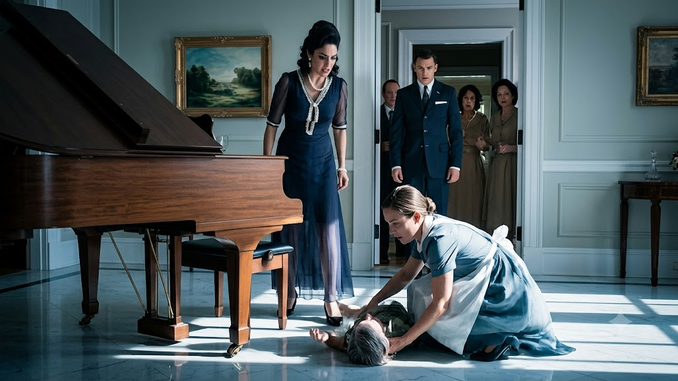
The billionaire’s fiancée shoved the maid’s toddler off the piano, but one look at the child’s eyes destroyed the wedding.
The little girl wasn’t stealing anything.
She wasn’t breaking crystal, smearing chocolate on silk, or running wild through the kind of mansion where even the silence seemed expensive. She was three years old, sitting at a grand piano in a sunlit parlor, pressing the keys with two tiny clean hands like she had discovered a doorway into heaven.
Then the billionaire’s fiancée walked in, saw the child of the maid touching what she believed already belonged to her, and said, “Get your dirty hands off that.”
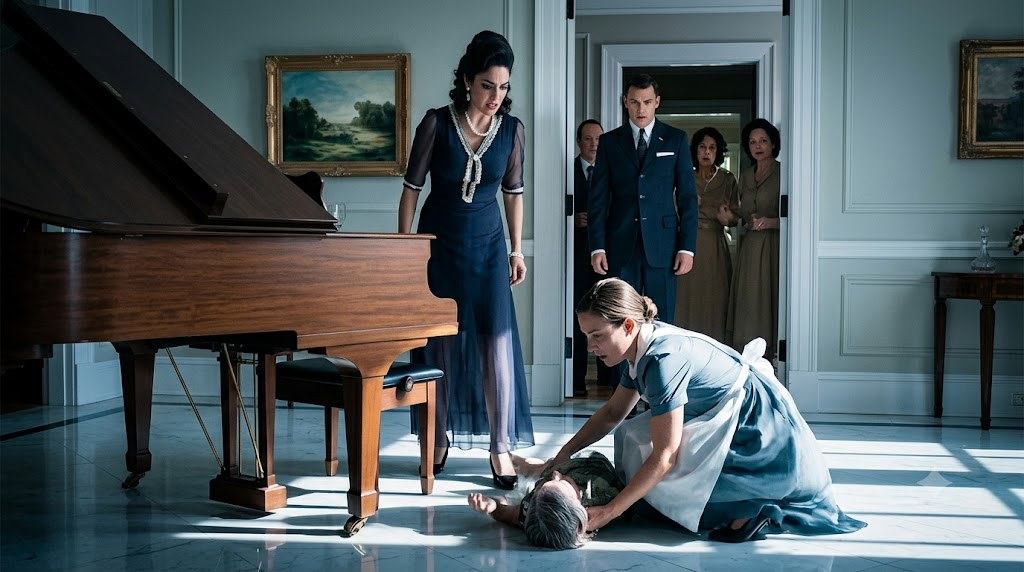
The child looked down at her palms.
They were spotless.
Before she could answer, the woman shoved her.
Not hard enough to call it violence, she would later claim. Not hard enough to matter, she would insist.
But three-year-olds are small. Piano benches have no backs. Marble floors do not forgive.
The child hit the floor with a soft, terrible sound.
And when Ethan Caldwell stepped into the room seconds later, he didn’t look at the piano. He didn’t look at his fiancée.
He looked at the little girl’s face.
Then his car keys slipped from his hand and struck the marble like a bell.
Because the child on the floor had his eyes.
There are houses that look warm from the outside and feel frozen once you step through the door. Ethan Caldwell’s estate in Greenwich, Connecticut, was one of them.
Sixteen rooms. White stone exterior. A circular driveway. Frosted boxwoods trimmed so perfectly they seemed afraid to grow. Inside, the floors were pale marble, the stair rail curved like something in a museum, and the windows were tall enough to make ordinary people feel smaller than they already knew they were.
In the east parlor sat the grand piano.
Black, polished, magnificent.
It had belonged to Ethan’s mother before she died. After that, it became one more beautiful object in a house full of beautiful objects no one touched.
Ethan had purchased companies, sold companies, saved failing firms, and turned himself into the kind of man newspapers called “self-made” even though his family name had opened doors before he learned how to knock. He was thirty-eight, controlled, private, disciplined down to the way he folded his napkin. People said he was brilliant. People said he was cold.
Both were true.
He noticed everything.
That was why Rosa Martinez unsettled him.
Rosa had been working in his home for two years. She arrived before the sun had fully lifted over the hedges, always wearing her hair pinned neatly, always moving through the rooms with quiet purpose. She was not invisible, though people treated her that way. Ethan had noticed the way she paused before touching framed photographs, not out of nosiness, but out of respect. He had noticed the way she never wasted words. He had noticed that she was tired.
And he had noticed the child.
Lily.
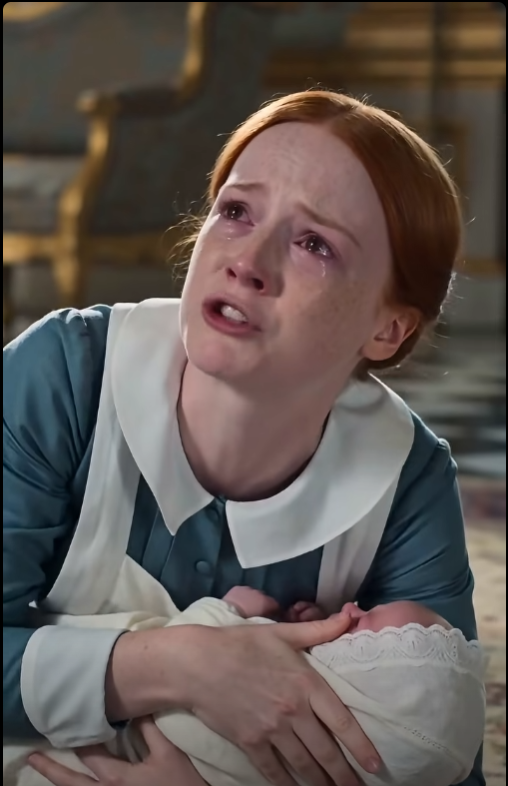
Three years old. Round cheeks. Dark lashes. A gap between her front teeth. A little cloth rabbit she called Button. On days when childcare fell apart, Rosa brought Lily with her and tucked her into a corner of the kitchen with crackers, crayons, and whispered instructions.
“Stay where Mama can see you,” Rosa would say.
Lily would nod very seriously.
Then, ten minutes later, she would disappear.
Not far. Never recklessly. She followed light, reflections, sounds. The mansion was too big, too quiet, too full of mysteries for a child to ignore. Her favorite mystery was the piano.
The first time she touched it, Rosa had nearly dropped a stack of folded towels.
“Lily Grace Martinez,” she whispered sharply from the doorway. “Get down.”
Lily froze, one finger still resting on middle C.
“It sings,” she whispered back.
Rosa’s face softened before fear took over again. “It’s not ours.”
Lily turned, confused. “But songs are everybody’s.”
Rosa had no answer for that. She only lifted her daughter off the bench and carried her back to the kitchen, heart beating too fast.
Because Rosa knew whose piano it was.
And Rosa knew whose house it was.
And Rosa knew the truth she had buried so deep it had almost become part of her bones.
Four years earlier, before she was cleaning Ethan Caldwell’s marble floors, Rosa had been a graduate student at Columbia. Biochemistry. Full scholarship. Top of her program. She had lived in a tiny apartment in Queens with a radiator that hissed all night and a kitchen table covered in textbooks.
She met Ethan at a university fundraiser where she was working as part of the catering staff to cover rent.
He spilled water.
She handed him a napkin.
He apologized like a man who was not used to being clumsy in public.
She laughed before she could stop herself.
“What?” he asked.
“You look like you just lost a war to a glass of ice water.”
That was the beginning.
Not a fairy tale. Not roses and violins. Just conversations that stretched past midnight. Cheap diners after expensive events. Ethan in rolled-up sleeves, talking about his mother. Rosa telling him about the chemistry teacher who changed her life. Three months of something neither of them named because naming it would make it real.
Then Ethan disappeared.
Not cruelly. Not dramatically. Worse.
Quietly.
A merger. Family pressure. A business crisis. Messages answered hours later, then days later. One canceled dinner. Then another. Then silence.
Six weeks after the last time she saw him, Rosa found out she was pregnant.
She sat on her bathroom floor with the test in her shaking hand and thought about calling him until the sun came up.
She didn’t.
She told herself she was protecting her child from being unwanted. Protecting herself from a rich man’s doubt. Protecting Ethan from an obligation he had never asked for.
But fear is very good at dressing itself up as dignity.
So Rosa kept the secret.
She left school. Took two jobs. Gave birth to Lily in a public hospital during a thunderstorm. Held her daughter against her chest and cried because the baby opened her eyes and looked back at her with Ethan Caldwell’s exact gray-green stare.
For three years, Rosa learned how to be enough.
Then an agency placed her at the Caldwell estate.
She almost refused.
But rent was late. Lily needed winter boots. Pride did not buy groceries.
So Rosa entered Ethan Caldwell’s house again, not as the woman he once kissed under a Queens awning in the rain, but as the maid who polished his mirrors.
If Ethan recognized her, he never said.
At first, Rosa thought that hurt.
Then she decided it was mercy.
By the November morning everything shattered, Ethan had been engaged to Victoria Haynes for four months.
Victoria was twenty-eight, blonde, elegant, and beautiful in a way that seemed professionally maintained. Her father built luxury condos in Miami, Dallas, and Boston. Her mother had once been Miss Georgia. Victoria had grown up around polished silver, charity boards, and women who smiled with their teeth while measuring each other’s worth.
She entered Ethan’s life like she had been cast for it.
They looked correct together.
That was the word people used.
Correct.
At the engagement gala, photographers captured Victoria’s diamond ring flashing beneath chandeliers. Ethan looked calm. Victoria looked triumphant.
Rosa saw the photo online while Lily slept beside her under a blanket with cartoon moons on it.
She closed the article and told herself she felt nothing.
On that Saturday, Victoria arrived at the estate early.
Rosa had been called in for extra hours because there would be a dinner party that evening. Investors. Friends. Victoria’s parents. A small celebration before wedding planning began in earnest.
Rosa could not find childcare.
She brought Lily.
“Kitchen only today,” Rosa whispered as she zipped Lily’s pink hoodie. “Promise me.”
“I promise,” Lily said.
“Lily.”
“I big promise.”
For almost two hours, Lily kept it.
Then she heard the piano.
A thin spill of sound floated down the hall. Three notes. Pause. Three notes again.
Rosa, upstairs changing linens, stopped cold.
“No,” she breathed.
At the same moment, Victoria Haynes walked into the east parlor carrying a porcelain cup of coffee and wearing cream wool slacks that probably cost more than Rosa made in a week.
She saw Lily sitting at the piano.
The child’s sneakers were on the wrong feet. Button the rabbit sat beside her. Her little fingers pressed the keys gently, not pounding, not careless. Sunlight touched her hair.
For one second, the room was almost holy.
Victoria ruined it.
“What are you doing?”
Chapter 2 – The Fall
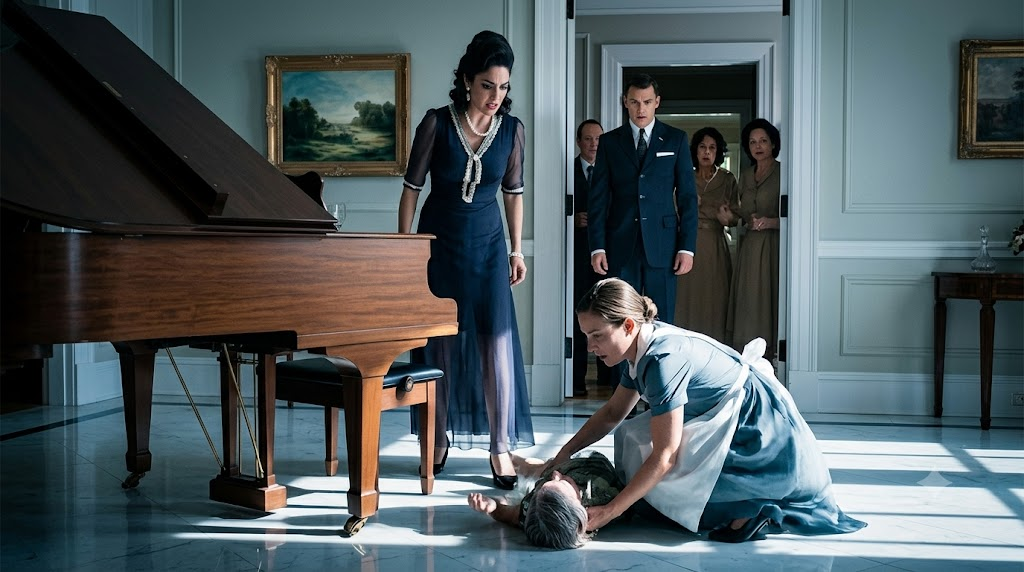
Lily’s small hands froze mid-note.
“I’m playing,” she said, with the simple, unguarded honesty of a three-year-old who had not yet learned that some rooms, and some pianos, belonged only to certain people.
“You’re not supposed to be in here.” Victoria’s voice carried the particular, clipped irritation of a woman whose morning had already been disrupted by wedding vendors and seating chart disputes, an irritation that found, in this small, unexpected intruder, an entirely disproportionate target. “Get your dirty hands off that.”
Lily looked down at her palms, confused. “They’re clean. Mama washed them.”
“I don’t care.” Victoria crossed the room in several sharp, irritated strides, her coffee cup still balanced in one hand. “This piano isn’t a toy, and you are not supposed to be wandering around this house unsupervised. Where is your mother?”
“Upstairs,” Lily said, her small chin beginning to wobble as the unfamiliar woman’s sharp tone finally registered as something threatening rather than merely confusing.
“Get down. Now.”
Lily hesitated, one hand still resting on the piano’s keys as though reluctant to fully abandon whatever magic she’d discovered in its sound, and that hesitation — that brief, entirely understandable pause from a frightened three-year-old — proved, in Victoria’s already frayed patience, apparently unforgivable.
She grabbed Lily’s arm and shoved.
It happened in less than two seconds. Lily’s small body, already precariously balanced on the piano bench’s narrow edge, tipped backward with nothing to catch her, no armrest, no backrest, nothing but empty air and, beneath it, unforgiving marble.
The sound she made hitting the floor was small and terrible — not a scream, not yet, just a soft, winded gasp as the impact knocked the breath entirely from her tiny lungs.
Rosa was already running by the time the sound reached her upstairs, some deep, primal instinct propelling her down the grand staircase faster than she’d ever moved in two years of careful, measured service in this house, arriving in the east parlor’s doorway at the exact moment Ethan Caldwell rounded the opposite corner, his car keys slipping from suddenly nerveless fingers to strike the marble floor with a sharp, ringing clatter.
He didn’t look at Victoria. He didn’t look at the piano, or the coffee cup now lying shattered beside it, dark liquid spreading slowly across the pale marble.
He looked at the small girl crumpled on the floor, her face contorted in the particular, delayed shock of a child who hadn’t yet found the breath to cry, and Ethan Caldwell felt the entire architecture of his carefully controlled life crack open in the space of a single devastating heartbeat.
Because the child on the floor had his eyes.
“Lily!” Rosa’s voice tore through the room as she dropped to her knees beside her daughter, gathering the small, shaking body carefully into her arms, her professional composure entirely abandoned in the raw, maternal terror of the moment. “Baby, look at me. Look at Mama. Are you hurt? Can you breathe?”
Lily finally found her breath, and with it, a wail of pain and fear that cut through the parlor’s tense silence, one small hand clutching at her arm where Victoria’s grip had left already-purpling marks.
“What happened?” Ethan’s voice, when he finally spoke, carried a controlled, dangerous calm that Rosa had never once heard from him in two years of working in his home.
“She was touching the piano,” Victoria said, her voice climbing toward something defensive, though her eyes remained fixed on the shattered coffee cup rather than on the crying child. “I told her to get down. She wouldn’t listen fast enough.”
“You pushed her,” Rosa said, her voice shaking with a fury she’d spent two years carefully, professionally suppressing in this house. “I saw your hand on her arm from the doorway. You shoved a three-year-old off a piano bench onto a marble floor.”
“I barely touched her,” Victoria said, though something uncertain had crept into her earlier defensive confidence, some dawning recognition of exactly how the scene must have appeared to the two people now staring at her with matching, controlled fury. “This is absurd. Ethan, tell them this is absurd.”
Ethan didn’t answer. He crossed the room instead, kneeling carefully beside Rosa and her still-crying daughter, his eyes moving across the child’s face with an intensity that had nothing to do with the immediate concern for her physical injuries and everything to do with the impossible, undeniable recognition unfolding behind his own controlled, careful expression.
“Rosa,” he said quietly, his voice carrying a rawness she’d never heard from him, not even during their brief, doomed months together four years earlier. “How old is she?”
Rosa’s arms tightened protectively around her daughter, understanding immediately, with a sick, plummeting certainty, exactly what question Ethan was actually asking.
“Three,” she whispered. “She turned three in August.”
Ethan’s eyes closed briefly, a full year of arithmetic completing itself behind his controlled expression, the timeline of their brief relationship, her sudden, unexplained absence from his life, and now, impossibly, a three-year-old girl with his own gray-green eyes crying in his east parlor, all crashing together into a single, devastating conclusion.
“Is she mine?” he asked, his voice barely above a whisper.
The room went utterly silent, even Victoria’s earlier defensive protests finally, completely dying in her throat as she absorbed, along with everyone else present, the full, staggering weight of the question hanging in the air.
Để lại một phản hồi